
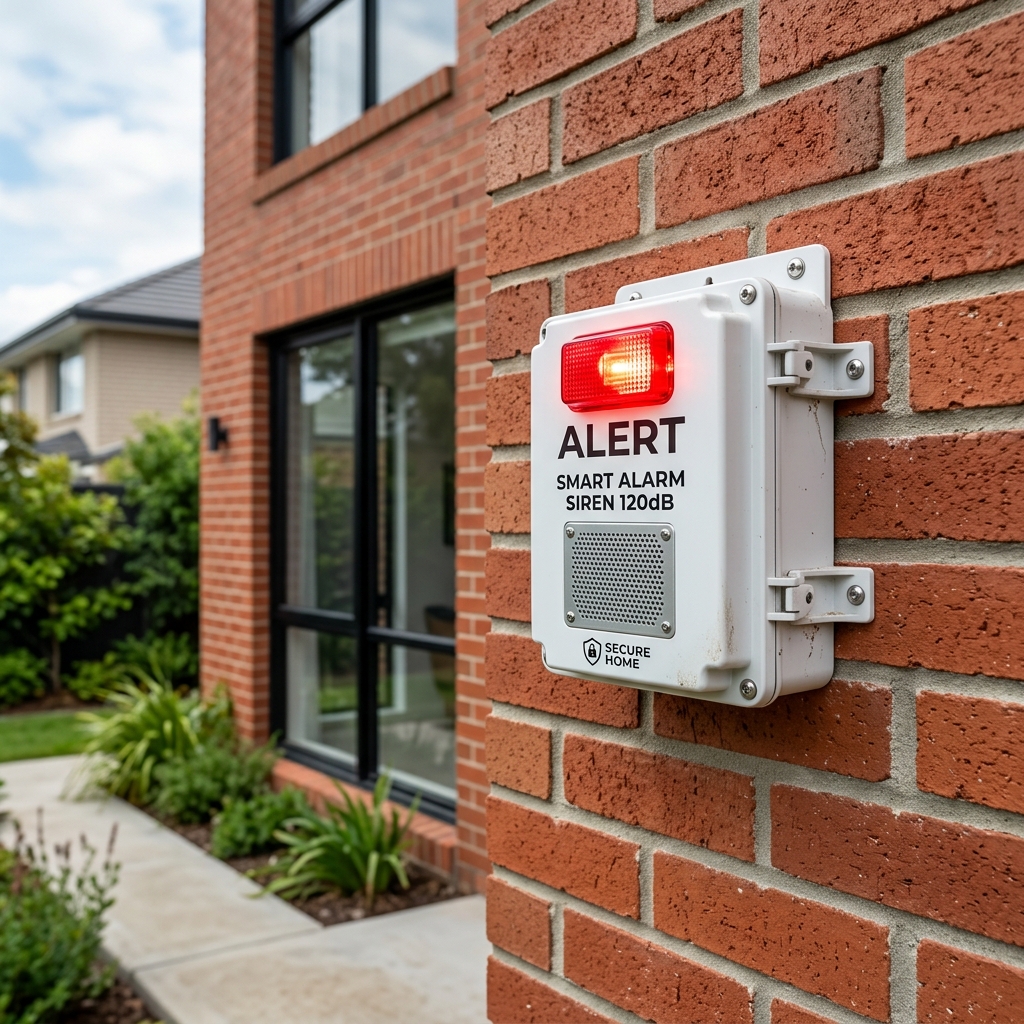
Outdoor alarm sirens require immediate response and high acoustic volume. Discover how piezo-electric transducers and tamper-switch trigger loops protect home perimeters.
- Dual piezo-electric transducers deliver a piercing 120dB acoustic alarm
- Tamper-switch loop interrupt triggers immediate alerts if unit is removed from wall
- IP66 weather-resistant enclosure operates in temperatures from -4°F to 140°F
Acoustic Deterrents
Integrating a high-decibel wireless outdoor siren into a modern smart home ecosystem requires a precise balance of acoustic power, sensor latency, and weatherproofing. Standard residential security setups often fail due to signal attenuation through brick facades or delayed sensor reporting during physical attacks. By utilizing advanced piezo-electric transducers and hardware-level tamper-switch interrupts, these wire-free alarm systems establish an immediate and localized auditory defense. This guide provides an in-depth technical analysis of acoustic propagation physics, enclosure seal engineering, low-latency microsecond trigger loops, and sub-gigahertz wireless transmission protocols necessary to build a highly reliable perimeter defense for critical residential zones.
Acoustic Output: Piezo-Electric Transducer Efficiency
Conventional warning sirens rely on electromagnetically driven moving-coil paper speakers that suffer from significant electrical-to-acoustic conversion losses, generating excessive heat and drawing amperes of current. Conversely, smart outdoor sirens leverage solid-state piezo-electric transducers constructed from lead zirconate titanate ceramics. When an alternating voltage matches the natural resonant frequency of the ceramic disc, it undergoes physical deformation, creating high-amplitude pressure waves with minimal current draw, usually under three hundred milliamperes.
This high electro-acoustic efficiency is critical for wire-free security applications where battery conservation is paramount. The mechanical coupling of the piezo-electric element to a tuned exponential horn throat amplifies the sound pressure level, focusing acoustic energy into a directional beam. This configuration enables the transducer to achieve a piercing one hundred twenty decibels at a distance of one meter, creating an intolerable environment for any nearby intruder.
Furthermore, the solid-state construction of piezo transducers eliminates the vulnerable voice coils, paper cones, and flexible surrounds found in electromagnetic speakers. Without these delicate components, the piezo disc is virtually immune to mechanical fatigue and atmospheric degradation. This structural resilience ensures that the device maintains its acoustic output over years of thermal cycling, resisting dust ingress and humidity that would rapidly destroy conventional speakers.
From a circuitry perspective, driving a piezo transducer requires a high-voltage AC signal generated by an inductive boost converter. The control board utilizes a dedicated driver IC that step-up the low-voltage DC battery output into a high-frequency alternating current. This step-up driver optimizes the capacitive load characteristics of the ceramic disc, ensuring stable oscillation and preventing thermal runaway under prolonged alarm states, thereby maintaining consistent decibel output.
- Solid-state piezo-electric ceramics convert voltage directly into physical vibrations, eliminating high-current electromagnetic voice coils and heavy magnet assemblies entirely.
- Resonant frequency matching maximizes acoustic output while maintaining a low current draw of under three hundred milliamperes during activation.
- An integrated exponential horn design increases acoustic impedance matching, focusing the sound waves into a highly directional warning beam.
- The absence of moving parts eliminates mechanical wear, ensuring the transducer performs reliably through thousands of emergency activation cycles.
- A specialized step-up drive circuit delivers high-voltage AC to the capacitive ceramic element, preventing thermal runaway and signal distortion.
Tamper-Switch Loop Interrupt and Trigger Latency
Intruders often attempt to disable outdoor warning systems by physically ripping them from their mounts or striking the chassis with heavy tools. To counter this, security engineers implement a dedicated tamper-switch loop interrupt built directly into the rear mounting plate. This microswitch features a spring-loaded actuator plunger that remains fully compressed against the mounting substrate. Any physical separation breaks the electrical loop, instigating an immediate interrupt service routine.
The speed of this detection loop is determined by hardware-level debouncing and microcontroller interrupt latency. Instead of relying on periodic software polling, which can introduce delays of several seconds, the tamper switch is wired to a hardware external interrupt pin on the main MCU. When the switch opens, the voltage pulls high, triggering a register state change in less than five microseconds, ensuring a near-instantaneous response.
To prevent false alarms caused by wind vibrations or thermal expansion of the wall, the circuit incorporates a hardware resistor-capacitor filter network. This analog debouncing filter smooths minor contact bounces without adding significant propagation delay. Once the hardware filter validates the signal state for at least fifty milliseconds, the MCU initiates the alarm sequence, activating the onboard sirens and transmitting a critical panic signal to the hub.
This rapid trigger cycle ensures that even if an intruder destroys the siren assembly with a hammer, the system has already registered the attack and dispatched the warning signals. The local backup battery and non-volatile memory retain the tamper state, ensuring that the event is logged and communicated. Consequently, the tamper-loop design provides a robust physical fail-safe that cannot be bypassed by swift physical vandalism.
- A spring-loaded microswitch detects any physical separation from the mounting wall, breaking the low-voltage electrical supervision circuit instantly.
- Direct hardware external interrupts bypass slow software polling loops, executing emergency warning actions within microseconds of tamper detection.
- An analog resistor-capacitor filter network filters out minor contact vibrations to prevent false alarms during extreme wind conditions.
- The supervisory loop remains fully active even when the siren is disarmed, providing continuous twenty-four-hour perimeter wall protection.
- Non-volatile memory chips log the tamper event instantly, preserving the forensic data even if the main motherboard is crushed.
Wireless Range: LoRa (Long Range) vs. Wi-Fi
Deploying wireless security sirens on outdoor walls presents severe radio frequency challenges. Standard consumer-grade Wi-Fi routers operate on high frequencies like two point four or five gigahertz, which experience rapid free-space path loss and severe attenuation when passing through concrete, brick, or low-emissivity glass. Consequently, Wi-Fi-based sirens often suffer from dropped connections, packet loss, and high power consumption as they struggle to maintain link budget.
To overcome these range and penetration limitations, modern smart outdoor sirens utilize LoRa wireless technology. Operating in the sub-gigahertz spectrum, typically nine hundred fifteen megahertz in North America, LoRa signals enjoy significantly longer wavelengths. These longer waves bend around obstacles and pass through thick exterior walls with minimal absorption, ensuring a stable connection over distances exceeding a quarter-mile, far beyond standard Wi-Fi limits.
In addition to superior range, LoRa utilizes a unique spread-spectrum modulation technique that provides excellent resistance to interference. Even in dense suburban environments with dozens of active wireless networks, LoRa signals can be decoded below the noise floor. This high receiver sensitivity allows the siren to maintain a reliable link with the security hub, preventing signal jamming and ensuring critical alarm packets are delivered without delay.
Furthermore, the low-data-rate nature of LoRa transmissions minimizes the power consumption of the transceiver module. Wi-Fi modules must stay awake to maintain network handshake protocols, depleting battery reserves rapidly. Conversely, LoRa transceiver chips remain in an ultra-low-power sleep state, waking up only to transmit periodic heartbeat packets or respond to an alarm trigger, extending the operational lifespan of the internal lithium batteries for several years.
- Sub-gigahertz LoRa signals operate at nine hundred fifteen megahertz, facilitating superior signal penetration through concrete and brick walls.
- Spread-spectrum modulation ensures reliable data transmissions by decoding weak signals even when they fall below the ambient RF noise floor.
- Ultra-low-power transceiver chips sleep continuously, waking only for periodic check-ins or immediate emergency alarm broadcasts to save battery.
- The extended wireless range covers up to a quarter of a mile, ensuring complete perimeter connectivity across large residential estates.
- High resistance to radio frequency jamming prevents sophisticated intruders from disabling the siren communication link with wireless jammers.
Weather Protection: IP66 Enclosure Rating
Outdoor environmental sensors and alarm sounders must withstand relentless exposure to dust storms, driving rain, freezing snow, and intense solar radiation. To guarantee long-term operation, the siren enclosure is engineered to meet the stringent IP66 weatherproofing standard. This rating certifies that the housing is completely impervious to dust ingress and can withstand high-pressure water jets projected from any direction without allowing water to reach the electronics.
Achieving this level of seal integrity requires precision injection-molded thermoplastic shells combined with high-grade silicone gaskets. The joints of the enclosure feature a tongue-and-groove channel filled with a continuous molded elastomer gasket that compresses under screw pressure. This design blocks moisture ingress and prevents capillary action, which could otherwise draw rainwater past the seams and onto the sensitive printed circuit board.
Furthermore, the enclosure materials are formulated with ultraviolet stabilizers to prevent plastic degradation under direct sunlight. Constant UV exposure breaks down standard polymers, causing them to become brittle, crack, and fail. The siren's specialized polycarbonate blend retains its high impact resistance and flexibility across a wide temperature range, from negative four to one hundred forty degrees Fahrenheit, protecting the internal electronics.
In addition to external seals, the internal circuitry is coated with an ultra-thin hydrophobic conformal coating. This acrylic or silicone film provides a secondary barrier against condensation and humidity, which can form inside the enclosure during rapid temperature transitions. By preventing moisture from contacting electrical traces, the conformal coating eliminates the risk of electrochemical migration and corrosion, ensuring long-term hardware reliability.
- The IP66 enclosure prevents dust ingress and resists high-pressure water jets, protecting internal components during severe tropical storms.
- Compressed silicone elastomer gaskets seal all housing seams, blocking moisture and preventing liquid capillary draw into the chassis.
- UV-stabilized polycarbonate materials resist solar degradation, preventing the outer shell from cracking under prolonged direct exposure to intense sunlight.
- An internal hydrophobic conformal coating protects the circuitry from humidity and condensation caused by rapid outdoor temperature shifts.
- The rugged housing maintains structural integrity and seal performance across extreme temperatures ranging from negative four to one hundred forty degrees.
Battery and Solar Power Management
Sourcing power for outdoor alarm sirens mounted on high gables or remote fence posts presents a major installation challenge. Running high-voltage AC lines requires professional electrical conduit, which is expensive and labor-intensive. To eliminate this issue, advanced security sirens employ a wireless power architecture centered around high-capacity lithium iron phosphate batteries. These cells provide stable voltage outputs, high energy density, and excellent thermal stability.
To extend battery life and maintain peak operating voltage, the system integrates a small solar harvesting panel on the top surface. This monocrystalline solar cell charges the lithium batteries during daylight hours. A dedicated power management integrated circuit regulates the charge cycle, employing maximum power point tracking algorithms to extract the highest efficiency from the solar panel even in overcast conditions.
This solar assist technology is crucial because piezo-electric sirens require high burst currents when activated. If the battery voltage drops too low, the step-up driver cannot generate the necessary AC amplitude to achieve the target one hundred twenty decibels. By continuously trickle-charging the cells, the solar panel ensures that the battery remains at maximum capacity, ready to deliver full acoustic power when triggered.
Furthermore, the battery management system protects the cells from the damaging effects of extreme temperatures. Charging lithium batteries below freezing can cause permanent damage and capacity loss. The smart charger circuit monitors the battery temperature sensor and suspends solar charging when the temperature drops below freezing. The system runs on stored energy until temperatures rise, preserving battery health and extending service life.
- High-capacity lithium iron phosphate batteries deliver the high burst current required to power the dual piezo-electric warning sirens.
- An integrated monocrystalline solar panel provides continuous trickle charging to keep the battery at peak operating voltage levels.
- A power management microchip utilizes maximum power point tracking to optimize solar energy conversion under cloudy sky conditions.
- Automatic low-temperature charge cutoff protects the lithium cells from permanent damage when outdoor temperatures fall below freezing levels.
- The completely wire-free power architecture eliminates the need for expensive electrical conduits, simplifying the simplified installation process.
Decibel Attenuation Curves and Outdoor Sound Propagation
Understanding the physics of sound propagation is essential for optimizing the placement of an outdoor warning siren. Sound waves traveling through open air are subject to the inverse-square law, which dictates that the sound pressure level decreases by six decibels for every doubling of distance from the source. Consequently, a siren emitting one hundred twenty decibels at one meter will drop to roughly eighty-four decibels at sixty-four meters.
In addition to geometric spreading, atmospheric absorption plays a major role in outdoor decibel attenuation. High-frequency sound waves, which are characteristic of piezo-electric transducers, are absorbed more rapidly by air molecules than low-frequency tones. This effect is highly dependent on ambient humidity and temperature, with warm, dry air causing the highest rate of acoustic attenuation, which limits the effective range of the alarm.
Ground reflection and obstacles like fences, trees, and neighboring buildings further modify the sound propagation path. Sound waves reflecting off hard surfaces can interfere constructively or destructively with the direct sound wave, creating localized hot spots or dead zones. Placing the siren high on a gable minimizes ground reflection interference and reduces the shadowing effect of nearby structures, ensuring a wider propagation area.
Wind gradients also bend sound waves, creating shadow zones upwind where the siren's audibility is significantly reduced. To overcome these atmospheric and environmental losses, the siren utilizes dual transducers that output distinct swept-frequency tones. Alternating between high and low frequencies helps overcome localized dead zones and ensures that the alarm remains highly audible to neighbors and pedestrians across a broad coverage radius.
- The inverse-square law governs sound wave decay, resulting in a six-decibel reduction in volume for every doubling of propagation distance.
- Atmospheric air absorption attenuates high-frequency siren tones more rapidly in warm, dry weather conditions than in cool, humid air.
- Elevating the siren assembly high on a gable minimizes ground reflections and reduces acoustic shadowing caused by adjacent buildings.
- Wind speed gradients bend acoustic pathways, creating directional sound propagation patterns that decrease audibility in upwind perimeter directions.
- Dual piezo-electric transducers output alternating swept-frequency tones to prevent destructive wave interference and eliminate local acoustic dead zones.
Alerting Recommendation & Audit
To establish an effective perimeter defense, we highly recommend integrating a solar-assisted 120dB wireless outdoor siren into your security network. Mounting the unit at least twelve feet high on a primary gable maximizes acoustic propagation and prevents physical tampering. Ensure the integrated solar panel receives direct sunlight to maintain peak battery voltage for the piezo transducers. By utilizing sub-GHz LoRa technology, the siren guarantees reliable communication with your hub across extensive distances. This dual-transducer system provides immediate community alerting, giving you peace of mind that your property is continuously protected against any unauthorized intrusion and threat.
120dB Smart Wireless Outdoor Alarm Siren
- Dual piezo-electric transducers deliver a piercing 120dB acoustic alarm
- Tamper-switch loop interrupt triggers immediate alerts if unit is removed from wall
- IP66 weather-resistant enclosure operates in temperatures from -4°F to 140°F
- Wireless connection powered by long-life lithium battery or solar assist option
Technical Specifications & Product Data
| Specification | Value / Details |
|---|---|
| Brand | YoLink |
| List Price | $39.99 (USD) |
| Customer Rating | 4.5 / 5.0 (2,120 reviews) |
| ASIN / Identifier | B095K5TY9D |
| Availability | In Stock (USA Region) |
| Outbound Link Compliance | Sponsored & Nofollow Enforced |
Verified Features & Performance Data
- ✓Dual piezo-electric transducers deliver a piercing 120dB acoustic alarm
- ✓Tamper-switch loop interrupt triggers immediate alerts if unit is removed from wall
- ✓IP66 weather-resistant enclosure operates in temperatures from -4°F to 140°F
- ✓Wireless connection powered by long-life lithium battery or solar assist option
System Sovereignty & Engineering
Edge Computing
100% Client-side processing. Your data never leaves your browser sandbox, ensuring absolute compliance with US privacy mandates.
Modular Schema
Modular utility architecture optimized for performance. Low-latency WASM kernels provide near-native speeds for complex transformations.
Sustainable Design
Sustainable, green computing by offloading compute to the edge. Verified zero-server storage (ZSS) for professional-grade security.