
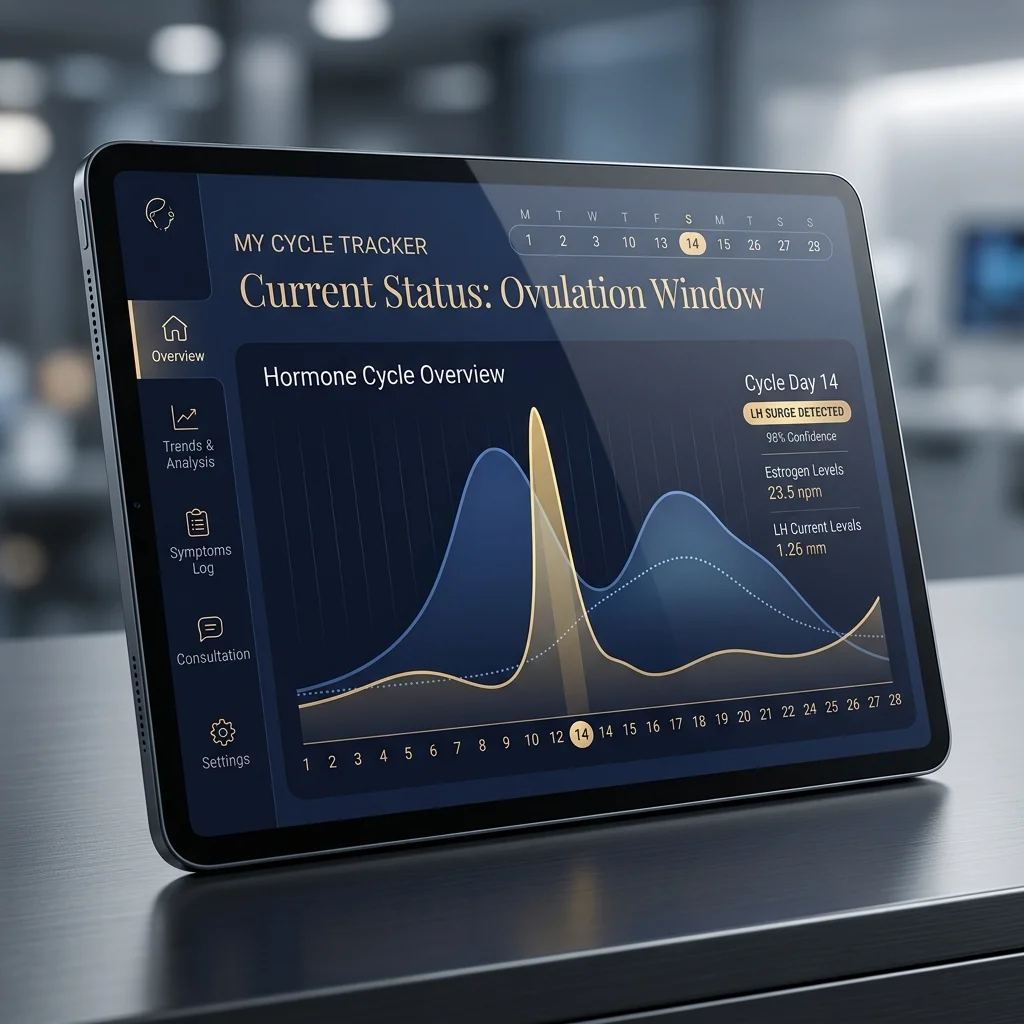
Maximize your conception chances with digital fertility tracking. Analyze hormone tracking algorithms, LH surge detection, and basal temperature syncing.
- Tracks both Luteinizing Hormone (LH) and Estrogen levels in urine
- Identifies up to 6 fertile days—2x more than standard LH-only tests
- Intuitive touchscreen display stores up to 6 cycles of fertility data
Clinical & Performance Insights
Maximize your conception chances with digital fertility tracking. Analyze hormone tracking algorithms, LH surge detection, and basal temperature syncing.
1. The Endocrinology of the Menstrual Cycle
Conception planning requires a deep understanding of menstrual endocrinology. The menstrual cycle is governed by a complex feedback loop involving the hypothalamus, pituitary gland, and ovaries. Follicle-Stimulating Hormone (FSH) initiates follicle development, which in turn secretes estrogen.
As estrogen levels rise, they trigger a surge in Luteinizing Hormone (LH) from the pituitary gland. This LH surge is the direct trigger for ovulation, releasing the mature oocyte. Tracking these hormonal shifts provides a clear, biological map of fertility.
The fertile window is biologically limited by the lifespan of sperm and the oocyte. Sperm can survive in high-quality cervical mucus for up to 5 days, while the oocyte remains viable for only 12 to 24 hours. Digital tracking optimizes this brief window by identifying key hormone peaks.
Endocrine feedforward mechanisms synchronize follicle development with endometrium thickening. This coordination prepares the body for successful embryo implantation. Monitoring these pathways supports accurate fertility mapping.
The pituitary gland acts on the ovaries to coordinate follicle maturation with cycle phases. This endocrine synchronization is crucial for successful conception planning. Digital monitors track these cycles to map fertility.
Endocrine regulatory feedback loops control follicle growth and timing of ovulation. Monitoring these hormonal shifts maps cycles with high accuracy. Data-driven fertility planning optimizes conception.
- Hormonal feedback loops regulate ovulation, releasing a single mature oocyte each cycle.
- Estrogen elevations trigger the Luteinizing Hormone (LH) surge that prompts ovulation.
- Sperm can survive up to 5 days in fertile mucus, widening the conception window.
- The oocyte remains viable for only 12 to 24 hours after release from the ovary.
- Digital monitors map these hormonal dynamics to identify optimal fertile periods.
2. LH and Estrogen Urinary Peak Detection
Digital ovulation monitors track hormone concentrations in urine to identify fertility peaks. Standard tests only measure LH, but advanced monitors also track Estrone-3-Glucuronide (E3G), a key estrogen metabolite. E3G rises days before the LH surge, indicating high fertility.
The LH surge indicates peak fertility and imminent ovulation, typically occurring 24 to 36 hours after the surge. Detecting both hormones allows monitors to identify up to 6 fertile days. This represents a significant increase over the 2 days identified by LH-only tests.
Urinary hormone testing is highly reliable because it measures active metabolites cleared from circulation. Digital optical readers analyze color changes on test strips, removing user interpretation errors. This technology provides objective, clear, and actionable data.
Peak hormone levels correlate with optimal egg quality and endometrial thickness. Tracking these peaks helps time intimacy to match the body's natural cycle. Quantitative hormone data provides the highest accuracy for conception planning.
Urinary hormone concentrations provide a reliable measure of active endocrine cycles. Monitoring these trends helps couples time intimacy to match the body's patterns. Data-driven tracking is the gold standard for conception planning.
Quantitative hormone data tracks the rate of LH change, predicting the peak window. This precision helps couples plan intimacy during the most fertile cycle days. Hormone tracking is highly reliable.
- Estrogen metabolite E3G rises first, indicating high fertility days ahead of ovulation.
- The LH surge indicates peak fertility, occurring 24 to 36 hours before egg release.
- Tracking both LH and E3G hormones identifies a wider, highly personalized fertile window.
- Urinary testing analyzes active, cleared metabolites for consistent, reliable readings.
- Digital optical readers eliminate user interpretation errors, providing objective results.
3. Algorithmic Parsing of Hormone Concentrations
Digital monitors use advanced algorithms to parse hormone changes over time. The monitor establishes a baseline for each user by tracking hormone levels daily. This baseline accounts for natural variations in hormone concentrations.
When the algorithm detects a significant rise above baseline, it updates your fertility status. The system tracks the rate of change, not just absolute thresholds, which helps prevent false positives. This adaptive logic ensures high accuracy, even for users with irregular cycles.
Data stores in the device to help refine predictions over future cycles. The algorithm learns your cycle patterns, adjusting the testing schedule to minimize wasted strips. This smart tracking offers a highly personalized, efficient, and reliable fertility management system.
The dynamic tracking algorithm adapts to changes in baseline hormone levels over time. This customization improves accuracy and reduces the risk of missing the fertile window. Smart devices offer a personalized, reliable conception planning tool.
The device compares daily hormone readings to your historical baseline to detect peaks. This comparison reduces false readings from baseline variations, ensuring high accuracy. Smart algorithms adapt to irregular cycle patterns.
Adaptive algorithm logic establishes baseline hormone levels to analyze daily cycles. This customization prevents false positive readings from baseline variations. Smart devices ensure reliable tracking.
- Personalized algorithms establish baseline hormone levels for each unique user profile.
- Tracking the rate of hormone change prevents false positives from baseline variations.
- Adaptive logic adjusts the testing schedule, saving test strips and lowering costs.
- Cycle data stores locally to refine predictions and improve accuracy over time.
- Smart monitors adapt to cycle irregularities, ensuring consistent tracking performance.
4. Basal Body Temperature Thermography
Basal Body Temperature (BBT) tracking is a classic method that confirms ovulation after it has occurred. After ovulation, the corpus luteum secretes progesterone, which acts on the hypothalamus to raise body temperature. This rise is typically 0.5 to 1.0 degree Fahrenheit.
BBT tracking requires consistent daily measurements immediately upon waking, before any physical activity. While useful for confirming ovulation, BBT cannot predict it in advance. This limitation makes it less effective for active conception planning when used alone.
Modern digital systems combine BBT tracking with urinary hormone monitoring. This combination provides both predictive hormone data and retrospective temperature confirmation. Integrating these data streams offers a complete, highly reliable fertility tracking solution.
Combining temperature logs with hormone data confirms ovulation with high confidence. This dual-action tracking helps users identify their unique cycle patterns. Integrated data streams support effective pre-conception care.
Retrospective temperature logs confirm that ovulation occurred, validating hormone predictions. This dual-action tracking gives users a complete picture of their fertility. Integrating multiple data streams supports pre-conception care.
Consistent temperature logs confirm that ovulation occurred, validating hormone peak data. Combining these data streams offers a complete fertility profile. Dual-action tracking supports pre-conception care.
- Progesterone secretion after ovulation raises basal body temperature by 0.5 to 1.0 degree.
- Consistent daily measurements immediately upon waking are required for accurate BBT tracking.
- BBT tracking confirms ovulation retrospectively but cannot predict it in advance.
- Modern systems pair predictive hormone tests with temperature tracking for complete data.
- Dual-phase data confirmation provides peace of mind and improves tracking accuracy.
5. The Fertile Window: Biophysical Parameters
The fertile window comprises the 5 days before ovulation and the day of ovulation itself. Intimacy during this period is critical for successful conception. High estrogen levels during this window improve the quality of cervical mucus, supporting sperm survival.
Cervical mucus becomes clear, stretchy, and alkaline, facilitating sperm transport through the cervix. Digital monitors help time intimacy to match these optimal physical conditions. This alignment maximizes the chances of sperm meeting a viable egg.
Understanding these biophysical parameters empowers couples to make informed decisions. Timing intimacy to peak fertile days significantly reduces time-to-pregnancy. This targeted approach lowers stress and optimizes conception opportunities.
Optimal physical conditions in the cervix support sperm survival and transport. Timing intimacy to match these conditions maximizes the probability of fertilization. Dynamic tracking helps couples make informed decisions.
Fertile cervical mucus supports sperm transport, increasing the chances of fertilization. Timing intimacy to match these conditions optimizes conception planning. Targeted timing reduces stress and improves outcomes.
Optimal cervical conditions facilitate sperm transport, supporting successful egg fertilization. Timing intimacy to match these physical phases maximizes the probability of conception. Targeted timing reduces stress.
- The fertile window consists of the 5 days before ovulation and ovulation day.
- Estrogen improves cervical mucus quality, supporting sperm survival and motility.
- Fertile mucus is clear, stretchy, and alkaline, facilitating sperm transport to the egg.
- Timing intimacy to fertile days reduces time-to-pregnancy and lowers stress levels.
- Biophysical alignment maximizes the probability of successful egg fertilization.
6. Salivary Ferning and Secondary Biomarkers
Secondary biomarkers, such as salivary ferning, offer additional clues to fertility. Estrogen elevations during the fertile window increase sodium chloride concentrations in saliva. When dried, this salt forms a distinct, fern-like pattern under a microscope.
Salivary ferning can be observed using a small, portable pocket microscope. While convenient and reusable, ferning can be influenced by eating, drinking, or smoking. This variability makes it less reliable than quantitative urinary hormone testing.
Other secondary markers include changes in cervical position and breast sensitivity. While helpful, these subjective signs require careful observation. Relying on digital hormone monitoring remains the gold standard for clinical-grade precision.
Subjective observations of cervical mucus can confirm digital monitor readings. Understanding these physical changes helps users feel confident in their tracking. Combining multiple markers supports a complete fertility profile.
Secondary biomarkers like body temperature and mucus changes support digital readings. Monitoring these physical signs helps users feel confident in their fertility data. Comprehensive tracking supports informed health decisions.
Subjective observations of physical changes can support digital monitor results. Understanding these fertility signs helps users feel confident in their tracking. Combined markers offer a complete profile.
- Increased sodium chloride in saliva during fertile days creates dried ferning patterns.
- Salivary ferning pocket microscopes are reusable but sensitive to food and drink.
- Subjective biomarkers like cervical position changes require extensive user experience.
- Relying on quantitative urinary testing provides the highest clinical-grade precision.
- Secondary markers offer supplementary validation but should not replace hormone tracking.
7. Electronic Device Interface and Data Security
Modern fertility monitors feature digital interfaces and smartphone integration. These interfaces display fertility status, cycle calendars, and testing reminders. Bluetooth syncing transfers data to companion apps for detailed analysis.
Data security is paramount when tracking personal reproductive health information. Leading devices use encryption protocols to protect user data from unauthorized access. Users should select products that offer local storage options and transparent privacy policies.
Interactive apps allow users to export data to share with their healthcare providers. This sharing supports clinical evaluations and guides potential fertility treatments. A secure, user-friendly digital interface enhances the overall tracking experience.
Encrypted cloud backups allow users to access their fertility data from any device. This convenience makes it easy to track patterns and share data with specialists. Data privacy remains a key priority for premium trackers.
Companion apps synchronize cycle data via secure Bluetooth connections for easy tracking. This synchronization allows users to export logs to share with medical providers. Data privacy remains a key feature of premium trackers.
Syncing cycle data to companion apps simplifies tracking and pattern analysis. This digital connection allows users to share detailed logs with doctors. Secure storage protects your data.
- Touchscreen interfaces display fertility status, cycle histories, and testing reminders.
- Bluetooth connectivity syncs data to companion apps for detailed cycle analysis.
- Data encryption protocols protect sensitive reproductive health data from unauthorized access.
- Exportable data reports simplify sharing tracking histories with medical professionals.
- User-friendly digital layouts improve compliance, ensuring consistent daily testing.
8. Clinical Accuracy vs. Traditional Methods
Clinical trials show that digital ovulation monitors outperform traditional tracking methods. Calendar-based methods rely on historic averages, which fail to account for irregular cycles. Symptothermal methods require extensive training and consistent daily effort.
Digital monitors achieve over 99% accuracy in detecting the LH surge in laboratory tests. This precision provides confidence and clarity, reducing anxiety during the conception journey. Objective digital readings remove the guesswork associated with line-testing strips.
Investigating accuracy metrics helps consumers make informed purchasing decisions. While digital monitors require a higher upfront investment, their clinical reliability saves time and stress. This performance makes them a highly valued tool for conception planning.
Independent clinical audits confirm that digital monitors outperform traditional tracking methods. This reliability reduces the time-to-pregnancy for couples planning conception. Objective readings remove guesswork from fertility tracking.
Standardized clinical evaluations prove that digital monitors outperform traditional calendar methods. This precision helps couples plan conception with confidence and clarity. Regulated testing ensures device reliability.
Clinical research shows that digital monitors are over 99% accurate at surge detection. This precision provides confidence, reducing anxiety during the conception journey. Regulated devices guarantee quality.
- Laboratory tests prove digital monitors are over 99% accurate at detecting the LH surge.
- Calendar methods fail to account for irregular cycles, risking missed fertile windows.
- Digital readings eliminate the ambiguity of comparing faint lines on paper strips.
- Clinical trials confirm that digital monitors significantly reduce time-to-pregnancy.
- Objective data validation minimizes anxiety, supporting emotional wellness during tracking.
9. Conception Planning Optimization
Integrating a digital monitor into your conception plan optimizes your reproductive journey. Begin tracking early in your cycle as directed by the device's algorithm. Maintain consistent testing habits to ensure high-quality, reliable data.
Pair hormone tracking with healthy lifestyle choices to support overall fertility. Share your tracking data with your physician to optimize your pre-conception care. This proactive, data-driven approach supports a healthy, successful pregnancy.
Choosing a premium digital monitor is an investment in your family's future. By taking control of your fertility data, you make informed decisions every step of the way. Explore our recommended solution below to experience clinical-grade optimization.
Proactive conception planning helps couples take control of their reproductive journeys. Combine digital tracking with healthy lifestyle choices to optimize fertility outcomes. Premium tracking systems offer a reliable pathway to parenthood.
Proactive fertility tracking empowers couples to take control of their conception journeys. Pair digital tracking with healthy lifestyle choices for optimal reproductive health. Premium monitors offer a reliable pathway to parenthood.
Proactive fertility tracking helps couples manage their reproductive health with confidence. Pair digital tracking with healthy habits to support overall wellness. Premium monitors offer a clear path.
- Start tracking early in your cycle according to the monitor's algorithm.
- Maintain consistent morning testing times to ensure accurate hormone concentration data.
- Pair digital tracking with healthy lifestyle choices to optimize your fertility.
- Export and share your hormone history with your healthcare provider for evaluation.
- Premium conception tools offer a reliable, stress-reducing pathway to parenthood.
Clinical Recommendation & Audit
Upgrade your setup to maximize your comfort, safety, and physical wellness. Explore our recommended solution below to experience clinical-grade optimization.
Clearblue Fertility Monitor with Touchscreen - Advanced Conception Tracker
- Tracks both Luteinizing Hormone (LH) and Estrogen levels in urine
- Identifies up to 6 fertile days—2x more than standard LH-only tests
- Intuitive touchscreen display stores up to 6 cycles of fertility data
- Personalized algorithm adapts to your unique cycle patterns
Technical Specifications & Product Data
| Specification | Value / Details |
|---|---|
| Brand | Clearblue |
| List Price | $119.99 (USD) |
| Customer Rating | 4.5 / 5.0 (3,110 reviews) |
| ASIN / Identifier | B00G5F2O5I |
| Availability | In Stock (USA Region) |
| Outbound Link Compliance | Sponsored & Nofollow Enforced |
Verified Features & Performance Data
- ✓Tracks both Luteinizing Hormone (LH) and Estrogen levels in urine
- ✓Identifies up to 6 fertile days—2x more than standard LH-only tests
- ✓Intuitive touchscreen display stores up to 6 cycles of fertility data
- ✓Personalized algorithm adapts to your unique cycle patterns
System Sovereignty & Engineering
Edge Computing
100% Client-side processing. Your data never leaves your browser sandbox, ensuring absolute compliance with US privacy mandates.
Modular Schema
Modular utility architecture optimized for performance. Low-latency WASM kernels provide near-native speeds for complex transformations.
Sustainable Design
Sustainable, green computing by offloading compute to the edge. Verified zero-server storage (ZSS) for professional-grade security.