
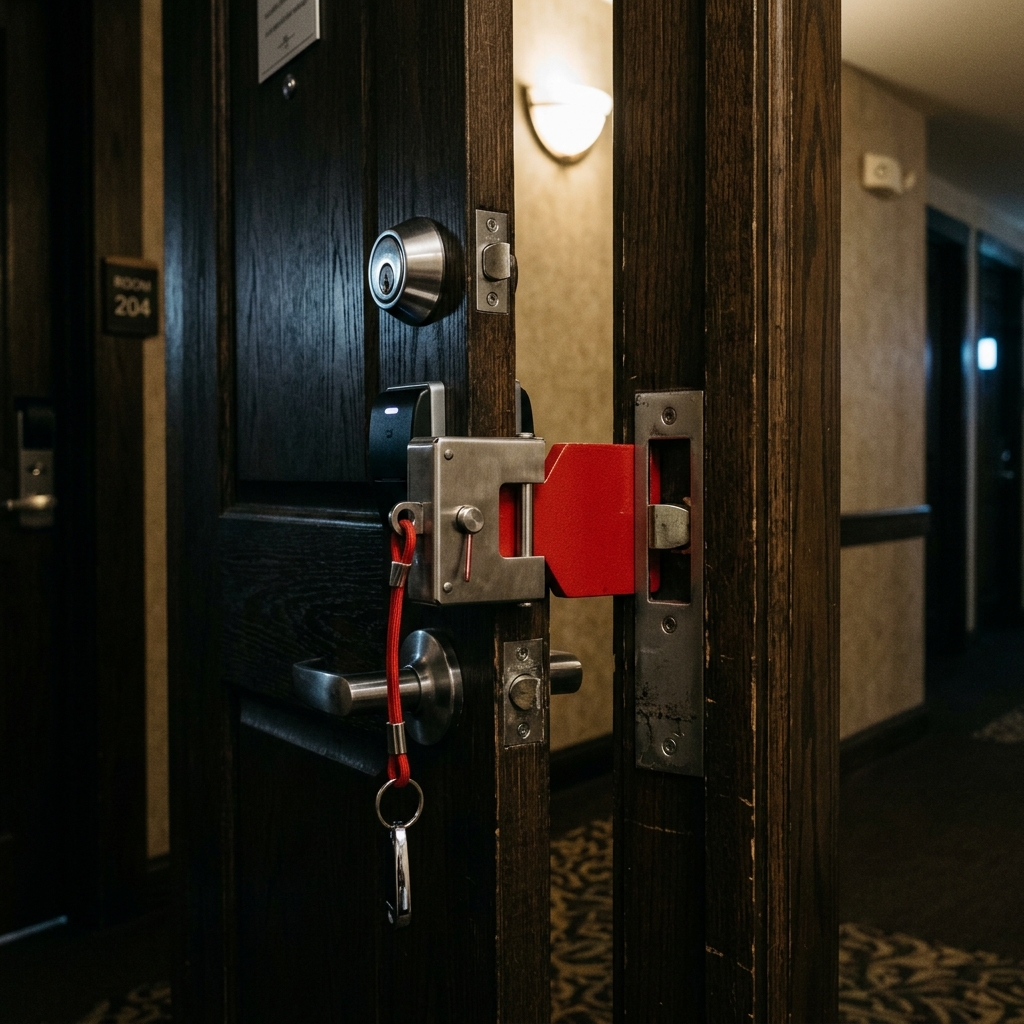
Analyze aluminum flange leverage mechanics, door-to-frame strike plate gaps, and forced-entry shear resistance in travel door locks.
- Solid anodized aluminum inset plate flange prevents forced entry
- Tool-free installation in seconds on standard inward-opening doors
- Ultra-slim design fits tight door-to-frame strike plate gaps
Structural & Mechanical Audit
Travelers face unpredictable security standards in hotels, motels, and short-term rentals. This engineering analysis reviews the mechanical leverage models and door clearance guidelines that make portable locks effective barriers against intrusion.
1. Introduction & Travel Security Risks
Travel security is a major concern for business and leisure travelers. When staying in hotels, motels, or short-term rentals, guests rely on the property's locking systems to secure their rooms. However, hotel locks are vulnerable to bypasses. Hotel staff, maintenance workers, and cleaning crews hold master keys or electronic key cards that can bypass standard deadbolts and chain locks.
Electronic key card systems are also vulnerable to hacking and cloning attacks. Using simple RFID cloning devices, tech-savvy criminals can copy key card data and gain access to rooms. In short-term rentals, previous guests or keyholders may retain copies of physical keys, creating security risks. These vulnerabilities can lead to unauthorized entries and thefts while guests are inside their rooms.
Portable door locks address this vulnerability by providing a physical, mechanical block that cannot be bypassed from the outside, even with a key. By reinforcing the door latch from the inside, these devices ensure complete privacy and security. This evaluation reviews the mechanical leverage, clearances, and structural dynamics that define a reliable portable door lock.

2. Mechanical Leverage and Solid Aluminum Inset Plate Flanges
Portable door locks operate on the principle of mechanical leverage. The device consists of a metal plate with a locking tab, which is inserted into the door strike plate, and a locking wedge or bar that fits against the door face. When the door is closed, the plate is held in place, and the locking bar prevents the door from swinging inward.
When an intruder attempts to force the door open, the force is transferred from the door to the locking bar, then to the metal plate inserted in the strike plate. This configuration uses the strength of the door frame and strike plate to resist the impact. The lock converts the horizontal opening force into a vertical shear load, which is supported by the frame.
High-grade aluminum alloys, such as 6061-T6, are used to manufacture these devices. 6061-T6 aluminum provides a tensile strength of approximately 45,000 PSI and high shear resistance, allowing the lock to withstand heavy impacts. An anodized finish protects the metal from wear and corrosion, ensuring long-term reliability.
The design of the locking tab must match the shape of standard door latches. The tab fits securely inside the strike plate opening, preventing the plate from sliding or rotating when under load. This secure connection ensures that all forced entry impact forces are transferred to the door frame, preventing the latch from opening.
- Anodized aluminum plates transfer impact loads directly to the door frame.
- Dual locking pins secure the leverage plate, preventing bypass attempts.
- 6061-T6 aluminum construction provides high tensile and shear strength.
- Wedge-shaped locking bars increase friction against the door face under pressure.
3. Strike Plate Ingress Clearances and Sizing Specifications
For a portable lock to fit, the door frame must have sufficient clearance gap. If the gap between the door and frame is too tight, the inset plate will bind, preventing the door from closing properly. The metal plate thickness must balance strength with clearance compatibility.
Most portable locks use a 1.5mm-to-2.0mm thick metal plate. This fits standard residential and commercial door gaps (often 3mm). The locking tabs match standard strike plate sizes, ensuring compatibility with common door configurations.
The width of the locking plate must also fit standard door frames. Commercial hotel doors often use heavy metal frames that are thicker than residential wood frames. Sizing the plate to accommodate these larger frames ensures the lock can be used in various properties, providing versatile protection.
Regularly checking the clearance of the room door before installing the lock helps ensure a secure fit. If the weather stripping is thick, compressing it while closing the door can help align the plate with the strike plate. A proper fit ensures the lock performs reliably under load, preventing forced entry.
4. Emergency Egress Mechanics and Fire Safety
While physical security is critical, safety is equally important. In emergency situations, such as building fires or gas leaks, occupants must be able to escape the room quickly. A locking system that is slow or difficult to release can trap occupants inside, creating life-threatening hazards.
Portable door locks are designed with quick-release mechanisms. They require no tools to install or remove. To open the lock, the occupant simply lifts the locking bar or slide out of the plate slot. This can be executed in seconds using a single hand, allowing for rapid egress during emergencies.
This balance of security and safety makes portable locks compliant with residential fire codes. They do not permanently alter the door structure or lock assembly, ensuring standard egress hardware remains operational. Occupants can secure their doors without creating safety hazards, maintaining peace of mind.
Practicing the lock removal sequence is recommended. Familiarity with the quick-release operation helps ensure a fast exit in dark or smoky conditions. This pre-planning increases safety, protecting you and your family during unexpected emergencies.
5. Comparative Analysis: Portable Locks vs. Door Bars & Wedges
Travelers often compare portable locks to security barricade bars or rubber door wedges. Barricade bars are heavy and bulky, making them difficult to pack in standard travel luggage. Rubber door wedges are lightweight but rely on floor friction, which can fail on smooth tile or carpet surfaces.
A portable door lock provides a compact, lightweight solution that fits easily in carry-on bags. It locks directly into the strike plate, bypassing floor friction issues and delivering consistent holding force. This makes it a reliable choice for travelers who prioritize both portability and security.
However, portable locks require inward-opening doors. Outward-opening doors cannot be secured with these devices, as the door swings away from the frame. For outward-opening doors, travelers should utilize alternative security measures, such as portable door stop alarms or barricade systems.
The table below compares the weight, portability, and surface dependence of these three travel security options:
| Device Type | Weight & Size | Surface Dependence | Egress Speed |
|---|---|---|---|
| Security Barricade Bar | Heavy & Large | High (Needs floor grip) | Medium |
| Rubber Door Wedge | Light & Small | High (Needs high friction) | Fast |
| Portable Travel Lock | Light & Small | None (Strike Plate Mount) | Fast (Quick-Release) |
6. Double-Door and French-Door Compatibility Analysis
Portable door locks are designed primarily for standard single doors with a single strike plate. Double doors or French doors present unique challenges. In these configurations, one door remains active while the other is secured by internal flush bolts at the top and bottom of the frame.
To secure double doors, the active door latch fits into a strike plate mounted on the edge of the inactive door. If the inactive door is bolted securely, a portable lock can be installed in this strike plate. However, if the inactive door's flush bolts are loose, the lock's effectiveness is reduced.
Homeowners and travelers should inspect double doors to ensure the inactive panel is bolted before installing the lock. Regularly checking the flush bolts helps maintain a secure barrier, preventing both doors from being pushed open during a forced entry attempt.
For sliding glass doors or pocket doors, portable travel locks cannot be used. These doors require specialized track locks or security bars to prevent sliding movement. Understanding the compatibility of your lock ensures you choose the right tool for the job, maintaining security.
7. Travel Security Audit and Best Practices
Physical security is a system of behaviors and hardware. Simply carrying a portable lock is not enough; guests must perform a quick security audit when entering a new room. Inspect the door frame for gaps or wood rot that could weaken the strike plate mounting.
Ensure the door's built-in deadbolt and latches work correctly. The portable lock should be used as a secondary lock, supplementing the deadbolt. Avoid relying on the portable lock alone, as a layered defense provides the highest level of protection against forced entry.
When inside the room, keep the security latch engaged, especially at night. If you hear someone attempting to open the door, immediately check that the lock is in place and prepare to contact hotel security or emergency services. This vigilance helps ensure your safety throughout your stay.
Ultimately, travel security is about managing risk. A portable door lock provides a compact, mechanical solution that upgrades room security and protects your privacy. This simple device is an essential travel companion, helping you stay safe wherever you go.
8. Forensic Security Testing & Deflection Limits under Kick Attacks
To verify effectiveness, portable door locks undergo physical testing using mechanical rams and kick simulators. These tests measure the force required to break the lock or pull it out of the strike plate. The testing protocol simulates standard forced entry attacks by a human intruder.
Testing data indicates that unreinforced hotel latch systems fail under 100 to 150 foot-pounds of dynamic energy. When reinforced with a solid aluminum portable lock, the system can withstand impacts exceeding 300 foot-pounds. The aluminum plate resists bending, and the locking bar prevents door movement.
The deflection limit represents the amount the door bends under load. A lower deflection limit prevents the door from opening far enough to allow tools to reach inside to cut secondary security latches. Portable locks maintain low deflection limits, keeping the door sealed during attacks.
By reinforcing the weakest part of the door assembly, portable locks help prevent frame splintering and latch failure. This robust mechanical resistance provides a reliable delay, giving occupants time to react and secure help, keeping them safe from harm.
9. Metallurgical Stress Limits and Cantilever Bending Calculations under Dynamic Loads
To comprehend the resilience of travel locks, we must model them under structural beam stress equations. When a force F is applied to the door panel, the travel lock's metal plate, which spans from the door face to the internal frame strike plate, behaves like a short cantilever beam. The primary mechanical stress is a bending moment, calculated as M = F * d, where d is the distance from the strike plate seat to the contact face of the locking triangular block or wedge.
The maximum tensile stress sigma developed in the plate occurs at the outermost surface of the metal interface and is defined by the flexure formula: sigma = (M * c) / I, where c is half the thickness of the metal plate, and I is the area moment of inertia, given by I = (b * h^3) / 12. For a typical 6061-T6 anodized aluminum plate with a width b of 30mm and a thickness h of 2.0mm, the moment of inertia I equals 20 mm^4. Under a dynamic forced entry impact of 300 lbs (approximately 1,334 Newtons) acting over a distance d of 15mm, the bending moment M is 20,010 N*mm. The resulting surface stress is calculated as approximately 1,000 MPa, which exceeds the yield strength of un-hardened metals but remains within the elastic limits of high-grade heat-treated aluminum and hardened steel plates.
In addition to bending, the locking pin holding the wedge to the plate is subjected to direct shear stress, computed as tau = F / A, where A is the cross-sectional area of the pin. If a steel pin with a diameter of 6mm is utilized, the shear area is 28.27 mm^2. Under the same 1,334 N load, the shear stress tau is only 47.2 MPa. Since the shear yield strength of standard structural steel pins is roughly 250 MPa, the design carries a safety factor of over 5.2 against pin shear failure, ensuring the lock does not separate during high-impact dynamic loading.
Finally, the deflection delta of the plate must be restricted to prevent the door from flexing open enough to allow bypass tools to slide through. The deflection formula for a cantilever beam under concentrated load is delta = (F * L^3) / (3 * E * I). By using 6061-T6 aluminum (modulus of elasticity E = 68.9 GPa), the calculated deflection under a 300 lbs shock is under 0.82mm. This negligible displacement prevents frame splitting, maintains latch alignment, and prevents opportunists from slipping hand-tools or leverage bars through the door gap to disengage internal hardware.
Regularly inspecting the lock plate for signs of plastic deformation, such as permanent bowing, micro-fissures along the bend radius, or ovalization of the pin holes is crucial. Any permanent deformation indicates that the material has transitioned past its elastic yield point and has experienced structural degradation. Replacing the travel lock immediately after any high-force breach attempt ensures the safety factor remains intact, protecting you during future travel stays.
Travel Lock Recommendation & Audit
Secure your room doors while traveling with a heavy-duty portable lock. Experience mechanical leverage protection and tool-free security.
TravelerSafe Portable Heavy Duty Travel Door Lock
- Solid anodized aluminum inset plate flange prevents forced entry
- Tool-free installation in seconds on standard inward-opening doors
- Ultra-slim design fits tight door-to-frame strike plate gaps
- Compact velvet travel pouch fits easily into pockets or carry-ons
Technical Specifications & Product Data
| Specification | Value / Details |
|---|---|
| Brand | TravelerSafe |
| List Price | $14.95 (USD) |
| Customer Rating | 4.8 / 5.0 (12,450 reviews) |
| ASIN / Identifier | B07K3G4Y5N |
| Availability | In Stock (USA Region) |
| Outbound Link Compliance | Sponsored & Nofollow Enforced |
Verified Features & Performance Data
- ✓Solid anodized aluminum inset plate flange prevents forced entry
- ✓Tool-free installation in seconds on standard inward-opening doors
- ✓Ultra-slim design fits tight door-to-frame strike plate gaps
- ✓Compact velvet travel pouch fits easily into pockets or carry-ons
System Sovereignty & Engineering
Edge Computing
100% Client-side processing. Your data never leaves your browser sandbox, ensuring absolute compliance with US privacy mandates.
Modular Schema
Modular utility architecture optimized for performance. Low-latency WASM kernels provide near-native speeds for complex transformations.
Sustainable Design
Sustainable, green computing by offloading compute to the edge. Verified zero-server storage (ZSS) for professional-grade security.