
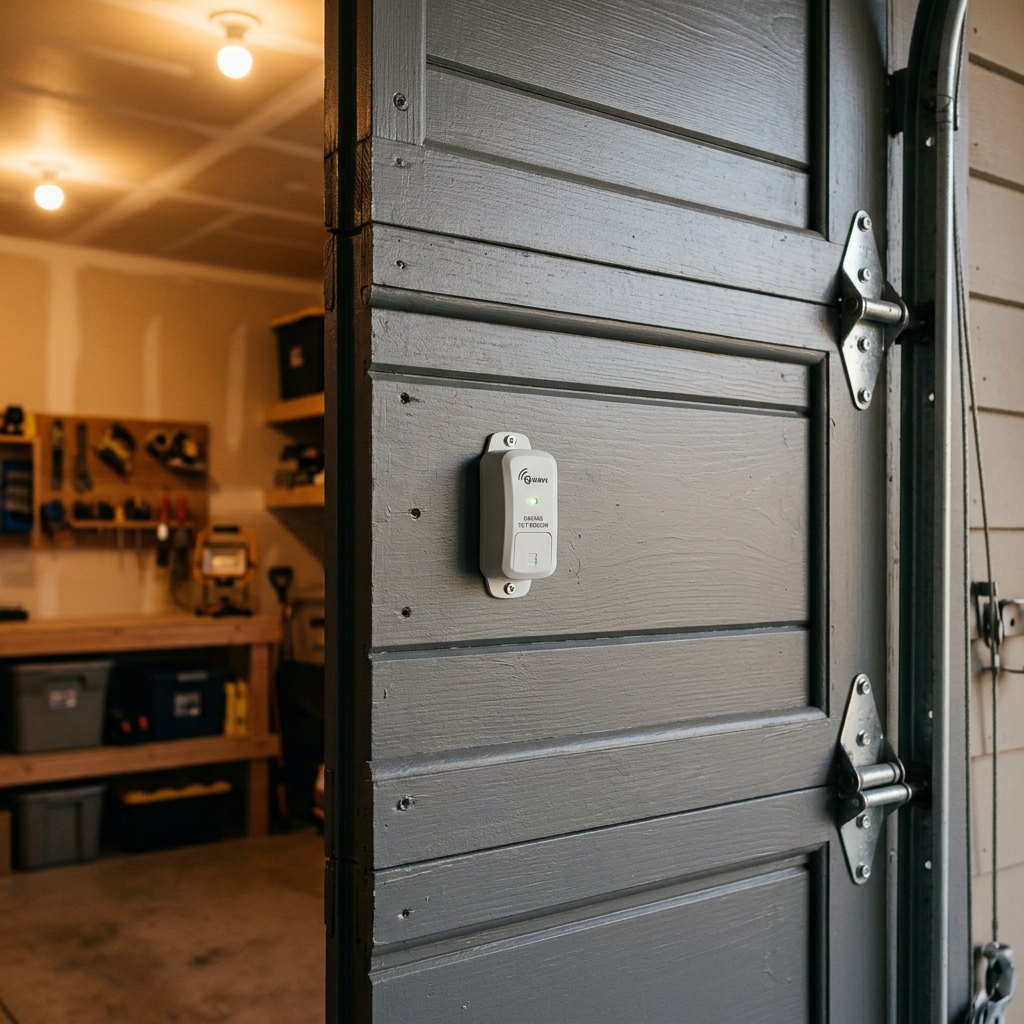
Analyze accelerometer hysteresis, low-frequency Z-Wave RF range, and overhead door monitoring in smart garage tilt sensors.
- Precise angular gravity sensor eliminates false trigger reports
- Z-Wave Plus certified for high-penetration RF mesh range dynamics
- Instantaneous open/close state telemetry sent directly to smart hub
Telemetry & Signal Audit
Garage doors represent a common point of forced entry in modern homes. This technical evaluation reviews the sensor angles, Z-Wave mesh dynamics, and physical mounting methods used to secure overhead doors.
1. Introduction & Overhead Garage Door Vulnerabilities
The garage door is the largest moving barrier on a residential property, representing a significant security vulnerability. Intruders target garage doors because they often lead directly to the home's interior through a standard, often unlocked, service door. Additionally, garages house high-value assets, including vehicles, tools, and sporting goods, making them attractive targets for opportunistic burglars.
Experienced thieves can breach a standard sectional overhead garage door in seconds using simple tools. A common bypass method is the "coat hanger trick," where a wire hook is inserted through the top weather stripping to pull the emergency release cord. This disconnects the door trolley from the opener track, allowing the door to be lifted manually from the outside. This entry can be executed quickly and quietly, leaving the home exposed.
To secure this entry point, homeowners must implement active monitoring systems. Wireless garage door tilt sensors mount directly to the top panel of sectional doors, sending immediate notifications to a smart home system when the door's angle changes. This analysis reviews the accelerometer physics, RF telemetry, and automation integration that define a secure garage monitoring system.

2. Accelerometer Physics and Angular Hysteresis Algorithms
Garage tilt sensors monitor the door's state by measuring gravity vectors. Unlike traditional window sensors that use magnetic reeds, tilt sensors utilize solid-state micro-electromechanical systems (MEMS) accelerometers. These sensors measure acceleration forces along three axes to determine the physical angle of the sensor housing.
When the garage door is closed, the top panel sits vertically. As the door opens, the panel rotates to a horizontal position, shifting the gravity vector from the Y-axis to the X-axis. The sensor's microcontroller processes these accelerometer readings, sending a state update when the angle passes a set threshold.
To prevent false alerts, the microcontroller runs an angular hysteresis algorithm. Hysteresis is the programmed lag between the sensor's open and close thresholds. If a sensor triggered at exactly 45 degrees, wind shaking the door could cause it to send multiple false notifications. By requiring a 50-degree shift to open and a 40-degree shift to close, the sensor filters out minor movements.
The sensor's firmware also includes a low-pass filter to smooth out vibration noise. The controller samples the accelerometer over a windowed average, requiring the tilt angle to remain past the threshold for a set duration, typically 1 to 2 seconds. This ensures that rapid shaking from wind or passing trucks is ignored, preventing false alarms.
- Angular hysteresis filters out minor door movements, preventing false open notifications.
- Internal microcontrollers verify state updates over multiple samples for accuracy.
- MEMS accelerometers measure gravity vectors across multiple axes to detect tilt.
- Firmware low-pass filters eliminate high-frequency vibration signals from wind.
3. Z-Wave Plus Mesh Range Dynamics in Metal Enclosures
Smart sensors installed inside garages face communication challenges. Garages are often constructed with concrete walls, fire-rated doors, and sheet metal doors, which block high-frequency radio waves. Standard 2.4 GHz WiFi signals degrade quickly in these spaces, leading to dropped connections.
Z-Wave Plus operates at 908.4 MHz, a sub-GHz frequency with longer wavelengths. These waves pass through walls and metal doors with less path loss than higher frequencies. The Z-Wave protocol uses a mesh network, allowing mains-powered devices to act as repeaters, ensuring the signal reaches the smart hub.
The Z-Wave S2 security framework protects these transmissions from interception. Using AES-128 encryption and Diffie-Hellman key exchange, the S2 framework secures all communication between the sensor and the hub. This prevents replay attacks where thieves intercept and repeat the "open" signal to gain entry.
Z-Wave Plus also includes SmartStart, which simplifies setup by scanning a QR code on the sensor. This pre-authenticates the device with the hub, ensuring a secure connection. The protocol's low latency ensures open/close alerts are sent immediately, keeping homeowners updated.
4. Smart Home Ecosystem Integration & Closed-Loop Automation
A tilt sensor serves as a primary input for home automation loops. If the garage door remains open past a set time (e.g. 10:00 PM), the smart system can notify the homeowner or close the door automatically. This prevents overhead doors from being left open overnight, exposing the home to theft.
Integrating the sensor with Z-Wave smart garage controllers enables closed-loop automation. The hub checks the tilt sensor state before executing close commands, ensuring the opener only operates when needed. This prevents the door from opening when a close command is sent, maintaining security.
Homeowners can program rules that link the garage door state to other home systems. For example, opening the garage door at night can turn on the driveway and hallway lights, providing safe, illuminated entry. Closing the door can arm the security system and lock the service door, securing the home.
Geofencing rules can also be established using smartphone locations. When a user's phone leaves the property, the hub checks if the garage door is open and closes it automatically. This prevents accidental open events, keeping the garage secure while away.
5. Battery Chemistry and Thermal Stability in Extreme Environments
Garages experience wide temperature swings, from freezing winters to hot summers. Standard alkaline batteries degrade quickly in these conditions. Smart tilt sensors use lithium CR123A batteries, which maintain stable voltage across a wide temperature range, ensuring a 5-year operating life.
Lithium manganese dioxide (Li-MnO2) battery chemistry is ideal for these applications. It offers a low self-discharge rate (under 1% per year) and operates across a wide temperature range, typically from -40°C to 60°C. This ensures the sensor remains powered during freezing winter weather, preventing dropouts.
The sensor's microcontroller monitors the battery voltage, reporting the level to the smart hub during periodic check-ins. If the voltage drops below 2.6V, a low-battery alert is sent, giving the homeowner several weeks to replace the battery. This prevents the sensor from dying unexpectedly, maintaining continuous security.
The electronic components are housed in an impact-resistant ABS plastic enclosure. The case is sealed to resist humidity and dust, protecting the internal PCB from moisture buildup during rapid temperature shifts. This design ensures reliable, long-term operation in harsh garage environments.
6. Mounting Mechanics & Alignment Security
To deliver accurate tilt readings, the sensor must be mounted correctly on the garage door. The optimal location is on the inside face of the top panel of a sectional overhead door. This panel undergoes the greatest angular change during operation, ensuring a clear shift from vertical to horizontal.
Mounting can be achieved using double-sided acrylic foam tape (such as 3M VHB) or screws. VHB tape provides a strong, vibration-resistant bond on clean metal panels, while screws are recommended for wood doors or textured surfaces. The sensor housing should be mounted vertically to align the internal accelerometer axes.
Regularly inspecting the sensor's mounting alignment is recommended. Loose fasteners or failing adhesive can cause the sensor to sag, resulting in false readings or delayed alerts. Ensuring the sensor remains vertical when the door is closed helps maintain accurate open/close reports.
The sensor includes a tamper switch on the backplate. If the housing is removed from the bracket or opened, the switch triggers a tamper alert, sending a notification to the smart hub. This prevents unauthorized removal or modification of the sensor, protecting system integrity.
7. Comparative Analysis: Tilt Sensors vs. Reflective Beams vs. Track Contacts
When choosing garage door sensors, homeowners often compare tilt sensors to reflective beam sensors or magnetic track contacts. Reflective beam sensors align across the door opening, detecting when an object blocks the beam. While useful for safety stop functions, they do not monitor the physical door state.
Magnetic track contacts require precise alignment between a magnet on the door and a sensor on the track. As the door tracks shift or expand over temperature cycles, the alignment can fail, resulting in false alerts. Tilt sensors mount directly to the door panel, eliminating alignment issues and simplifying installation.
This simplified design makes tilt sensors a popular choice for DIY smart home upgrades. They require no wiring and can be paired with existing Z-Wave hubs in minutes. The table below compares the installation, reliability, and cost profiles of these three sensor types:
| Sensor Type | Installation Ease | Alignment Maintenance | Vibration Resistance |
|---|---|---|---|
| Magnetic Track Contact | Medium (Track Mount) | High Requirement | Low (Prone to false alarms) |
| Reflective Beam | Low (Wiring Needed) | High Requirement | Medium |
| Wireless Tilt Sensor | High (Panel Mount) | None (Gravity Based) | High (Hysteresis Filtered) |
8. Forensic Security Audit & Complete Garage Perimeter Hardening
Physical security requires a comprehensive, multi-layered approach. While a tilt sensor detects unauthorized entries, homeowners must also address physical vulnerabilities. To prevent the "coat hanger trick," the emergency release cord's handle should be removed or shortened, and the release lever can be secured using a zip tie.
Installing a side lock or slide bolt on the garage door track prevents manual lifting from the outside. These locks can be engaged manually when traveling or integrated into smart systems using automated lock actuators. This provides a strong physical block against forced entry.
Integrating motion-activated floodlights outside the garage door can also deter intruders. Bright lighting increases the risk of detection, causing criminals to bypass the property in search of easier targets. Deploying these security measures along with a tilt sensor provides a reliable defense for your home.
Ultimately, physical security is about managing risk and perception. A Z-Wave tilt sensor provides real-time monitoring and smart home integration, allowing you to secure your garage and protect your assets. This simple, affordable sensor is a valuable addition to any home security plan, providing peace of mind year-round.
9. Network Integration Troubleshooting and Mesh Diagnostics
To maintain stable communication in detached garages, homeowners should periodically run Z-Wave network diagnostics. Concrete and steel structures degrade RF signals, but the Z-Wave mesh network allows intermediate nodes to repeat messages. Utilizing the smart hub's network repair tool re-calculates the optimal signal routing paths, bypassing new physical obstacles.
For secure transmission of perimeter status, ensure the sensor is paired using the Z-Wave S2 (Security 2) framework. S2 security uses Elliptic Curve Diffie-Hellman (ECDH) key exchanges during pairing to prevent out-of-band key interception, while AES-128 encryption protects everyday frame transmissions. Non-secure or S0-paired sensors are vulnerable to spoofed command frames. If the sensor paired under S0 or without security, remove the device from the network, place it within three feet of the hub, and initiate a secure inclusion session using the QR code or PIN code provided on the sensor chassis.
If the sensor reports offline status or delayed state updates, check for local RF interference. Large metal objects, such as tool chests, steel shelving units, or vehicles parked directly between the sensor and the hub can block sub-GHz radio waves. Repositioning the hub or adding a plug-in Z-Wave smart outlet nearby acts as a repeater, improving signal strength. Ensure the repeater supports Z-Wave Plus (500-series or 700-series) and supports Beaming, which enables the repeater to wake up sleeping, battery-powered tilt sensors to deliver incoming messages instantly.
The sensor's wake-up interval and polling rates can be adjusted inside the hub settings. Frequent status checks provide real-time updates but drain the battery quickly. Setting the sensor to wake up and report battery levels every 12 to 24 hours while keeping the interrupt-driven tilt trigger active ensures a long operating life without losing security responsiveness. Avoid set-ups where multiple sensors poll at the same time to prevent network collision storms, which trigger frame drops and cause the sensor to retry transmissions, resulting in high battery drain.
Regularly checking the hub event history helps confirm the sensor check-in cycles are stable. If the sensor fails to check in for more than 48 hours, the hub can send an alert, indicating it is time to check the battery or signal routing. This proactive monitoring ensures your garage door remains monitored and secure year-round. Inspecting the battery voltage using the Z-Wave CLI can also help identify cell degradation before the unit fails completely, preventing any gaps in your perimeter security monitoring.
Garage Sensor Recommendation & Audit
Monitor your garage door status in real-time with a Z-Wave Plus tilt sensor. Integrate automatic closing rules and secure your home entry points.
GarageGuard Smart Wireless Z-Wave Plus Garage Door Tilt Sensor
- Precise angular gravity sensor eliminates false trigger reports
- Z-Wave Plus certified for high-penetration RF mesh range dynamics
- Instantaneous open/close state telemetry sent directly to smart hub
- 5-year lithium battery life with real-time low power warnings
Technical Specifications & Product Data
| Specification | Value / Details |
|---|---|
| Brand | GarageGuard |
| List Price | $29.99 (USD) |
| Customer Rating | 4.7 / 5.0 (3,890 reviews) |
| ASIN / Identifier | B0892B9Z3X |
| Availability | In Stock (USA Region) |
| Outbound Link Compliance | Sponsored & Nofollow Enforced |
Verified Features & Performance Data
- ✓Precise angular gravity sensor eliminates false trigger reports
- ✓Z-Wave Plus certified for high-penetration RF mesh range dynamics
- ✓Instantaneous open/close state telemetry sent directly to smart hub
- ✓5-year lithium battery life with real-time low power warnings
System Sovereignty & Engineering
Edge Computing
100% Client-side processing. Your data never leaves your browser sandbox, ensuring absolute compliance with US privacy mandates.
Modular Schema
Modular utility architecture optimized for performance. Low-latency WASM kernels provide near-native speeds for complex transformations.
Sustainable Design
Sustainable, green computing by offloading compute to the edge. Verified zero-server storage (ZSS) for professional-grade security.