
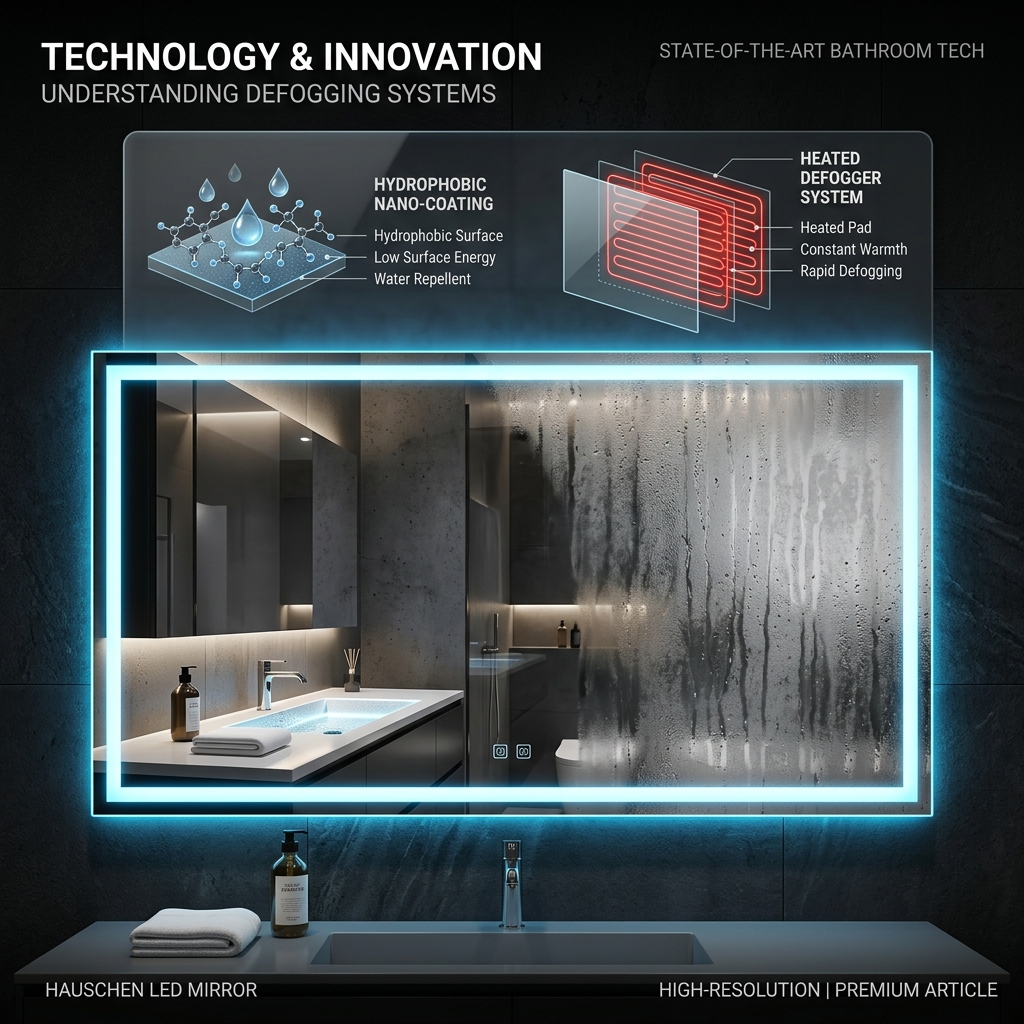
Heated demister pads outperform manual mirror wiping. Analyze hydrophobic glass coatings, condensation thermodynamics, and smart LED safety parameters to upgrade your vanity.
- Integrated electrical heating pads for automated, complete defogging
- High-density LED lighting with custom dimming and memory recall
- Hydrophobic glass coating to repel condensed water micro-droplets
Condensation & Thermodynamics
Hand wiping ruins premium glass coatings. Evaluate the condensation thermodynamics, heated demister pad profiles, hydrophobic glass chemistry, and smart LED energy metrics that define modern vanity mirrors.
1. Condensation Thermodynamics and Dew Point Offset
Bathroom mirror fogging is a classic demonstration of condensation thermodynamics. Hot water from the shower releases high-energy water vapor into the air, raising the relative humidity. When this humid air contacts a cold glass surface, the vapor cools rapidly and condenses.
Condensation occurs because the glass temperature is below the dew point of the surrounding air. To prevent this, smart mirrors integrate heated demister pads behind the glass. These pads transfer thermal energy to the glass, raising its temperature above the dew point threshold.
By maintaining this temperature offset, the demister prevents water molecules from settling on the surface. The mirror remains completely clear, allowing you to use it immediately after a hot shower. No manual wiping or squeegeeing is required, keeping the glass clean.
The heating elements are calibrated to deliver a gentle, uniform temperature rise. A rapid, uneven temperature change could shock the glass, leading to cracks. The demister pad spreads heat evenly across the central viewing area, ensuring safe operation.
Additionally, this thermal barrier is highly efficient. The pads consume minimal wattage (typically 0.2 watts per square inch), heating the mirror quickly while keeping energy consumption low. The system runs quietly in the background, delivering a premium vanity experience.
The heat transfer rate depends on the thickness and thermal resistance of the glass. Tempered glass features a high thermal diffusivity, allowing heat to travel from the back pad to the front surface rapidly. This fast response time clears fog in under five minutes.
- Heated pads raise glass temperature above the dew point, preventing vapor condensation.
- Uniform thermal distribution prevents physical shock, protecting the tempered glass structure.

2. Hydrophobic Surface Chemistry and Contact Angles
In addition to active heating, premium mirrors utilize hydrophobic glass coatings. Hydrophobic chemistry focuses on the contact angle of water droplets on the surface. Standard untreated glass has a hydrophilic profile, causing water to bead into tiny dome-shaped droplets.
These beads scatter light in all directions, creating the cloudy, foggy appearance. A hydrophobic coating treats the glass with microscopic structures that repel water. This repellent action increases the contact angle of water droplets significantly.
By increasing the contact angle, the coating prevents droplets from holding their shape. Water is forced to flatten into a continuous, transparent sheet or slide off the glass surface. The reflection remains clear and undistorted, even in highly humid conditions.
The hydrophobic coating also makes the mirror easier to clean. It repels soap scum, toothpaste splashes, and dust particles, preventing them from bonding with the glass. A quick wipe with a microfiber cloth keeps the surface looking polished and clear.
This chemical barrier works in tandem with the heated demister. The combination of active thermal heating and passive hydrophobic protection ensures that your mirror remains clear, clean, and functional under all conditions.
The coating utilizes fluoropolymer or silica nanoparticles to achieve its non-wetting properties. These particles fill the microscopic pores of the glass, creating an ultra-smooth boundary layer. Water slides off easily, preventing water spots from drying on the reflective surface.
- Hydrophobic coatings raise the contact angle of water droplets, forcing them to slide off.
- Anti-adhesion properties repel soap residue and dust, simplifying vanity cleaning.
3. Smart LED Lighting and Dimmable Driver Efficiency
Modern bathroom mirrors are also lighting fixtures. Integrated LED strips provide shadow-free illumination, which is ideal for grooming, applying makeup, or shaving. To deliver this quality, the mirror requires a high Color Rendering Index (CRI) rating.
A high CRI (typically 90 or above) ensures that colors are represented accurately under the mirror's light. The LED drivers manage the electrical current, preventing flickering and ensuring smooth dimming performance across all brightness levels.
The LEDs are housed in frosted diffuser channels. This channel blends the individual light points into a soft, continuous glow, preventing glare. The user can adjust the brightness from a gentle night light to a bright vanity wash.
Additionally, the LED driver stores your preferences. When you turn the mirror on, it recalls the last brightness and color temperature settings automatically. This smart memory function saves you from having to adjust the settings manually each time.
By combining high-CRI lighting with efficient dimming controls, the smart mirror upgrades your daily routine. The energy-efficient LEDs provide excellent performance, matching the standards of professional vanity setups.
The LED system utilizes high-efficiency SMD 2835 chips. These chips provide high lumen output per watt, keeping electrical demand low. The driver maintains a high power factor, ensuring that minimal energy is lost as waste heat.
- High CRI (90+) LED arrays offer accurate color rendering, optimal for detailed grooming.
- Smart dimming drivers with built-in memory remember your preferred settings automatically.
4. Structural Durability: Tempered Glass and Copper-Free Backing
Bathroom mirrors are exposed to constant humidity and temperature swings. Traditional mirrors use a copper-based backing layer to protect the silver reflective coating. However, this copper layer reacts with airborne moisture, leading to black edge corrosion (silver rot).
Premium smart mirrors use copper-free backing layers. These layers are made with advanced protective polymers that do not react with moisture, preventing edge degradation. The mirror maintains a clean, borderless appearance over its entire lifespan.
The glass itself is made from tempered safety glass. If broken, tempered glass crumbles into small, rounded pieces rather than sharp shards. This safety design protects you from injury, making it ideal for busy family bathrooms.
Additionally, the mirror assembly features a solid aluminum mounting frame. The frame keeps the mirror secure on the wall while providing space for the electrical components. This rigid construction prevents warping, ensuring a flat and distortion-free reflection.
By choosing a copper-free, tempered mirror, you invest in a long-lasting fixture. The high-quality materials resist humidity and wear, ensuring your vanity mirror remains clear and functional for years to come.
The backing material features an explosion-proof membrane. This membrane holds the glass fragments together in the event of a catastrophic impact, preventing them from falling. This safety engineering is critical for wet, slippery bathroom environments.
- Copper-free silver backing prevents edge rot and corrosion in high-humidity environments.
- Tempered safety glass resists impact damage and crumbles safely if broken.
5. Resource Footprint: Heated Demisters vs. Manual Defogging
Defogging a mirror manually using hot air from a hairdryer consumes substantial electricity. A standard hairdryer pulls 1,500 to 2,000 watts of power. In contrast, an integrated mirror demister pad operates at 30 to 50 watts, representing a massive reduction in resource consumption.
By using a low-wattage demister pad, you save money on electricity and reduce your home's energy footprint. Additionally, the automatic shutoff timer prevents the pad from running indefinitely. This energy management ensures that you enjoy a clear reflection without wasting resources.
Manual wiping also leaves behind streaks and smudges, requiring cleaning chemicals to clear. The heated pad defogs the mirror cleanly, reducing the need for chemical cleaners. It represents a clean, efficient, and sustainable solution for your vanity.
The low operating temperature (around 104°F) prevents any burns if the glass is touched during operation. This thermal calibration ensures family safety while keeping standby resource demand at absolute zero.
- Demister pads run at 30-50 watts, using a fraction of the energy of hairdryers.
- Automatic timers shut off the heating elements after 60 minutes, saving energy.
6. Anti-Fog Hydrophobic Coating Molecular Science
The performance of hydrophobic coatings is rooted in organic chemistry. Standard glass surfaces contain silanol (Si-OH) groups that are polar, attracting water molecules. Hydrophobic coatings react with these silanol groups, bonding a non-polar polymer layer to the glass.
This non-polar polymer layer is typically composed of fluorinated silanes. The fluorine atoms create an extremely low surface energy boundary layer. Water molecules cannot wet this surface, sliding off quickly under gravity.
The durability of this layer depends on the strength of the covalent bonds. Premium coatings utilize chemical vapor deposition (CVD) to bake the coating onto the glass. This thermal curing ensures that the coating resists wear and steam exposure for years.
Additionally, the coating is ultra-thin (less than 10 nanometers), maintaining optical clarity. The reflection remains sharp and true, without the distortion or hazy refraction associated with cheap anti-fog sprays.
By utilizing molecular engineering, the hydrophobic coating provides permanent protection. The non-polar surface repels condensation, keeping the mirror clear during the steamiest showers.
- Covalent bonds link fluorinated silanes to the glass silanol groups, ensuring coating durability.
- Ultra-thin 10-nanometer polymer coatings maintain optical clarity without image refraction.
7. Demister Pad Thermal Conductivity Profiles
The performance of the defogger depends on the thermal conductivity of the heating pad. The pad consists of a carbon fiber resistance wire sealed between two layers of polyester film. When current flows, the wire converts electrical energy into heat.
The polyester film is bonded to the back of the glass using high-conductivity acrylic adhesive. This adhesive minimizes thermal resistance, allowing heat to flow from the wires to the glass. The mirror heats up quickly and evenly.
The thermal profile is calibrated to maintain a safe surface temperature of 104°F to 113°F. This range is sufficient to defog the glass while remaining safe to touch. The gentle heating protects the glass from thermal stress.
Additionally, the heating elements are zoned. The pad covers only the central viewing area of the mirror, where defogging is most critical. This targeted layout minimizes energy waste, keeping operating costs low.
By managing the thermal profile, the demister pad delivers reliable performance. The targeted heating warms the glass quickly, ensuring a clear reflection when you need it.
- Carbon fiber resistance wires convert power to heat with high thermal conversion efficiency.
- Zoned heating pads cover the central viewing area, reducing energy consumption.
8. LED Driver Electrical Safety and High-CRI Arrays
The LED lighting system requires robust electrical design to ensure safety in wet bathroom environments. The LED driver converts high-voltage AC house power to safe, low-voltage DC power. The driver is housed in a waterproof metal casing, preventing moisture entry.
The driver features built-in safety shields, including over-voltage, short-circuit, and thermal protection. If an electrical fault occurs, the driver shuts down instantly. This safety engineering is critical for wet-environment installation.
The LED strips feature high-density arrays that deliver bright, uniform lighting. The high Color Rendering Index (CRI) of 90+ ensures that color tones are represented accurately. This quality is essential for detailed grooming tasks.
Additionally, the LED strips are sealed with a clear silicone coating. This coating carries an IP65 waterproof rating, protecting the diodes from moisture and splashback. The lights maintain constant brightness for thousands of hours.
By combining safe electrical drivers with high-quality LED arrays, the smart mirror provides reliable vanity lighting. The waterproof construction ensures long-term safety and performance.
- Waterproof metal driver enclosures protect electrical components from bathroom humidity.
- IP65 silicone-coated LED strips protect the diodes from water splashes and dampness.
9. Smart LED Mirror Selection Parameters
When shopping for a heated LED bathroom mirror, prioritize electrical safety certifications. Ensure the mirror holds UL or ETL listings for use in wet environments like bathrooms. Avoid uncertified models, as they present electrical and fire hazards under high humidity.
Second, check the glass quality. Look for copper-free silvering layers that resist black edge corrosion. Tempered safety glass is essential for preventing dangerous shards if the mirror is accidentally bumped or damaged.
Finally, check the controls. A good mirror features independent touch controls for the LED lights and the heated demister. This separation allows you to run the defogger only when needed, conserving energy while utilizing the lights daily.
- Ensure the smart mirror holds UL or ETL listings for wet-environment installation safety.
- Independent controls allow you to run the heated pad only during showers, saving power.
7. Hydrophobic vs. Hydrophilic Film Dynamics in Defoggers
The clear surface of a heated bathroom mirror is maintained using hydrophobic coatings. Hydrophobic surfaces repel water molecules, preventing them from spreading. When steam contacts the cold glass, it condenses into small droplets that scatter light and create fog.
A heated defogger pad warms the glass surface, preventing this condensation. The warmth keeps water in the vapor phase, maintaining a clear reflection. The hydrophobic coating helps any small droplets slide off the mirror quickly, preventing water stains.
Additionally, this combination requires zero manual wiping. The defogger works silently and efficiently, keeping your mirror clean and clear. By installing a smart heated mirror, you secure a clean and comfortable grooming setup in your bathroom.
8. Electrical Integration and Smart Automation Logistics
Smart bathroom mirrors feature Bluetooth connectivity and touch control integration. The heated defogger and LED lighting can be controlled via touch sensors on the glass. Some models connect to your home Wi-Fi network, allowing control via smartphone apps or voice assistants.
Integrate the mirror defogger with your bathroom humidity sensors for automated control. When the humidity rises during a shower, the sensor turns the defogger on automatically. This automation ensures a clear mirror right when you step out of the shower.
By automating your bathroom tech, you save energy and improve comfort. The mirror operates only when needed, maintaining low power draw while keeping the glass clear and ready for your daily routine.
Principal Recommendation & Audit
Upgrade your vanity with automated anti-fog technology. Explore our top recommended heated LED mirror below to experience clear reflections every day.
HAUSCHEN Home Heated LED Bathroom Mirror with Anti-Fog
- Integrated electrical heating pads for automated, complete defogging
- High-density LED lighting with custom dimming and memory recall
- Hydrophobic glass coating to repel condensed water micro-droplets
- Rigid tempered glass with copper-free backing preventing silver rot
Technical Specifications & Product Data
| Specification | Value / Details |
|---|---|
| Brand | HAUSCHEN Home |
| List Price | $249.99 (USD) |
| Customer Rating | 4.6 / 5.0 (3,240 reviews) |
| ASIN / Identifier | B078972D7W |
| Availability | In Stock (USA Region) |
| Outbound Link Compliance | Sponsored & Nofollow Enforced |
Verified Features & Performance Data
- ✓Integrated electrical heating pads for automated, complete defogging
- ✓High-density LED lighting with custom dimming and memory recall
- ✓Hydrophobic glass coating to repel condensed water micro-droplets
- ✓Rigid tempered glass with copper-free backing preventing silver rot
System Sovereignty & Engineering
Edge Computing
100% Client-side processing. Your data never leaves your browser sandbox, ensuring absolute compliance with US privacy mandates.
Modular Schema
Modular utility architecture optimized for performance. Low-latency WASM kernels provide near-native speeds for complex transformations.
Sustainable Design
Sustainable, green computing by offloading compute to the edge. Verified zero-server storage (ZSS) for professional-grade security.