
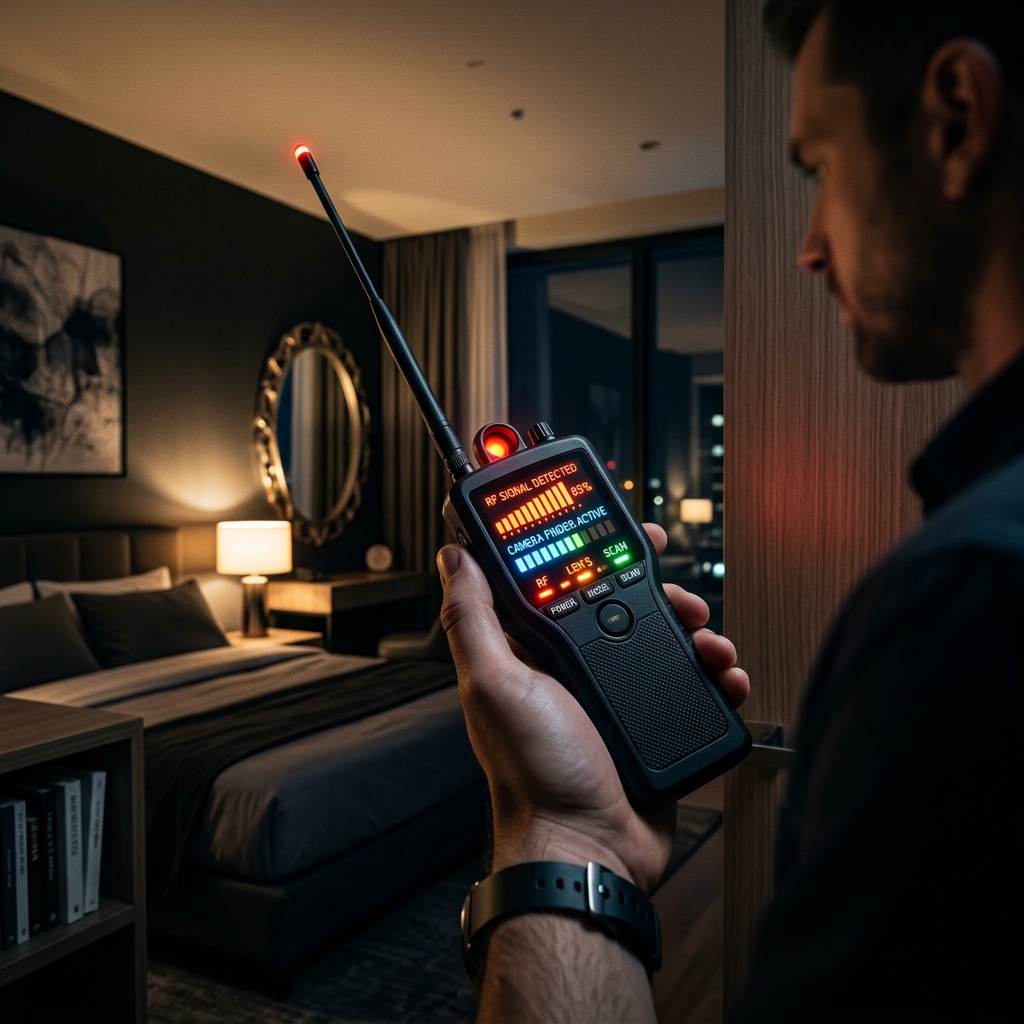
Hidden cameras and illicit tracking devices are increasingly common in rentals. Discover how infrared laser reflection and RF scanning detect hidden cameras and wireless signals.
- Sweeps wide RF frequency spectrum from 1 MHz to 6.5 GHz for active signals
- Red LED laser light array finds pinhole camera lenses through reflection
- Dual mode alerts: audio buzzer or silent vibration for discrete sweeping
Digital Privacy Engineering
The proliferation of high-definition, miniaturized surveillance technology has transformed private spaces into potential vectors for espionage and data extraction. Modern pinhole camera lenses, wireless bugs, and cellular tracking modules can easily evade standard visual inspection. Safeguarding your physical and digital privacy within temporary environments like hotels, Airbnbs, and rental vehicles requires a rigorous, scientifically grounded sweeping protocol. By combining optical retroreflection analysis with wide-spectrum radio frequency monitoring and localized magnetic field scanning, individuals can systematically discover, locate, and neutralize hidden monitoring systems to secure their environments.
1. Physics of Optical Retroreflection in Pinhole Lenses
Optical retroreflection represents the fundamental physics principle exploited by high-grade hidden camera detectors. When collimated electromagnetic radiation, specifically in the red or near-infrared spectrum, encounters a camera lens, it enters the optical aperture. The light passes through the glass elements to the focal plane, which acts as a reflective surface. This setup acts as a retroreflector, bouncing light directly back along its incident path to the emitter with minimal dispersion.
This optical phenomenon occurs regardless of the camera's power state, meaning even inactive, powered-down, or offline lenses are vulnerable to retroreflective identification. The curved glass-to-air interfaces of pinhole lenses focus incoming light onto the sensor. The detector's red filter window isolates this specific return wavelength from ambient light, revealing the lens as a bright, highly concentrated crimson hotspot that stands out against surrounding non-reflective surfaces.
However, successful detection requires adjusting the angle of incidence during sweeps. Tinted glass, curved acrylic panels, or semi-translucent plastic covers are often used to conceal pinhole cameras within clocks, smoke detectors, and wall chargers. By changing your viewing angle relative to the target surface, you ensure that the retroreflected beam align with the detector's optical viewfinder, overcoming the light attenuation caused by these dark protective covers.
To execute this process effectively, users should stand between three to ten feet from the target surface. The human eye has difficulty detecting low-intensity retroreflections at long ranges, so slow, structured geometric patterns are necessary. Systematically sweep every square inch of a room, keeping the detector close to your line of sight. This technique maximizes the return signal and helps identify the sub-millimeter apertures of modern spy gear.
- Retroreflective optical target returns project highly concentrated crimson illumination points directly through the detector's specialized red viewing filter window.
- Collimated LED light arrays exploit the convex geometry of pinhole camera lenses to return incoming beams directly to their original source.
- Varying the scanning angle overcomes the ambient light diffusion caused by tinted plastic covers or deep housing recesses on spy devices.
- Systematic geometric sweeping patterns expose hidden lenses regardless of whether the target camera is actively recording or completely powered off.
- Maintaining an optimal detection range of three to ten feet guarantees sufficient retroreflective intensity for reliable human eye target recognition.

2. Wide-Spectrum RF Field Strength Scanning
Wireless surveillance transmitters rely on radio frequency radiation to broadcast captured video or audio data to remote receiving stations. These covert transmitters operate on various standard communication frequencies, typically spanning from 1 megahertz up to 6.5 gigahertz. This wide range encompasses modern protocols like dual-band Wi-Fi, Bluetooth, Zigbee, and cellular networks, making a wide-spectrum radio frequency detector essential for scanning these transmission bands.
RF signal scanners capture high-frequency electromagnetic waves using a broadband omnidirectional antenna and convert the detected energy into visual RSSI levels or audible alerts. As the detector moves closer to the hidden transmitter, the local electromagnetic field strength spikes, indicating the device's exact location. This approach allows users to locate active transmitters hidden inside hollow walls, ceiling vents, and electrical appliances.
To perform an accurate RF sweep, you must first isolate the test environment by disabling all authorized wireless transmitters in the area. Power down routers, smartphones, smart televisions, and Bluetooth accessories to reduce the background RF noise floor. Once you have cleared these ambient signals, any remaining spikes in field strength will point directly to unauthorized, hidden surveillance transmitters.
Furthermore, adjusting the detector's sensitivity dial is crucial for locating weak, intermittent, or frequency-hopping spy transmitters. High sensitivity helps detect faint signals from deep within walls, but it can also cause false alerts from distant cellular towers. Gradually reducing the sensitivity as you approach a suspected source helps narrow down its location to a specific wall plate, outlet, or object.
- Broadband antennas capture radio frequency emissions across a wide 1 MHz to 6.5 GHz spectrum for comprehensive signal monitoring.
- Visual Received Signal Strength Indicators allow operators to map local electromagnetic fields and pinpoint active transmitter locations with precision.
- Powering down household wireless devices establishes a clean baseline RF noise floor to isolate unknown, unauthorized spy signals easily.
- Fine-tuning sensitivity controls prevents external background interference from masking weak or buried signals originating inside the scanned room.
- Slow, sweeping motions near electronic appliances help distinguish normal standby component emissions from active RF bug transmissions.
3. Magnetic Field Probe Detection for Car Trackers
Illicit vehicle tracking devices are often mounted using high-strength neodymium magnets, which allow quick attachment to a vehicle's ferrous metal frame. Because many GPS trackers are designed to remain dormant or transmit location data in brief, irregular cellular bursts, standard RF detectors often miss them. To locate these sleeping tracking devices, sweeps must rely on magnetic flux detection using a dedicated magnetic field probe.
Magnetic field probes utilize built-in hall-effect sensors to measure static magnetic flux density in the local environment. When the probe approaches a permanent magnet used to mount a tracking device, it registers a major spike in magnetic field strength. This trigger bypasses the tracker's wireless silence, allowing you to discover active, standby, or completely dead units attached to the vehicle.
A thorough sweep requires checking the entire undercarriage, bumpers, wheel wells, and engine compartment, as these are common placement locations. The probe's flexible metal neck allows it to reach deep into chassis channels, behind exhaust shields, and inside fuel door assemblies. These are areas where trackers can be easily hidden away from quick visual inspections.
Inside the cabin, inspectors should focus on seat frames, glove compartments, and the dashboard wiring harness area. Many trackers are wired directly to the vehicle's 12-volt power system but use magnetic mounts to stay secure behind interior panels. Slowly passing the probe over these surfaces helps locate the magnets holding the tracking hardware in place.
- Hall-effect sensors detect the static magnetic flux emitted by permanent neodymium magnets commonly used to secure vehicle trackers.
- Flexible metal probe extensions reach deep into narrow chassis channels, wheel wells, and other difficult-to-inspect automotive undercarriage locations.
- Magnetic detection works independently of device transmission status, exposing even dormant, offline, or cellular-inactive GPS tracking units.
- Structured sweeps of both internal cabin structures and external chassis frames ensure no magnetic mounting hardware remains undetected.
- Audible alert spikes highlight localized magnetic field increases, guiding the inspector directly to the hidden tracker's location.
4. Professional Sweeping Protocols for Travel and Rentals
Securing temporary accommodations like hotels or Airbnb rentals requires a structured, multi-phase inspection protocol. Relying on casual visual scans is insufficient, as pinhole cameras can be integrated into everyday items like smoke detectors, clocks, and wall chargers. A professional sweep begins with a physical assessment of the space, noting any unusual objects, duplicate items, or electronics positioned with an direct line of sight to the bed.
The second phase involves an optical lens sweep using the detector's red light array. Turn off the room's main lights and draw the curtains to create a dark environment, which increases the visibility of retroreflections. Peer through the red viewing filter while slowly scanning the room in a circular pattern, paying close attention to smoke detectors, mirrors, and power outlets.
Next, execute the RF signal sweep by walking slowly along the perimeter of the room with your detector set to medium sensitivity. Gradually bring the antenna close to electrical outlets, clocks, and appliances, which are common power sources for active transmitters. If the signal indicator spikes, reduce the sensitivity and sweep the area closely to isolate the exact source of the transmission.
Finally, check two-way mirrors and common physical storage areas for hidden recording equipment. Press your fingernail against any mirror; if there is a gap between your nail and the reflection, it is a standard mirror, but no gap suggests a two-way glass setup. By combining these steps, you create a robust security shield that keeps your personal space private during travel.
- Darkening the room before initiating an optical sweep increases the visibility of faint laser reflections from tiny pinhole lenses.
- Inspecting electronic items like clock radios and wall chargers covers the most common power sources for hidden spy cameras.
- Reducing the detector's RF sensitivity as you approach a signal source helps isolate the exact location of active transmitters.
- A simple fingernail test on glass surfaces helps identify two-way mirrors that could be used for illicit visual surveillance.
- Following a structured perimeter sweep pattern prevents operators from overlooking hidden cameras or audio transmitters in larger rooms.
5. Battery Optimization and Portable Field Integrity
A professional-grade privacy sweep is a time-consuming process that requires a reliable, long-lasting power source. High-performance detectors utilize integrated lithium-polymer batteries to sustain the high current draw of the laser LED array and the RF scanning circuitry. These advanced batteries provide up to 25 hours of continuous operation on a single charge, ensuring the device remains functional throughout detailed, multi-room inspections.
To maximize battery efficiency, these devices incorporate smart power management systems that optimize voltage delivery to different components. When switching from RF scanning to magnetic probe detection, the system shuts down unused sensors to conserve power. Low-battery indicators and automatic standby modes prevent sudden power loss, allowing you to complete sweeps without interruption.
Portable field integrity also depends on the physical durability of the detector's housing. Constructed from lightweight, impact-resistant ABS plastic or aluminum alloy, premium detectors are built to withstand the bumps and drops of travel. The compact design allows the device to slide easily into luggage, backpacks, or camera bags, making it a highly portable addition to your travel gear.
Furthermore, shielded internal components prevent electromagnetic self-interference, ensuring the detector's own circuits do not trigger false RF alerts. High-quality shielding isolates the sensitive receiver from the battery and power management circuits, maintaining measurement accuracy. This engineering focus guarantees reliable performance, allowing you to trust the detector's readings in any environment.
- High-capacity lithium-polymer batteries provide up to 25 hours of continuous run time for intensive, multi-room security sweeps.
- Smart power management systems shut down inactive sensor modules to conserve battery charge during single-mode operations.
- Durable, impact-resistant outer housings protect sensitive internal measurement components from damage during travel and demanding field use.
- Internal electromagnetic shielding prevents the device's own circuits from causing false positives during high-sensitivity RF sweeps.
- Compact, lightweight designs ensure the detector fits easily into standard travel luggage for convenient access on the go.
6. Detection Thresholds for Cellular Spyware Transmitters
Modern cellular spyware transmitters present a unique detection challenge due to their intermittent, low-power transmission methods. These advanced bugs do not broadcast continuously; instead, they store captured audio or video data locally and upload it in rapid, compressed bursts. To catch these fleeting transmissions, an RF detector must have a high sampling rate and a wide frequency range that covers common cellular bands.
The detection threshold is determined by the receiver's sensitivity and the distance to the transmitter. Modern cellular bugs operate on standard 4G and 5G frequencies, which can be difficult to isolate from nearby cell towers. By using a directional antenna and adjusting the sensitivity threshold, operators can filter out distant signals and focus on high-frequency bursts within the room.
Additionally, some spyware transmitters use frequency-hopping spread spectrum technology to avoid detection by standard scanners. These devices constantly switch carriers within a specific frequency band, making them appear as brief, random noise. A wide-spectrum RF scanner with a fast response time can capture these hops, alerting the user to the presence of a sophisticated transmitter in the area.
To successfully sweep for these devices, you must monitor the RF spectrum over an extended period. Leave the detector powered on and positioned in the center of the room while you perform other tasks. If the detector alerts during periods of relative silence, it indicates an intermittent transmitter is uploading data, allowing you to trace the signal to its source.
- High sampling rates enable detectors to capture the rapid, compressed data bursts typical of modern cellular spyware transmitters.
- Directional antennas help operators isolate local signal sources and filter out background interference from distant cellular towers.
- Adjusting the sensitivity threshold prevents false alarms from ambient cellular traffic while maintaining detection for close-range transmitters.
- Fast response times allow wide-spectrum scanners to register frequency-hopping signals that would bypass slower, less advanced detectors.
- Long-term monitoring sessions catch intermittent transmitters that remain dormant for long periods to avoid quick sweep detection.
Privacy Recommendation & Audit
Maintaining your personal privacy in an era of ubiquitous surveillance requires active vigilance and professional-grade tools. While basic physical checks can expose obvious cameras, detecting sophisticated wireless transmitters, cellular bugs, and magnetically mounted GPS trackers requires a dedicated RF and optical scanner. The JMDHKK Anti-Spy RF Signal and Hidden Camera Detector offers the complete feature set needed to secure your environment, including a wide 1 MHz to 6.5 GHz sweep range, a high-intensity red LED lens finder, and a sensitive magnetic field probe. We highly recommend adding this versatile device to your travel security kit.
Anti-Spy RF Signal and Hidden Camera Detector
- Sweeps wide RF frequency spectrum from 1 MHz to 6.5 GHz for active signals
- Red LED laser light array finds pinhole camera lenses through reflection
- Dual mode alerts: audio buzzer or silent vibration for discrete sweeping
- Includes magnetic probe to locate hidden GPS trackers and vehicle bugs
Technical Specifications & Product Data
| Specification | Value / Details |
|---|---|
| Brand | JMDHKK |
| List Price | $59.99 (USD) |
| Customer Rating | 4.5 / 5.0 (6,430 reviews) |
| ASIN / Identifier | B07B88XG74 |
| Availability | In Stock (USA Region) |
| Outbound Link Compliance | Sponsored & Nofollow Enforced |
Verified Features & Performance Data
- ✓Sweeps wide RF frequency spectrum from 1 MHz to 6.5 GHz for active signals
- ✓Red LED laser light array finds pinhole camera lenses through reflection
- ✓Dual mode alerts: audio buzzer or silent vibration for discrete sweeping
- ✓Includes magnetic probe to locate hidden GPS trackers and vehicle bugs
System Sovereignty & Engineering
Edge Computing
100% Client-side processing. Your data never leaves your browser sandbox, ensuring absolute compliance with US privacy mandates.
Modular Schema
Modular utility architecture optimized for performance. Low-latency WASM kernels provide near-native speeds for complex transformations.
Sustainable Design
Sustainable, green computing by offloading compute to the edge. Verified zero-server storage (ZSS) for professional-grade security.