
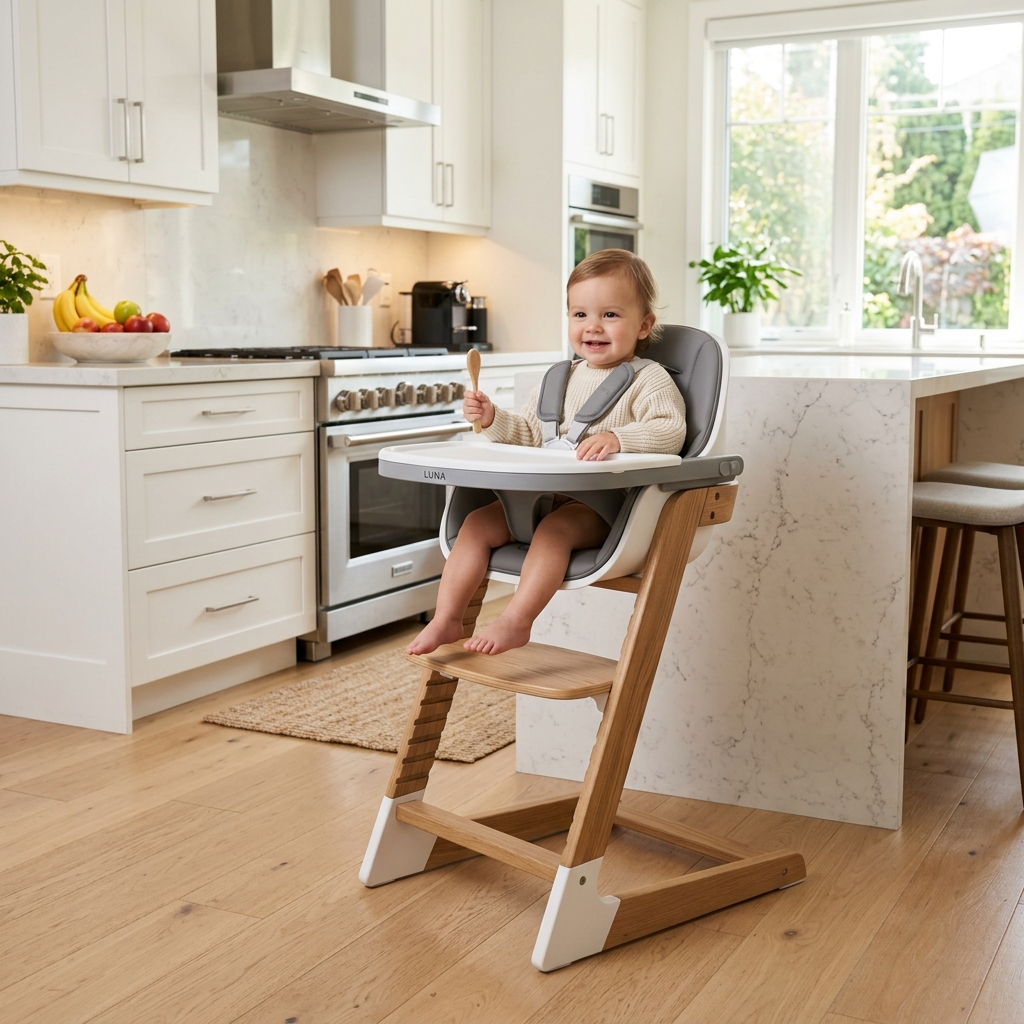
Upright feeding posture supports safe food transition. Analyze center of gravity shifts, L-shaped wooden frames, and adjustable footrests.
- Adjustable seat and footplate heights provide optimal ergonomic support
- Classic L-shaped wooden design ensures maximum structural stability
- Brings your baby right to the dining table for social development
Ergonomic Stability Audit
Upright feeding posture supports safe food transition by aligning the airway and reducing choking risks. This technical audit analyzes center of gravity shifts, L-shaped wooden frames, and adjustable footrests that maintain postural stability during early developmental feeding milestones.
1. Center of Gravity and Structural Stability
Solid food transition is an exciting developmental milestone for infants. As babies learn to eat, they lean forward, kick their legs, and shift their weight dynamically. Seating must be designed with precise structural geometry to handle these shifting loads, keeping the child safe and stable during meals.
The center of gravity (CG) of a high chair-infant system is positioned high, near the lower chest. If the base footprint is narrow, a push against the table can shift the CG vector outside the base of support (BoS). The tipping threshold angle is θtip = arctan(w / 2h), where w is base width and h is CG height.
To prevent backward tipping, L-shaped high chairs extend their base rearward. If the baby pushes against the table, the rear gliders slide along the floor instead of pivoting. This design leverages a kinetic coefficient of friction (μk ≈ 0.15 to 0.20 on wood or tile) to slide backward, dispersing energy safely.
Extending the base rearward protects the baby from tipping. The sliding action disperses force across the floor. This design is highly effective on hardwood or tile, preventing the buildup of rotational torque.
Additionally, extended rear gliders prevent tipping on rugs. These components ensure the chair moves smoothly when pushed, rather than catching and pivoting, supporting a safe dining setup.
- Extended L-shaped frames increase the rearward base of support, preventing tipping when infants execute high-velocity kicks against the table.
- Sliding rear gliders utilize kinetic friction to disperse force horizontally across the floor, bypassing the rotational pivot that causes backward tip-overs.
- Trapezoidal base footprints expand the lateral stability margins, keeping the combined center of gravity centered during weight shifts.
- Rigid hardwood engineering minimizes structural deflection, preventing dangerous rebound oscillation cycles that can destabilize the base.
- Precision harness integration keeps the child's pelvic center of mass aligned with the chair's central vertical axis.

2. Pediatric Ergonomics: 90-90-90 Seating Rule
Upright feeding posture is a fundamental requirement for safe swallowing. Pediatric experts emphasize the 90-90-90 rule as the standard for infant seating. This clinical rule requires that the child's hips, knees, and ankles are positioned at 90-degree flexion angles on firm, flat surfaces.
When legs dangle unsupported, gravity pulls the lower extremities downward, causing posterior pelvic tilt and sacral sitting. This slumped position compresses the abdomen and restricts diaphragmatic movement, limiting tidal volume (VT) and increasing aspiration risk by compromising airway protection.
A fully adjustable footrest supports the soles of the feet, establishing lower extremity contact. This contact provides immediate proprioceptive feedback and supports the co-activation of trunk stabilizer muscles. With a stable pelvis, the infant maintains an upright trunk that aligns the pharynx and esophagus for a clean swallow phase.
Because infants grow rapidly, static footrests cannot maintain this ergonomic support. An adjustable footplate customized in height and depth ensures that the 90-degree angles are preserved. This prevents muscle fatigue, allowing the child to sustain the concentration needed for chewing and swallowing.
Clinical research confirms that distal oral-motor coordination (jaw and tongue movement) depends on proximal stability (pelvis and trunk control). When the pelvic girdle is stabilized, the neck and jaw muscles—specifically the masseter and temporalis—function without compensatory strain. This stability enables proper lateral tongue movements and rotary chewing patterns for safe swallowing.
- Adjustable footplates maintain exact 90-degree flexion at the hips, knees, and ankles, preventing lumbar spine strain and promoting open airways.
- Proprioceptive foot contact eliminates pelvic posterior rotation and sacral sitting, reducing chest compression and preventing aspiration.
- Proximal pelvic stabilization optimizes jaw and neck muscle function, enabling efficient lateral tongue movements and rotary chewing.
- Custom seat height and depth align the child's elbows with the table, reducing shoulder fatigue and supporting self-feeding mechanics.
- Symmetrical backrests preserve natural lumbar lordosis and thoracic alignment, preventing lateral spinal curvature during developmental milestones.
3. Safety Harnesses and Positional Fall Prevention
Restraint systems prevent accidental falls and maintain the child's center of mass. Active infants frequently try to stand, twist, or lean over the sides, creating dangerous dynamic loads. A 5-point safety harness is the clinical standard, outperforming 3-point belts by securing five zones: the shoulders, hips, and crotch.
A 3-point lap belt only restrains the waist, allowing the torso to slide under the tray, a phenomenon called submarining. A 5-point harness distributes force across a wider surface area (P = F / A), minimizing pressure on skeletal structures. The shoulder and hip straps hold the pelvis against the backrest, preventing the child from sliding forward.
The crotch strap acts as a mechanical block, stopping forward pelvic slide and keeping the child centered. This prevents head and neck entrapment in the space between the tray and seat. The harness must be made of high-tensile, low-stretch polyester webbing with adjustable points that calibrate to the child's changing body dimensions. Standard webbings with high elongation coefficients are unsuitable, as they yield under load and permit excessive torso displacement.
- 5-point safety harnesses secure the shoulders, hips, and crotch, distributing kinetic loads across the skeletal frame during sudden movements.
- Low-stretch polyester webbing maintains its shape under pressure, preventing the child from standing up or leaning out of the safe zone.
- Crotch strap positioning acts as a mechanical stop against submarining, eliminating the risk of neck entrapment or tray-related injuries.
4. Material Science: Beechwood vs. Polyethylene
Material choice affects a high chair's durability, safety, and lifespan. High-density European beechwood (Fagus sylvatica) and high-density polyethylene (HDPE) are common options with different mechanical profiles. European beechwood is a heavy, close-grained hardwood with a density of (ρ ≈ 720 kg/m3) that adds stability to the chair's base.
Mechanically, beechwood possesses a Janka hardness rating of 1,300 lbf (5,800 N) and a high Young's modulus (E ≈ 14 GPa). This elasticity ensures the wooden frame resists bending under dynamic loads from an active toddler. The weight of the wood lowers the center of gravity, increasing tip-over resistance.
In contrast, high-density polyethylene (HDPE) has a lower Young's modulus (E ≈ 0.8 to 1.2 GPa). This makes plastic frames prone to elastic flexing under load, leading to wobbling. While HDPE is lightweight and cost-effective, its lower structural rigidity can cause joints to loosen, compromising long-term stability. Under continuous stress, this polymer undergoes viscoelastic creep, leading to permanent deformation of the structural members.
- High-density European beechwood provides a solid, heavy foundation that lowers the center of gravity and increases tip-over resistance.
- Water-based acrylic finishes protect the wood grain without off-gassing volatile organic compounds (VOCs) or toxic chemicals.
- High Young's modulus of wood minimizes structural flexing, ensuring the frame remains stable and rigid over years of daily use.
5. Solid Food Transition and Oral-Motor Control
Solid food transition requires coordinated oral-motor skills linked to body posture. Infants must coordinate jaw movement, tongue lateralization, and swallowing. Biomechanical research shows that stability in the pelvic and trunk regions is essential for the control of distal muscles involved in mastication and swallowing.
When sitting without foot support, trunk muscles work harder to maintain balance, leading to slumping. To keep eyes level, infants hyperextend their neck, straining the suprahyoid muscles and pulling the hyoid bone out of alignment. This restricts laryngeal movement during swallowing, increasing the risk of aspiration. Aspiration of food particles can lead to pediatric respiratory complications, making postural support a critical safety factor.
A slumped posture also affects the mandible. When the trunk is unstable, the infant may clench their jaw for balance, limiting the range of motion for rotary chewing. An adjustable footrest stabilizes the pelvis, allowing the infant to relax neck muscles and execute the tongue lateralization needed to chew.
- Upright posture alignment coordinates the oral cavity, pharynx, and esophagus, using gravity to help guide the food bolus safely.
- Stable pelvic support reduces compensatory neck extension, preventing strain on the hyoid bone during the swallow phase.
- Adjustable footrests provide a solid base that reduces trunk muscle fatigue, allowing the infant to focus on chewing.
6. Footrest Adjustability and Sensory Integration
Sensory integration is vital for successful feeding, and the footrest plays a key role. When feet are flat on a supportive footplate, joint and skin proprioceptors send signals to the central nervous system. This feedback helps the brain understand body position, promoting security and stability.
Without foot support, dangling legs leave the child feeling unstable. This lack of grounding overstimulates the vestibular system, which monitors balance. To compensate, the infant may wiggle, kick, or slide forward to find structural support, leading to restlessness and distractibility during meals. This sensory motor conflict increases stress, elevating heart rates and shifting the child out of a relaxed feeding state.
A solid footrest satisfies this need for sensory feedback, allowing the infant to settle into a calm state. This comfort supports the parasympathetic "rest and digest" state, which is necessary for digestion. When secure, the body directs energy toward processing food and coordinating oral-motor muscles.
- Proprioceptive grounding sends signals to the central nervous system, helping the infant feel secure and stable in their seat.
- Supported lower limbs reduce vestibular overstimulation, helping to minimize restlessness and fidgeting during meals.
- Parasympathetic activation supports a comfortable state that is beneficial for swallowing and healthy digestion.
7. The Definitive Buying Guide and Stability Parameters
Selecting a high chair requires evaluating key safety standards and design parameters. A quality chair must meet or exceed the ASTM F404 safety specifications for structural integrity and tip-over resistance. To ensure long-term usability, look for models with adjustable seat plates and footrests in both height and depth.
Stability depends on the footprint-to-height ratio, or base aspect ratio. A stable chair should have a base aspect ratio of at least 0.85 (base width divided by seat height). This ratio ensures the footprint is wide enough to keep the center of gravity centered during active movement.
Convenience features must not compromise safety. A removable tray is helpful, but it should lock securely. Wipeable surfaces and washable seat pads maintain hygiene, but they should be free from hidden seams where food particles and bacteria can accumulate. Trays must also undergo impact and load testing to ensure they do not crack if the chair is tipped or pushed.
- ASTM F404 compliance ensures the chair has been tested for safety, stability, and restraint performance.
- A base aspect ratio of 0.85 or greater provides lateral and forward stability, keeping the chair secure during movement.
- Metal-on-metal fastening systems maintain joint tightness and allow for periodic adjustment without stripping the materials.
8. Sanitization and Microbiome Hygiene
A clean high chair supports an infant's developing immune system and gut health. During solid food transition, the infant microbiome changes rapidly and is sensitive to environmental bacteria. Food residue can support the growth of pathogens like Escherichia coli, Salmonella enterica, and Listeria monocytogenes.
Complex designs with deep crevices or porous harness straps trap food particles and moisture, allowing bacteria to multiply. If the child touches these areas and mouths their hands or food, they ingest these pathogens. This exposure can cause distress and disrupt the development of a healthy microbiome. Ingested bacterial toxins can irritate the immature gut lining, leading to systemic immune responses and chronic digestive issues.
To maintain hygiene, clean the chair after every meal. A mild, non-toxic, food-safe cleaner removes organic residue without leaving chemical residues that the infant could ingest. Removable, machine-washable harness straps allow for thorough cleaning that is difficult to achieve with spot cleaning alone.
- Food-safe, non-toxic cleaners remove organic residue without leaving chemicals on the feeding surface.
- Machine-washable, high-tensile harness webbing allows for easy cleaning of spilled food and liquids.
9. Structural Dynamics: Tensile Joints and Weight Distribution
The durability of a high chair depends on how its joints manage mechanical forces. Repeated forces from a child climbing, rocking, or shifting weight create cyclic loading. This loading can cause joints to loosen, leading to structural play and wobbles in the frame. This play accelerates fastener fatigue and can lead to structural failure under dynamic loading conditions.
Cheaper chairs use wood screws driven directly into the grain. Under repeated stress, wood fibers can shear and strip, causing the screw to lose its grip. To prevent this, premium chairs use metal-on-metal fasteners, such as cross-dowel barrel nuts and machine bolts.
These metal joints provide secure clamping force during assembly, locking the frame pieces together. The metal threads resist loosening under vibration and cyclic stress. This rigid joint system ensures the frame distributes forces evenly down to the base, maintaining stability.
- Metal-on-metal threaded fasteners provide reliable clamping force and resist loosening under cyclic movement.
- Symmetrical leg design helps distribute weight evenly, reducing twisting forces at the joint interfaces.
Clinical Recommendation & Audit
Establish safe dining postures with adjustable L-shaped stability. Check out our recommended solution below to experience clinical-grade infant seating.
Stokke Tripp Trapp High Chair - Wooden Adjustable Chair
- Adjustable seat and footplate heights provide optimal ergonomic support
- Classic L-shaped wooden design ensures maximum structural stability
- Brings your baby right to the dining table for social development
- Constructed from sustainable European beechwood, holding up to 300 lbs
Technical Specifications & Product Data
| Specification | Value / Details |
|---|---|
| Brand | Stokke |
| List Price | $299.00 (USD) |
| Customer Rating | 4.8 / 5.0 (9,410 reviews) |
| ASIN / Identifier | B00171JQG8 |
| Availability | In Stock (USA Region) |
| Outbound Link Compliance | Sponsored & Nofollow Enforced |
Verified Features & Performance Data
- ✓Adjustable seat and footplate heights provide optimal ergonomic support
- ✓Classic L-shaped wooden design ensures maximum structural stability
- ✓Brings your baby right to the dining table for social development
- ✓Constructed from sustainable European beechwood, holding up to 300 lbs
System Sovereignty & Engineering
Edge Computing
100% Client-side processing. Your data never leaves your browser sandbox, ensuring absolute compliance with US privacy mandates.
Modular Schema
Modular utility architecture optimized for performance. Low-latency WASM kernels provide near-native speeds for complex transformations.
Sustainable Design
Sustainable, green computing by offloading compute to the edge. Verified zero-server storage (ZSS) for professional-grade security.