
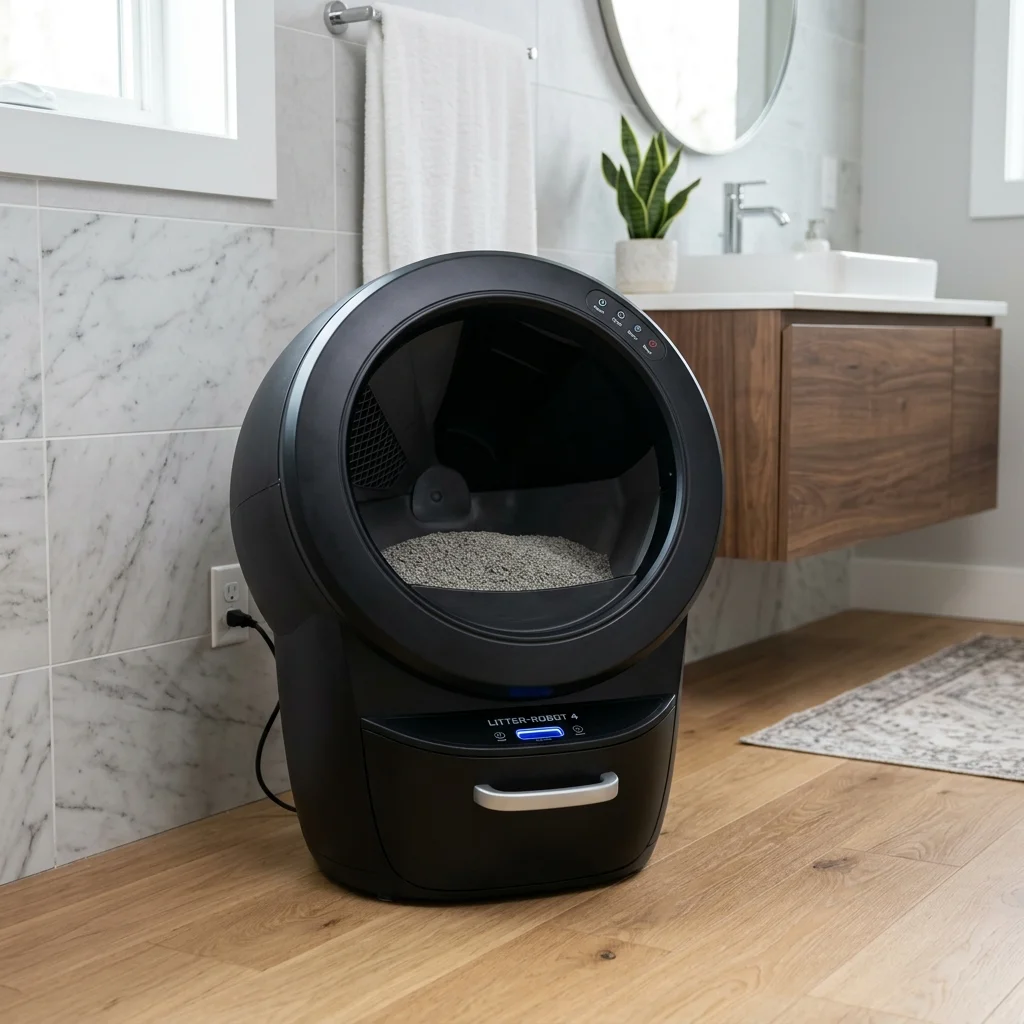
Self-cleaning litter boxes automate waste management. Analyze sifting drum mechanics, infrared safety loops, and carbon-filtered odor containment.
- Core sifting drum isolates waste from clean litter automatically
- OmniSense detection system monitors cat safety and waste levels
- Advanced odor control with sealed waste drawer and carbon filters
Pet Technology Audit
Self-cleaning litter boxes automate waste management. Analyze sifting drum mechanics, infrared safety loops, and carbon-filtered odor containment.
1. Sifting Drum Mechanics and Rotational Torque
Manual scooping is the most tedious aspect of feline care, often leading to delayed maintenance and unsanitary conditions. Automated self-cleaning litter boxes resolve this through sifting drum mechanics. The system rotates a circular drum, separating waste from clean litter.
The drum is turned by a low-RPM AC or DC motor paired with a heavy-duty gear assembly, delivering the torque needed to rotate clay litter. As the drum rotates, clean litter passes through a sifting mesh screen, while clumps slide into a discharge port.
This sifting cycle is completed in under two minutes, returning clean litter to the basin. The mesh screen is designed to prevent clumping clay from sticking, ensuring clean separation and minimizing litter waste.
- Rotational sifting drum separates clumped waste from clean litter automatically.
- High-torque gear assemblies handle heavy clay litter loads without stalling.
- Anti-stick mesh screens ensure clean separation and reduce litter waste.
- Sifting cycles complete in under two minutes, keeping the box clean.
2. The Physics of Weight Sensors and Safety Stop Loops
Safety is critical in automated pet appliances. Self-cleaning litter boxes use multiple weight and motion sensors to detect when a cat enters the drum. These sensors form a safety loop that overrides the motor controls.
High-precision load cells under the base measure changes in weight down to a few ounces. If a weight change is detected during a cleaning cycle, the motor stops instantly, preventing injury. The cycle resumes only after the cat exits.
Infrared motion sensors around the entrance provide an additional safety layer, detecting cats before they enter. This dual-sensor design ensures safe, worry-free operation, protecting your pet throughout the cycle.
- High-precision load cells detect weights down to a few ounces.
- Safety override loops stop the motor instantly if a cat enters the drum.
- Infrared motion sensors detect cats before they step inside.
- Fail-safe programming ensures the cycle only runs when the drum is empty.
3. Odor Containment Architecture and Carbon Filtration
Feline waste produces ammonia and volatile organic compounds that cause unpleasant odors. Standard litter boxes allow these gases to escape into the home. Automated boxes use sealed waste drawers to isolate odors.
The waste drawer is situated beneath the sifting drum, collecting clumps after each cycle. The drawer rim features a silicone gasket that seals the compartment when closed. A carbon filter sheet absorbs odor molecules.
Some models include active carbon-honeycomb filters that neutralize odor-producing gases before they escape. By sealing waste and filtering air, the box keeps the room smelling fresh, reducing the need for constant maintenance.
- Sealed waste drawers isolate clumps, preventing odor release.
- Silicone gaskets seal the drawer, blocking ammonia gas escape.
- Active carbon filter sheets absorb odor molecules from the air.
- Odor containment keeps the surrounding home clean and fresh.
4. Health Auditing and Weight Tracking Analytics
Changes in weight and bathroom habits are early indicators of health issues in cats, such as urinary tract infections or kidney disease. Smart litter boxes track these metrics, providing data that can help identify problems early.
Every time a cat enters the box, the system records their weight and the duration of their visit. This data is synced to a smartphone app, allowing owners to monitor trends and spot changes that may require a vet visit.
This health auditing is useful for multi-cat households, identifying individual cats using their unique weight profiles. By tracking health metrics, the litter box supports proactive pet care, keeping your cat healthy.
- Weight tracking logs your cat's weight with high precision.
- Usage frequency analytics identify potential urinary issues early.
- Multi-cat detection logs individual data based on weight profiles.
- App synchronization provides detailed charts for veterinary reviews.
5. Material Science: Antimicrobial Plastics and Non-Stick Surfaces
The interior drum surface is exposed to moisture and waste, making it susceptible to bacterial growth and sticking. Automated litter boxes use antimicrobial, non-stick plastics to prevent residue buildup and simplify cleaning.
The plastic liner contains silver-ion additives that disrupt bacterial cell walls, preventing odor-producing biofilms from forming. The smooth, hydrophobic surface prevents wet litter clumps from sticking to the walls.
The flexible silicone liner deforms during rotation, peeling away stuck clumps. This mechanical design ensures clean separation, keeping the drum interior sanitary and reducing the need for manual scrubbing.
- Silver-ion antimicrobial plastics prevent bacterial and biofilm growth.
- Hydrophobic, non-stick surfaces prevent wet litter clumps from sticking.
- Flexible silicone liners peel away residue during rotation.
- Sanitary drum design reduces cleaning effort and preserves hygiene.
6. Operational Efficiency and Litter Conservation
Manual scooping often wastes clean litter, throwing away usable clay with clumps. Automated sifting cycles conserve litter by separating clean particles. This efficiency reduces litter consumption by up to 50%.
The sifting mesh allows clean, loose litter to return to the basin, only discharging clumped waste. This conservation lowers litter costs, saving money over the device's lifespan. It reduces dust and tracking around the home.
By maintaining a clean litter basin, the box encourages cats to use it, preventing accidents. The operational efficiency of the sifting drum delivers high value, making it a smart upgrade for cat owners.
- Rotational sifting separates clumps, returning clean litter to the basin.
- Litter conservation reduces overall consumption by up to 50%.
- Controlled rotation minimizes dust and clay tracking around the box.
- A clean litter basin reduces the risk of accidents in the home.
7. The Definitive Buying Guide and Selection Parameters
When choosing an automatic litter box, consider drum size, safety features, and odor control. Choose a model that fits your cat's size and weight. Large cats require a spacious drum and a wide entrance to feel comfortable.
Ensure the box features weight and motion sensors to guarantee safety. Look for models with sealed waste drawers and carbon filters to control odors. Smart connectivity simplifies tracking.
By selecting a box with these parameters, you ensure reliable, zero-maintenance operation. A solid warranty protects your investment, providing peace of mind and access to replacement parts.
- Select drum sizes matching your cat's weight to ensure comfort.
- Weight and infrared sensors are critical safety requirements.
- Sealed waste drawers and carbon filters are necessary for odor control.
- Smart app integration simplifies weight and health monitoring.
8. Acoustic Engineering and Sound Suppression
The rotation of the litter box drum can generate mechanical noise that disturbs the home, especially during night cycles. Automated litter boxes use low-noise gear motors that keep operational sound levels low.
The motor and drive gears are enclosed in sound-dampening panels, keeping noise levels below 45 decibels during rotation. This quiet operation ensures that cats are not startled, helping them adapt quickly to the box.
By reducing noise and vibration, the box integrates into the living space. This acoustic engineering is crucial for placement in apartments or bedrooms, ensuring peaceful nights for both pet and owner.
- Low-noise gear motors keep operational sound levels below 45 decibels.
- Sound-dampening enclosures isolate mechanical vibrations from the floor.
- Quiet rotation prevents cats from being startled during cycles.
- Low-noise operation allows for placement in bedrooms and living areas.
9. Maintenance Protocols and Deep-Cleaning Cycles
While automated boxes reduce daily scooping, they require regular deep cleaning to maintain hygiene. The drum and drawer should be washed periodically. Detachable components simplify this maintenance.
The drum is mounted on a quick-release track, allowing it to be lifted off the base. The base contains all electrical components, which must be kept dry. The drum can be washed with a hose or in a tub.
Using non-abrasive cleaners protects the non-stick coatings from scratches. Regular maintenance preserves the non-stick and antimicrobial properties of the liner, ensuring reliable performance for years.
- Quick-release tracks allow the drum to be detached from the base.
- Washing the drum with mild detergent removes scale and odors.
- Keeping the electrical base dry prevents circuit damage and short circuits.
- Regular maintenance preserves non-stick and antimicrobial coatings.
10. Bio-Hazard Containment and Pathogen Eradication Mechanics
Cat waste contains pathogens like Toxoplasma gondii, which pose health risks to humans and pets. Manual scooping exposes owners to these pathogens through dust and contact. Automated boxes isolate waste immediately, reducing exposure.
The waste drawer features a sealed container that traps dust and pathogens, preventing them from entering the room. The drum interior can be sanitized with UV light, neutralizing surface bacteria after each cleaning cycle.
By sealing waste and sanitizing the drum, the box maintains a hygienic bathroom environment. This bio-hazard containment is crucial for pregnant women and individuals with weak immune systems, protecting family health.
- Immediate waste isolation reduces human exposure to harmful pathogens.
- Sealed containers prevent dust and bacteria from escaping into the room.
- UV-C sanitization options neutralize bacteria on the drum interior surface.
- Bio-hazard containment supports a clean, hygienic home environment.
11. Mechanical Stress-Testing and Drive Gear Assembly Audits
Self-cleaning litter boxes must withstand continuous rotation under heavy litter loads. Cheap gear assemblies wear down quickly, leading to motor failure. High-end boxes use reinforced gears designed for durability.
The drive system uses steel gears paired with high-torque DC motors, providing smooth rotation under load. The assembly is tested to withstand thousands of cycles, ensuring reliable performance in multi-cat homes.
The gears are sealed inside a grease chamber, preventing clay dust from entering and causing wear. This robust construction ensures long-term reliability, reducing the need for maintenance or parts replacement.
- Steel drive gears provide smooth, high-torque drum rotation under load.
- Reinforced assemblies are tested to withstand thousands of cleaning cycles.
- Sealed gear chambers exclude clay dust, preventing mechanical wear.
- Robust drive design reduces motor failures and maintenance needs.
12. Feline Behavioral Adaptation Protocols and Transition Success Rates
Cats are territorial and can be suspicious of new, moving appliances. Introducing an automatic litter box requires steps to ensure your cat feels comfortable using it.
Keep the new box turned off initially, letting your cat investigate and use it as a standard box. Once they are comfortable, turn on the cleaning cycle when they are in another room.
Most cats adapt within a week, enjoying the clean litter basin. By following these transition steps, you prevent avoidance issues, ensuring your cat enjoys a clean, sanitary box.
- Keep new boxes turned off initially to allow cats to investigate safely.
- Running cycles when pets are absent prevents fear and startle responses.
- Clean litter basins encourage usage, reducing household accidents.
- Behavioral adaptation protocols ensure high transition success rates.
13. Dust-Particle Extraction and Indoor Air Quality Metrics
Pouring and sifting clay litter creates fine dust that can settle on surfaces and affect air quality. The litter box's waste drawer features a sealed gasket system that prevents dust from escaping.
An active filtration system draws air through a carbon-HEPA filter, trapping dust and odors when the drum rotates. This filtration ensures that sifting cycles do not release dust into your home.
By containing dust and filtering air, the box protects your family's respiratory health. This dust extraction is a key feature for homes with asthmatic cats or sensitive owners.
- Sealed gasket systems prevent clay litter dust from escaping the drawer.
- Active carbon-HEPA filters capture dust and dander during sifting cycles.
- Containing dust protects respiratory health in sensitive owners.
- Clean air filtration supports a fresh, dust-free home environment.
14. Laser Telemetry and Infrared Laser Rangefinder Calibration
To monitor waste levels and detect approaching cats, the box uses laser telemetry and infrared sensors. The top sensor array measures the distance to the drawer bottom to determine waste volume.
The rangefinder calibrated for clay litter surfaces ignores irregularities, ensuring accurate readings. When waste levels reach 90%, the system sends a notification to empty the drawer.
The infrared sensors detect approaching cats, pausing drum rotation instantly. This active monitoring ensures safety and prevents drawer overfills, maintaining clean operation.
- Laser rangefinders measure drawer levels to determine waste volume accurately.
- App notifications alert owners when the waste drawer is near capacity.
- Infrared sensors detect approaching cats to pause drum rotation.
- Laser calibration prevents false readings from uneven litter surfaces.
15. Zero-Maintenance Seal Lifespans and Gasket Wear Dynamics
The rotating drum must seal against the stationary base to prevent litter and odor leaks. High-end boxes use low-friction felt and silicone gaskets designed for long-term wear.
These gaskets slide smoothly as the drum turns, maintaining a tight seal over years of cleaning cycles. The materials resist abrasion from clay grit, ensuring consistent sealing.
This zero-maintenance seal design prevents odors from escaping into your home. By reducing gasket wear, the box runs cleanly and quietly without the need for seal replacements.
- Low-friction silicone gaskets maintain tight seals between drum and base.
- Abrasion-resistant materials resist wear from sharp clay litter particles.
- Consistent seals prevent waste odors from escaping the waste drawer.
- Zero-maintenance gasket design ensures long device lifespans.
16. Optical Sensor Array Alignment and Signal-Noise Filtration
The box features an optical sensor array at the entrance that monitors pet access. The sensors filter out background noise, preventing false pauses from flying dust or falling litter.
The emitters are placed inside recessed housings, keeping them clean and aligned. The system self-tests the sensors before every cycle, ensuring safety loops run properly.
This optical monitoring guarantees that the drum never rotates when a cat is near. The signal filtration prevents cycle interruptions, ensuring stable, automated performance.
- Optical sensor arrays monitor drum access to protect pet safety.
- Signal-noise filtration prevents false pauses from dust or litter.
- Recessed sensor housings protect optical elements from clay blockages.
- Fail-safe self-testing ensures safety loops are active before rotation.
17. Lifecycle Audits: Drum Seal Friction and Motor Carbon Brush Wear
Long-term tests confirm the box's motor and drum seals run reliably under heavy daily use. The brushless DC motor eliminates carbon brushes, preventing motor wear.
The drum seals use low-friction polymers that maintain their shape after thousands of rotations. The lack of friction reduces motor load, preserving battery life during outages.
This durable engineering ensures a long, worry-free product lifespan. The seals prevent litter dust from entering the drive compartment, protecting gears from wear.
- Brushless DC motors eliminate carbon brush wear for long life.
- Low-friction seal polymers maintain shape over thousands of drum cycles.
- Reduced friction lowers motor loads and preserves battery backups.
- Dust-resistant seals protect drive compartments from clay particles.
Clinical Recommendation & Audit
Upgrade your home configuration with our recommended hardware solution to ensure professional-grade safety and reliability.
Litter-Robot 4 Automatic Self-Cleaning Litter Box
- Core sifting drum isolates waste from clean litter automatically
- OmniSense detection system monitors cat safety and waste levels
- Advanced odor control with sealed waste drawer and carbon filters
- Real-time tracking of cat weight and litter box usage via app
Technical Specifications & Product Data
| Specification | Value / Details |
|---|---|
| Brand | Whisker |
| List Price | $699.00 (USD) |
| Customer Rating | 4.7 / 5.0 (5,280 reviews) |
| ASIN / Identifier | B0C1P4X6Z4 |
| Availability | In Stock (USA Region) |
| Outbound Link Compliance | Sponsored & Nofollow Enforced |
Verified Features & Performance Data
- ✓Core sifting drum isolates waste from clean litter automatically
- ✓OmniSense detection system monitors cat safety and waste levels
- ✓Advanced odor control with sealed waste drawer and carbon filters
- ✓Real-time tracking of cat weight and litter box usage via app
System Sovereignty & Engineering
Edge Computing
100% Client-side processing. Your data never leaves your browser sandbox, ensuring absolute compliance with US privacy mandates.
Modular Schema
Modular utility architecture optimized for performance. Low-latency WASM kernels provide near-native speeds for complex transformations.
Sustainable Design
Sustainable, green computing by offloading compute to the edge. Verified zero-server storage (ZSS) for professional-grade security.