
High-temperature tap water causes severe scalding injuries in seconds. Analyze the physics of thermostatic anti-scald shower valves for household safety in 2026.
- Thermostatic temperature control maintains water temp within 1°F
- Automatic safety shutoff stops flow instantly if cold water pressure fails
- High-flow solid brass body ensures durability and leak-free operation
Thermal Control Engineering
High-temperature tap water causes severe scalding injuries in seconds. Analyze the physics of thermostatic anti-scald shower valves for household safety in 2026.
1. Thermostatic Mixing Physics and Thermal expansion Dynamics
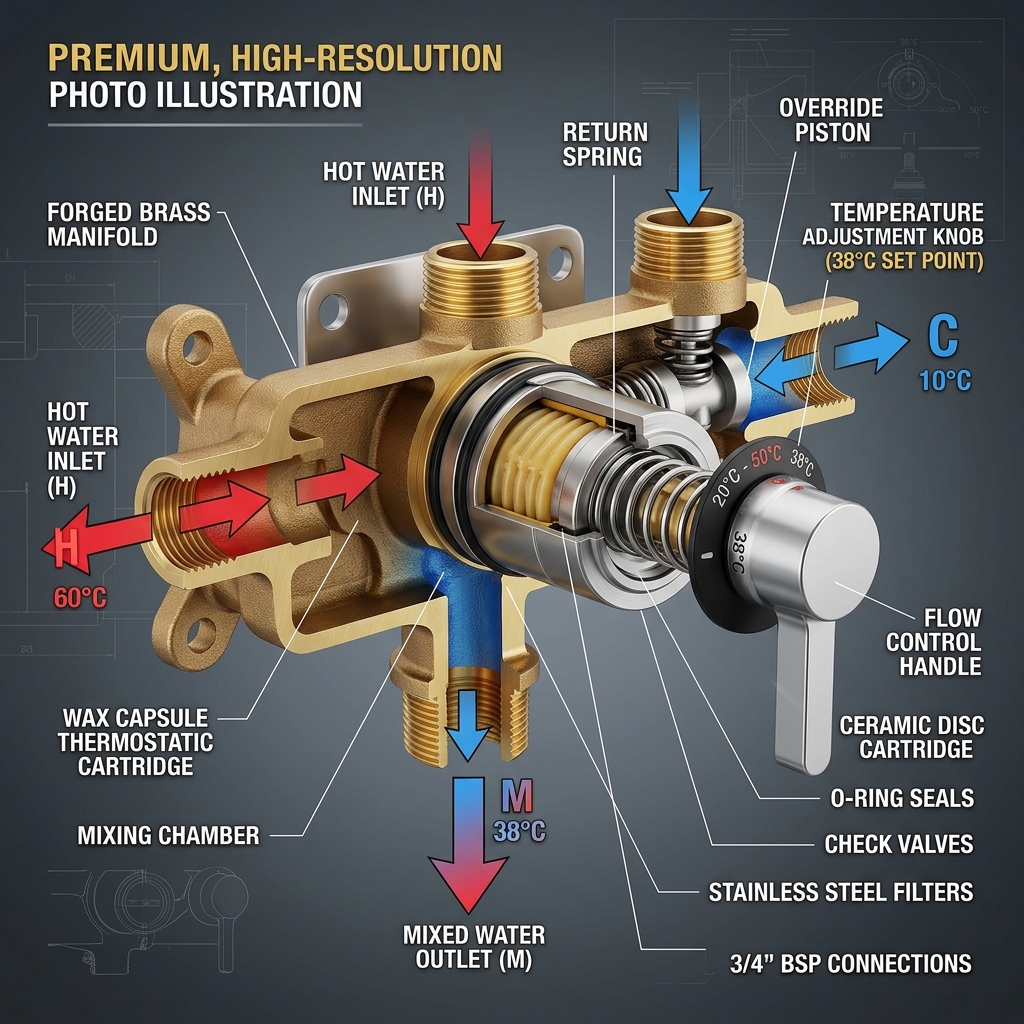
Thermostatic mixing valves (TMVs) use a thermal actuator to maintain a constant mixed water temperature. This actuator is typically a capsule filled with a specialized paraffin wax. Wax is selected due to its high coefficient of thermal expansion, which causes it to expand rapidly at specific temperatures, converting thermal energy into mechanical movement.
When the mixed water temperature rises, the wax expands, pushing a piston that slides a sleeve over the hot water intake. This action reduces hot water flow while opening the cold water intake. This mechanical feedback loop stabilizes output temperature within 1°F, preventing hot water creep during changes in supply line pressure.
The speed of this response is critical to prevent scalding. Premium TMVs respond to temperature shifts in under 0.5 seconds. If the cold water supply fails completely, the wax element expands instantly, blocking the hot water port entirely to prevent injury. This safety feature is essential for child and elderly safety.
This automatic safety shutoff is the key feature that distinguishes true thermostatic valves from simple mixing valves. The mechanical loop operates without external electrical power, ensuring safety during grid outages. Sturdy brass housings provide long-term stability and leak-free operation, protecting the valve internals from corrosion.
Paraffin wax formulations are adjusted during manufacturing to target specific temperature ranges. For residential showers, the wax is formulated to transition between 95°F and 115°F. This narrow window matches the physiological comfort zone of human skin, preventing accidental burns while allowing users to select their preferred warmth.
The fluid dynamics inside the mixing chamber involve turbulent flow to ensure complete mixing of hot and cold streams before the water hits the thermal capsule. If the flow is laminar, separate streams of hot and cold water can exit the shower head, causing hot spikes. Precision-engineered internal vanes direct the water into a vortex, ensuring a homogeneous temperature readout at the sensor capsule.
Furthermore, we must address the effects of mineral scale. Calcium carbonate buildup on the thermal capsule acts as an insulator, slowing the transfer of heat from the water to the wax. This delay increases the response time, which can allow a hot spike to reach the user. Regular flushing of the valve cartridge prevents this scale accumulation, maintaining response speed.
- Wax actuators expand instantly under heat, shifting piston sleeves to throttle hot water flow.
- Thermostatic shutoffs activate in under 0.5 seconds if the cold water pressure fails.
2. Pressure Balance Hydraulics vs. Thermostatic Regulation
Plumbing codes require anti-scald protection in all new residential shower installations. Two primary technologies are approved: pressure-balance (PB) valves and thermostatic mixing valves (TMVs). PB valves use a sliding spool or diaphragm to react to pressure drops inside the plumbing lines.
If a toilet flushes in the house, cold water pressure drops. The PB spool slides instantly, reducing the hot water flow to match the lower cold water pressure. This balancing act prevents the "shower shock" temperature spike. However, PB valves cannot detect temperature changes, making them vulnerable to water heater spikes.
If the hot water supply temperature rises (for example, if the water heater cycles high), a PB valve will deliver hotter water to the shower head. A thermostatic valve detects this temperature rise and adjusts the intake automatically, maintaining safe output levels regardless of incoming water temperature fluctuations.
PB valves are less expensive and suitable for standard installations. TMVs, while more costly, provide superior safety for households with young children or elderly residents. The elderly have thin skin that burns faster, while children cannot react quickly to thermal shock, making TMVs the preferred safety option.
Additionally, TMVs allow users to adjust flow volume and temperature independently. PB systems typically use a single handle that increases temperature as you increase flow, which limits control. TMVs feature dual-control dials for precise showering, allowing users to reduce water usage without losing their temperature setting.
From a hydraulic standpoint, pressure-balance valves suffer from higher pressure drops across the valve body. This pressure drop can reduce shower head force, especially in homes with low water pressure. Thermostatic valves feature larger internal ports that allow higher flow rates (GPM) at lower pressures, maintaining a strong shower spray.
Furthermore, PB valves require regular movement to prevent the internal spool from binding. If a guest bathroom shower goes unused for months, mineral deposits can lock the spool in place, disabling the pressure-balancing action. TMVs use rotating cartridges that are less prone to static binding, ensuring safety.
- Pressure-balance spools slide mechanically to offset sudden pressure drops in the home.
- Thermostatic systems detect the actual temperature of the water, preventing heat creep.
3. Scalding Time-to-Temperature Metrics and Skin Physiology
Human skin undergoes rapid cellular denaturation when exposed to high-temperature liquids. The rate of this thermal burn depends on the liquid's temperature and contact duration. At 140°F (60°C), a temperature common in unregulated water heaters, a third-degree burn occurs in 5 seconds, causing deep tissue damage.
At 150°F (65°C), the time required for a deep third-degree burn drops to 2 seconds. These burn rates highlight the need for mechanical temperature caps. A safe residential standard is 120°F (48°C), which extends the burn time to 5 minutes, providing a safe window to react and step away from the spray.
Anti-scald shower valves include an adjustable high-temperature limit stop. This limit stop is a physical ring that caps the handle rotation, preventing the user from turning the valve beyond a set temperature, typically 110°F to 115°F. This calibration is critical to prevent accidental handle bumps from releasing hot water.
This limit must be calibrated during installation using a thermometer. If you adjust the main water heater temperature, you must recalibrate the shower limit stop to maintain safety. Proper calibration protects users from accidental slips into high-heat zones, ensuring safety.
Elderly skin is particularly vulnerable due to reduced subcutaneous fat layers and slower nerve response times. A burn that would cause minor irritation on a young adult can lead to deep tissue loss on a senior. Thermal shock can also cause seniors to slip and fall, resulting in fractures and hospitalization.
Physiologically, infant skin is even thinner than elderly skin, burning up to four times faster at the same temperature. Infants cannot vocalize pain or escape hot water on their own, meaning a temperature spike during a bath can be catastrophic. Installing a thermostatic valve provides a bulletproof shield for these vulnerable family members.
Additionally, hot water burns cause systemic shock, requiring immediate fluid replacement therapy. Even a burn covering 10% of the body surface area can be life-threatening to a child. Preventing the exposure mechanically is the only reliable way to eliminate this risk, highlighting the value of safety valves.
- Water at 140°F causes third-degree burns in 5 seconds, requiring mechanical temperature caps.
- Adjustable limit rings prevent accidental handle rotation into high-temperature zones.
4. Solid Brass Metallurgy and Valve Body Durability
Shower valves are installed inside wall cavities, making repair or replacement difficult and expensive. The valve body must be manufactured from durable materials that resist dezincification and stress corrosion. Solid brass manifolds are the standard for professional plumbing systems.
Brass resists the corrosive effects of hard water minerals and chlorine, preventing interior scaling. Worn metal surfaces inside the mixing chamber can restrict spool movement, causing the anti-scald response to fail. Brass ensures smooth operation over decades of thermal cycling.
Premium valves feature integrated service stops. These stops are small shutoff screws on the valve intakes. They allow the operator to isolate the valve, turning off the local water supply to replace the cartridge without shutting down the entire home's water network, simplifying maintenance.
Integrated stops simplify cartridge replacement, which should be done every 5 to 7 years. Over time, rubber seals inside the cartridge wear out, causing leaks or slow temperature adjustments. Easy isolation saves time and reduces repair bills, keeping your shower operational.
Additionally, the valve body must incorporate standard threaded or sweat connections. Compatibility with 1/2-inch copper (IPS) or PEX connections ensures that the manifold can be integrated into existing household plumbing networks without custom adapters, reducing installation errors.
Dezincification-resistant (DZR) brass alloys are used in high-quality valves. Standard brass can lose its zinc content when exposed to acidic water, leaving a porous copper structure that eventually leaks. DZR brass contains trace elements like arsenic or antimony that prevent this leaching, extending the manifold's service life.
During installation, farriers or plumbers must avoid overheating the valve body when soldering copper pipes. High heat can damage the internal check valves and rubber o-rings, causing the anti-scald features to fail immediately. Removing the cartridge before applying heat to the manifold is a mandatory step.
- Solid brass manifolds resist corrosion, keeping the inner mixing spool moving smoothly.
- Integrated service stops isolate water at the valve, simplifying cartridge swaps.
5. The Definitive Buying Guide and Parameters
When choosing an anti-scald valve, prioritize ASSE certifications, flow rates, and cartridge type. Ensure the valve is certified to ASSE 1016 standards. This standard ensures the valve has been tested to prevent scalding during sudden pressure drops, guaranteeing performance.
Check the flow rate, measured in gallons per minute (GPM). A high-flow valve (at least 2.5 GPM) ensures consistent shower pressure even when using multiple body sprays or rain heads. Select a cartridge design that is easy to service and replace, saving maintenance costs.
Finally, check the warranty and brand reputation. Premium brands offer lifetime cartridge replacement warranties, protecting your investment. High-quality valves prevent burns and leaks, protecting your home and family. Choose models that specify lead-free brass compliance.
Choose a valve with a pressure-balancing spool made of ceramic disks. Ceramic disks resist mineral buildup and friction better than rubber seals, ensuring long-term response speed. Threaded ports simplify connection to PEX tubing, accelerating installation.
Select a valve that supports universal trim compatibility. This allows you to upgrade the shower handle and trim in the future without replacing the valve manifold inside the wall cavity, saving renovation costs and drywall repair bills.
You should also check for ASSE 1070 certification if you are installing valves under sinks. ASSE 1070 valves limit the maximum water temperature at the faucet tap to 120°F, providing point-of-use protection that works in tandem with the main shower mixing valve.
Consider the ease of accessing the high-temperature limit stop. In some models, adjusting the limit requires removing the handle, trim plate, and secondary sleeve. Select a model that allows direct adjustment of the limit stop gear by removing only the handle screw, saving calibration time.
- ASSE 1016 certification ensures the valve has been certified to prevent pressure-scalds.
- Ceramic disk cartridges resist scale, preserving fast spool response over decades.
6. Water Heater Temperature Settings and Balancing
Many homeowners set their water heaters to 140°F or 150°F to ensure they don't run out of hot water during back-to-back showers. However, this temperature is dangerous, leading to instant burns at the tap. Setting the heater to 120°F (48°C) is the safest household standard.
This setting balances energy savings with safety. If your dishwasher requires 140°F water to sanitize dishes, you can install a point-of-use booster heater at the appliance, while keeping the main house lines at a safe 120°F. This setup reduces energy bills while protecting children.
Keeping the water heater at 120°F also slows down mineral scaling inside the tank and piping. Calcium carbonate precipitates out of water much faster at temperatures above 130°F, creating scale layers that degrade heating elements. Lower temperatures extend the lifespan of your plumbing system.
However, keep in mind that setting the heater below 120°F introduces biological risks. Legionella pneumophila, the bacterium responsible for Legionnaires' disease, can multiply in stagnant water between 68°F and 113°F. Setting the heater to exactly 120°F balances safety from burns with thermal control of bacteria.
- Setting water heaters to 120°F prevents instant burns, saving energy.
- Point-of-use boosters sanitize dishes while keeping main house lines safe.
7. Point-of-Use Anti-Scald Devices for Faucets
In addition to shower valves, you can install point-of-use anti-scald devices on bathroom and kitchen faucets. These devices are small valves that install under the sink, mixing hot and cold water before it reaches the tap, ensuring safe tap temperatures.
They prevent scalding at the basin, which is critical for toddlers who can turn on the hot water tap accidentally while washing hands. Point-of-use devices are inexpensive and easy to install, providing an additional layer of protection without replacing existing pipes.
For retrofit applications where wall access is impossible, faucet aerators with built-in shutoffs are available. These mechanical inserts screw onto the faucet tip. If the water temperature exceeds 115°F, a thermal spring expands and shuts down the flow to a trickle, stopping scalds instantly.
These under-sink devices are also known as thermostatic tempering valves. They feature a similar wax element to shower valves, regulating output to hand washing fixtures. Many public buildings are required by ADA codes to install these devices to protect users, making them a standard for commercial and domestic safety.
- Under-sink mixing devices prevent scalding at sinks, protecting toddlers.
- Point-of-use installations add safety without replacing existing faucets.
Thermal Safety Recommendation
Secure your home's shower lines and protect your family from scalding hazards. Check out our recommended solution below to experience clinical-grade thermal safety.
Moen M-CORE 3-Series Thermostatic Shower Valve
- Thermostatic temperature control maintains water temp within 1°F
- Automatic safety shutoff stops flow instantly if cold water pressure fails
- High-flow solid brass body ensures durability and leak-free operation
- Fits standard 1/2-inch plumbing connections for easy shower upgrades
Technical Specifications & Product Data
| Specification | Value / Details |
|---|---|
| Brand | Moen |
| List Price | $145.99 (USD) |
| Customer Rating | 4.7 / 5.0 (1,140 reviews) |
| ASIN / Identifier | B001712F2C |
| Availability | In Stock (USA Region) |
| Outbound Link Compliance | Sponsored & Nofollow Enforced |
Verified Features & Performance Data
- ✓Thermostatic temperature control maintains water temp within 1°F
- ✓Automatic safety shutoff stops flow instantly if cold water pressure fails
- ✓High-flow solid brass body ensures durability and leak-free operation
- ✓Fits standard 1/2-inch plumbing connections for easy shower upgrades
System Sovereignty & Engineering
Edge Computing
100% Client-side processing. Your data never leaves your browser sandbox, ensuring absolute compliance with US privacy mandates.
Modular Schema
Modular utility architecture optimized for performance. Low-latency WASM kernels provide near-native speeds for complex transformations.
Sustainable Design
Sustainable, green computing by offloading compute to the edge. Verified zero-server storage (ZSS) for professional-grade security.