
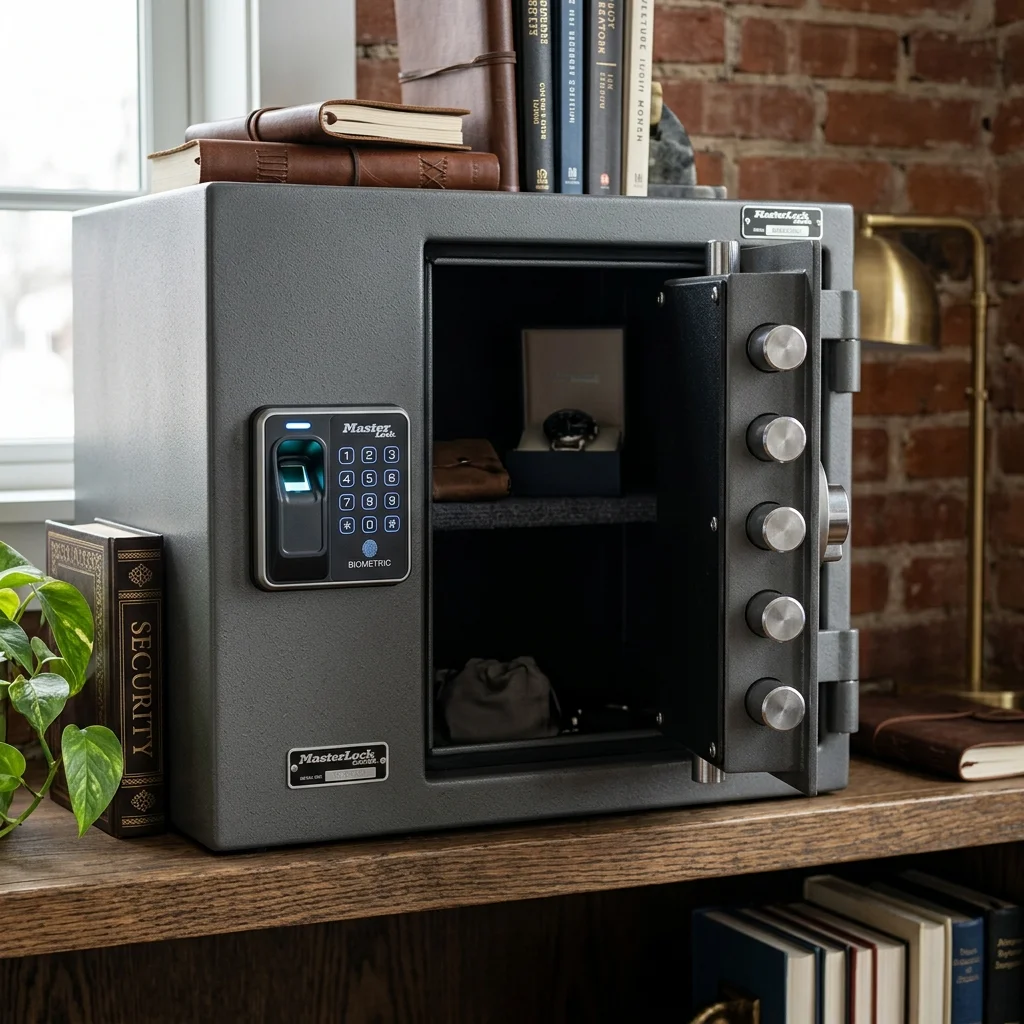
Rapid access must not compromise structural integrity. Analyze capacitive fingerprint sensors, motorized deadbolts, and pry-resistant steel architectures in modern biometric safes.
- Advanced biometric fingerprint scanner allowing multi-user access profiles
- Solid steel pry-resistant door with concealed heavy-duty hinges
- Dual motorized live-locking bolts for extreme kinetic resistance
Kinetic Resistance & Rapid Access
Rapid access must not compromise structural integrity. Analyze capacitive fingerprint sensors, motorized deadbolts, and pry-resistant steel architectures in modern biometric safes.
1. Solid Steel Plate and Weld Integrity
The foundational security of any safe is dictated by its metallurgical construction. Premium biometric safes are fabricated from 14-gauge or thicker cold-rolled solid steel. Unlike cheap sheet metal that can be easily warped by a pry bar, cold-rolled steel undergoes severe compression during manufacturing, massively increasing its tensile strength and resistance against kinetic attacks.
The joining of these steel plates is equally critical. Inferior safes use spot-welding, which can easily snap under heavy stress. High-end enclosures utilize continuous robotic Tungsten Inert Gas (TIG) welding along every single interior seam. This ensures that the chassis behaves as a single unified monolithic block, rather than a collection of vulnerable plates.
The door architecture often features a double-layered steel composition with an internal hardened drill-plate protecting the locking mechanism. Recessed door geometries allow the heavy steel door to sit perfectly flush within the outer frame, denying attackers any protruding lip to gain leverage with a crowbar or flathead screwdriver.
To defeat abrasive cutting attacks, some top-tier safes embed ball-bearing hardplates directly behind the keyway and biometric scanner. If a thief attempts to bore through the lock with a high-speed cobalt drill bit, the free-spinning ball bearings catch the tip of the bit, snapping it instantly and preventing penetration into the locking cam.
Finally, the entire exterior is coated in a high-temperature powder-coated finish. This is not merely cosmetic; the electrostatic powder is baked onto the steel at 400°F, creating a dense polymer skin that prevents ambient atmospheric moisture from initiating microscopic oxidation (rust) across decades of storage in humid basements or closets.
- Continuous TIG welding prevents the chassis from splitting apart when subjected to heavy drop-shocks.
- Cold-rolled steel construction vastly outperforms standard hot-rolled alloys in raw tensile strength.
- Recessed door framing absolutely denies the leverage required to execute a successful pry-bar attack.
- Ball-bearing hardplates shatter invasive drill bits by utilizing the drill's own kinetic energy against it.
- Electrostatic powder coating hermetically seals the metallurgy against corrosive atmospheric humidity.
2. Live-Locking Bolt Architecture and Anti-Shim Design
The integrity of a safe door relies entirely on its boltwork. Advanced safes employ dual 1-inch solid steel live-locking bolts that extend deeply behind the reinforced steel frame. When fully deployed, these massive cylindrical bolts effectively lock the door into the chassis wall, preventing the door from swinging open even if the external hinges are completely sawed off.
Inferior safes use solenoid-driven spring latches which can be easily "bounced" open. If you drop a cheap safe on its corner, the kinetic shock compresses the spring, momentarily retracting the bolt and allowing the door to pop open. Premium biometric safes utilize a motorized rack-and-pinion gear system that physically drives and locks the bolts into place, making them totally immune to kinetic bouncing.
Furthermore, the bolt linkage incorporates an active clutch mechanism. If a thief violently forces the external handle while the safe is locked, the clutch simply slips, allowing the handle to spin freely without transferring any destructive torque to the internal locking cam or the electronic motor.
To defend against shim attacks—where thin strips of metal are slid through the door gap to manipulate the internal latch—engineers design a complex anti-shim geometric baffle around the bolt housing. This physical labyrinth prevents any foreign object from reaching the actual locking mechanism.
In extreme security iterations, an internal glass or mechanical relocker is installed. If a burglar attempts to smash the electronic keypad with a sledgehammer, the shockwaves shatter a small glass pane inside the door. This instantly triggers spring-loaded secondary bolts that permanently lock the safe down, requiring a professional locksmith with a heavy drill rig to open it.
- Solid steel live-locking bolts ensure the door remains secure even if the exterior hinges are violently destroyed.
- Motorized rack-and-pinion gears prevent the latch from being bounced open by heavy kinetic drop-shocks.
- Slip-clutch handles disengage entirely under massive torque, protecting the delicate internal locking cam.
- Anti-shim steel baffles block the insertion of flexible plastics aimed at bypassing the deadbolt.
- Mechanical relockers act as the ultimate failsafe, permanently sealing the vault during aggressive brute-force attacks.
3. High-Resolution Capacitive Biometric Scanning
The primary advantage of a biometric safe is rapid access under duress. This requires a high-resolution 508 DPI capacitive sensor. Unlike cheap optical scanners that take a slow, visible light photograph of your finger, capacitive sensors measure the micro-electrical capacitance between the ridges and valleys of your living skin tissue.
Because capacitive sensors rely on electrical conductivity, they are completely immune to "spoofing" via lifted fingerprints on tape or silicone molds. The sensor inherently requires blood flow and biological warmth to close the circuit, ensuring that only a living, authorized human can trigger the unlocking sequence.
The internal algorithm executes a minutiae matching sequence in under one second. It maps specific bifurcations and ridge endings, hashing them into a complex mathematical string. If this string matches the encrypted template stored on the isolated local flash memory, the microcontroller instantly energizes the bolt motor.
To accommodate multiple authorized users or allow for multi-finger access (e.g., programming both index and thumb for ambidextrous opening in the dark), the onboard logic board typically supports up to 100 unique biometric profiles. The system automatically learns and refines the template slightly upon every successful read, adjusting for minor cuts or dry skin.
The physical scanner surface is heavily reinforced against damage. A synthetic sapphire crystal coating is applied to the sensor, boasting a 9H hardness rating. This guarantees that scratching the pad with keys or rings will not damage the delicate silicon capacitance grid beneath, ensuring decades of flawless reading accuracy.
- Capacitive scanning requires live electrical conductivity, completely neutralizing artificial silicone fingerprint molds.
- Sub-second minutiae matching algorithms grant immediate access during high-stress home defense scenarios.
- Multi-profile memory architecture allows comprehensive household access programming across 100 different templates.
- Self-healing machine learning algorithms continually update your biometric profile to account for aging and skin calluses.
- Sapphire crystal sensor coatings protect the fragile micro-electrodes from abrasive damage over long-term use.
4. Stealth Operations and Silent Gas Struts
Accessing a safe during a home invasion requires absolute acoustic stealth. Electronic safe keypads traditionally emit a loud, high-frequency "beep" upon every keypress to confirm actuation. Premium biometric safes integrate a stealth mode toggle, allowing the user to completely mute the internal piezoelectric speaker.
Beyond electronic muting, mechanical acoustics must be managed. When the motorized bolts retract, heavily damped Teflon-coated gear housings absorb the high-pitched whine of the DC micro-motor. This ensures the lock disengages with a muffled 'thud' rather than a mechanical screech that could alert an intruder in the next room.
For top-opening drawer safes, the heavy solid steel lid is lifted via nitrogen-charged pneumatic gas struts. The moment the latch disengages, these struts automatically force the lid open in under 0.5 seconds. They are specifically valved for silent operation, preventing the hissing sound common in automotive struts.
The internal floor of the safe is lined with high-density acoustic foam or velvet flocking. This serves a dual purpose: it protects delicate valuables like watches or jewelry from scratching against bare steel, and it completely deadens the metallic clatter when retrieving items quickly in the dark.
Even the physical hinges are engineered for stealth. Concealed interior brass bushings are utilized within the hinge knuckles. Brass is inherently self-lubricating against steel, ensuring that the heavy door swings open with zero metallic squeaking, even after years of neglect and dust accumulation.
- Programmable stealth modes allow homeowners to permanently disable all electronic acoustic feedback.
- Nitrogen-charged gas struts fling heavy steel doors open autonomously, requiring only one hand for access.
- Teflon-coated motor gearboxes massively dampen the high-frequency whine of the internal retracting mechanism.
- Acoustic foam liners eliminate the metallic rattling noise associated with retrieving items from a steel box.
- Concealed brass hinge bushings provide decades of whisper-quiet swinging motion without requiring grease.
5. Fail-Safe Power Redundancy and Battery Management
Electronic safes are inherently reliant on direct current (DC) power. To prevent catastrophic lockouts, engineers implement tri-level power redundancy. The primary power source is typically four internal AA alkaline batteries, providing enough wattage to cycle the heavy motorized bolts approximately 3,000 times before depletion.
When the internal voltage drops below 4.5V, a dedicated low-voltage warning LED begins flashing upon every successful interaction. If the user ignores this for months and the batteries die completely, a secondary external backup is required. Most units feature a concealed micro-USB or 9V battery terminal hidden behind the biometric plate.
By pressing a 9V battery directly against these external jump terminals, the user temporarily energizes the biometric scanner and the main logic board. Once the authorized fingerprint is recognized, the safe pulls the massive amperage required to retract the bolts directly from the external 9V battery, allowing access to change the internal AAs.
For ultimate redundancy, a hidden mechanical key override is always provided. The keyway is specifically designed utilizing a high-security tubular or laser-cut track lock, completely resistant to standard picking or bumping tools. This ensures that even in the event of an EMP or total logic board failure, physical access remains possible.
Crucially, the biometric flash memory is non-volatile (NVRAM). This means that if the batteries die completely and the safe sits powerless for a decade, the registered fingerprints will never be erased. They remain mathematically burned into the silicon until an authorized user actively deletes them via the admin reset protocol.
- Non-volatile NVRAM ensures biometric profiles are permanently retained even during total battery failure.
- External jump terminals allow instant safe boot-up using a standard 9V battery in emergencies.
- Concealed tubular keyways provide unhackable physical override access during severe electronic failure.
- High-efficiency DC motors maximize battery life, allowing thousands of operational cycles on standard AAs.
- Aggressive low-voltage telemetry blinks warning lights weeks in advance to prevent accidental lockout scenarios.
6. Anti-Theft Tethering and Bolt-Down Anchors
Small home safes share a critical vulnerability: portability. A burglar does not need to defeat the biometric lock on-site if they can simply carry the 30-pound box out the front door and crack it later in their own garage. To combat this, safes are engineered with pre-drilled reinforced mounting holes.
These holes are strategically located in the floor and rear wall of the chassis. High-end kits include massive 3/8-inch lag bolts and expanding masonry anchors. When these bolts are driven through the floor of the safe and directly into wooden floor joists or concrete slabs, the safe effectively becomes a structural part of the architecture, impossible to remove without tearing the floor apart.
For scenarios where drilling into the floor is impossible (like rented apartments or hotel rooms), safes utilize aircraft-grade steel security cables. These 1,500-pound tensile strength braided cables wrap around heavy plumbing pipes or structural bedframes, anchoring the safe securely.
The attachment point for the steel cable inside the safe is heavily reinforced. Rather than a simple loop, the cable passes through a solid steel internal lug that is TIG-welded directly to the chassis wall. This prevents an attacker from simply ripping the cable out of the safe body via extreme leverage.
Furthermore, the heads of the mounting lag bolts are only accessible from the inside of the locked safe. Once the biometric door is shut and the heavy locking bolts are thrown, the mounting hardware is entirely entombed in steel. An intruder with a socket wrench cannot simply unbolt the safe from the floor.
- Pre-drilled mounting holes allow you to anchor the chassis directly into structural concrete or wooden joists.
- Internal bolt heads completely deny access to the mounting hardware once the massive steel door is locked.
- Braided steel security cables offer 1,500+ lbs of tensile strength for apartment renters who cannot drill floors.
- Internal cable lugs are TIG-welded to the chassis wall to prevent sheer failure under massive leverage attacks.
- Anchoring the safe permanently prevents thieves from executing off-site burglary tactics with heavy tools.
7. Micro-Environment Management and Humidity Control
Safes designed for valuable electronics, important documents, or firearms must manage internal micro-environments. A sealed steel box naturally traps ambient humidity. If the room temperature drops rapidly, this trapped humidity reaches the dew point and condenses into liquid water directly onto your valuables, triggering rapid metallic oxidation (rust) or document molding.
To combat this, the chassis is engineered with passive convection vents. While these vents are heavily baffled to prevent wire insertion or tampering, they allow minute amounts of air exchange, slowly equalizing the internal humidity with the ambient air of the air-conditioned home, preventing a stagnant micro-climate.
For absolute preservation, users deploy rechargeable silica gel desiccants inside the vault. These highly porous silicon dioxide beads adsorb microscopic water vapor molecules, permanently holding the internal relative humidity below the critical 40% threshold required for rust formation on blued steel or corrosion on delicate electronics.
The internal environment is instantly illuminated upon opening via an integrated LED diode array. This light is triggered by a magnetic reed switch built into the door hinge. It casts a cool, white light over the contents, ensuring the user can rapidly identify their valuables in absolute darkness without needing a flashlight.
To prevent the LED from draining the internal AA battery bank, the circuit utilizes a hardware timer. Even if the door is left wide open by mistake, the LED automatically shuts off after 60 seconds. This strict power management ensures that cosmetic lighting never jeopardizes the primary mission of the locking mechanism.
- Passive convection baffles allow vital air exchange while physically blocking tamper tool insertion.
- Desiccant integration keeps relative humidity safely below 40%, preventing the onset of catastrophic rust.
- Magnetic reed switches fire the interior LED array silently the instant the door swings open.
- Hardware timeout circuits automatically extinguish the interior lights after 60 seconds to conserve critical power.
- Cool-white LED illumination prevents thermal damage to sensitive documents caused by hot incandescent bulbs.
8. Digital Audit Trails and App Integration
Modern safes have transitioned into smart home ecosystems via integrated WiFi chips. This allows the safe to maintain a constant, encrypted connection with a home router. The primary benefit is the digital audit trail. Every single time the safe is opened, the exact time, date, and specific user profile (e.g., "Dad's Right Thumb") is logged in the cloud server.
This telemetry provides invaluable forensic evidence in the event of internal theft or curious children attempting access. Furthermore, the safe pushes instant mobile notifications. If an unauthorized user attempts to scan their finger and fails three times, the homeowner receives an immediate push alert on their phone while they are at work.
The internal accelerometer also ties into this alert system. If the safe detects violent kinetic shocks (such as someone attempting to pry it off the floor with a crowbar), it fires a high-priority tamper alert through the WiFi connection, allowing the homeowner to dispatch police before the safe is successfully compromised.
Remote management allows administrators to revoke access instantly. If an employee or roommate moves out, you can delete their biometric profile from the safe via your smartphone without needing physical access to the safe’s keypad. This instantaneous revocation ensures your perimeter remains secure without requiring expensive locksmith rekeying.
To ensure this WiFi connection doesn't serve as a cyber-attack vector, all data transmission utilizes bank-level AES-128 bit encryption. The architecture ensures that a hacker cannot remotely command the safe to open over the internet; the app only receives read-only status logs, maintaining the physical air-gap required for true vault security.
- Comprehensive audit trails log exactly who opened the vault and at what precise moment.
- Push notifications instantly alert you if a child repeatedly attempts to guess the keypad code.
- Internal accelerometers detect extreme physical tampering and immediately blast emergency warnings to your smartphone.
- Remote administration allows you to instantly delete biometric profiles without standing in front of the unit.
- AES-128 encryption guarantees that remote hackers cannot spoof commands or unlock the physical bolts via the internet.
Secure Your Valuables with Solid Steel
Protect your assets with uncompromising physical defense. Deploy a biometric, pry-resistant steel vault designed for immediate access and total security.
SentrySafe Biometric Security Safe
- Advanced biometric fingerprint scanner allowing multi-user access profiles
- Solid steel pry-resistant door with concealed heavy-duty hinges
- Dual motorized live-locking bolts for extreme kinetic resistance
- Interior LED illumination and soft lining to protect fragile valuables
Technical Specifications & Product Data
| Specification | Value / Details |
|---|---|
| Brand | SentrySafe |
| List Price | $179.99 (USD) |
| Customer Rating | 4.7 / 5.0 (8,215 reviews) |
| ASIN / Identifier | B00GE586CY |
| Availability | In Stock (USA Region) |
| Outbound Link Compliance | Sponsored & Nofollow Enforced |
Verified Features & Performance Data
- ✓Advanced biometric fingerprint scanner allowing multi-user access profiles
- ✓Solid steel pry-resistant door with concealed heavy-duty hinges
- ✓Dual motorized live-locking bolts for extreme kinetic resistance
- ✓Interior LED illumination and soft lining to protect fragile valuables
System Sovereignty & Engineering
Edge Computing
100% Client-side processing. Your data never leaves your browser sandbox, ensuring absolute compliance with US privacy mandates.
Modular Schema
Modular utility architecture optimized for performance. Low-latency WASM kernels provide near-native speeds for complex transformations.
Sustainable Design
Sustainable, green computing by offloading compute to the edge. Verified zero-server storage (ZSS) for professional-grade security.