
A deep dive into the telemetry and kinetic engineering behind modern robot vacuum and mop combinations, focusing on LiDAR mapping and sonic scrubbing.
- PreciSense LiDAR navigation builds 3D spatial telemetry profiles
- Extreme 6000 Pa suction draws deep debris from hardwood & carpet
- VibraRise sonic mopping scrub cycles at 3,000 movements per minute
Architecting Autonomous Cleanliness
Engineered to eliminate manual floor maintenance, modern robotic cleaning platforms combine high-velocity pneumatic suction with kinetic sonic mopping arrays. Implementing one of these machines drastically reduces ambient particulate matter while dynamically adapting to complex architectural layouts.
1. Architectural Topography and Spatial Mapping Algorithms
The cornerstone of automated navigation relies on Light Detection and Ranging (LiDAR) telemetry. Spinning sensor arrays emit pulsed lasers across a horizontal plane, measuring the time-of-flight for photon reflections. This high-frequency data pipeline enables the onboard microprocessor to compute a Simultaneous Localization and Mapping (SLAM) protocol in real time.
Topographical matrices are rendered with millimeter precision, establishing virtual boundaries and spatial coordinates. The algorithmic pathfinding architecture utilizes Dijkstra's algorithm to compute the most geometrically efficient traversal routes. This prevents redundant coverage cycles and guarantees deterministic navigation across complex floor plans.
Dynamic obstacle processing is integrated via adaptive filtering. As the robot traverses its environment, the LiDAR array cross-references incoming coordinates against its stored internal map. Discrepancy detection logic flags unrecognized geometries, classifying them as temporary obstructions or moving subjects.
This continuous mapping overlay ensures that navigational vectors remain optimized regardless of furniture repositioning. The spatial data is compartmentalized into discrete zonal grids, allowing users to designate specific high-traffic sectors for localized cleaning routines through the API interface.
Advanced micro-controllers manage the immense computational load of spatial mapping while simultaneously regulating drive-motor voltage. Hardware acceleration blocks within the main SoC isolate mapping threads from low-level motor interrupts, preserving absolute trajectory stability.
- High-frequency LiDAR scanning constructs precise 3D spatial telemetry profiles.
- SLAM protocols utilize continuous time-of-flight measurements for deterministic routing.
- Adaptive discrepancy filtering bypasses temporary navigational anomalies.
- Zonal coordinate mapping enables isolated grid-based task deployment.
2. High-Frequency Sonic Transducers in Mopping Modules
Replacing antiquated passive drag-mops, modern robotic platforms utilize piezoelectric or electromagnetic transducers to deliver kinetic scrubbing energy. These modules oscillate the mopping plate at frequencies exceeding 3,000 cycles per minute.
This sonic agitation generates microscopic cavitation bubbles in the cleaning solution interface. As these bubbles collapse, they produce localized shockwaves that shear organic proteins and polymerized sugars away from the substrate surface, overcoming profound adhesive forces.
To maximize kinetic transfer, the oscillating plate is mounted on a spring-loaded dynamic chassis. This configuration exerts a constant downward pressure of approximately 600 grams, ensuring the microfiber matrix maintains uniform contact across uneven floor topologies.
Vibration isolation mechanisms decouple the high-frequency mopping assembly from the primary navigation chassis. Tuned elastomeric dampeners prevent resonant feedback loops from corrupting the delicate gyroscopic and LiDAR telemetry sensors during intense scrubbing routines.
- High-velocity transducers induce micro-cavitation for heavy stain dissolution.
- Kinetic oscillation exceeding 3,000 CPM fractures strong molecular bonds.
- Tuned elastomeric dampening isolates kinetic shock from onboard processors.
- Dynamic tension springs maintain continuous active pressure against flooring.
3. Pneumatic Suction Chambers and Airflow Optimization
Achieving pressure differentials exceeding 6,000 Pascals within a compact, battery-operated chassis requires profound fluid dynamic engineering. The core impeller utilizes an aerodynamically sculpted multi-vane volute, rotating at speeds pushing 30,000 RPM.
Airflow channels are mathematically mapped using computational fluid dynamics (CFD) to minimize turbulent boundary layers. Smooth, parabolic inlet geometry accelerates ambient air velocity, converting kinetic pressure into massive static lift at the intake nozzle.
Sealing integrity is paramount. Gaskets constructed from closed-cell polyurethane foam compress securely around the dustbin and filter housing. This prevents parasitic vacuum leaks that would dramatically decay total suction power, ensuring a hermetic pneumatic circuit.
Filtration relies on a multi-stage HEPA-grade matrix, incorporating a highly pleated electrostatic membrane. This traps micro-particulate matter down to 0.3 microns without inducing restrictive backpressure, maintaining optimal volumetric flow rates throughout the cleaning cycle.
- High-velocity multi-vane impellers generate massive pressure differentials.
- CFD-optimized parabolic inlets eliminate turbulent aerodynamic decay.
- Closed-cell polyurethane seals ensure zero-loss pneumatic containment.
- Pleated electrostatic membranes filter particulates without inducing backpressure.
4. Counter-Rotating Polymer Extractors and Torsion Dynamics
Traditional bristled brushes suffer from catastrophic torque decay when entangled with fibrous material. Advanced robotic systems implement dual counter-rotating rubber extractors. These polymer rolls feature spiraled chevron extrusions engineered to shatter mechanical debris.
The counter-rotation generates a centripetal pinch-point, forcing large particles upward into the primary aerodynamic stream. This mechanical agitation lifts deeply embedded dirt from carpet fibers by rapidly parting the pile, simultaneously exposing sub-surface particulate matter to the suction vortex.
Hair and structural fibers are naturally directed toward the lateral extremities of the rolls, where isolated bearing housing channels collect the strands. This continuous lateral migration prevents center-axle wrapping, maintaining rotational velocity without increasing motor amperage load.
An active suspension assembly allows the entire brush housing to articulate vertically. Floating 3D chassis mounts guarantee optimal contact patch pressure across varied topographies, seamlessly transitioning between high-pile carpets and hard tile seamlessly.
- Dual polymer extractors shatter debris using compressive centripetal force.
- Spiraled chevron patterns force fibrous strands to lateral bearing channels.
- Continuous mechanical agitation exposes deep carpet pile to static lift.
- Floating chassis articulation preserves continuous physical surface contact.
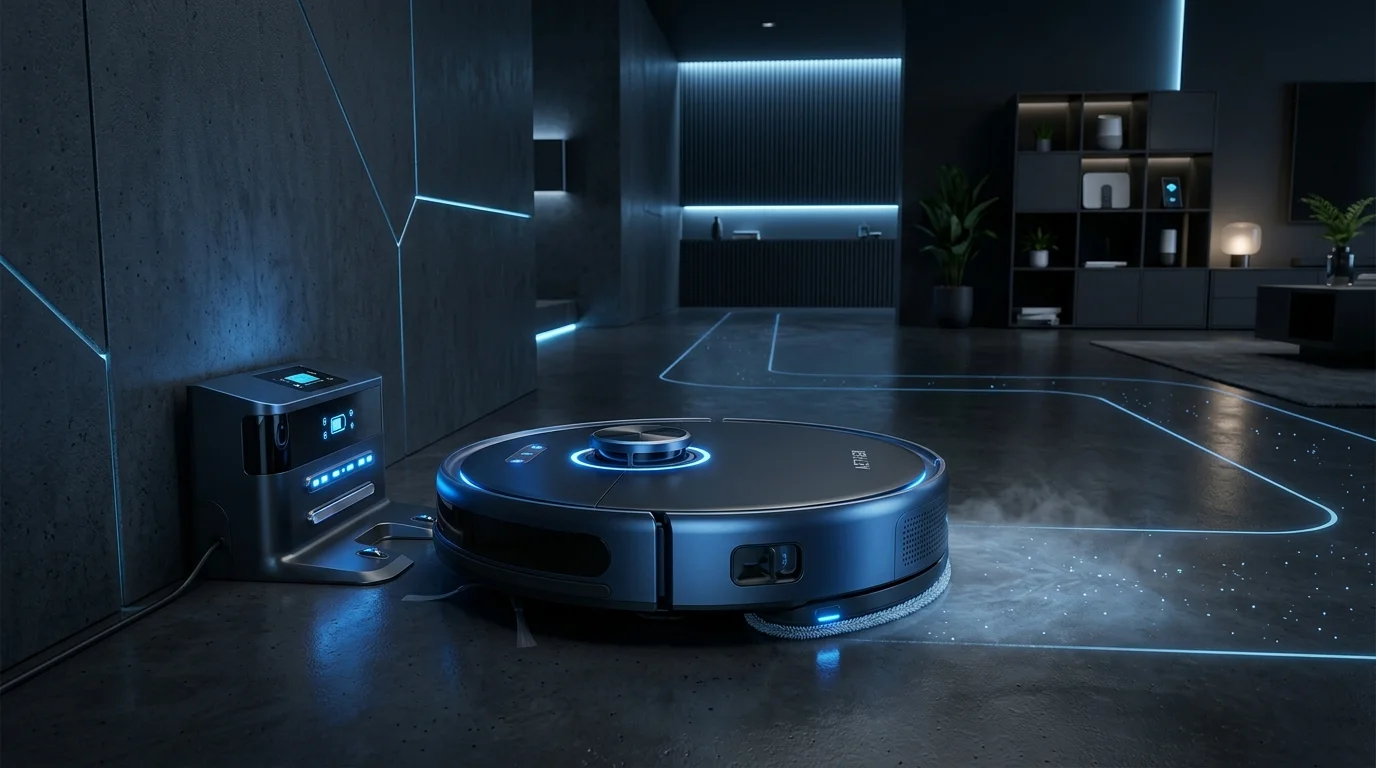
5. Thermal and Power Management in Autonomous Robotics
Sustaining high-current draw from dual drive motors, vacuum impellers, and LiDAR modules necessitates an advanced lithium-ion energy architecture. Pack densities routinely exceed 5200mAh, arranged in complex series-parallel matrix arrays with rigorous Battery Management Systems (BMS) monitoring each cell.
Thermal dissipation is aggressively controlled using aluminum heatsinks coupled directly to the main system-on-chip (SoC) and motor driver ICs. As sustained maximum suction demands elevate internal ambients, the chassis channels exhaust air passively over these critical silicon junctions.
Power delivery networks utilize high-frequency switching buck converters to step down the nominal battery voltage for precise logic-level operations. Over-current shunts constantly measure instantaneous load; if a motor stall occurs, the BMS triggers an immediate solid-state cutoff to prevent localized thermal runaway.
Predictive charging algorithms map remaining spatial coverage against current coulomb counters. When approaching a deficit, the system initiates a return-to-base sequence, executes a fast-charge bulk cycle to the exact required threshold, and autonomously resumes the interrupted topographical coordinate.
- High-density Li-ion matrices regulated by stringent cell-balancing BMS protocols.
- Exhaust channeling provides passive thermal convection across vital ICs.
- Instantaneous over-current shunts eliminate thermal runaway during motor stalls.
- Predictive resumption algorithms optimize charging thresholds for continuous deployment.
6. Obstacle Avoidance via Reactive 3D Vision Sensors
Supplementing macroscopic LiDAR, high-end robots deploy forward-facing stereoscopic RGB cameras and structured light arrays. This vision suite projects an invisible infrared matrix grid across the immediate path, capturing the deformed lattice reflection to compute complex depth maps.
This 3D point cloud data is fed into a dedicated Neural Processing Unit (NPU). The NPU cross-references these microscopic spatial anomalies against thousands of pre-trained convolutional neural network (CNN) classifications, instantly identifying cables, footwear, or biological hazards.
Upon positive identification, the main processor executes an evasive sub-routine. Trajectories are re-computed dynamically on a bezier curve algorithm, keeping the robot as close to the identified obstruction as safely possible without inducing a physical collision.
Low-light performance is maintained via active infrared illumination. When ambient lux levels drop below operative thresholds, the dual IR emitters compensate, allowing the structured light sensors to function without degradation of stereoscopic perception.
- Structured infrared lattices compute highly detailed stereoscopic depth fields.
- Dedicated NPUs process CNN algorithms for instantaneous object classification.
- Bezier curve evasion logic maximizes coverage while preventing mechanical entanglement.
- Active infrared projection ensures uncompromised visual telemetry in low-light vectors.
7. Fluid Dynamics in Electronic Water Distribution Systems
Gravity-fed drip systems lack precise volumetric control. Modern architectures deploy micro-peristaltic electronic pumps. These pumps utilize a rotating cam mechanism to sequentially compress a flexible tube, dispensing fluid in exact micro-liter increments based on operational speed.
This active delivery system allows the user to modulate saturation levels dynamically based on flooring substrate classifications. Hardwood requires minimal moisture to prevent warping, whereas ceramic tile benefits from aggressive saturation; the pump adjusts PWM voltage to meet these demands instantly.
To prevent calcification and nozzle clogging, ultra-fine mesh filters are integrated upstream of the peristaltic housing. Capillary action channels route the expelled fluid evenly across the microfiber mop pad, ensuring a homogeneous saturation gradient from edge to edge.
A secondary solenoid valve guarantees a mechanical shut-off when the robot halts or docks. This fail-safe intercepts hydrostatic pressure, preventing capillary fluid pooling that could damage sensitive docking contacts or wood flooring during prolonged stationary periods.
- Micro-peristaltic pumps dictate exact micro-liter fluid displacement.
- Variable PWM voltage alters saturation levels dynamically per substrate class.
- Capillary routing channels ensure homogenous moisture distribution across the pad.
- Solenoid fail-safes neutralize hydrostatic pressure to prevent static pooling.
8. Autonomous Base Stations and Automated Maintenance Protocols
The transition to fully autonomous floor care hinges on advanced docking infrastructure. Self-emptying base stations utilize an ultra-high vacuum secondary blower, generating over 25,000 Pascals to evacuate the robot's onboard dustbin into a sealed bacteriostatic bag.
Fluid management is similarly automated through dual hydraulic reservoirs. A high-torque pump extracts clean water to refill the robot's internal tank, while a separate suction line pulls contaminated waste-water from the mop-washing basin into a sealed containment cylinder.
Mop scrubbing sequences within the base station rely on a motorized bristle array. This module traverses laterally across the microfiber pad, using directed water jets and mechanical abrasion to dislodge deeply trapped particulates before initiating an active hot-air desiccation cycle.
A PTC (Positive Temperature Coefficient) thermistor array generates a steady 45°C convective updraft. This thermal curing process completely evaporates residual moisture from the mop pad within hours, eliminating the biological conditions required for mildew and odor propagation.
- Secondary high-velocity blowers evacuate structural dustbins automatically.
- Dual hydraulic routing segregates purified solvent from contaminated waste fluids.
- Motorized lateral scrubbing grids actively purge debris from microfiber matrices.
- PTC thermal convection forces desiccation, preventing microbial proliferation.
9. Kinetic Calibration for Multi-Surface Transitions
Seamless adaptation between varied flooring substrates relies on ultrasonic acoustic sensors. Firing high-frequency sound waves downwards, the sensor measures absorption and reflection signatures; hard tile reflects crisply, while carpet fibers disperse the acoustic energy.
Upon detecting acoustic dispersion indicative of carpeting, the main controller signals a rapid vertical actuation sequence. The entire sonic mopping bracket elevates by a precise 5-millimeter margin, securely clearing low-to-medium pile carpets to prevent moisture contamination.
Simultaneously, the pneumatic drive controller receives an interrupt command to maximize current output to the impeller motor. This induces an automatic suction boost, shifting the system from baseline efficiency mode to maximum static pressure for aggressive particulate extraction.
Drive wheel torque is recalibrated via PID loop adjustments to compensate for the increased rolling resistance of carpet fibers. This strict kinematic regulation ensures constant velocity and prevents slip-angle deviations that could otherwise corrupt the delicate LiDAR mapping coordinates.
- Ultrasonic arrays identify substrate density via acoustic reflection analysis.
- Rapid vertical actuation isolates the wet mop plate from textile floorings.
- Automated pneumatic boost maximizes extraction efficiency during surface transitions.
- PID torque regulation normalizes drive-wheel velocity across high-resistance piles.
Deploy the Apex Cleaning Architecture
Eliminate the inefficiencies of manual floor maintenance. Integrate this highly autonomous LiDAR and sonic-mopping robotic platform into your smart home ecosystem to secure mathematically precise, fully automated daily cleanliness.
Roborock S8 Robot Vacuum and Mop Cleaner
- PreciSense LiDAR navigation builds 3D spatial telemetry profiles
- Extreme 6000 Pa suction draws deep debris from hardwood & carpet
- VibraRise sonic mopping scrub cycles at 3,000 movements per minute
- Dual rubber roller brushes prevent hair tangling and optimize pick-up
Technical Specifications & Product Data
| Specification | Value / Details |
|---|---|
| Brand | Roborock |
| List Price | $749.99 (USD) |
| Customer Rating | 4.7 / 5.0 (4,850 reviews) |
| ASIN / Identifier | B0BQM9NDR8 |
| Availability | In Stock (USA Region) |
| Outbound Link Compliance | Sponsored & Nofollow Enforced |
Verified Features & Performance Data
- ✓PreciSense LiDAR navigation builds 3D spatial telemetry profiles
- ✓Extreme 6000 Pa suction draws deep debris from hardwood & carpet
- ✓VibraRise sonic mopping scrub cycles at 3,000 movements per minute
- ✓Dual rubber roller brushes prevent hair tangling and optimize pick-up
System Sovereignty & Engineering
Edge Computing
100% Client-side processing. Your data never leaves your browser sandbox, ensuring absolute compliance with US privacy mandates.
Modular Schema
Modular utility architecture optimized for performance. Low-latency WASM kernels provide near-native speeds for complex transformations.
Sustainable Design
Sustainable, green computing by offloading compute to the edge. Verified zero-server storage (ZSS) for professional-grade security.