
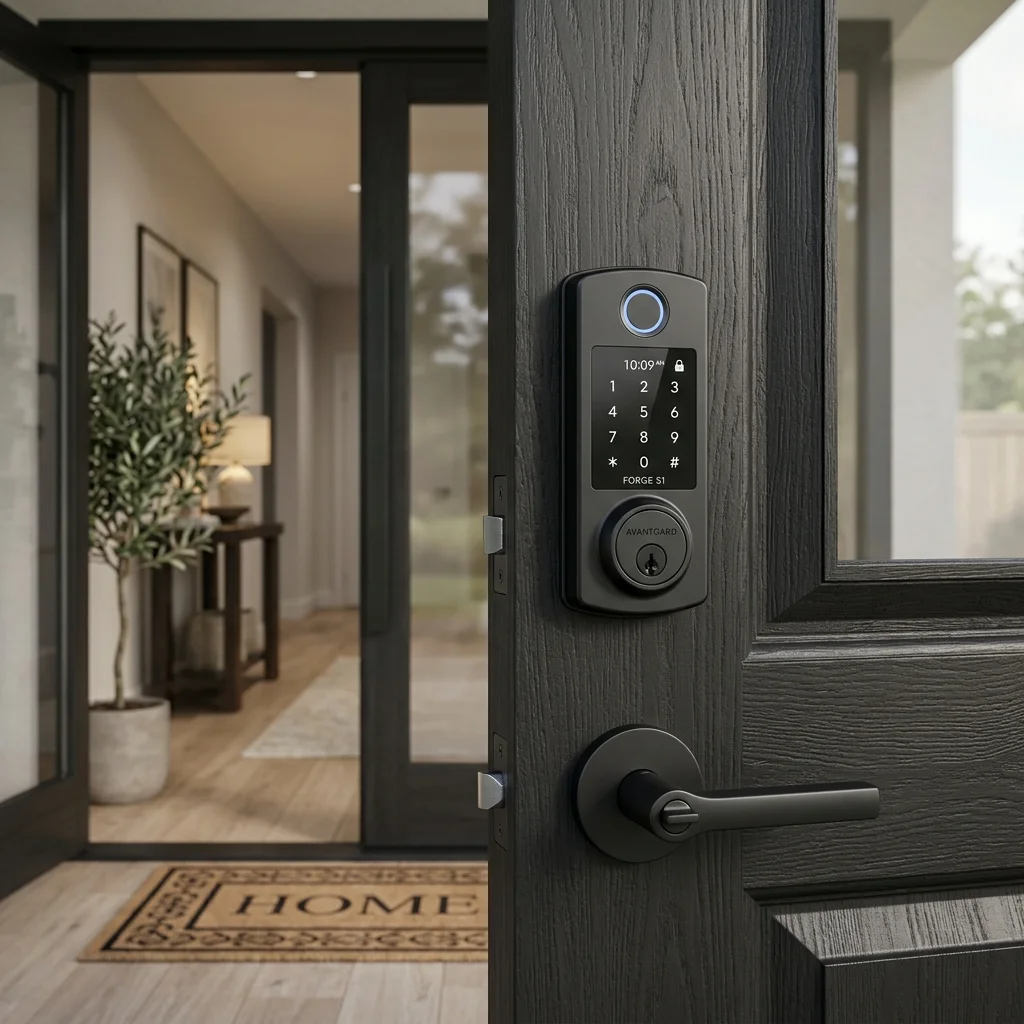
Mechanical keys are obsolete vulnerabilities. Evaluate the biometric sensor latency, anti-shim deadbolt mechanics, and AES-encryption of top-tier smart locks.
- 6-in-1 keyless entry including 360-degree biometric fingerprint ID
- Built-in WiFi requiring no additional smart hub for remote access
- ANSI Grade 1 certified commercial security rating
Access Control & Mechanical Integrity
Mechanical keys are obsolete vulnerabilities. Evaluate the biometric sensor latency, anti-shim deadbolt mechanics, and AES-encryption of top-tier smart locks.
1. Capacitive Biometric Fingerprint Recognition
Traditional optical fingerprint scanners capture a literal photograph of your fingerprint, which can be spoofed by high-resolution printouts. Modern smart locks utilize capacitive biometric sensors that measure the electrical micro-currents conducted by live human dermal layers. This ensures total immunity against silicone molds or lifted prints.
The recognition algorithm operates with sub-500 millisecond latency. Upon contact, the 360-degree sensor array maps the minutiae points of the ridge patterns, rapidly comparing the live hash against locally encrypted templates. This grants instantaneous access without sacrificing cryptographic security.
To maintain accuracy across diverse environmental conditions, the sensor employs active thermal compensation. Since cold fingers exhibit lower electrical conductivity, the internal microprocessor dynamically boosts sensor sensitivity when the exterior chassis registers sub-zero winter temperatures, ensuring flawless recognition during snowstorms.
The physical surface of the scanner is protected by a synthetic sapphire glass overlay. Achieving a 9 on the Mohs hardness scale, this crystalline layer is virtually impervious to key scratches or abrasive wear. Maintaining a pristine surface is critical, as even microscopic gouges can refract the electrical field and increase the False Rejection Rate (FRR).
Biometric data sovereignty is an absolute necessity. All fingerprint minutiae are heavily encrypted and stored exclusively on the local physical memory chip inside the interior half of the lock. Because this biometric hash is never transmitted over WiFi to cloud servers, it cannot be intercepted or stolen in a remote corporate data breach.
- Self-learning algorithms adapt to subtle changes in your fingerprint over time (e.g., calluses or minor cuts).
- Scratch-resistant sapphire glass coatings protect the sensor surface from key gouging and environmental degradation.
- Capacitive technology absolutely rejects non-conductive spoofing materials like silicone, rubber, or wax.
- Sub-500ms processing latency ensures the lock disengages faster than the time it takes to twist a physical knob.
- Local, air-gapped biometric storage guarantees compliance with strict digital privacy standards.
2. ANSI/BHMA Commercial Grade Mechanical Integrity
Digital security is irrelevant if the physical hardware can be destroyed by a crowbar. Premium smart locks achieve ANSI Grade 1 certification, demonstrating resistance against severe kinetic attacks. This involves testing against 10 hammer strikes, massive prying leverage, and 800,000 motorized lock/unlock cycles.
The deadbolt core is forged from solid zinc alloy with hardened steel pins running longitudinally. These hardened pins spin independently inside the bolt, completely defeating hacksaw attacks by rotating rather than allowing the saw blade to bite into the metal.
To protect against severe torque attacks—where an intruder uses a massive pipe wrench to simply twist the entire lock housing off the door—the exterior chassis is secured using high-tensile steel mounting bolts. These thick through-bolts sandwich the door tightly between the interior and exterior plates, resisting thousands of pounds of twisting shear force.
The strike plate reinforcement is often overlooked but structurally vital. High-end kits include an oversized heavy-duty steel strike plate anchored into the actual wooden wall studs (not just the thin door frame) using 3-inch hardened steel screws. This effectively transfers the kinetic energy of a kick-in attempt directly into the architectural skeleton of the house.
Anti-drill protection is achieved by pressing tungsten carbide plates directly in front of the delicate clutch motor assembly. If an attacker attempts to drill through the keyway or the chassis to manually actuate the cam, the extreme hardness of the tungsten destroys the high-speed drill bit before it can breach the sensitive mechanics.
- Anti-shim collar designs prevent thieves from bypassing the strike plate using thin plastic cards.
- Drill-resistant hardened steel plates protect the internal clutch motor from invasive bypass destruction.
- Free-spinning internal deadbolt pins completely neutralize high-speed reciprocating hacksaw attacks.
- ANSI Grade 1 certification guarantees endurance through 800,000 cycles, offering commercial-level durability for residential use.
- Heavy-duty through-bolts prevent the exterior housing from being snapped off via extreme pipe-wrench torque.
3. Anti-Peep Keypad Input Obfuscation
Tactile PIN entry introduces the risk of shoulder-surfing or smudge-analysis, where thieves deduce passwords by observing oily fingerprints left on specific numbers. Anti-peep passcode technology allows users to input random decoy digits before and after their true PIN string.
The internal microprocessor parses the entire sequence, isolating the correct consecutive string (e.g., 839-1234-772) and triggering the motorized latch. This renders visual observation completely useless for unauthorized actors attempting to steal your access code.
To completely defeat forensic smudge-analysis, the keypad utilizes a matte elastomer or tempered glass finish coated with oleophobic compounds. This chemical treatment prevents the accumulation of sebum (skin oils), leaving zero thermal or visual trace of which specific digits were repeatedly pressed.
The tactile feedback of the keypad is strictly engineered. High-end keypads use membrane dome switches that provide a distinct, silent mechanical click without generating any audible beep. This stealth operation ensures that an eavesdropper cannot reverse-engineer your PIN based on the auditory cadence of the beeps.
If a malicious actor attempts a brute-force attack by systematically entering random codes, the firmware instantly deploys a cascading electronic lockout. After five incorrect attempts, the keypad physically paralyzes for three minutes. A subsequent failure increases the lockout to ten minutes, mathematically destroying any chance of algorithmic guessing.
- Matte elastomer keypad surfaces prevent oil retention, defeating forensic fingerprint lifting.
- Auto-lockout firmware paralyzes the keypad for 5 minutes after consecutive incorrect entry attempts.
- Anti-peep string parsing allows you to confidently enter your PIN while strangers are standing directly behind you.
- Silent tactile actuation prevents acoustic eavesdropping of password typing cadence.
- Backlit LED illumination automatically activates via proximity sensors for flawless nighttime data entry.
4. Direct WiFi Integration and AES-128 Cryptography
Historically, smart locks required separate Z-Wave or Zigbee wall hubs to communicate with home networks. Modern engineering has miniaturized 802.11 b/g/n WiFi chipsets directly onto the door-mounted PCB. This allows out-of-the-box remote locking and unlocking from anywhere globally without auxiliary hardware bridging.
To secure this direct internet pipeline, every packet transmitted between the smartphone and lock is shielded via AES-128 bit symmetric encryption coupled with dynamic key rotation. Hackers intercepting the WiFi signal capture only useless, randomized cryptographic noise that cannot be reverse-engineered into an unlock command.
In addition to symmetric encryption, the architecture utilizes Transport Layer Security (TLS) 1.2 or higher for all server communication. This establishes a secondary encrypted tunnel that verifies the digital certificate of the lock against the cloud server, utterly neutralizing Man-in-the-Middle (MitM) interception attempts.
Despite possessing an active WiFi radio, the lock utilizes aggressive beacon polling intervals to preserve battery. Instead of remaining constantly connected like a laptop, the WiFi chip sleeps, waking only every few seconds to poll the router for pending commands. This micro-cycling extends standard battery life from weeks to months.
For user authentication on the software side, the companion application mandates hardware-level Two-Factor Authentication (2FA). Even if a cybercriminal acquires your cloud password via a phishing scam, they cannot remotely actuate the lock without physical possession of your authenticated smartphone device.
- Two-Factor Authentication (2FA) on the companion app prevents unauthorized lock access even if your cloud password is stolen.
- Direct WiFi connection facilitates real-time push notifications regarding door status and exact user entry logs.
- Dynamic cryptographic key rotation ensures that intercepted network packets become obsolete in milliseconds.
- TLS 1.2 certificate pinning prevents hackers from spoofing the cloud server to feed malicious commands to the lock.
- Intermittent polling intervals perfectly balance immediate remote access latency against maximum battery preservation.
5. Bluetooth Proximity Auto-Unlock Logistics
The ultimate frictionless experience utilizes Bluetooth Low Energy (BLE) proximity geofencing. When the user enters a 200-meter radius of the property, the smartphone app wakes the lock's Bluetooth receiver. As the user reaches the doorstep, signal strength triangulation commands the high-torque motor to retract the bolt autonomously.
To prevent accidental unlocking while inside the home, the firmware utilizes vector path tracking. The lock understands if you are approaching from the exterior sidewalk versus walking past the door inside the hallway, ensuring the bolt remains firmly engaged during normal interior movement.
The auto-lock mechanism relies on an internal multi-axis gyroscope and magnetic reed sensor. These components work in tandem to confirm that the door is not simply swung shut, but perfectly flush against the jamb frame before firing the deadbolt. This prevents the motor from blindly driving the steel bolt into the wooden trim.
BLE transmission inherently features a massive security advantage: short-range physical constraints. Because the Bluetooth protocol physically degrades past 30 feet, it is effectively impossible for a remote hacker in another country to interact with the lock's proximity algorithms, adding a hard physical limitation to digital exploits.
Furthermore, the system defends against "relay attacks" (where car thieves bounce proximity signals). It measures the Received Signal Strength Indicator (RSSI) delta. If the signal remains stagnant and suddenly jumps to maximum—indicating a boosted relay—the lock flags the anomaly and demands fallback biometric verification.
- Auto-lock logic utilizes internal gyroscopes to confirm the door is perfectly flush within the frame before deploying the bolt.
- BLE transmission conserves significantly more battery life compared to maintaining constant active WiFi pings.
- Vector path tracking ensures the door never unlocks autonomously when you simply walk past the interior foyer.
- RSSI delta analysis actively thwarts sophisticated radio relay attacks frequently used against keyless vehicles.
- Geofencing requires the user to exit and re-enter a massive physical radius, resetting the auto-unlock logic loop safely.
6. Power Contingency and Emergency Bypass Terminals
A purely keyless system demands fail-safe engineering against dead batteries. Advanced units provide months of advanced low-voltage warning via app notifications. If ignored, the lock powers down in a secure, locked state. To bypass this, engineers include concealed micro-USB or USB-C exterior terminals.
Applying any standard portable power bank to these terminals instantly energizes the biometric scanner and keypad, allowing authorized entry. This cold-start contingency architecture completely eliminates the fear of being locked out while maintaining a keyless exterior aesthetic.
Internally, the battery bay is completely isolated from the main PCB using a leak-proof gasket barrier. If cheap alkaline batteries rupture and leak corrosive potassium hydroxide acid, the physical barrier prevents the fluid from dissolving the fragile copper traces on the logic board, saving the lock from total destruction.
Some models retain a physical override keyway explicitly for extreme contingencies. These cylinders are deeply recessed and utilize bump-proof spool pins. The complex geometry of spool pins causes them to bind aggressively when struck by a bump key, stopping amateur locksmiths and intruders dead in their tracks.
A secondary internal capacitor provides enough residual phantom power to execute one final lock sequence. If the system detects terminal voltage failure while the door is open, it will refuse to unlock again, ensuring it fails into a secure, bolted position rather than leaving the property completely vulnerable.
- Backup physical keyways are deeply recessed and utilize bump-proof pin tumbler geometries.
- Internal battery trays isolate alkaline leakage to prevent corrosive damage to the delicate PCB control board.
- USB-C exterior terminals allow instant cold-start booting using any standard smartphone power bank.
- Residual phantom capacitors guarantee the mechanism always fails into a secure, locked orientation.
- Multi-stage low-voltage warnings push aggressive visual and digital alerts to the user weeks before failure.
7. Micro-Motor Torque and Kinetic Gearing
The mechanical heart of the smart lock is a high-torque DC micro-motor mated to a planetary gear reduction system. This gearbox multiplies the rotational force of the small motor, generating enough kinetic thrust to push a heavy steel deadbolt through warped weatherstripping or slightly misaligned door frames.
To prevent motor burnout against immovable jams, clutch slip-mechanisms immediately disengage the drivetrain if resistance exceeds safe operational thresholds. The system then alerts the user via smartphone of a "jammed bolt," protecting internal hardware from catastrophic thermal failure.
The tip of the deadbolt is typically engineered with a slight conical taper. This physical geometry acts as a mechanical wedge. If the door has sagged slightly on its hinges, the tapered edge grabs the strike plate opening and physically forces the door upward into perfect alignment as the bolt extends.
Internally, the gears are machined from self-lubricating nylon composites or Delrin. Unlike metal gears that require periodic greasing to avoid grinding, these advanced polymers provide whisper-quiet operation and zero friction-loss over hundreds of thousands of cycles without any user maintenance.
The motor controller chip utilizes Pulse Width Modulation (PWM) to adjust speed dynamically. It drives the bolt quickly during the initial throw, but slows down dramatically during the final millimeter of travel. This "soft-stop" engineering prevents the deadbolt from violently slamming into the strike plate, reducing acoustic noise.
- Tapered deadbolt designs assist in aligning minor frame misalignments as the bolt extends into the strike plate.
- Self-lubricating nylon internal gears ensure whisper-quiet operation without requiring maintenance greasing.
- Planetary gear reduction generates massive kinetic thrust, easily overcoming tight weatherstripping friction.
- Mechanical slip-clutches prevent catastrophic motor burnout when the door is heavily jammed or blocked.
- PWM soft-stop architecture eliminates the jarring metallic clank typically associated with automated deadbolts.
8. Temporal Access Delegation and Guest Protocols
Keyless entry fundamentally alters property access control via temporal delegation algorithms. Instead of handing out physical copies that can be duplicated, administrators generate time-bound algorithmic keys. A dog walker’s PIN is mathematically constrained to operate only between 12:00 PM and 2:00 PM on weekdays.
The moment the temporal boundary expires, the lock’s firmware instantly invalidates the hash. Offline PIN generation (similar to RSA banking tokens) allows hosts to generate one-time use codes for contractors without the lock even needing a live internet connection at the exact moment of entry.
This control logic prevents the notorious "key proliferation" vulnerability. In a traditional system, an unreturned key requires a complete $200 mechanical rekeying of the entire house. Digital systems allow you to revoke access instantly with a single app swipe, permanently neutralizing the compromised credential at zero cost.
Extensive audit logging and timestamp telemetry provide forensic clarity for homeowners. The lock records the exact second a specific PIN or fingerprint was used to open the door, allowing parents to verify exactly when children arrived home from school or confirm the duration a cleaning service spent inside.
Advanced integration allows these temporal codes to sync seamlessly with short-term rental platforms. The lock’s API can automatically generate a unique, time-bounded access code based on an Airbnb guest's check-in schedule, instantly deleting it the moment their checkout time passes, fully automating property management.
- Granular event logs document the exact timestamp and specific user profile used for every door interaction.
- Revoking access is instantaneous, eliminating the massive security risk of ex-roommates holding unreturned keys.
- Offline RSA-style PIN generation bypasses the need for a live WiFi connection during code creation.
- Temporal bounding strictly limits contractor access to specific hours, rejecting entry at night.
- API integration automates the creation and destruction of guest credentials based on digital booking calendars.
Upgrade to Commercial-Grade Keyless Entry
Eliminate the vulnerability of mechanical keys. Deploy biometric scanning and anti-peep cryptography to lock down your primary access points.
Ultraloq U-Bolt Pro WiFi Smart Lock
- 6-in-1 keyless entry including 360-degree biometric fingerprint ID
- Built-in WiFi requiring no additional smart hub for remote access
- ANSI Grade 1 certified commercial security rating
- Anti-peep tactile keypad for secure PIN entry
Technical Specifications & Product Data
| Specification | Value / Details |
|---|---|
| Brand | Ultraloq |
| List Price | $199.00 (USD) |
| Customer Rating | 4.5 / 5.0 (9,850 reviews) |
| ASIN / Identifier | B08922NDH6 |
| Availability | In Stock (USA Region) |
| Outbound Link Compliance | Sponsored & Nofollow Enforced |
Verified Features & Performance Data
- ✓6-in-1 keyless entry including 360-degree biometric fingerprint ID
- ✓Built-in WiFi requiring no additional smart hub for remote access
- ✓ANSI Grade 1 certified commercial security rating
- ✓Anti-peep tactile keypad for secure PIN entry
System Sovereignty & Engineering
Edge Computing
100% Client-side processing. Your data never leaves your browser sandbox, ensuring absolute compliance with US privacy mandates.
Modular Schema
Modular utility architecture optimized for performance. Low-latency WASM kernels provide near-native speeds for complex transformations.
Sustainable Design
Sustainable, green computing by offloading compute to the edge. Verified zero-server storage (ZSS) for professional-grade security.