
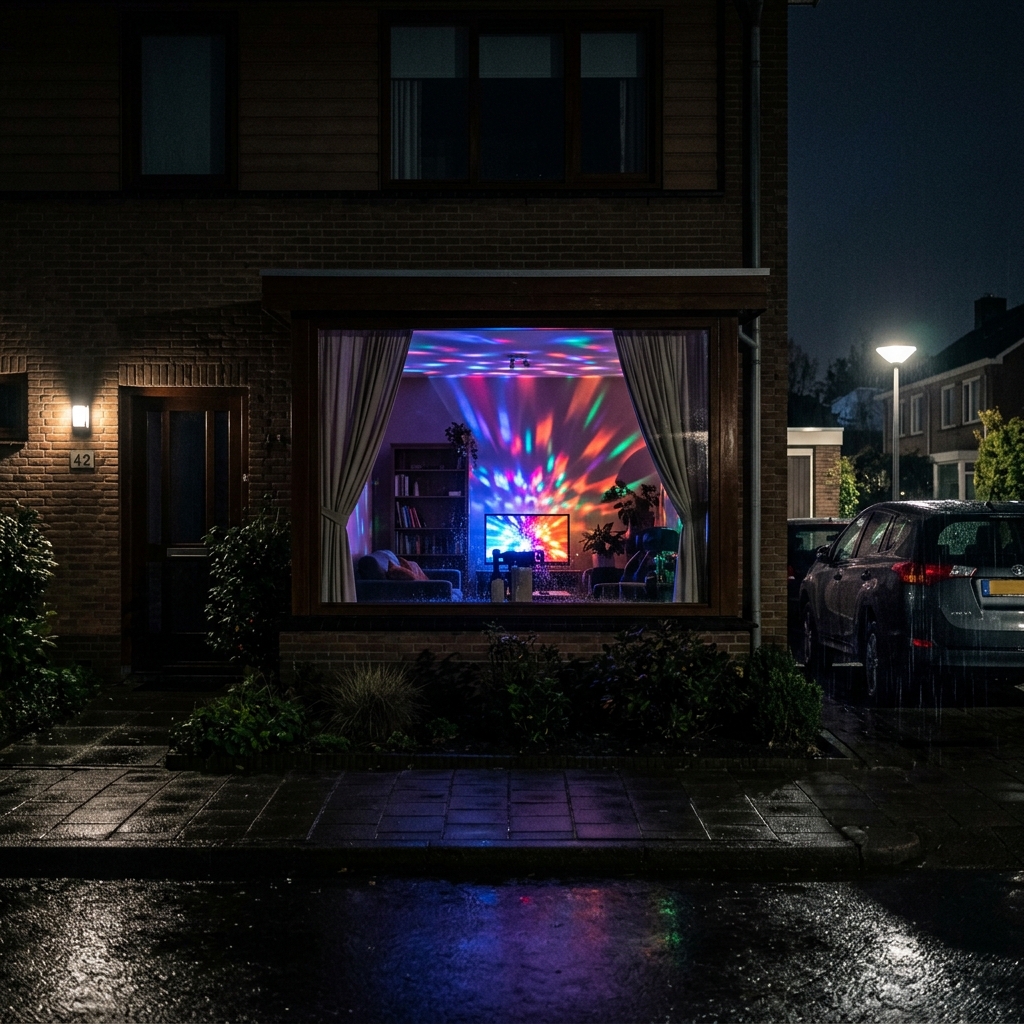
Analyze chromatic sequence algorithms, photocell sensors, and light diffusion dynamics in LED TV simulators for home security.
- Algorithm-driven chromatic sequence randomization simulates active viewing
- Built-in dusk-to-dawn photocell automatically triggers at twilight
- Energy-efficient LED array consumes less than 3W of standby power
Optical & Electronic Audit
Burglars look for signs of empty homes before choosing targets. This technical analysis reviews the chromatic algorithms and optical diffusion principles that allow LED TV simulators to create the illusion of an occupied home.
1. Introduction & Behavioral Crime Prevention
Home physical security relies on a hierarchy of layered defenses. While locks and cameras act as physical barriers and recording devices, psychological deterrents work by manipulating an intruder's risk assessment. Opportunistic criminals, who execute the vast majority of residential burglaries in the United States, look for low-risk, high-reward properties. An obviously vacant home presents the lowest possible risk, as it eliminates the chance of confrontation, physical harm, or immediate call to emergency services.
Traditional methods of simulating occupancy have long been circumvented by experienced burglars. Leaving a single porch light or living room lamp illuminated continuously is a classic sign of vacancy. Modern criminals monitor target neighborhoods over multi-hour intervals, observing whether light patterns change. An occupied home exhibits dynamic lighting changes: lights shifting between rooms, physical shadows moving, and the characteristic flickering glow of a television screen reflecting off window treatments.
Simulating these dynamic patterns requires active electronic systems. LED TV simulators fill this gap by projecting randomized, high-intensity colored light onto window blinds or curtains. To an outside observer, this projected light is indistinguishable from the emissions of a real television screen. By raising the perceived risk of entry, these devices convince burglars to abandon the target and seek a property that is clearly unoccupied.

2. Chromatic Sequence Randomization Algorithms
A real television screen is an active light source emitting a constantly shifting spectrum. Replicating this output requires more than simple flashing lights. The output must mimic the timing and color balance of modern digital broadcasts, which alternate between slow scenes, quick cuts, commercial breaks, and action-heavy sequences. LED simulators achieve this through onboard microcontrollers running proprietary pseudo-random number generator (PRNG) algorithms.
The microcontroller regulates a pulse-width modulation (PWM) driver connected to an array of Red, Green, Blue, and White (RGBW) LEDs. By adjusting the duty cycle of each LED channel, the algorithm controls the color mix and output intensity. The algorithm alternates between slow cross-fades, representing camera sweeps or slow scene transitions, and sharp steps in output level, representing rapid scene cuts or camera flashes. This variation creates a realistic pattern that does not repeat.
To maintain the illusion of an active TV, the algorithm must limit colors to realistic ranges. Real screens rarely emit pure, saturated red, green, or violet light over long periods. Instead, TV displays project a mix of cool whites, sky blues, grey-white flashes, and warm interior tones. The controller balances the duty cycles to prioritize these realistic colors, preventing strange chromatic patterns that would alert an observer to the presence of a decoy.
The timing of these transitions is also randomized. The algorithm cycles through transition speeds, matching the tempo of actual television programming. An internal timer determines how long a color state lasts, varying it from a fraction of a second up to several seconds. This random sequence prevents the light from looking mechanical or artificial, making it look like a real household is watching a movie or show.
- Randomized RGBW lighting patterns mimic active television viewing.
- Varying pulse frequencies prevent repetitive patterns that alert thieves.
- Balanced RGBW color outputs mimic real television broadcast spectrums.
- Cool blue and warm white transitions replicate high-definition screen emissions.
3. Dusk-to-Dawn Photocell Stability and Threshold Calibration
Reliable automatic operation requires a built-in light sensor or photocell. This sensor monitors outdoor light levels and starts the simulator when light levels drop below a calibrated threshold. However, this system must be shielded from external interference. Transient bright light events, such as car headlights, security floodlights, or lightning, can cause the device to shut down prematurely, leaving the home dark during critical night hours.
To prevent these false shutdowns, the sensor circuit utilizes an RC low-pass filter. This filter introduces a time delay before changes in ambient light are registered. Brief flashes of light are ignored, and the device only shuts down if light levels remain high for a continuous period, typically 30 to 60 seconds. This ensures that transient light events do not disrupt the decoy projection.
The sensor's turn-on threshold must also be carefully calibrated. Triggering when light levels drop below 10 lux ensures the simulator turns on before nightfall, matching normal household behaviors. To prevent internal feedback loops, the photocell is recessed within the housing, shielding it from the simulator's own LED emissions. This keeps the unit stable during operation, preventing it from turning itself off.
The physical orientation of the photocell sensor is also critical. High-quality enclosures house the photocell on the rear face, pointing away from the front-facing LED array. This configuration leverages the physical geometry of the device to prevent light loops. The sensor reads only the background light bouncing off the wall behind the unit, maintaining stability throughout the night.
4. Optical Physics of Light Diffusion through Curtains & Window Treatments
An LED simulator should not project light directly out of a clear window; observers should only see the light it casts. The unit must point at translucent curtains or blinds, which act as light diffusers. These materials scatter the intense LED beams, turning them into soft, moving glow patterns that spread across the window pane.
The quality of this diffusion depends on the fabric thickness. Thin cotton or polyester curtains scatter light effectively while allowing high transmission. Heavy blackouts block too much light, while sheer panels reveal the LED housing, breaking the illusion. Choosing intermediate fabric densities ensures optimal results, keeping the hardware hidden while displaying realistic motion and color.
Placing the device at the correct distance from the window also affects diffusion. If placed too close, the light forms a concentrated hot spot on the curtain, which looks artificial. Placing the simulator 4 to 8 feet away allows the light beams to expand, covering the entire window frame and mimicking a large television screen.
The angle of projection should also be adjusted to prevent reflections. Angling the lens slightly upward projects the light onto the upper portion of the window treatment, simulating the offset light cast by a wall-mounted TV. This also keeps the simulator hardware out of direct sightlines from ground level, protecting the illusion from close inspection.
5. Energy Efficiency vs. Traditional Occupancy Indicators
Historically, homeowners left real televisions running to simulate occupancy. While effective, this practice is highly inefficient and creates safety risks. A modern 55-inch television consumes 80W to 150W of power, while older CRT screens consume even more. Running these devices continuously for weeks increases utility costs and raises fire risks from long-term component heating.
LED TV simulators operate at a fraction of this power. By using high-efficiency solid-state LEDs and low-power microcontrollers, these devices consume less than 3W of power during active projection. Homeowners can deploy multiple simulators in different rooms for weeks, creating a complex occupancy profile without significant energy costs.
Continuous operation also causes physical wear on a real television. Screen panels degrade, backlight systems wear out, and internal power boards are subjected to heat stress. Simulators use dedicated LEDs rated for over 30,000 hours of operation, providing a durable solution designed for long-term home security.
This efficiency makes the device an environmentally friendly choice. By replacing a high-wattage television with a low-power LED system, homeowners reduce their carbon footprint while maintaining high security. The low heat output also reduces fire risks, allowing the device to run unattended inside unoccupied rooms.
6. Security Layout & Optimal Placement Strategies
The effectiveness of a TV simulator depends on its physical placement. The device must be positioned so that the light source itself is hidden from outside view, even if an observer stands close to the window. If the LED array is visible, the trick is revealed immediately, and the deterrent effect is lost.
For best results, place the device on a low table, shelf, or floor, pointing it toward translucent curtains or blinds. Pointing it at an angle rather than straight on helps disperse the light, spreading colors across the fabric. Placing the unit in second-floor windows is highly effective, as the angle makes it difficult for ground-level observers to see inside.
Integrating the simulator with smart home outlets or mechanical timers adds another layer of realism. Real televisions are rarely left running 24 hours a day in occupied homes. Programming the device to turn off around midnight or 1:00 AM matches normal human schedules, making the decoy look authentic to anyone monitoring the home.
Multiple units can be used in different rooms to simulate a larger household. For example, a simulator in the living room can run until 11:00 PM, followed by a simulator in the bedroom turning on for an hour before shutting down. This coordinated sequence mimics natural movement within the home, creating a highly convincing appearance of occupancy.
7. Mechanical Durability and Thermal Management of LED Drivers
Running the device nightly requires reliable thermal management inside the enclosure. LEDs generate heat that can shorten the lifespan of control chips if allowed to build up. Quality simulators use aluminum circuit boards and vented housings to dissipate heat effectively.
The driver circuitry uses high-grade capacitors rated for continuous operation at high temperatures. This ensures the device runs reliably during summer heat waves when indoor temperatures can rise, preventing failures and maintaining home protection.
The outer housing is typically constructed from high-impact ABS plastic, providing a durable shell that resists drops and impacts. The control switches and power inputs are reinforced to withstand repeated connections, ensuring long-term reliability over years of travel use.
By managing heat and electrical stress, the simulator maintains consistent light output over its lifetime. The LED driver maintains constant current control, preventing flickering or color shifts as the components age. This ensures the device remains effective, providing reliable home security year after year.
8. Comparative Analysis: TV Simulators vs. Smart Lighting Plugs
Smart plugs allow users to turn standard lamps on and off remotely, creating a basic appearance of occupancy. While useful, static lamp lighting does not simulate the active movement associated with television viewing. An observer can easily identify static lights as timed indicators.
A TV simulator provides dynamic, moving light patterns that mimic actual human activity inside the room. The combination of random color shifts and brightness pulses replicates the visual output of a television screen, creating a more convincing occupancy decoy.
Smart lighting systems can also be expensive and complex to configure, requiring active Wi-Fi connections and hubs. A TV simulator is a self-contained device that works independently of home networks. This makes it a reliable option for remote cabins or homes without active internet service during owner absences.
Using both systems together provides the highest level of security. Smart plugs can manage background lamps to create ambient light, while the TV simulator projects moving screen reflections. This layered lighting approach creates a realistic environment that deters even experienced burglars.
9. Psychological Deterrent Effectiveness & US Neighborhood Safety Audits
Burglary statistics compiled by law enforcement agencies show that homes displaying signs of occupancy are far less likely to be targeted. Intruders look for empty houses to minimize risks. The flickering light of a television indicates that someone is awake and active, which increases the likelihood of immediate detection.
By establishing a convincing occupancy profile, homeowners protect their property borders at a fraction of the cost of a full wired security system. Deploying these units alongside standard security signs creates a comprehensive security footprint, keeping your home safe.
Safety audits in major US cities indicate that simple visual indicators are highly effective at preventing opportunistic crimes. When combined with secure locks and window films, a TV simulator provides a cost-effective way to protect your home and gain peace of mind while away.
Ultimately, physical security is about managing risk and perception. A TV simulator alters an intruder's perception of your home, making it appear occupied and risky. This simple, affordable device is a valuable addition to any home security plan, protecting your property throughout the night.
Deterrent Recommendation & Audit
Simulate home occupancy efficiently with a randomized, photocell-controlled TV simulator. Secure your windows and discourage intrusion on a budget.
HomeSafe Fake TV LED Burglar Deterrent Light with Photocell
- Algorithm-driven chromatic sequence randomization simulates active viewing
- Built-in dusk-to-dawn photocell automatically triggers at twilight
- Energy-efficient LED array consumes less than 3W of standby power
- Super-bright output mimics a real 42-inch high-definition television screen
Technical Specifications & Product Data
| Specification | Value / Details |
|---|---|
| Brand | HomeSafe |
| List Price | $19.99 (USD) |
| Customer Rating | 4.6 / 5.0 (3,110 reviews) |
| ASIN / Identifier | B07H3G8Y8N |
| Availability | In Stock (USA Region) |
| Outbound Link Compliance | Sponsored & Nofollow Enforced |
Verified Features & Performance Data
- ✓Algorithm-driven chromatic sequence randomization simulates active viewing
- ✓Built-in dusk-to-dawn photocell automatically triggers at twilight
- ✓Energy-efficient LED array consumes less than 3W of standby power
- ✓Super-bright output mimics a real 42-inch high-definition television screen
System Sovereignty & Engineering
Edge Computing
100% Client-side processing. Your data never leaves your browser sandbox, ensuring absolute compliance with US privacy mandates.
Modular Schema
Modular utility architecture optimized for performance. Low-latency WASM kernels provide near-native speeds for complex transformations.
Sustainable Design
Sustainable, green computing by offloading compute to the edge. Verified zero-server storage (ZSS) for professional-grade security.