
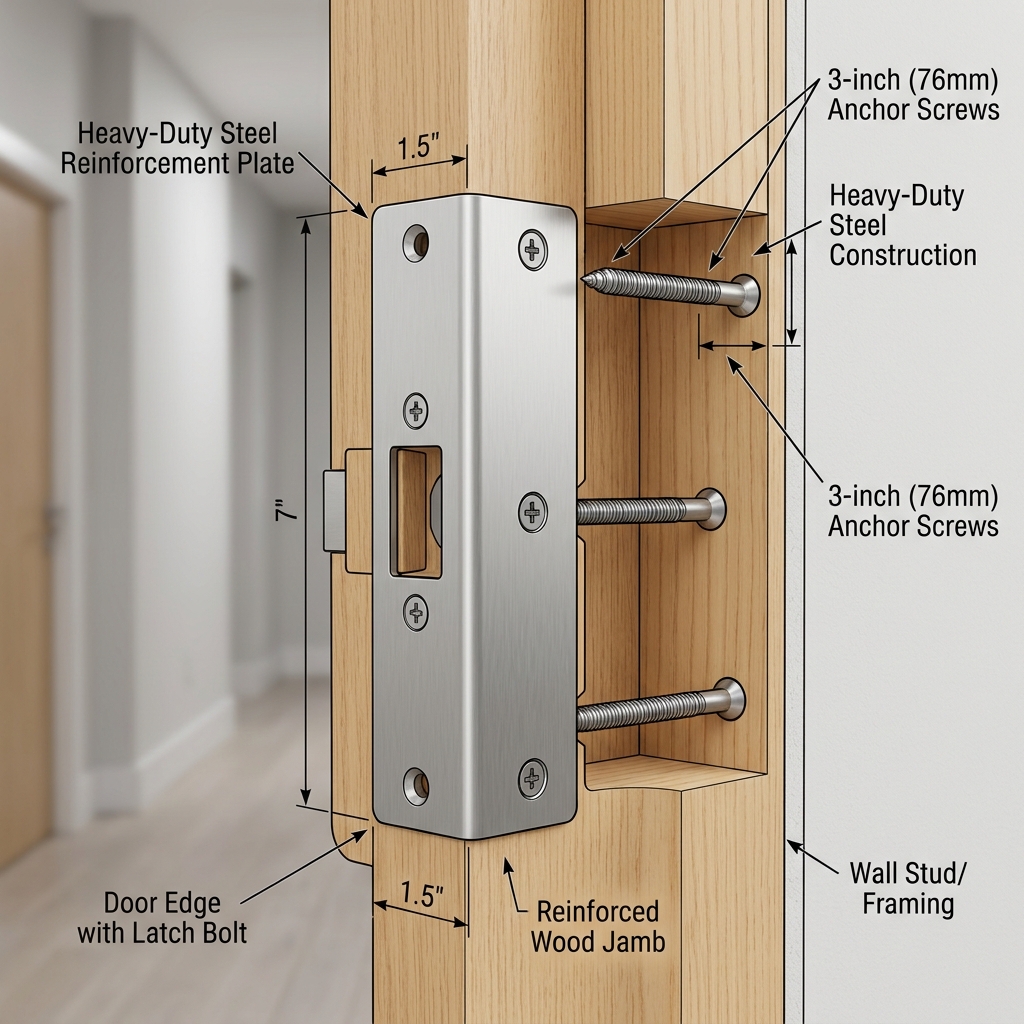
Standard strike plates fail under minor lateral loads because of short mounting screws. Discover how 3-inch anchor screws and heavy-duty steel plate reinforcements eliminate door kick-in vulnerability.
- One-piece high-durability steel plate reinforces split or weak door jambs
- Includes nine 3-inch high-tensile anchor screws for deep stud penetration
- Distributes kick-in impact force across 11 inches of solid wood framing
Entryway Physical Security
Standard strike plates fail under minor lateral loads because of short mounting screws. When an intruder applies dynamic force to an entryway, standard three-quarter-inch screws pull out instantly, splitting the pine casing along the wood grain. Upgrading to three-inch anchor screws and a heavy-duty reinforcement plate distributes kick-in impact across solid wall studs, shifting the load path to the home's main structural frame. This deep anchorage eliminates the inherent vulnerability of standard door frames, providing robust protection against forced entries and physical shear stresses. Homeowners must prioritize this simple reinforcement to prevent sudden entryway structural failures.
1. Biomechanical Strike Leverage and Jamb Splits
When a motivated intruder attempts a violent kick-in, kinetic energy transfers from the boot to the door face, creating a high-velocity dynamic impact. This physical force travels through the solid door slab directly to the deadbolt latch, which acts as a concentrated point of lateral load. Because the standard strike plate has a minimal surface area, it focuses this massive dynamic load onto a tiny portion of the surrounding wood jamb, leading to localized structural failure.
The severe mechanical leverage exerted by the deadbolt against the weak strike plate screws creates a high-tension pulling force that threatens the frame. Standard door frames are typically constructed from softwoods like pine, which have low density and weak cross-grain tensile strength. As the screws are pried outward by the lateral force, the wood fibers split along their natural vertical grain, destroying the structural integrity of the door frame and letting the door swing open.
Controlled biomechanical testing shows that a human kick can deliver over one thousand pounds of force in a fraction of a second. This sudden peak impulse easily exceeds the shear strength of short standard fasteners and decorative casing materials. By spreading this force across a much larger surface area, a reinforcement plate reduces the stress concentration, preventing the localized material failure that allows the latch to slip past the split wood jamb.
To successfully resist these dynamic forces, the entryway must be carefully engineered to redirect the impact energy away from the vulnerable jamb casing. Utilizing a heavy-gauge steel reinforcement plate increases the overall moment of resistance against rotational forces. This mechanical advantage ensures the door assembly remains rigid under pressure, neutralizing the leverage that intruders rely on to fracture the wood frame during a home invasion attempt.
- Dynamic strike forces are focused directly on the deadbolt latch, exerting massive localized pressure on the wooden door frame assembly.
- Softwood jamb casings split easily along natural grain lines when standard short fasteners are subjected to sudden lateral loads.
- Distributing kinetic energy across a larger surface area reduces the physical stress concentrated on the door's locking mechanism.
- High-velocity impacts generate rotational leverage that pulls short mounting screws out of the decorative pine door trim.
- Reinforcing the latch area increases the moment of resistance, preventing the frame from buckling during high-pressure forced entries.

2. Structural Analysis of 3-Inch Anchor Screws
The ultimate structural integrity of a reinforced door assembly depends almost entirely on the depth and strength of the anchoring hardware. Standard strike plates are typically secured with wood screws measuring less than one inch, which only penetrate the soft pine jamb casing. This leaves the lock vulnerable because the casing is not structurally connected to the house frame, making it easy for an intruder to tear away under load.
By replacing standard screws with three-inch hardened steel fasteners, the installation reaches past the decorative casing and the hollow shim space. The screws penetrate deep into the structural double two-by-four wall studs, which are tied directly to the building's robust framing foundation. This structural connection successfully transfers the force of an impact from the decorative trim to the massive wood framing of the home, significantly increasing security.
We must analyze the lateral shear threshold of the metal fasteners used in the strike plate assembly to understand the physics. Brittle drywall screws will snap under sudden lateral loads because they lack the necessary ductile properties. High-tensile, heat-treated wood screws offer superior shear resistance, allowing them to bend slightly under extreme impact loads without experiencing complete structural failure or head separation.
Pre-drilling pilot holes of the correct diameter is critical when installing three-inch fasteners into older, dried vertical studs. Without pilot holes, the intense friction of driving a long screw can generate excessive heat and torque, snapping the screw head clean off. Additionally, forcing a thick screw into dry wood fibers can split the stud, which weakens the hold and compromises the entire entryway security setup.
- Three-inch fasteners bridge the gap between the casing and the structural framing, anchoring the plate to solid wall studs.
- Heat-treated steel screws provide exceptional lateral shear resistance, preventing fastener breakage under sudden high-impact kick-in loads during an attack.
- Pre-drilling pilot holes prevents wood splitting in dry studs, ensuring maximum thread contact and optimal holding power.
- Deep thread engagement distributes withdrawal loads across a much larger volume of structural timber, resisting massive pull-out forces under stress.
- Avoiding brittle fasteners like drywall screws ensures the entryway reinforcement can withstand repeated physical impacts without failing prematurely.
3. Material Selection: Heavy-Gauge Steel vs. Standard Brass Plates
Material thickness and mechanical properties dictate how well a security strike plate performs under intense physical home attacks. Standard commercial strike plates are often made of thin brass or stamped aluminum, which offer very little resistance to bending. When a deadbolt strikes a thin plate under load, the metal bends easily, allowing the door latch to slip past the frame and compromise the entry in a matter of seconds.
Heavy-duty strike plates are constructed from heavy-gauge, cold-rolled steel, which has a much higher yield strength than standard brass hardware. Cold-rolling increases the metal's strength and hardness by orienting its internal grain structure. This material remains rigid under extreme pressure, preventing the strike plate from buckling or distorting when the deadbolt is slammed against it during a violent kick-in attempt.
In addition to mechanical strength, the thickness of the plate plays a crucial role in preventing structural deformation of the assembly. A thin plate allows the mounting screws to pull at an angle, which concentrates stress on the screw heads and casing. A thick steel plate keeps the screws aligned perpendicular to the frame, ensuring the lateral load is transferred evenly along the shaft of the fasteners.
While raw steel offers excellent mechanical properties, it must be treated to prevent oxidation and rust in humid entryway environments. High-quality reinforcement plates feature durable brass, bronze, or satin nickel plating over the strong steel core. This coating provides the aesthetic appeal of traditional hardware while preserving the high-tensile strength of the steel, ensuring long-term durability and reliable home security.
- Cold-rolled steel plates feature high yield strength, preventing material bending and buckling under extreme lateral impact forces.
- Heavy-gauge metal thickness keeps mounting fasteners aligned, preventing the screws from pulling out at angled directions during impact.
- Thin decorative brass plates yield easily under physical stress, allowing the deadbolt to slip past the damaged frame.
- Protective plating finishes prevent corrosion of the underlying steel core, ensuring consistent mechanical performance in humid entry environments.
- High-tensile material selection ensures the entryway remains secure, blocking prying attacks and high-force physical entry attempts by intruders.
4. Alignment and Deadbolt Clearance Optimization
Precise physical alignment is absolutely critical to ensure that a reinforced strike plate functions correctly and maintains home security. If the plate is installed even slightly off-center, the deadbolt will rub against the metal edge when locking. This friction prevents the bolt from extending fully into the jamb cavity, leaving the locking mechanism partially disengaged and vulnerable to dynamic bypass techniques like lock bumping.
A deadbolt must extend its full throw, which is typically one inch, to reach the maximum strength of its physical locking mechanism. When the bolt is fully extended, it is supported by the internal steel collar of the lock body. If the bolt is blocked by a misaligned plate and only extends halfway, it lacks this support and can bend or retract under light external pressure or tools.
To achieve perfect alignment, installers should use marking paint or chalk on the tip of the deadbolt latch before closing it. By closing the door and throwing the lock, the chalk leaves a precise imprint on the wood frame. This mark shows exactly where to carve the recess for the plate, ensuring the deadbolt can slide into the opening smoothly without binding or rubbing during operation.
Recessing the plate so it sits flush with the wood door jamb is another key step in the installation process. If the plate sits proud of the wood surface, it can catch on the door edge or weatherstripping. This contact prevents the door from closing tightly, which ruins the environmental seal and can cause the door to rattle when external wind pressure changes.
- Marking the deadbolt center with paint or chalk ensures precise alignment, preventing latch friction and lock binding.
- Full deadbolt extension is necessary to engage the internal steel collar, which supports the lock against physical forces.
- Flush-mounting the metal reinforcement plate prevents contact with the door edge, protecting the weatherstripping and door alignment over time.
- Misaligned strike plates prevent deadbolts from securing fully, leaving the entryway vulnerable to simple physical bypass methods by lockpicking.
- Optimizing deadbolt clearance ensures smooth mechanical operation, reducing wear on lock components and maintaining consistent long-term home security.
5. Upgrading the Entire Entryway Security System
While reinforcing the strike plate is highly effective, it only secures one side of the entryway assembly. A secure door must be viewed as a complete security system where all components work together to resist forced entry. If you strengthen the lock side but leave the hinges vulnerable with short screws, an intruder can simply kick the door open from the pivot side without much effort.
To secure the hinges, replace the standard short screws with three-inch wood screws, driving them deep into the studs behind the jamb. This binds the hinge leaves to the structural frame of the house, matching the strength of the reinforced strike plate. This upgrade also prevents the door from sagging over time, ensuring the deadbolt remains aligned with the strike plate opening.
The door slab itself is another critical link in the overall physical security of the home that must be evaluated. Hollow-core wood doors offer almost no resistance to force, as they can be punctured easily by a kick or blow. Homeowners should install solid-core wood or insulated steel doors, which have the density and strength to resist splitting or collapsing under high impact forces.
Finally, upgrading the lock hardware to grade-one commercial-rated deadbolts completes the security envelope for the entryway. These premium locks feature hardened steel inserts inside the bolt that resist sawing and drilling attacks. When combined with a heavy-duty strike plate and reinforced hinges, the entryway becomes a unified system capable of resisting severe physical attacks and keeping your home safe from intruders.
- Upgrading hinge screws to three-inch fasteners secures the pivot side of the door, preventing the door from being forced open.
- Solid-core wood or insulated steel doors offer high impact resistance, preventing door panel splits and structural failure during kick-ins.
- Grade-one deadbolts contain hardened steel cores that resist physical cutting, sawing, and drilling attacks by motivated intruders.
- A complete security system balances the physical strength of locks, hinges, frames, and door panels for maximum protection.
- Properly anchored hinges prevent door sag, keeping the deadbolt perfectly aligned with the strike plate for smooth operation.
6. Impact Force Dissipation and Wall Stud Mechanics
To understand how a door security system survives a kick-in, we must study the physics of force dissipation in detail. When a dynamic load hits the door, the kinetic energy must be absorbed or redirected. Standard strike plates concentrate this energy on a small section of the door jamb, causing the wood fibers to fail because the stress exceeds their physical limit.
A reinforced strike plate works by spreading this kinetic energy over a much larger volume of wood casing. By extending the plate length to eleven inches or more, the impact is distributed across multiple anchor screws. This distribution reduces the force applied to any single point, keeping the wood fibers within their elastic limit and preventing the jamb from splitting under stress.
The anchor screws transfer this distributed load directly into the double two-by-four wall studs behind the door frame. These studs are tied together and fastened to the floor plate and ceiling joists of the house structure. This connection allows the entire frame of the building to absorb the impact energy, turning a local load into a global load that the structure handles easily.
This mechanical behavior is similar to how bridge trusses distribute weight across their structural members to support heavy loads safely. By utilizing the strength of the home's framing, the reinforced entryway can withstand forces that would shatter standard door casings. This engineering approach makes the door frame resilient against repeated physical attacks, securing your home's main entry point.
- Extending the strike plate length distributes the dynamic impact energy across a much larger volume of the wood frame.
- Deep anchor screws transfer forces from the weak door casing directly into the sturdy double wall stud framing members.
- Distributing dynamic loads prevents localized wood fiber stress from exceeding the natural elastic limits of the pine door jamb.
- Utilizing the home's primary structural framing allows the building to absorb impact energy, preventing localized entryway failure.
- Spreading forces across multiple screw fasteners reduces shear stress on each individual screw, preventing sudden hardware breakage.
Physical Security Recommendation
Reinforce your entryway framework is a critical step to eliminate kick-in risks and protect your home. By replacing weak standard strike plates with heavy-duty steel reinforcement plates and installing three-inch anchor screws, you secure the door frame to the structural wall studs. This simple upgrade distributes impact forces, prevents wood splitting, and ensures your deadbolt remains locked. To achieve maximum security, we highly recommend installing a heavy-duty strike plate device, which provides the strength, durability, and classic brass finish needed to secure your primary entryways against physical attacks. This small investment significantly improves the physical resistance of your entry doors.
Door Strike Plate Reinforcement Device
- One-piece high-durability steel plate reinforces split or weak door jambs
- Includes nine 3-inch high-tensile anchor screws for deep stud penetration
- Distributes kick-in impact force across 11 inches of solid wood framing
- Classic satin brass finish fits standard household entry locks and trim
Technical Specifications & Product Data
| Specification | Value / Details |
|---|---|
| Brand | Defender Security |
| List Price | $11.98 (USD) |
| Customer Rating | 4.7 / 5.0 (8,920 reviews) |
| ASIN / Identifier | B00D2K38J4 |
| Availability | In Stock (USA Region) |
| Outbound Link Compliance | Sponsored & Nofollow Enforced |
Verified Features & Performance Data
- ✓One-piece high-durability steel plate reinforces split or weak door jambs
- ✓Includes nine 3-inch high-tensile anchor screws for deep stud penetration
- ✓Distributes kick-in impact force across 11 inches of solid wood framing
- ✓Classic satin brass finish fits standard household entry locks and trim
System Sovereignty & Engineering
Edge Computing
100% Client-side processing. Your data never leaves your browser sandbox, ensuring absolute compliance with US privacy mandates.
Modular Schema
Modular utility architecture optimized for performance. Low-latency WASM kernels provide near-native speeds for complex transformations.
Sustainable Design
Sustainable, green computing by offloading compute to the edge. Verified zero-server storage (ZSS) for professional-grade security.