
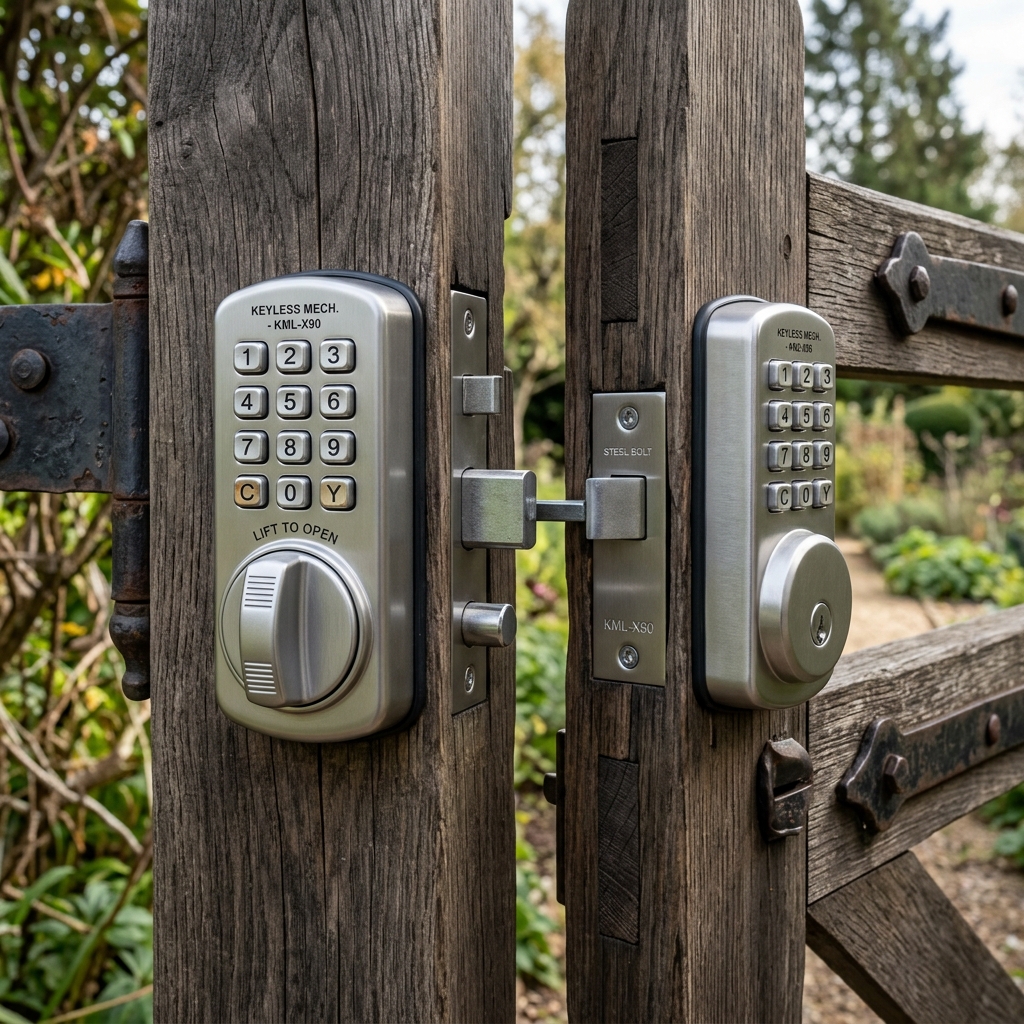
Outdoor gate security systems are subject to harsh weather and corrosion. Discover how double-sided mechanical deadbolts and Teflon coatings protect outdoor perimeters.
- Double-sided keypad locks requires passcode validation to enter or exit
- Marine-grade Teflon coating resists corrosion in salt-air climates
- 100% mechanical engineering eliminates batteries, wiring, and software failures
Physical Access Control
Securing outdoor perimeters requires heavy-duty access systems that can withstand both severe weather and aggressive physical attacks. Standard electronic locks often fail in freezing rain or direct hot sun, while low-grade hardware rusts and jams under salt air. This evaluation explores double-sided mechanical locks equipped with marine-grade Teflon coatings, designed to provide keyless security without batteries, wiring, or software vulnerabilities. We examine how mechanical tumblers operate, how hydrophobic coatings prevent rust, and how double-sided keypads block reach-through bypass attempts. By understanding these critical design features, property managers can select hardware that ensures long-term perimeter security.
1. Mechanical Actuation of Code Tumbler Pins
The mechanical core of a keyless perimeter gate lock relies on a series of spring-loaded code tumbler pins that regulate physical access control. When a user presses a key on the external interface, the corresponding internal slide chamber shifts laterally. This movement repositions the mechanical gates of the code plates, adjusting their slot alignment to either accept or block the retraction stroke of the primary actuator bar.
Unlike standard brass pin-tumbler cylinders that rotate with a physical key profile, these push-button mechanisms use linear sliding elements to decode input sequences. Each button is mechanically linked to a specific tumbler plate containing notched gates. Entering the correct sequence aligns all these gates, forming a continuous clearance channel that allows the heavy-duty deadbolt linkage to slide freely into the unlocked state.
The mechanical integrity of this system relies entirely on physical forces, eliminating reliance on electronic components, solenoids, or wiring. The physical force applied by the operator's hand directly compresses the return springs and aligns the tumbler plates. Consequently, this design bypasses failures caused by low temperatures, dead batteries, or electrical shorts, making it ideal for isolated exterior gates.
To modify the security combination, a technician must physically swap the color-coded code and non-code tumblers within the internal carriage assembly. This manual configuration alters the mechanical geometry of the gating sequence, ensuring that only the new key combination can line up the clearance path. This mechanical programming is immune to remote hacking or digital bypass techniques, maintaining high physical security.
- Mechanical keypads slide internal code tumblers into alignment to establish a clear mechanical channel for manual deadbolt retraction.
- Spring-loaded pin assemblies operate entirely on kinetic input, eliminating the need for electrical power or sensitive battery packs.
- Internal chamber housings are constructed from zinc alloy to protect sliding plates against forced shear and physical impact.
- Manually swappable code and non-code pins allow perimeter managers to customize combinations without electronic interfaces or software tools.
- Direct mechanical actuation ensures the access system functions reliably in freezing sub-zero conditions where electronic keypads routinely fail.

2. Marine-Grade Teflon Coatings and Atmospheric Corrosion
Outdoor perimeter locks are subjected to relentless atmospheric conditions, including heavy precipitation, relative humidity, and airborne saline particulate matter. In coastal environments, moisture laden with sodium chloride accelerates galvanic corrosion between dissimilar metals inside the lock body. If left unprotected, standard brass tumblers and steel return springs will oxidize, forming crusty metal oxides that restrict pin movement and cause mechanism seizure.
To mitigate atmospheric corrosion, high-end gate hardware features a marine-grade polytetrafluoroethylene, or Teflon, coating across all critical moving parts. This fluoropolymer cladding provides a highly hydrophobic layer that prevents water molecules from adhering to internal surfaces. By shielding raw steel and brass from moisture contact, the coating eliminates the electrolyte medium necessary for galvanic degradation to proceed.
Beyond moisture resistance, the Teflon coating acts as a dry film lubricant with an extremely low coefficient of friction. Standard wet lubricants like grease or oil attract airborne dust, sand, and pollen, turning into an abrasive paste that wears down internal pin tolerances. In contrast, Teflon ensures smooth sliding action without attracting debris, preserving the tight mechanical clearances of the internal code plates.
Furthermore, the coating protects the delicate return springs that push the tumbler plates back into their locked positions after actuation. If these springs lose their elasticity due to rust, the lock will fail to reset, leaving the gate vulnerable to bypass. Utilizing coated steel springs ensures consistent tension and recoil force, extending the overall operating lifespan of the security system.
- Marine-grade Teflon cladding creates an advanced hydrophobic barrier that repels water droplets and prevents corrosion on active metal parts.
- Self-lubricating properties reduce mechanical wear on code plates, eliminating the need for sticky grease that attracts outdoor dust.
- Fluoropolymer coating prevents galvanic reactions between copper pins and steel springs, ensuring smooth actuation in harsh marine climates.
- Coated return springs maintain crucial mechanical tension over millions of cycles, preventing failure from structural fatigue or rust.
- Atmospheric sealing protects the lock internals from salt-air exposure, making the deadbolt ideal for high-humidity coastal installation sites.
3. Double-Sided Keypad Entry and Exit Control
A major vulnerability of standard fence gates is the ease with which intruders can bypass single-sided locks. If a gate has a mechanical keypad on the exterior but a simple thumbturn on the interior, a trespasser can easily reach through the fence slats or scale the top rail to turn the handle. This reach-around attack renders even the most robust external keypad security completely ineffective.
To address this vulnerability, double-sided mechanical gate locks incorporate fully independent keypad entry systems on both the exterior and interior faces. To open the gate from either side, a user must input the authorized access code. This design completely blocks reach-through attacks, as turning the interior handle is mechanically impossible without first satisfying the internal code tumbler gate alignment on that side.
This dual-keypad configuration is particularly beneficial for securing perimeters that enclose high-risk zones, commercial yards, or residential pool areas. In addition to stopping external intruders, it prevents unauthorized egress, ensuring that children or pets cannot open the gate from the inside. The lock effectively establishes a secure two-way barrier that regulates all movement across the boundary line.
From an engineering perspective, the double-sided design requires independent spindle assemblies to transmit rotational force to the latch. The interior and exterior keypads operate distinct slider columns that interface with a central deadbolt actuator. This mechanical separation ensures that compromising the external keypad housing does not affect the locking state or security of the internal mechanism, maintaining perimeter integrity.
- Dual mechanical keypads force code verification for both entry and exit, securing the perimeter from unauthorized access from either direction.
- Independent internal lock spindles prevent intruders from bypassing the system by reaching through fence pickets to rotate the inner handle.
- Two-way access control keeps young children and domestic animals safely contained inside the yard, preventing accidental or unmonitored egress.
- Isolated keypad operations ensure that physical vandalism to the exterior housing does not compromise the locking status of the interior assembly.
- Mechanical code configurations can be set to different combinations on each side, allowing custom permissions for incoming and outgoing personnel.
4. Mechanical Actuator Torque and Gate Slam Stresses
Heavy exterior gates, particularly those constructed from wrought iron or heavy timber, generate massive kinetic energy when closing. Under high wind conditions or the tension of heavy-duty automatic gate closers, the gate can slam shut with severe force. This impact transmits high-g deceleration forces directly through the latch bolt and into the internal mechanical components of the lock housing.
Standard residential door locks are not designed to withstand these violent forces, often suffering bent spindles or fractured latch housings. In contrast, heavy-duty mechanical gate locks utilize reinforced latch bolts forged from high-tensile steel alloys. These components are specifically engineered to absorb the shock of repeated gate slams, preventing the internal alignment of the code tumblers from shifting or jamming.
The internal design incorporates shock-damping springs and hardened steel backing plates that distribute the force of impact across the entire lock body. This prevents localized stress concentration on the delicate slide chambers and pins. Additionally, the deadbolt mechanism features a hardened steel roller pin inside the bolt itself, which spins freely to resist hacksaw cutting attempts.
To handle the torque required to retract a heavy latch against gate warping or wind loading, the lock handles are connected to heavy-duty torsion springs. These springs ensure that the handle returns to its horizontal resting position after use, readying the locking mechanism. The robust internal linkages ensure that the user's hand torque is efficiently converted into linear retraction force.
- Reinforced steel latch bolts absorb high kinetic forces from windy conditions and automatic closers, preventing deformation of internal mechanical linkages.
- Shock-damping internal plates distribute slamming stresses across the entire metal body to shield the sensitive code tumblers from sudden impact.
- Heavy-duty internal torsion springs ensure that handles return to their original locked position, preventing drooping and incomplete latch engagement.
- Hardened steel roller pins embedded inside the deadbolt rotate under saw blades, rendering physical cutting attacks completely ineffective.
- High-torque mechanical linkages convert minimal handle rotation into maximum retraction force, overriding slight gate misalignment or binding.
5. Gate Thickness and Profile Adaptation
One of the primary challenges when installing security hardware on outdoor gates is the wide variety of gate profiles and materials. Unlike standard wooden residential doors that have uniform thicknesses, gates can range from thin hollow steel tubes to thick, irregular wooden posts. A commercial-grade gate lock must feature a highly adaptable mounting architecture to fit these different structural profiles.
To accommodate thickness variations, keyless gate locks use modular spindle and mounting screw packages. The main spindle, which connects the handles through the gate, can be cut to length or swapped with longer alternatives to fit gate thicknesses from 1-3/16 inches to 2 inches. This ensures the lock housing clamps securely to the gate frame without internal binding.
For gates with very thin frames, such as ornamental iron or chain-link gates, installers use specialized adapter boxes. These metal enclosures protect the exposed spindle and latch assembly from tampering, while providing a solid, flat surface for mounting the lock body. The adapter box acts as a structural extension of the gate frame, ensuring a clean and secure installation.
Furthermore, the latch spacing must be adjustable to handle gap tolerances between the gate and the latch post. High-quality locks include adjustable deadbolts or latch brass extensions that can be lengthened or shortened. This flexibility allows installers to compensate for gate sagging or seasonal shifting of the fence posts, ensuring the lock continues to latch securely over time.
- Modular spindle kits allow installers to customize the lock depth, accommodating gate thicknesses ranging from thin metal to thick wood.
- Protective adapter boxes provide secure mounting platforms on round chain-link or square metal frames, shielding the internal spindle from weather.
- Adjustable deadbolt spacing compensates for seasonal shifting of posts or gate sagging, preventing binding and ensuring smooth latch engagement.
- Through-bolt mounting designs clamp the lock bodies together from both sides of the gate, maximizing resistance against physical leverage attacks.
- Universal handing configurations allow the lock to be configured for either left- or right-hand gate orientations during the installation process.
6. Pin Combination Randomization and Anti-Pry Shields
A common method used by intruders to bypass mechanical push-button locks is analyzing wear patterns on the keypad. Over months of use, the buttons in the active code combination can become worn, shiny, or slightly loose. This visual indicator allows a malicious actor to quickly determine which buttons are part of the passcode, drastically reducing the number of permutations needed to guess the correct sequence.
To defend against this, high-security mechanical locks use premium, wear-resistant metal buttons and a non-sequential decoding design. Since the mechanical tumblers do not care about the order in which the buttons are pressed, the user can press the code keys in any sequence. This allows the user to randomize the input order, reducing the localized wear on specific buttons and keeping the code secret.
Another critical vulnerability is physical manipulation or prying of the lock body. Intruders may attempt to slide thin shims or pry bars into the gap between the lock and the gate frame to force the latch back. To block this, security locks feature integrated anti-pry shields and latch guards that cover the latch bolt, preventing direct physical access to the mechanism.
Finally, the internal chambers are designed with slip clutch mechanisms in the handles. If an intruder attempts to force the handle down without entering the correct code, the clutch slips, allowing the handle to rotate freely without engaging the deadbolt. This prevents the transfer of forced rotational torque to the internal code tumblers, protecting the delicate internal gears from damage.
- Wear-resistant button coatings prevent visual clues and mechanical indicators from revealing frequently pressed keys to potential intruders.
- Non-sequential mechanical code logic allows combination keys to be entered in any order, complicating attempts to guess the passcode sequence.
- Integrated anti-pry shields cover the latch gap to block shimming tools and crowbars from accessing the deadbolt from outside.
- Slip clutch handles disengage the lever from the deadbolt mechanism when forced, preventing torque damage from brute-force vandalism.
- Internal chamber shielding prevents lock-picking needles and diagnostic tension tools from feeling the gate positions inside the code tumblers.
Access Recommendation & Audit
To achieve maximum perimeter security and eliminate maintenance overhead, we recommend installing a double-sided mechanical gate deadbolt. When selecting a lock, prioritize models with marine-grade Teflon internal coatings to ensure smooth operation in salt-air and high-humidity climates. Verify that the gate thickness and frame profile align with the lock's adjustable spindle specifications, and consider adding a protective adapter box for thin metal posts. Regular combination changes will prevent keypad wear patterns from revealing your access code. Check out our top-rated recommendation below to upgrade your outdoor security setup with a robust, battery-free solution.
Double-Sided Mechanical Keyless Deadbolt for Outdoor Gates
- Double-sided keypad locks requires passcode validation to enter or exit
- Marine-grade Teflon coating resists corrosion in salt-air climates
- 100% mechanical engineering eliminates batteries, wiring, and software failures
- Heavy-duty deadbolt fits gate thicknesses from 1-3/16 to 2 inches
Technical Specifications & Product Data
| Specification | Value / Details |
|---|---|
| Brand | LockeyUSA |
| List Price | $189.95 (USD) |
| Customer Rating | 4.6 / 5.0 (2,840 reviews) |
| ASIN / Identifier | B0046E56QW |
| Availability | In Stock (USA Region) |
| Outbound Link Compliance | Sponsored & Nofollow Enforced |
Verified Features & Performance Data
- ✓Double-sided keypad locks requires passcode validation to enter or exit
- ✓Marine-grade Teflon coating resists corrosion in salt-air climates
- ✓100% mechanical engineering eliminates batteries, wiring, and software failures
- ✓Heavy-duty deadbolt fits gate thicknesses from 1-3/16 to 2 inches
System Sovereignty & Engineering
Edge Computing
100% Client-side processing. Your data never leaves your browser sandbox, ensuring absolute compliance with US privacy mandates.
Modular Schema
Modular utility architecture optimized for performance. Low-latency WASM kernels provide near-native speeds for complex transformations.
Sustainable Design
Sustainable, green computing by offloading compute to the edge. Verified zero-server storage (ZSS) for professional-grade security.