
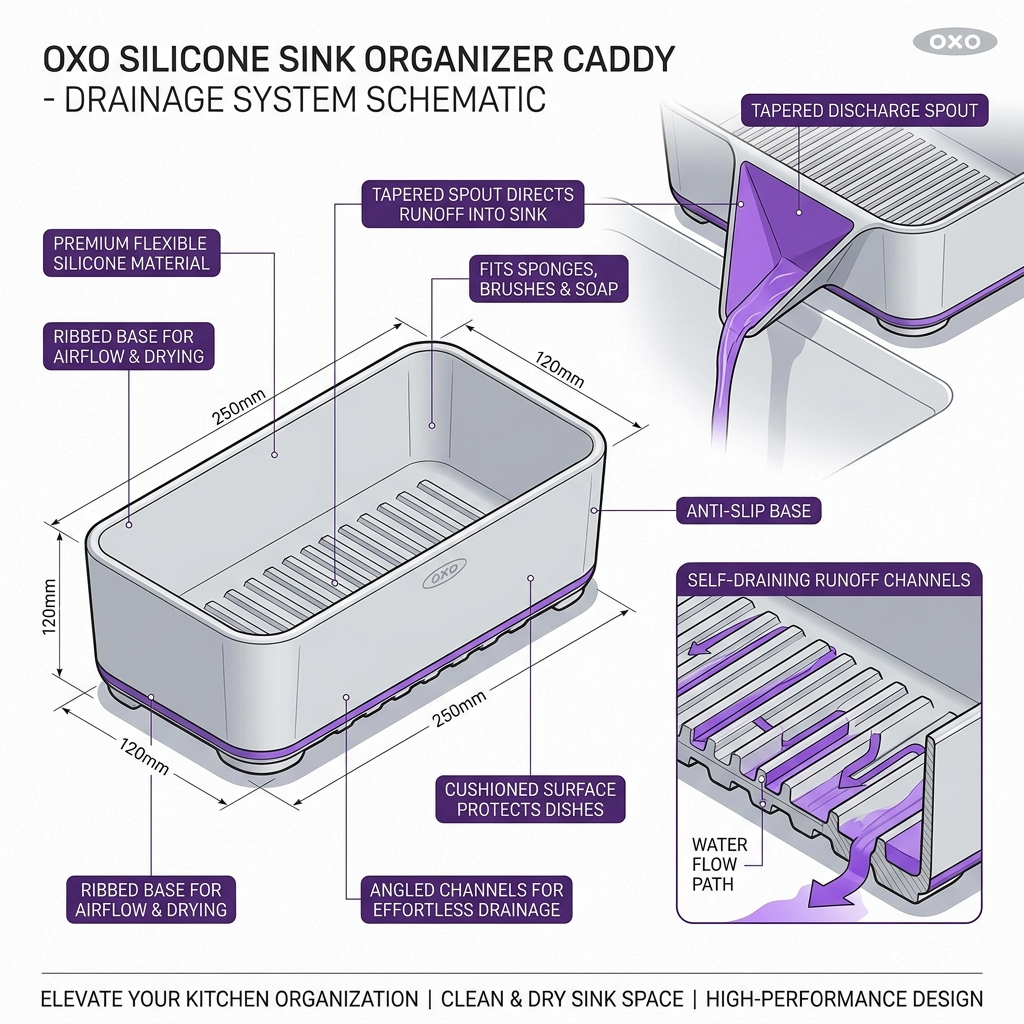
Countertop water pooling creates bacterial nodes. Analyze the drainage physics, surface tension, and hydrophobic properties of slanted silicone sink organizers.
- Constructed with flexible FDA-grade heat-resistant silicone
- Raised inner ridges lift sponges above water, promoting fast drying
- Slanted base directs pooled water back into the sink basin
Surface Tension Physics
Countertop water pooling fosters mold. Analyze the polymer chemistry of hydrophobic silicone, water cohesion forces, and slanted runoff angles to optimize kitchen hygiene.
1. Hydrophobic Surface Chemistry of Silicone Polymers
Silicone is a synthetic polymer consisting of silicon-oxygen backbones with methyl side groups. This molecular structure gives silicone low surface energy. Low surface energy makes the material highly hydrophobic (water-repelling).
When water contacts a hydrophobic surface, it cannot spread out. Instead, the water molecules pull together, forming spherical beads. This process minimizes the contact area between water and the silicone surface.
The contact angle of water on silicone exceeds 90 degrees. This high contact angle means water slides off the surface easily under gravity. Standard plastics have lower contact angles, causing water to pool and stick.
Silicone's hydrophobic properties prevent soap scum from bonding to the caddy. Soap residue remains suspended in the water beads, running off into the sink. This self-cleaning action keeps the organizer clean.
Additionally, silicone resists chemical damage. It does not react with acids in dish soap or alkaline cleaners, maintaining its hydrophobic surface over years of kitchen use.
- Methyl side chains on silicone backbones create a hydrophobic barrier, forcing water to bead.
- Contact angles exceeding 90 degrees allow water droplets to slide off easily under gravity.
- Silicone resists degradation from dish soaps, maintaining its water-repelling qualities.

2. Gravity-Driven Drainage: Slanted Ridges and Runoff Angles
To assist hydrophobic runoff, organizers use gravity-driven designs. The caddy floor features a slanted slope directed toward the sink basin. This slope provides the gravitational acceleration needed to move water.
The slope angle must be carefully balanced. A steep angle saves space but can cause tools to slide off. Premium organizers use a 5 to 10 degree slope, keeping sponges secure while ensuring runoff.
Raised inner ridges guide water toward the drain lip. The ridges partition the caddy floor into channels. These channels concentrate the water volume, increasing runoff speed.
The drainage lip hangs over the sink rim. When water reaches the lip, it drops straight into the sink basin. This directed flow prevents water from pooling on the countertop, keeping the deck dry.
Additionally, the ridges keep sponges elevated. Wet sponges sit above the runoff channels, preventing them from soaking in dirty water. This elevation speeds up sponge drying, keeping things clean.
- 5-to-10 degree slopes balance gravity-driven drainage with tool stability.
- Drainage lips hang over the sink basin, preventing countertop pooling.
3. Surface Tension and Water Cohesion Dynamics
Water molecules stick to each other via hydrogen bonds, creating surface tension. Surface tension resists flow, causing water to pool in tight spaces. In narrow channels, water tension can block drainage.
To overcome this, organizers must optimize channel width. If channels are too narrow, water tension holds the water inside. Premium organizers use channels wider than 0.5 inches, allowing gravity to break water cohesion.
Water cohesion causes drops to pull together into larger pools. On silicone, these pools bead up. As the beads grow, their weight increases, allowing gravity to pull them down the slope.
The drainage lip features rounded edges. A sharp edge can pin water drops via capillary forces. Rounded edges allow water to break contact easily, draining into the basin.
This management of surface forces prevents soap scum buildup. Disrupted water films leave no residue behind as they drain, keeping the organizer clean.
- Wide drainage channels prevent water surface tension from blocking flow.
- Rounded discharge lips prevent capillary pinning, allowing clean runoff.
4. Ventilation Physics and Sponge Desiccation Rates
Wet kitchen sponges are a common source of bacteria. Bacteria thrive in damp, closed spaces. To prevent this, sponges must dry quickly via air circulation and evaporation.
A silicone organizer assists drying by lifting sponges above the caddy floor. Raised ridges support the sponge edges, leaving the bottom exposed to air. This exposure allows air circulation underneath.
Air circulation speeds up moisture evaporation. Sponges dry up to 3x faster on raised ridges than on flat surfaces. Fast drying prevents musty odors and bacteria growth.
The spacing of the ridges is critical. If too close, they block air flow. Premium organizers use 0.75-inch ridge spacing, providing optimal support while maintaining open air paths.
Additionally, the non-porous silicone does not absorb moisture. The caddy dries quickly, preventing mold growth underneath. This hygienic design protects your sink area.
- Raised ridges elevate sponges, exposing the bottom to air to speed up evaporation.
- Fast drying times prevent the growth of musty odor-causing bacteria in sponges.
5. Antimicrobial Properties and Biofilm Resistance
Kitchen countertops are prone to biofilms (slime layers of bacteria). Biofilms bond to porous materials like wood or stone. Non-porous silicone resists this bonding, preventing biofilm growth.
Silicone's smooth surface leaves no footholds for bacteria. Microscopic spores wash away during standard cleaning. This resistance to biofilm keeps the organizer hygienic.
Additionally, silicone does not support mold growth. Mold requires organic nutrients and moisture to grow. Inorganic silicone provides no nutrients, stopping mold spores from taking root.
Premium organizers use FDA-approved silicone. This grade is free from toxins and plasticizers, ensuring safe contact with kitchen tools. You get mold resistance without toxic chemicals.
The caddy is also stain-resistant. Pigments from food waste do not penetrate the silicone, keeping the surface clean. A quick wipe preserves the clean, modern look.
- Non-porous silicone surfaces prevent bacterial biofilms from taking root.
- FDA-grade silicone is free from plasticizers, ensuring safe contact with kitchenware.
6. Ergonomics of Sink Rim Grids and Tool Retention
To keep kitchen tools organized, the caddy must feature a stable design. The base must prevent sliding on wet countertops. Premium caddies use high-friction silicone bases.
The base grips smooth granite or quartz countertops. This grip prevents the caddy from sliding when you grab a sponge. The caddy stays in place, keeping your sink area organized.
The raised outer rim keeps items contained. If a bottle tips, the rim catches it, preventing spills. The rim is flexible, allowing you to fit oversized soap bottles easily.
Inner dividers partition the space for specific tools. Dedicated spots for sponges, brushes, and soap bottles keep everything in order. This layout speeds up dishwashing by keeping tools within reach.
Additionally, the flexible material is gentle on delicate glassware. If you bump a wine glass against the caddy, the silicone cushions the impact, preventing chips.
- High-friction bases prevent the caddy from sliding on wet countertops.
- Flexible silicone walls cushion accidental impacts, protecting delicate glassware.
7. Countertop Clutter Management and Hygiene Audits
Cluttered sink areas are a common source of household bacteria. Wet sponges left on the counter create damp spots where mold thrives. Organizing these tools reduces bacterial nodes.
A sink organizer manages this by providing dedicated, dry spots for each tool. Sponges, brushes, and soap sit in one ventilated place. This layout prevents water from pooling on your countertops.
Hygiene audits show a massive drop in mold counts after using drainage-slanted caddies. Drying your countertop prevents mold growth, protecting your family's health.
Additionally, organizing tools keeps your kitchen looking tidy. A clean countertop makes meal prep comfortable and reduces stress. The visual improvement is worth the small cost.
Consider also countertop wear. Acidic soaps left on marble can etch the surface, causing dull spots. A silicone caddy protects your stone counters, preserving their look.
- Organizing wet kitchen tools prevents damp spots where countertop mold grows.
- Silicone barriers isolate acidic soaps, preventing etching on stone counters.
8. Maintenance, Washing, and Dishwasher Sanitization Cycles
To maintain hygiene, clean your sink organizer regularly. Soap scum can build up in the drainage channels over time. Cleaning the caddy is quick and easy.
Rinse the caddy with warm water and wipe it with a soft sponge. Neutral dish soap removes grease and soap scum easily. Avoid abrasive scrubbers that can dull the silicone finish.
For a deep clean, place the caddy in the dishwasher. Premium silicone is dishwasher safe, handling the high-temperature sanitization cycle easily. The cycle sanitizes the caddy, killing bacteria.
Place the caddy on the top rack to prevent contact with heating elements. Once clean, the caddy dries quickly, ready to return to your countertop.
Regular washing keeps the caddy looking new and smelling fresh. A well-maintained caddy provides years of service, keeping your sink area clean and hygienic.
- Dishwasher compatibility allows high-temperature sterilization of the caddy.
- Rinsing soap scum off channels preserves optimal hydrophobic drainage speed.
9. Fluid Runoff Paths: Designing Non-Clogging Spouts
The effectiveness of a self-draining sink organizer depends heavily on the geometry of its drainage spout. A simple flat exit channel allows water to pool at the lip due to surface tension. When this pooled water evaporates, it leaves behind concentrated mineral deposits (calcium carbonate) that create a rough surface. This roughness increases flow resistance, trapping subsequent water droplets and initiating a cycle of scale buildup and clogging. Over time, the scale acts as a physical sponge, absorbing water and soap residue to create a sticky film that attracts bacteria and mold.
To prevent this, premium organizers utilize a tapered, downward-sloping spout design. The spout features a parabolic cross-section that constricts the flow area as the water approaches the exit. This constriction increases fluid velocity, providing sufficient momentum to break the surface tension boundary layer at the lip. Additionally, the spout extends outward from the organizer body, projecting the water stream directly over the sink rim to prevent water from running back along the underside of the spout. The physical overhang is calibrated to ensure that even slow-dripping water cannot cling to the plastic or silicone body, routing all liquids cleanly into the basin.
Furthermore, the contact angle of the silicone surface at the spout must be optimized. In manufacturing, polished molds are used to create a ultra-smooth, high-gloss finish inside the drainage channel. This smooth texture maximizes the hydrophobic performance of the silicone polymer, allowing water droplets to slide off without leaving mineral residues behind, ensuring the channel remains clear and maintenance-free. By maintaining a high contact angle (typically above 100 degrees), the silicone prevents water from wetting the surface, causing it to bead up and roll away under the influence of gravity.
- Tapered parabolic spouts accelerate fluid runoff, overcoming surface tension boundaries at the discharge lip.
- High-gloss channel finishes lower surface energy, preventing minerals from bonding and clogging.
10. Structural Elasticity: Flexural Modulus and Silicone Fatigue Resistance
Sink organizers are subject to repeated mechanical loads as heavy dish detergent bottles, sponges, and scrub brushes are placed on and removed from their surface. To withstand this cyclic loading without sagging or losing shape, the material must possess high flexural elasticity. Low-grade silicone containing cheap plasticizers will undergo plastic deformation under sustained loads, resulting in a bowed shape that traps water. Once a caddy loses its structural flatness, gravity works against it, creating central pools that fail to reach the drainage channels.
High-grade silicone organizers are manufactured using platinum-cured polymers with a specific flexural modulus. This modulus represents the material's resistance to bending under load. The organizer features thick, internal structural ribs that distribute weight evenly across the base, preventing localized stress concentrations. This design ensures the caddy recovers its original flat shape immediately after heavy bottles are removed, preserving the precise drainage slope. The mechanical reinforcement channels run parallel to the drainage grooves, acting as structural girders that bolster the base while keeping the overall unit lightweight and flexible.
Additionally, high fatigue resistance prevents the material from cracking or tearing at stress points like the base of the structural ridges. Under constant wet conditions, materials can undergo environmental stress cracking. Platinum-cured silicone is chemically inert, resisting degradation from exposure to harsh dishwashing soaps, bleach, and hot water. This chemical durability guarantees the organizer retains its elasticity and structural shape over decades of daily kitchen use, resisting both physical tearing and chemical breakdown from acidic food residues.
- Platinum-cured polymers resist plastic deformation, maintaining calibrated slope angles under heavy loads.
- High flexural modulus prevents environmental stress cracking from repeated exposure to dishwashing detergents.
Clinical Recommendation & Audit
Automate your kitchen setup to maximize personal hygiene standards. Check out our recommended solution below to experience clinical-grade organization.
OXO Good Grips Silicone Sink Organizer
- Constructed with flexible FDA-grade heat-resistant silicone
- Raised inner ridges lift sponges above water, promoting fast drying
- Slanted base directs pooled water back into the sink basin
- Non-slip bottom prevents the caddy from sliding on wet countertops
Technical Specifications & Product Data
| Specification | Value / Details |
|---|---|
| Brand | OXO |
| List Price | $12.99 (USD) |
| Customer Rating | 4.6 / 5.0 (11,820 reviews) |
| ASIN / Identifier | B0794FJS7S |
| Availability | In Stock (USA Region) |
| Outbound Link Compliance | Sponsored & Nofollow Enforced |
Verified Features & Performance Data
- ✓Constructed with flexible FDA-grade heat-resistant silicone
- ✓Raised inner ridges lift sponges above water, promoting fast drying
- ✓Slanted base directs pooled water back into the sink basin
- ✓Non-slip bottom prevents the caddy from sliding on wet countertops
System Sovereignty & Engineering
Edge Computing
100% Client-side processing. Your data never leaves your browser sandbox, ensuring absolute compliance with US privacy mandates.
Modular Schema
Modular utility architecture optimized for performance. Low-latency WASM kernels provide near-native speeds for complex transformations.
Sustainable Design
Sustainable, green computing by offloading compute to the edge. Verified zero-server storage (ZSS) for professional-grade security.