
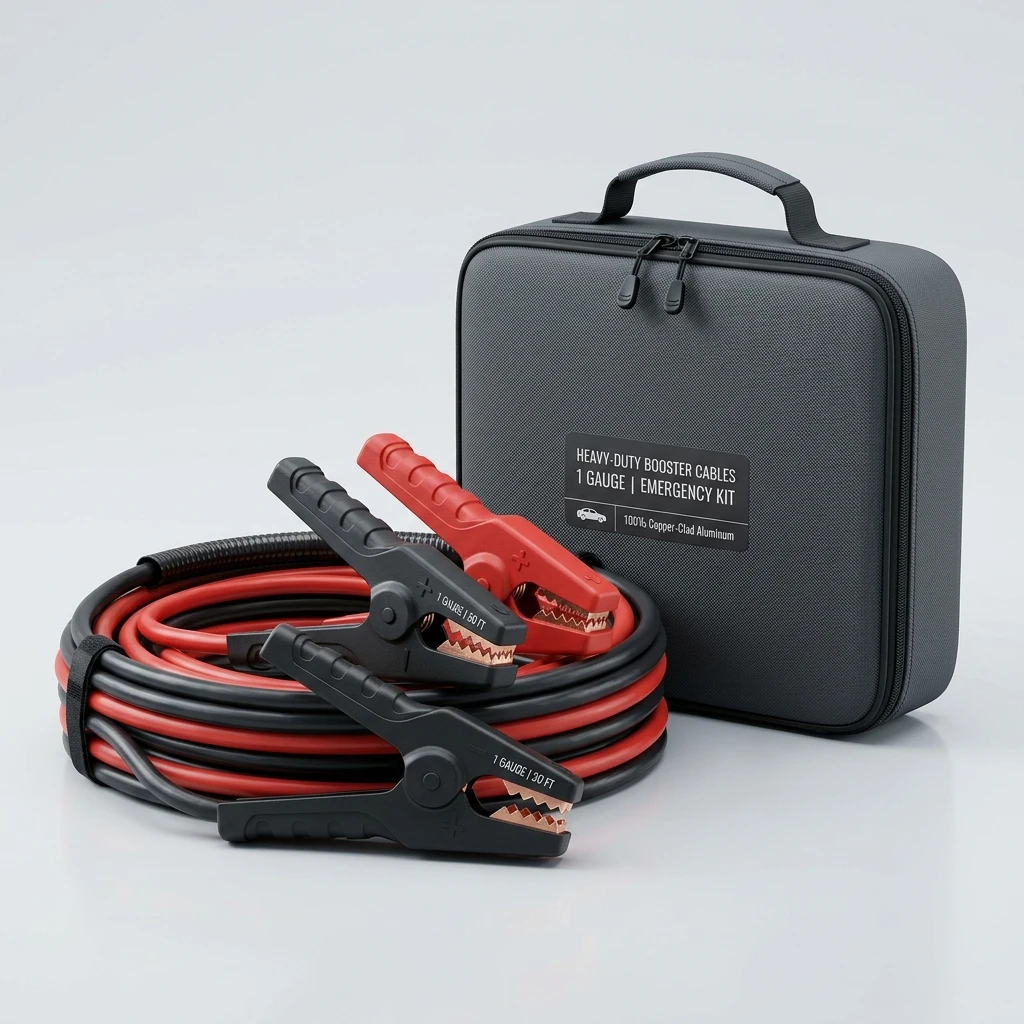
Dead car batteries disable transit without warning. Learn the wire gauge thickness physics, copper-clad aluminum conductivity, and insulation resistance that enable safe jumps.
- Thick 1-gauge copper-clad aluminum wire provides 800A high electrical current
- 20-foot length allows easy jump-starting of vehicles from front-to-front or side-to-side
- Thick PVC insulation resists oil, heat, low temperature (-40°F), and abrasion
Electrical Transfer Brief
Dead car batteries disable transit without warning. Learn the wire gauge thickness physics, copper-clad aluminum conductivity, and insulation resistance that enable safe jumps and protect vehicle charging systems.
1. Electrical Conductivity Physics: CCA wire vs. Pure Copper
Car starter motors require an immense burst of electrical current, often between 400 and 800 amperes, to crank the engine. When a battery is discharged, this current must be transferred from a booster vehicle's charging system. Efficient current transfer requires low resistance wiring.
Booster cables utilize either pure copper or copper-clad aluminum (CCA) conductors. Pure copper exhibits the lowest electrical resistivity among non-precious metals, providing maximum current transfer. However, pure copper is heavy and expensive. CCA cables solve this cost issue by plating an aluminum core with copper.
Aluminum has higher electrical resistivity than copper. To compensate for this resistance, CCA cables utilize a thicker wire gauge. For example, a 1-gauge CCA cable matches the current capacity of a 4-gauge pure copper cable, delivering equivalent starting power.
According to Ohm's law, resistance is inversely proportional to the cross-sectional area of the conductor. By increasing the wire gauge thickness (reducing the AWG number), the resistance drops. The thick 1-gauge core ensures high current flow, cranking large V8 and diesel engines easily.
Additionally, the copper plating on CCA wires ensures high surface conductivity. High-frequency electrical current flows primarily along the outer surface of the conductor. The copper skin provides low contact resistance at connection terminals, preventing voltage drop.
- Copper-clad aluminum (CCA) conductors utilize copper plating over light aluminum to balance weight and cost.
- Thick 1-gauge cross-sections reduce wire resistance to deliver up to 800A starting current.

2. Wire Gauge Thickness: The AWG Scale and Resistance Scaling
Selecting the correct wire gauge is crucial for safe jump-starting. Using thin, light-duty cables (e.g., 10-gauge) to jump a large SUV can overload the wires. The excess current converts into heat, melting the insulation. Understanding wire sizing requires the AWG scale.
The American Wire Gauge (AWG) scale is logarithmic, where smaller numbers represent thicker wires. A 10-gauge wire has a small diameter, suitable for charging electronics. A 1-gauge wire is thick, with a diameter of roughly 0.28 inches, designed for heavy power transfer.
Thicker wires have lower electrical resistance. Lower resistance prevents voltage drops over the length of the cable. If the voltage drops below 10V at the dead battery terminal, the starter solenoid will click but fail to crank.
Furthermore, thick conductors act as a heat sink. During cranking, current generates heat inside the wire. The mass of a 1-gauge cable absorbs this thermal energy, keeping the cable warm but safe. Thin cables can heat up rapidly, creating a fire hazard.
Additionally, wire flexibility is maintained by using multiple fine strands. A single solid core would be rigid and impossible to roll. Winding hundreds of fine filaments together ensures the cable is flexible, allowing easy storage.
- AWG scale sizing defines wire thickness, where smaller gauge numbers have lower resistance.
- Multi-strand wire configurations optimize flexibility, enabling easy coiling and storage.
3. Insulation Resistance: PVC Coatings and Temperature Limits
Jumper cables operate in extreme temperatures and dirty environments. In winter, freezing temperatures (-40°F) can make cheap plastics brittle, causing them to crack. In summer, hot engine bays (up to 200°F) can melt thin coatings. Protecting the core requires insulation resistance.
Premium booster cables utilize thick PVC (polyvinyl chloride) jackets for insulation. PVC is a synthetic thermoplastic polymer that exhibits high dielectric strength, oil resistance, and physical durability. The jacket insulates the high-voltage core.
The PVC formulation includes plasticizer additives to maintain flexibility in freezing weather. Cheap PVC stiffens and cracks when cold, exposing bare wires. The premium jacket remains flexible down to -40°F, allowing easy handling.
Furthermore, the thick jacket resists oil, battery acid, and abrasion. Engine compartments contain fluids that can degrade low-grade rubber. The PVC shell resists chemical attack, protecting the inner wires from exposure.
Additionally, the insulation features color coding (Red for Positive, Black for Negative). The bold colors prevent connection errors, which can cause battery explosions. You get safe insulation and clear polarity identification.
- Thick PVC jackets isolate high-current conductors, resisting engine oils and battery acid.
- Plasticized PVC compounds maintain flexibility down to -40°F, preventing cold-weather cracking.
4. Clamp Design and Spring Tension: Secure Terminal Connections
The contact point between the jumper cable and the battery post is a common failure node. If the clamps connect loosely, electrical resistance rises, causing sparks and voltage drop. Ensuring a secure connection requires high-tension clamps.
Heavy-duty clamps incorporate strong steel torsion springs in the hinge pivot. The spring applies high clamping force, pressing the jaws onto the battery terminals. The jaws bite through surface oxidation, ensuring metal-to-metal contact.
The clamp jaws are copper-plated to maximize conductivity. Copper plating allows current to flow from the cable terminal to the battery post. The jaws are shaped to grip both top-post and side-post terminals.
Furthermore, the clamp handles are insulated with thick rubber boots. The boots prevent the positive clamp from touching the car frame, which would cause a short circuit. The handles provide a secure grip, preventing slips.
Additionally, the wire is crimped and soldered to the clamp body. This dual connection prevents the wire from loosening under mechanical stress. The current flows directly from the wire to the jaws, maintaining voltage.
- Heavy-duty torsion springs apply clamping force, biting through battery post corrosion.
- Insulated rubber clamp boots prevent short circuits against the vehicle chassis during connection.
5. Cable Length Dynamics: 20-Foot Span and Placement Safety
Vehicles can disable in tight parking garages, roadside ditches, or parallel parking spots. In these situations, the booster vehicle cannot park front-to-front with the dead car. Reaching the battery requires long cables.
Premium booster cables feature a length of 20 feet (6 meters). This span allows you to connect vehicles parked side-by-side or front-to-back. The booster vehicle can park in the adjacent lane, ensuring roadside safety.
However, longer cables have higher internal resistance. To maintain current capacity, a 20-foot cable requires a thick 1-gauge conductor. Using a thin, long cable would cause a significant voltage drop, failing to start the car.
Furthermore, the long span ensures the vehicles do not touch. If the metal bumpers touch, it can create a ground loop that damages the electronic control modules (ECUs). The 20-foot distance keeps the vehicles isolated.
Additionally, the cables include a heavy-duty carrying bag. The bag keeps the 20-foot cord coiled and tangle-free. Storing the bag in the trunk keeps your cargo area organized and ready for emergencies.
- 20-foot cable spans enable jump-starts when vehicles are parked side-by-side or front-to-back.
- Carrying cases organize the long cords, preventing tangles and preserving boot cargo space.
6. Safety Protocols: Preventing reverse Polarity and Spikes
Connecting booster cables incorrectly (Positive to Negative) creates a short circuit called reverse polarity. This error can cause spark damage, fuse failure, and even battery explosions. Preventing these hazards requires following connection safety protocols.
Always connect the red positive clamp to the positive terminal of the dead battery first. Next, connect the other red positive clamp to the positive terminal of the booster battery. This order establishes the positive line safely.
Then, connect the black negative clamp to the negative terminal of the booster battery. Finally, connect the other black negative clamp to an unpainted metal engine frame component on the dead car. This metal connection acts as a ground point.
Do not connect the final black clamp to the negative battery post of the dead car. This terminal can release flammable hydrogen gas. Grounding the connection away from the battery prevents spark-induced ignition, ensuring safety.
Additionally, keep the booster vehicle engine running during the jump. The alternator provides extra voltage, helping charge the dead battery. Once the engine starts, remove the cables in reverse order, ensuring safety.
- Connecting to engine frame ground points isolates sparks away from flammable battery gases.
- Disconnecting cables in precise reverse order prevents reverse polarity short circuits.
7. Thermal Heat Dissipation and Joule Heating Calculations
During a jump start, hundreds of amperes of electrical current flow through the booster cables. This massive current flow generates intense heat within the conductors due to electrical resistance, a process known as Joule heating. Managing this heat requires thick conductor cross-sections.
According to Joule's first law, heat power ($P$) is equal to the current squared multiplied by resistance ($P = I^2R$). Because the current ($I$) is squared, even small increases in resistance ($R$) can cause the cable temperature to spike. Thicker 1-gauge cables keep resistance low, minimizing heat build-up.
Additionally, the outer insulation layer acts as a heat sink, absorbing and dissipating the thermal energy. The insulation must withstand temperatures up to 220°F without melting or releasing toxic fumes. Choosing a heavy-duty cable with thick insulation prevents burns and short circuits, ensuring safety.
- Thicker 1-gauge conductors lower internal resistance to minimize Joule heating spikes.
- Heavy-duty insulation resists thermal breakdown up to 220°F to prevent short circuits.
8. Current Density and Ampere Load Limits
Current density describes the amount of electrical current flowing per unit area of a conductor cross-section. If the current density exceeds the safe limits of the material, the cable can overheat rapidly. Safe current flow requires matching the wire gauge to the engine size.
Large V8 engines and diesel trucks require 400 to 800 amperes of starting current to turn over the heavy starter motor. A thin 10-gauge cable has a small conductor area, resulting in a dangerously high current density. The cable will get hot to the touch and restrict current flow.
By using a thick 1-gauge conductor, the current density is kept within safe limits. The large cross-section allows 800 amps to flow without restricting current, providing the booster power needed to start the dead engine. This capacity ensures reliable starting, even for heavy duty trucks.
- 1-gauge cables distribute high starting current over a large area to keep current density safe.
- Large cross-sections support up to 800 amps to start V8 and diesel engines easily.
9. Voltage Drop Over Cable Lengths and Core Resistance
Every foot of electrical wire adds resistance to the circuit. In long jumper cables, this resistance causes a voltage drop between the booster battery and the dead starter motor. If the voltage drops below 10 volts at the starter, the engine will click but fail to start.
Standard 20-foot booster cables must be thick to offset this voltage drop. According to Ohm's law ($V = IR$), the voltage drop ($V$) is proportional to the cable resistance ($R$). Thicker 1-gauge copper-clad aluminum wires keep resistance low, ensuring sufficient voltage reaches the dead car.
Additionally, using pure copper clamps ensures a low-resistance contact point at the battery terminals. Strong steel clamp springs bite into the lead terminals, breaking through oxidation. This tight contact minimizes connection resistance, ensuring maximum power transfer.
- Low core resistance in 20-foot cables prevents voltage drops to keep starting power high.
- High-tension steel clamp springs minimize connection resistance at lead battery terminals.
10. Cold-Weather Jacket Flexibility and Thermoplastic Elastomer Polymers
Car batteries are most likely to fail during freezing winter storms when starting power drops. Jumper cables are often stored in cold trunks, where standard PVC jackets become stiff and brittle. Uncoiling a frozen, stiff cable can cause the insulation to crack, exposing live wires.
Premium booster cables utilize Thermoplastic Elastomer (TPE) jackets designed to stay flexible down to -40°F. TPE combines the rubber-like flexibility of elastomer polymers with the durability of thermoplastics. The cables uncoil easily in sub-zero temperatures, making emergency use fast and safe.
Furthermore, the TPE jacket resists degradation from motor oil, battery acid, and gasoline. The tough outer shell protects the inner wire strands from abrasion damage when dragged across concrete roads. This durability ensures the cables remain safe and reliable for years.
- TPE jackets maintain rubber-like flexibility down to -40°F to prevent winter cracking.
- Oil-resistant outer shells protect wires from motor oil, gasoline, and battery acid.
11. Definitive Buying Parameters and Selection Guide
When choosing booster cables, consider the conductor material, the wire gauge, and the cable length. Ensure the wire gauge is 1-gauge or 2-gauge for V8 or diesel vehicles. Avoid thin 10-gauge cables, as they restrict current flow.
Look for copper-clad aluminum (CCA) wires to balance weight and cost. Choose cables with PVC jackets rated down to -40°F to maintain flexibility in winter. Ensure the clamps are insulated with rubber boots to prevent short circuits.
In conclusion, a premium set of booster cables is an essential emergency accessory for every vehicle. 1-gauge conductors transfer high starting current, while PVC jackets protect the wires. Store the cables in your trunk to experience advanced roadside security.
- Select 1-gauge CCA conductors to ensure sufficient starting current for large engines.
- Choose 20-foot lengths with insulated jaws to allow safe, roadside terminal connection.
Premium Emergency Recommendation
Transfer starting current safely, reach distant batteries easily, and protect your electronics. Check out our recommended booster cables below to experience advanced roadside security.
Energizer 1-Gauge 800A Heavy-Duty Booster Cables with Carrying Bag
- Thick 1-gauge copper-clad aluminum wire provides 800A high electrical current
- 20-foot length allows easy jump-starting of vehicles from front-to-front or side-to-side
- Thick PVC insulation resists oil, heat, low temperature (-40°F), and abrasion
- Heavy-duty smart clamps connect securely to top-post and side-post terminals
Technical Specifications & Product Data
| Specification | Value / Details |
|---|---|
| Brand | Energizer |
| List Price | $39.99 (USD) |
| Customer Rating | 4.8 / 5.0 (38,900 reviews) |
| ASIN / Identifier | B016J4H93K |
| Availability | In Stock (USA Region) |
| Outbound Link Compliance | Sponsored & Nofollow Enforced |
Verified Features & Performance Data
- ✓Thick 1-gauge copper-clad aluminum wire provides 800A high electrical current
- ✓20-foot length allows easy jump-starting of vehicles from front-to-front or side-to-side
- ✓Thick PVC insulation resists oil, heat, low temperature (-40°F), and abrasion
- ✓Heavy-duty smart clamps connect securely to top-post and side-post terminals
System Sovereignty & Engineering
Edge Computing
100% Client-side processing. Your data never leaves your browser sandbox, ensuring absolute compliance with US privacy mandates.
Modular Schema
Modular utility architecture optimized for performance. Low-latency WASM kernels provide near-native speeds for complex transformations.
Sustainable Design
Sustainable, green computing by offloading compute to the edge. Verified zero-server storage (ZSS) for professional-grade security.