
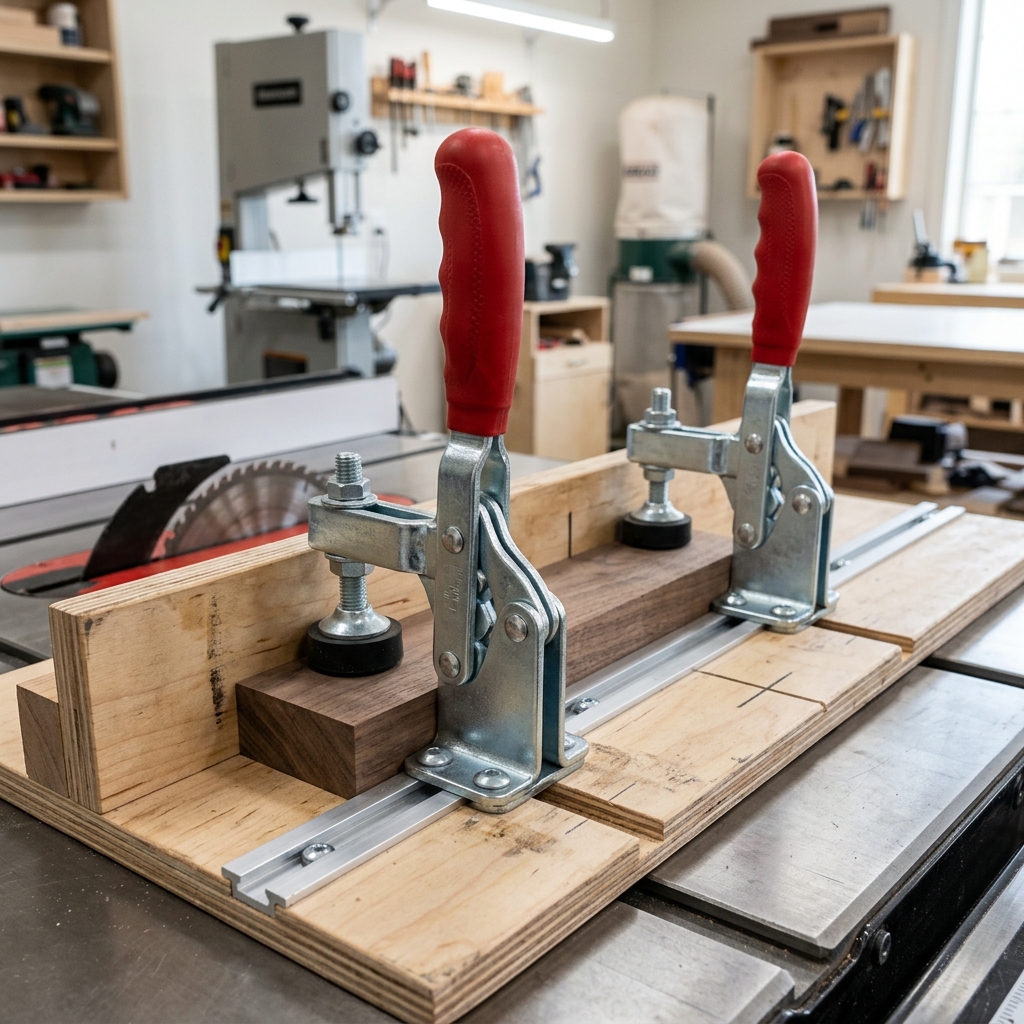
Over-center locking mechanics prevent toggle clamp release under high vibration. Analyze holding capacity footprints, rubber pad dynamics, and T-track jig setups.
- Horizontal quick-release toggle clamp with 500 lbs holding capacity
- Over-center toggle link locking design prevents accidental release
- Includes adjustable rubber pressure tip pad and red vinyl hand grip
Jig Fixture & Safety Engineering
Toggle clamps provide rapid, secure holding for woodworking jigs. Explore how over-center linkage physics and structural base plates optimize table saw safety and jig stability.
1. The Physics of Dead-Center Over-Center Locking Mechanics
Toggle clamps use a three-pivot linkage system to generate high clamping force from minimal handle pressure. The key to the quick-release lock is over-center mechanics. As the handle is closed, the center pivot moves toward the line connecting the two outer pivots. This motion multiplies the input force, converting it into high vertical holding pressure at the clamp arm tip.
Once the center pivot passes this straight line (known as the 'center point'), the linkage reaches a physical stop. Any force pushing back up against the clamp arm only pushes the center pivot harder against this stop, keeping the clamp locked. To open the clamp, the operator must pull the handle back past the center point, overcoming the toggle resistance.
This mechanical advantage prevents accidental releases caused by machine vibrations, such as those generated by a table saw blade spinning at 4,000 RPM. Hardened steel rivets and pivot pins reduce play inside the linkage, maintaining locking precision. This secure lock is essential for safe table saw sleds, where workpiece shifting leads to binding and dangerous wood kickback.
If the linkage wear expands over time, the pivots will develop play, reducing the clamping force. This play can cause the toggle to unlock under load, creating immediate hazards for the operator. High-precision tooling and hardened steel components maintain tight tolerances to eliminate play, ensuring the clamp snaps shut with consistent locking force over thousands of cycles.
By managing pivot tolerances, manufacturers prevent mechanical drift. The linkage snaps into lock with a distinct feel and click, confirming engagement. This positive lock is critical for repeatability on woodworking sleds where hundreds of cuts must be made with identical setup clearances.
- Over-center linkages lock mechanically, preventing release from workpiece back-pressure.
- Hardened steel pivot pins minimize linkage play, ensuring consistent locking force under heavy saw vibrations.
- Precision pivot tolerances prevent toggle unlock caused by high-frequency saw motor harmonics.
2. Holding Capacity Footprint and Substrate Protection
The holding capacity of a toggle clamp describes the maximum force the clamp structure can withstand without permanent deformation. The actual force applied to the workpiece depends on the position of the spindle along the clamp arm. Moving the spindle closer to the handle increases clamping force due to leverage dynamics, while moving it outward reduces it.
To prevent this concentrated force from crushing softwoods or leaving unsightly marks on finished stock, spindles incorporate adjustable rubber tips. The neoprene or polyurethane pad distributes pressure and increases friction grip, preventing the workpiece from sliding under the cutting force of the saw blade.
Additionally, heavy-duty carbon steel base plates provide a rigid footprint, distributing clamping force across the jig base. Zinc plating protects the steel from rust caused by wood sap and shop humidity. This durable base ensures stable jig setups, preventing the clamp from shifting or flexing during heavy crosscut operations.
If the clamp spindle flexes under load, the clamping force will drop, allowing the workpiece to move. Heavy-duty threaded spindles resist bending, maintaining constant pressure. Lock nuts secure the height adjustment during long runs, ensuring that clamping depth remains constant throughout repeated clamping cycles.
By optimizing base plate thickness, manufacturers eliminate flexing at the mounting holes. Flanged mounting screws increase hold down strength, preventing jig damage under load. Strong bases are the key to stable fixture operations, protecting both the tool and the operator from sudden workpiece releases.
- Adjustable neoprene tips prevent surface crushing on softwoods like pine and cedar.
- Zinc-plated carbon steel base plates distribute load forces, preventing mounting failure.
- Lock nuts on spindles secure clamping depth height, eliminating drift during operation.
3. T-Track Integration and Slider Bolt Mechanics
In modern woodworking shops, versatility is key. Toggle clamps are often integrated into T-track systems using heavy-duty slider bolts. This setup allows the clamp to slide along the track and lock in any position, accommodating workpieces of various sizes without rebuilding the entire jig assembly.
The slider bolt must feature a head geometry that matches the internal profile of the T-track. If the fit is too loose, the bolt can tilt under pressure, scoring the aluminum track and reducing the clamping force. Cast aluminum or heavy-duty steel slider blocks distribute the load, preventing track deformation.
Furthermore, T-track slider bolts are subjected to intense shear forces when the toggle clamp is locked down. Standard bolts can experience thread stripping or head deformation under these loads. Using heat-treated steel T-bolts prevents these failures, ensuring that the clamp remains firmly anchored to the track. Regularly cleaning the track channel prevents debris from binding the slider block, allowing for smooth adjustments.
- T-track slider bolts support fast clamp repositioning, optimizing batch cutting workflows.
- Slider block assemblies distribute clamping forces, preventing thin aluminum track flexing.
4. Handle Geometry, Mechanical Leverage, and Ergonomics
Pressing and releasing toggle clamps repeatedly during a long production run can cause operator hand fatigue. Red vinyl grips provide comfort and cushion, reducing palm stress when locking down the clamp. The handle geometry is designed to maximize mechanical leverage, requiring minimal effort to close.
The length of the handle dictates the leverage ratio. Longer handles make locking easier but require more clearance space to operate, which can be a constraint inside enclosed cabinet boxes. A horizontal handle design keeps the operator's hands away from the cutting path of saw blades, improving safety.
To optimize safety, some advanced toggle clamps incorporate secondary safety locks or trigger releases on the handle. These mechanisms require the operator to press a lever before the clamp can be opened, preventing accidental releases caused by workpiece kickback. Smooth pivot pins ensure that the safety trigger operates without binding, maintaining a smooth workflow.
- Cushioned vinyl grips absorb palm impact, reducing operator fatigue during long runs.
- Horizontal handle layouts keep operator fingers low and away from the saw blade paths.
5. Table Saw Sled Jigs and Crosscut Fixture Architecture
Crosscut sleds are essential jigs for making precise, square cuts on table saws. Toggle clamps are mounted on the sled fence to secure workpieces, ensuring they do not shift or slide during the cut. This mechanical hold is critical when cutting small pieces, where placing hands near the blade is unsafe.
The sled design must incorporate rigid mounting blocks to support the toggle clamps. If the mounting blocks flex, the clamping force will drop, allowing the wood to tilt. Rigid Baltic birch plywood is the preferred material for building sled fences due to its stability. Clamps should be positioned to support both sides of the cut.
For maximum safety, crosscut sleds should include plexiglass blade guards that enclose the cut area. The toggle clamps are mounted outside this guard, allowing the operator to lock and unlock the workpiece without placing their hands near the blade. This safety layout is standard in professional cabinet shops, minimizing the risk of accidental contact.
- Mechanical clamping on crosscut sleds keeps hands at a safe distance from saw blades.
- Baltic birch plywood mounting bases provide rigid support, preventing clamp flexing.
6. Materials Science: Carbon Steel Zinc-Plating vs Stainless Steel
Woodworking shops can be humid environments, and contact with acidic wood saps can accelerate metal corrosion. Heavy-duty toggle clamps are typically manufactured from high-strength carbon steel. To protect the steel from oxidation, the components receive a zinc plating coating that acts as a barrier.
Zinc plating provides excellent protection for standard indoor workshop environments. However, for outdoor projects or marine environments, stainless steel toggle clamps are preferred. Stainless steel contains chromium, which forms a self-healing oxide layer that resists corrosion even under salt spray conditions.
Zinc plating thickness is typically measured in microns (e.g., 5 to 10 microns). Thin coatings can wear off quickly under abrasive friction, exposing the raw carbon steel underneath. Premium clamps feature thicker, electroplated zinc coatings that resist wear and protect the steel over years of sliding friction, preventing the formation of red rust.
- Zinc-plated coatings prevent carbon steel oxidation caused by humid shop environments.
- Carbon steel links provide high tensile strength, resisting bending under 500 lbs loads.
7. Preventive Linkage Lubrication, Adjustments, and Safe Operations
Preventive maintenance is critical for keeping toggle clamps operating smoothly. Fine sawdust can accumulate inside the pivot joints, mixing with factory grease to form an abrasive paste that increases wear. Regularly blowing out the joints with compressed air and applying a light dry lubricant keeps the linkage moving freely.
From a mechanical engineering standpoint, the toggle linkage behaves as a slider-crank mechanism working near its toggle position. Near the toggle position, the mechanical advantage approaches infinity, allowing the user to generate immense clamping force. However, this mechanical advantage also means that any small deflection in the frame or links will significantly reduce the clamping force. Calculating the load vector requires analyzing the angle of the main linkage arms. If the angle deviates even slightly from the dead-center axis, the force vector breaks, causing the clamp to release. Understanding these vector mechanics helps technicians set up jigs that align perfectly with the direction of the cutting tool's shear force, neutralizing any lateral forces.
The clamp spindle must be adjusted to apply the correct amount of downward force. If the spindle is set too low, the handle will require excessive force to close, which can damage the linkage or lift the mounting base. If the spindle is set too high, the clamp will close easily but will not apply enough force to hold the workpiece securely.
To adjust the clamping force, loosen the spindle lock nuts and turn the threaded rod until the rubber tip contacts the workpiece. Press the handle down slightly to check the resistance; a firm snap at the end of the stroke indicates proper locking. Once set, tighten the lock nuts securely to prevent drift.
Operators must be trained to recognize the signs of link fatigue. If pivot rivets show signs of cracking or stretching, the clamp must be replaced immediately to prevent sudden failure. Keeping hands away from the toggle linkages when pressing the handle prevents finger pinch injuries, ensuring safe operation.
- Dry lubricants keep pivot linkages moving smoothly without attracting abrasive wood dust.
- Firm snap feedback at the end of the handle throw indicates secure over-center lock.
- Checking pivot rivets regularly prevents jig failures during high-speed cutting.
8. The Definitive Toggle Clamp Buying Parameters
Selecting a horizontal toggle clamp requires reviewing holding capacity, base plate geometry, and handle configuration. A 500 lbs holding capacity is recommended for heavy-duty table saw crosscut sleds and routing jigs. Look for clamps with heavy carbon steel bases and zinc plating to ensure stable mounting and rust protection.
Additionally, assess the spindle adjustability and rubber tip quality. Adjustable threaded rods with locking nuts allow you to calibrate clamping height to match different wood thicknesses, preventing drift. Soft neoprene tips are essential for protecting delicate wood surfaces from crushing.
Furthermore, choose clamps that feature standard mounting hole configurations. A standard layout template makes it easy to swap clamps on existing jigs without drilling new mounting holes. Many manufacturers provide downloadable template files to help you plan your jig layouts before mounting the hardware.
- Heavy carbon steel linkages prevent structural bending under high workpiece resistance.
- Zinc-plated coating acts as a sacrificial barrier, protecting steel from rust.
9. Industrial Workholding Standards and Jig Safety Audits
In commercial manufacturing facilities, all custom jigs and fixtures must undergo regular safety compliance audits. These audits verify that the holding capacity footprint matches the maximum shear force exerted by the machining tools. For heavy routing and shaping tasks, toggle clamps must be configured with a safety factor of at least 2:1 to prevent sudden release if material defects cause tool binding.
Furthermore, OSHA guidelines require that hand-operated clamping devices be positioned to allow one-handed engagement without placing fingers near pinch points. Safety guards or barrier fences must isolate the operator's hands from spin zones. Keeping mounting fasteners tight and verifying structural base plate stability under load are essential checklist items for any commercial shop safety inspection.
- Safety compliance audits verify jig capacity matching against tool shear forces.
- A 2:1 safety factor prevents accidental release during severe wood knots binding.
Professional Recommendation & Audit
For heavy-duty table saw sled jigs and crosscut fixtures, we highly recommend the POWERTEC 20306 Horizontal Quick-Release Toggle Clamp. Its 500 lbs holding capacity, over-center toggle lock mechanics, and heavy carbon steel base plate provide rock-solid workholding and ultimate safety.
POWERTEC 20306 Horizontal Quick-Release Toggle Clamp
- Horizontal quick-release toggle clamp with 500 lbs holding capacity
- Over-center toggle link locking design prevents accidental release
- Includes adjustable rubber pressure tip pad and red vinyl hand grip
- Heavy-duty carbon steel base plate fits standard T-track jigs
Technical Specifications & Product Data
| Specification | Value / Details |
|---|---|
| Brand | POWERTEC |
| List Price | $15.00 (USD) |
| Customer Rating | 4.7 / 5.0 (4,320 reviews) |
| ASIN / Identifier | B004K5Y06O |
| Availability | In Stock (USA Region) |
| Outbound Link Compliance | Sponsored & Nofollow Enforced |
Verified Features & Performance Data
- ✓Horizontal quick-release toggle clamp with 500 lbs holding capacity
- ✓Over-center toggle link locking design prevents accidental release
- ✓Includes adjustable rubber pressure tip pad and red vinyl hand grip
- ✓Heavy-duty carbon steel base plate fits standard T-track jigs
System Sovereignty & Engineering
Edge Computing
100% Client-side processing. Your data never leaves your browser sandbox, ensuring absolute compliance with US privacy mandates.
Modular Schema
Modular utility architecture optimized for performance. Low-latency WASM kernels provide near-native speeds for complex transformations.
Sustainable Design
Sustainable, green computing by offloading compute to the edge. Verified zero-server storage (ZSS) for professional-grade security.