
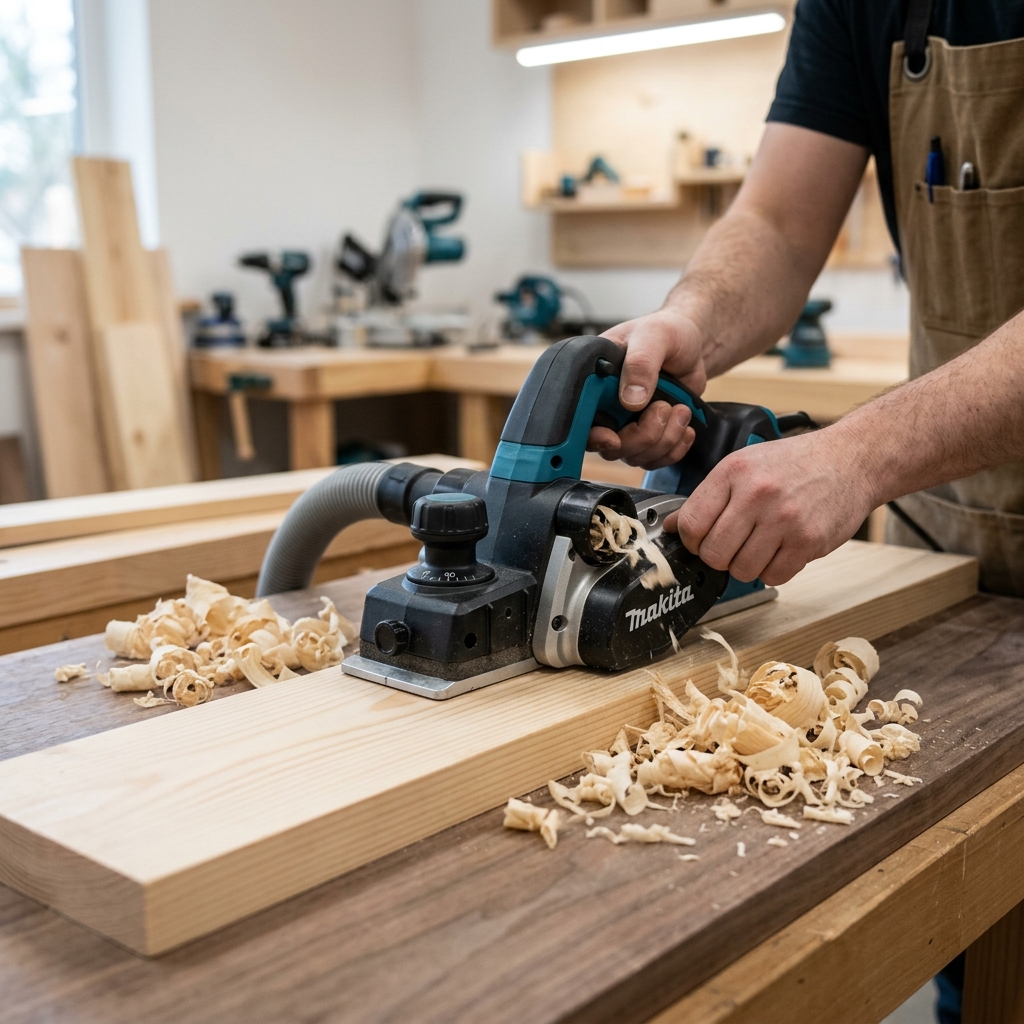
Cutterhead rotational velocity determines wood finish quality. Analyze dual-blade carbide cutterheads, chip evacuation paths, and base plate chamfering grooves.
- Brushless motor provides power and runtime, maintaining 15,000 RPM
- 3-1/4 inch cutting width with up to 5/64 inch maximum depth of cut
- Precision-machined front and back aluminum shoes ensure parallel cuts
Precision Milling & Levelling
Handheld electric planers allow fast stock removal and precise levelling. Explore how cutterhead physics and base plate design optimize warped door fitting and timber tapering.
1. Rotational Velocity Dynamics of Carbide Cutterheads
Electric hand planers use a rotating drum containing two or more straight blades. As the planer moves, the blades shear thin layers of wood. The speed of this rotation, measured in revolutions per minute (RPM), determines the surface quality. A high cutterhead velocity (e.g., 15,000 RPM) delivers clean cuts on dense wood fibers, preventing tear-out. This high speed creates a smooth shearing action rather than chopping the wood, preventing motor bog-down when leveling warped door edges.
Additionally, brushless motors maintain stable RPMs under load by adjusting current delivery in real time. This electronic regulation prevents speed drops when encountering dense knots or grain transitions. Consistent cutterhead velocity is the foundation of high cuts-per-inch (CPI) milling, which is necessary to avoid post-work sanding. When the motor maintains its speed, the planer shears the wood grain at a consistent angle, reducing surface irregularities.
Without stable rotational speed, blades will strike the wood unevenly, leaving wavy ridge lines. This defect, known as planemark, requires extensive sanding to remove and ruins the appearance of finished carpentry. High velocity mitigates this by bringing cuts closer together, producing a flat surface. In heavy stock removal, maintaining high RPM is also a safety feature, as it reduces kickback risks when the blade encounters sudden grain resistance.
By optimizing motor efficiency, brushless systems run cooler during heavy shaving tasks. Heat is the main cause of blade wear; keeping operating temperatures low preserves carbide tip hardness and prevents premature degradation of the cutting edge. On a busy jobsite, this thermal management translates to fewer blade changes and more consistent depth execution throughout the project's duration.
- 15,000 RPM cutterhead speeds deliver clean shearing action, preventing wood fiber tear-out.
- Brushless motor stabilization maintains speed when leveling dense pine or oak doors under load.
- High rotational speeds maximize cuts per inch, reducing post-planing surface prep time.
2. Dual-Blade Cutterhead Alignment and Calibration
For parallel planing, both cutting blades must sit at the exact same height relative to the rear shoe. If one blade sits slightly higher, it will do all the work, resulting in rapid dulling and an uneven surface profile. Precision alignment jigs are essential for setting blade heights, ensuring that both cutting edges share the load equally. This even distribution is critical for maintaining tool balance at 15,000 RPM.
Modern cutterheads use double-sided tungsten carbide blades that drop into indexing slots. This self-aligning design eliminates the need for manual dial gauge calibration, which was a time-consuming process on older models. Locking plates secure the blades, preventing shifting caused by high centrifugal forces during operation. These plates must be tightened with uniform torque to prevent drum distortion.
To maintain balance, both blades must be replaced at the same time. An unbalanced cutterhead causes motor vibration, leading to wavy cuts and bearing wear. Precision blade alignment ensures clean, repeatable milling results. When blades are perfectly balanced, the tool operates with minimal noise, and the user experiences less hand-arm vibration, which is a major factor in long-term operator comfort.
If blades are clamped with uneven pressure, the cutterhead can deform, causing dynamic imbalance during rotation. Using calibrated wrench torques prevents this issue, keeping the drum perfectly concentric. Balanced drums ensure smooth operation, preventing premature wear on the drive belt and motor brushes. This calibration is particularly important when working with exotic hardwoods that exert high resistance forces on the cutting head.
- Tungsten carbide blades resist wear, remaining sharp up to ten times longer than steel.
- Self-aligning slots ensure fast, tool-free blade changes without dial indicators.
- Balanced dual-blade cutterheads eliminate spindle vibration, protecting the motor bearings.
3. Fluid Dynamics of High-Volume Chip Evacuation
Electric planers produce a massive volume of waste chips very quickly. Clogged exhaust chutes cause chips to get trapped under the blades, resulting in deep scoring marks on the wood and premature blade wear. Proper evacuation paths are designed using fluid dynamics principles to maximize airflow and pull chips away from the cutting zone before they can recut.
High-velocity fans generate positive static pressure inside the cutterhead housing. This airflow ejects chips through exhaust ports, preventing clogging when making deep cuts. Some planers incorporate dual-port ejectors, allowing the user to select the direction of chip ejection based on their stance or position relative to the workpiece, keeping the workspace clear.
Connecting the planer to a dust collection system dramatically improves evacuation efficiency. Vacuum suction pulls chips away immediately, reducing cleanup time and maintaining clean air on the jobsite. The design of the port connector must minimize turbulent airflow, preventing chip build-up at transitions or elbows in the ductwork.
When planing resinous woods like pine, sticky sap can accumulate inside the exhaust path. Smooth interior walls and wide-diameter ports prevent sap-coated chips from adhering to the housing. Keeping these channels clear preserves the fan's static pressure, ensuring consistent performance throughout heavy-duty milling applications.
- High-static-pressure fans prevent chip accumulation when planing damp timber.
- Dual-ejection ports allow directing chips away from the operator's face.
- Aerodynamic port geometries reduce turbulent flow, preventing exhaust blockages.
4. Ergonomics, Handle Geometry, and Depth Dial Mechanical Feedback
Operating a hand planer requires precise control over feed rate and downward pressure. Handles with ergonomic overmolds increase grip friction, reducing hand strain during long work sessions. A balanced center of gravity ensures the tool sits naturally on the wood, minimizing the effort required to steer the planer straight.
The depth adjustment dial sits at the front of the planer, doubling as a secondary handle. Click-detents provide mechanical feedback, allowing the operator to adjust the depth of cut in precise increments (e.g., 0.1 mm) without looking. This feedback ensures repeatable setups when executing tapered cuts or matching joint dimensions.
Additionally, front handle positioning allows the user to apply downward force at the start of the cut, preventing the front shoe from lifting. Proper force distribution is key to avoiding board snipe. Clear depth scales, marked in both metric and imperial units, ensure compatibility with different plan sets.
The main trigger handle should incorporate safety locks to prevent accidental starts when picking up the tool. Placing trigger switches within easy reach of the thumb allows for one-handed operation. Ergonomic tool balance reduces joint fatigue in the operator's wrists and elbows, promoting safer handling techniques.
- Ergonomic handle overmolds increase friction, preventing slippage under dusty conditions.
- Click-detents on the depth dial provide precise mechanical adjustment feedback.
- Balanced tool layouts allow natural control, reducing wrist strain on vertical edges.
5. Shoe Coplanarity, Chamfering Grooves, and Snipe Mitigation
The base plates, or shoes, must be perfectly coplanar when the depth is set to zero. If the front adjustable shoe is not parallel to the fixed rear shoe, the planer will cut tapered profiles or gouge the timber. Cast aluminum construction provides the necessary structural rigidity to resist twisting under lateral pressure.
The front shoe incorporates one or more V-shaped grooves for chamfering board edges. These grooves align the planer at a 45-degree angle to the corner, ensuring a uniform bevel along the entire edge. Precision machining ensures the grooves are centered, preventing uneven cuts when working on edge profiles.
Snipe occurs when the planer dips at the beginning or end of a board, resulting in a deeper cut. To mitigate snipe, the operator must apply downward pressure on the front shoe at the start of the cut, and shift pressure to the rear shoe as the planer exits the wood. A spring-loaded kickstand at the rear shoe protects the blades and workpiece when resting the tool down.
Precision shoe flatness also prevents wood scoring. Any burrs or scratches on the aluminum shoes can mark the freshly planed wood. Regularly inspecting and polishing the sole plates keeps them sliding smoothly. Cast aluminum shoes are machined to within tolerances of less than 0.05 mm to ensure maximum coplanarity.
- Cast aluminum shoes machined to high tolerances ensure flat, coplanar cuts.
- Precision V-grooves allow uniform 45-degree chamfering on exposed corners.
- Spring-loaded kickstands protect both the workpiece and blades from damage between cuts.
6. Material Physics of Hardwoods vs Softwoods in Planing Applications
Different wood species respond uniquely to planing forces due to their cellular structure and fiber density. Softwoods, such as pine or cedar, have lower density and are easily sheared, but they are prone to fiber crushing if blades are dull. Hardwoods, like oak, maple, or walnut, require higher cutting forces and sharp blade edges to shear the dense wood cells without tear-out.
Blades must cut through wood fibers at an optimal angle to prevent grain lifting. When planing against the grain, the blade lift fibers, causing deep tear-out. To avoid this, always plane in the direction of the grain. If the grain pattern is complex or interlocked, reducing the depth of cut and increasing the feed speed produces a cleaner surface finish.
Timber moisture content also affects the planing process. Wet wood is more flexible and can clog the exhaust ports, while dry wood is more brittle and prone to chipping. Choosing the correct feed rate based on wood density and moisture content prevents motor strain and keeps blades running cool, maximizing tool lifespan.
Furthermore, knots represent areas of extremely high density where the grain direction changes rapidly. When encountering a knot, the cutterhead experiences a sudden load spike. Brushless motors compensate for this by adjusting voltage to maintain RPM, ensuring a smooth transition across the knot without gouging the surrounding wood.
- Planing in the direction of the grain prevents fiber lifting and tear-out.
- Fine depth settings prevent grain chip-out on figured or interlocked hardwoods.
7. Preventive Blade Care, Belt Maintenance, and Jobsite Safety
Preventive maintenance is critical for keeping an electric planer operating at peak efficiency. Operators must inspect blades regularly for nicks or rounding, which can cause motor drag and poor surface quality. Cleaning the blades with a resin-dissolving solvent removes sap build-up, preserving the sharp cutting edge and reducing thermal load on the motor.
The drive belt transfers power from the motor to the cutterhead and is subject to intense wear. Over time, the belt can stretch or crack, leading to slippage and lost RPMs under load. Regularly checking belt tension and replacing worn belts prevents sudden failures. Modern planers utilize poly-V belts which offer superior grip and longer service life than flat designs.
Safety protocols must be strictly followed when operating high-speed planers. Always disconnect the battery or power source before performing blade adjustments or cleaning the exhaust chute. Wearing safety glasses and hearing protection protects against flying chips and high-frequency motor noise. Keeping hands away from the cutterhead until the drum stops spinning prevents severe accidents.
Using the correct accessories, like parallel fences or rebating guides, improves control and accuracy. Fences hold the planer square to the workpiece, preventing shifting during edge profiling. Storing the tool on its kickstand protects the blades from damage when not in use, ensuring the cutting edge remains pristine for the next pass.
- Poly-V drive belts provide positive power transfer, preventing belt slip under heavy load.
- PTFE blade cleaning removes resin buildup, preserving cutting edge sharpness.
- Disconnecting power before servicing blades is a critical jobsite safety requirement.
8. The Definitive Handheld Electric Planer Buying Parameters
Selecting a handheld electric planer requires reviewing motor configuration, cutting width, and shoe design. Brushless motors provide superior efficiency and runtime, maintaining stable cutterhead velocity under heavy loads. Look for planers with Cast aluminum shoes for maximum coplanarity and long-term durability on active jobsites.
Additionally, assess the chip evacuation system and directional control. Dual-port ejectors and aerodynamic ports prevent blockages, keeping your workspace clean. The depth adjustment dial should provide clear click-detents for precise control over stock removal, allowing you to calibrate depth in small increments.
Finally, consider battery compatibility and safety features. Spring-loaded kickstands and trigger locks protect workpieces and operators from accidents. A well-designed handheld planer is an essential tool for framing, doors fitting, and tapering, providing clean cuts and reducing hand fatigue throughout the workday.
- Cast aluminum shoes resist warping, maintaining coplanarity under heavy pressure.
- Brushless motors extend battery runtime, allowing more cuts per charge on the jobsite.
Professional Recommendation & Audit
For heavy-duty framing and carpentry, we highly recommend the DEWALT 20V MAX Brushless Handheld Planer (DCP580B). Its brushless motor maintains a constant 15,000 RPM, while its coplanar cast aluminum shoes and precision V-grooves ensure straight, smooth cuts.
DEWALT 20V MAX Brushless Handheld Planer (DCP580B)
- Brushless motor provides power and runtime, maintaining 15,000 RPM
- 3-1/4 inch cutting width with up to 5/64 inch maximum depth of cut
- Precision-machined front and back aluminum shoes ensure parallel cuts
- Built-in poly-V drive belt provides increased durability and power transfer
Technical Specifications & Product Data
| Specification | Value / Details |
|---|---|
| Brand | DEWALT |
| List Price | $179.00 (USD) |
| Customer Rating | 4.8 / 5.0 (2,150 reviews) |
| ASIN / Identifier | B01C92R410 |
| Availability | In Stock (USA Region) |
| Outbound Link Compliance | Sponsored & Nofollow Enforced |
Verified Features & Performance Data
- ✓Brushless motor provides power and runtime, maintaining 15,000 RPM
- ✓3-1/4 inch cutting width with up to 5/64 inch maximum depth of cut
- ✓Precision-machined front and back aluminum shoes ensure parallel cuts
- ✓Built-in poly-V drive belt provides increased durability and power transfer
System Sovereignty & Engineering
Edge Computing
100% Client-side processing. Your data never leaves your browser sandbox, ensuring absolute compliance with US privacy mandates.
Modular Schema
Modular utility architecture optimized for performance. Low-latency WASM kernels provide near-native speeds for complex transformations.
Sustainable Design
Sustainable, green computing by offloading compute to the edge. Verified zero-server storage (ZSS) for professional-grade security.