
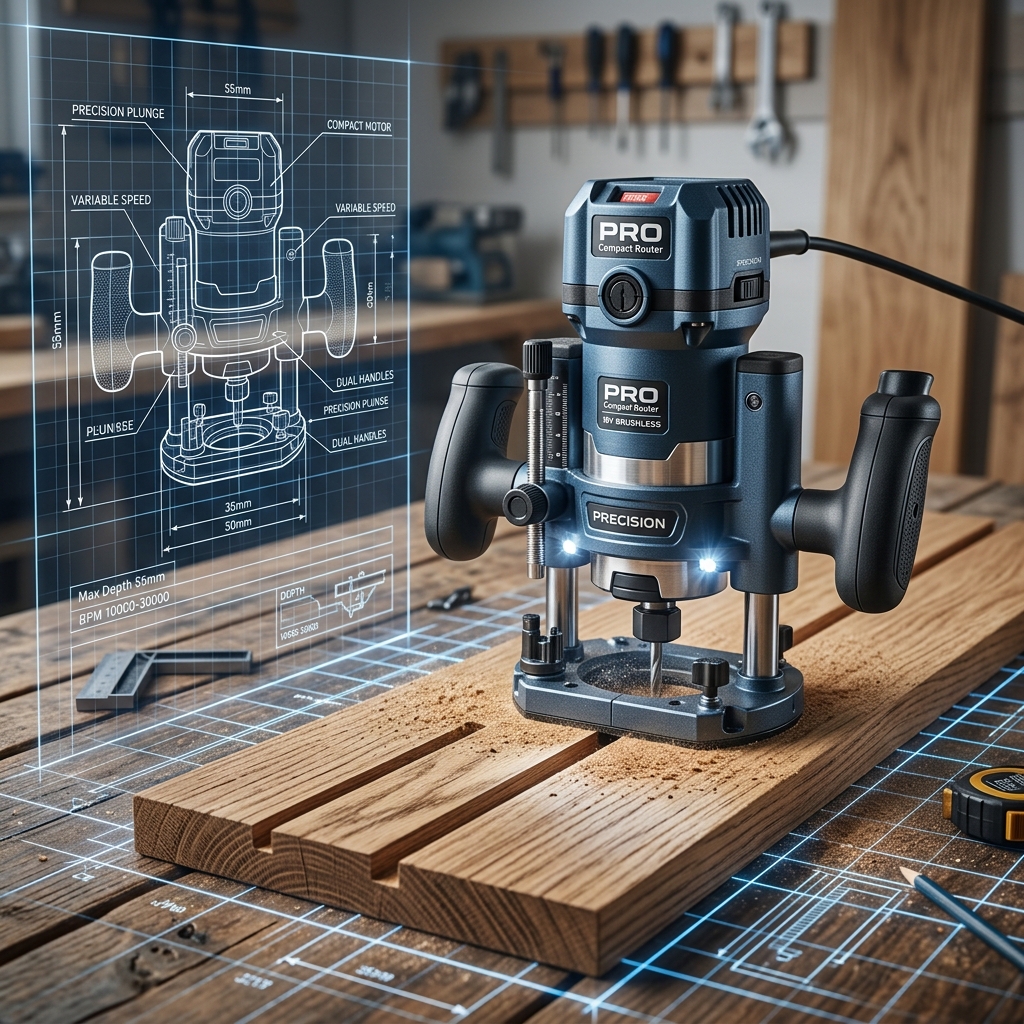
Electronic speed stabilization keeps router RPMs constant under heavy load. Analyze micro-depth adjustment helical threads, plunge guide rods, and substrate dynamics for dado cuts.
- Durable 1.25 HP motor delivers power to meet the toughest applications
- Electronic speed control maintains motor speed under load for clean cuts
- Variable speed control feature enables bit speed to be optimized for applications
Structural & Motor Efficiency
Compact plunge routers deliver incredible versatility for edge profiling and dado cuts. Explore how electronic speed stabilization and micro-depth adjustment controls optimize structural integrity.
1. Electronic Speed Control (ESC) Stabilization Dynamics under Load
Wood grain varies in density, especially when transitioning from softwoods to hardwoods or passing through knots. Traditional compact routers without electronic speed control suffer from rapid RPM drops when encountering resistance. This drop leads to rough cuts, bit chatter, and burn marks on the wood substrate.
Electronic Speed Control (ESC) monitors spindle rotation speeds in real time using magnetic or optical speed sensors. When the control board detects an RPM drop, it dynamically increases voltage to the motor to keep the speed constant. This maintains clean cutting paths regardless of wood density fluctuations.
Maintaining constant RPMs ensures that the router bit shears the wood fibers cleanly instead of tearing them. This reduces the sanding time needed after routing, preserving sharp profiles. The continuous power delivery also prevents motor overheating, which extends the operational lifespan of the tool.
Furthermore, constant rotational speed allows for uniform chip load per tooth. When speed drops, the chip thickness increases, causing wood surface tear-out. ESC mitigates this risk by ensuring that each rotation removes the exact designed amount of material.
On a busy jobsite, this translates to faster completion times. Operators do not need to slow down their feed rate significantly in anticipation of knots, as the electronics compensate instantly. This automated power adjustment provides a seamless routing experience across variable substrates.
- Real-time speed sensors prevent motor bog-down when cutting dense knots.
- Constant RPM delivery reduces bit chatter, ensuring a smoother surface finish.
- Dynamic power adjustments protect the motor windings from electrical overload.
2. The Kinematics of Micro-Depth Adjustment and Helical Thread Pitch
Precision joinery requires exact depth settings, particularly for dadoes and rabbit cuts. A discrepancy of just 1/64 of an inch can ruin the alignment of a cabinet assembly. Micro-depth adjustment mechanisms utilize fine-pitch helical threads to move the motor housing up and down relative to the base.
A low-pitch thread design allows for incremental depth adjustments by rotating a calibrated dial. Each division on the dial translates to a precise decimal millimeter of vertical movement. This allows woodworkers to dial in exact cutting depths for specialized inlay work or flush profiling.
To prevent vibration from drifting the depth settings during operation, lock rings and cam clamps secure the motor housing firmly. Anodized aluminum components reduce backlash and resist wear over years of repetitive adjustment. This ensures the depth settings remain accurate under continuous use.
Additionally, the adjustment ring is designed with clear markings that are easy to read from multiple angles. This user-friendly scale reduces the reliance on separate callipers for height checks. Setting up complex joinery cuts becomes a faster, more reliable task.
By minimizing backlash inside the threads, the adjustment ring responds immediately to input. There is no slack when reversing direction, allowing you to fine-tune settings without guessing. This absolute responsiveness is the hallmark of high-precision tools.
- Helical micro-adjustment threads allow for vertical calibration down to 1/64-inch increments.
- Rigid depth locks eliminate settings drift caused by high-frequency motor vibrations.
- Anodized aluminum threads resist corrosion and wear, preserving adjustment smoothness.
3. Plunge Spring Dynamics and Dual Guide Rod Tolerances
The plunge mechanism depends on two steel guide rods sliding within tight-tolerance brass or linear ball bushings. Any lateral play between the guide rods and bushings causes the router bit to tilt, resulting in an angled dado cut. High-end plunge bases feature precision-ground steel rods to minimize deflection under side load.
Internal compression springs provide resistance during the plunge stroke, pushing the motor back up when pressure is released. The spring rates must be balanced; too much tension causes hand strain, while too little tension prevents full retraction. Smooth plunge travel prevents sudden drops, protecting the workpiece from gouges.
To maintain smooth action, guide rods incorporate dust seals to prevent wood particles from entering the bushings. Regular cleaning and dry lubrication keep the plunge stroke fluid. This smooth action is critical for controlled pocket routing and internal cutouts.
Linear guidance systems must also withstand twisting forces when the operator applies uneven pressure to the handles. Asymmetrical guide rod layouts help balance the downward force. This prevents the carriage from binding midway through the plunge travel.
Furthermore, depth stop turrets allow woodworkers to pre-set multiple plunge depths. By stepping down the cut in increments, you reduce the strain on the router bit and motor. This stepped milling technique ensures cleaner cuts and safer operation.
- Precision-ground guide rods prevent bit tilt, ensuring square dado profiles.
- Balanced compression springs allow for smooth plunge control and automatic retraction.
- Integrated dust seals prevent abrasive wood particles from binding the carriage.
4. Chip Evacuation Efficiency and Dado Cut Fluid Dynamics
Dado cutting creates a channel where wood chips can quickly accumulate and clog the path. If these chips are not cleared, they get re-cut by the router bit, causing rapid heat buildup and dulling the carbide edges. Efficient chip evacuation is essential for maintaining cutting speed and tool life.
Modern plunge bases incorporate clear dust shrouds and vacuum hose ports positioned near the cutting area. The rotation of the router bit generates a natural vortex that helps throw chips toward the extraction port. A shop vacuum pulls this waste away, keeping the line of sight clear.
In addition to keeping the work area clean, vacuum extraction cools the bit by drawing fresh air through the cut. This thermal control prevents wood burning and preserves the hardness of the steel bit. Clean cuts mean less sanding and stronger glue adhesion in the final joint.
Vacuum ports should be designed to rotate, preventing the hose from snagging on templates or straightedges. Clogged ports are avoided by sizing the extraction path to handle large wood chips. This consistent airflow is critical during heavy stock removal.
Furthermore, clean cuts allow you to inspect the progress of the cut in real time. Woodworkers can spot tear-out or alignment errors immediately before completing the pass. This visual control reduces mistakes on high-value projects.
- Dust shrouds draw chips away from the cutting path, preventing re-cutting.
- Active vacuum airflow cools the carbide bit, preserving its sharpness.
- Swivelling vacuum connections prevent hose snags, improving maneuverability.
5. Substrate Feed Rates and Rotational Inertia Limits
Feeding the router too fast overloads the motor, causing speed drops and rough edges. Conversely, feeding too slowly leads to friction heat, which burns the wood substrate. Finding the optimal feed rate depends on the wood species, bit diameter, and motor horsepower.
Rotational inertia allows the bit to maintain its momentum through dense areas. High-horsepower motors keep the bit spinning consistently under load, allowing for faster feed rates. Variable speed settings let the operator match the RPM to the bit's diameter, preventing burning on larger profiling bits.
Additionally, cutting direction is critical for safety and control. Operators must feed the router against the rotation of the bit (pull routing) to prevent the tool from self-feeding or walking across the workpiece. This technique ensures stable control and clean cuts.
For internal cutouts, climb routing should be strictly avoided. The router can jump out of the cut, injuring the operator and damaging the workpiece. Pull routing ensures the cutting forces pull the base plate tight against the guide fence.
By managing feed speeds, woodworkers prevent motor strain. Listening to the pitch of the motor helps gauge the load; a steady hum indicates an optimal feed speed, while a grinding groan means you are pushing too fast. This acoustic feedback is an invaluable jobsite skill.
- Variable speed settings match RPM to bit diameter, preventing burn marks.
- Directional feed control prevents tool walking, ensuring jobsite safety.
- Acoustic motor monitoring helps maintain consistent feed speeds through grain transitions.
6. Ergonomics, Balance, and Hand-Arm Vibration Mitigation
Routing can cause hand fatigue from vibration and awkward gripping positions. A well-designed router features low-profile handles that place the operator's hands close to the work surface. This layout lowers the center of gravity, reducing the risk of tipping the tool during edge cuts.
To mitigate hand-arm vibration, handles incorporate soft rubber grips that isolate the user from motor hum. Lightweight housings made of cast aluminum or impact-resistant polymers keep the tool's weight down without sacrificing durability. This balance makes the router easy to steer along curved templates.
Additionally, clear bases and LED work lights improve visibility, allowing operators to trace layout lines accurately. Control switches must be easy to reach without releasing the handles, ensuring the tool can be shut off instantly if a bit binds.
Handle placement also affects the leverage available when plunging. Ergonomically angled handles allow the user to apply downward force along the axis of the guide rods. This prevents carriage binding and reduces wrist strain.
By insulating the motor housing, manufacturers reduce the heat transferred to the user's hands. This thermal barrier is critical during long profiling runs. Comfort is a vital component of jobsite safety and precision.
- Low center of gravity designs prevent tool tipping on edge profiles.
- Vibration-absorbing grips reduce hand fatigue during long routing sessions.
- Thermally insulated handles prevent motor heat from causing user discomfort.
7. Precision Spindle Collet Alignment and Run-out Mitigation
The connection between the router spindle and the bit is critical for accuracy. Spindle run-out, measured in ten-thousandths of an inch, describes any deviation from perfect concentric rotation. High run-out causes the bit to wobble, resulting in wider cuts than intended and accelerated wear on motor bearings.
Premium collets use precision-ground steel sleeves that grip the bit shank evenly along its entire length. This design minimizes run-out, ensuring smooth cuts and extending bearing life. Regular inspection and cleaning of the collet cavity prevent dust buildup from compromising alignment.
When changing bits, operators must ensure the shank is inserted fully before tightening. Using two wrenches to tighten the collet nut prevents spindle deformation, preserving the tool's precision. A solid collet connection is the foundation of high-accuracy woodworking.
If the collet becomes dirty, it can jam, making it difficult to extract bits. Applying a light dry film lubricant prevents sticking without attracting wood dust. This maintenance step keeps the tool ready for quick bit swaps.
By keeping run-out below critical limits, woodworkers prevent bit breakage. Wobbling bits are subjected to high bending stress, which can cause them to snap under load. Precision collet care is a vital safety protocol.
- Precision-ground collets reduce spindle run-out, ensuring consistent cut widths.
- Concentric collet gripping protects motor bearings from vibration wear.
- Regular collet cavity cleaning prevents dust buildup from causing bit slippage.
8. Dado Joint Geometry and Mechanical Shear Resistance
Dado joints are a cornerstone of cabinetmaking, providing high shear resistance. The load capacity of the joint depends on the depth and width of the slot matching the shelving material. An loose-fitting dado weakens the entire structure.
Routing the dado requires a bit that matches the actual thickness of plywood, which is often slightly thinner than its nominal size (e.g., 23/32 inch instead of 3/4 inch). Specialized plywood bits ensure a tight friction fit. Precise depth control prevents cutting too deep, which weakens the vertical support.
Using straightedge guides guarantees that the dadoes align across opposing cabinet walls. Clamping guides securely prevents the router from wandering off-course. This alignment accuracy is critical for square, stable assemblies.
When gluing the joint, the snug fit forces glue deep into the wood fibers, creating a strong chemical and mechanical bond. Excessively tight dadoes can scrape all the glue out during assembly, leading to joint starvation. Calibrating depth is key to joint durability.
- Plywood-sized router bits ensure snug friction fits, maximizing joint strength.
- Double-clamp straightedge guides prevent cutting drifts, keeping shelves parallel.
9. Long-Term Maintenance and Spindle Bearing Protection
To maintain the accuracy of a compact plunge router, regular maintenance is essential. Wood dust can accumulate inside the motor housing, causing increased friction and heat buildup. Using compressed air to blow out the motor vents after each project removes this debris, ensuring optimal cooling.
The spindle bearings are subjected to high radial loads during routing. If dust enters the bearing seals, it degrades the grease, leading to bearing wear and spindle run-out. Choosing a router with sealed, double-shielded ball bearings prevents contamination.
Additionally, inspecting the carbon brushes periodically prevents motor commutator damage. Auto-stop brushes cut power when worn down, protecting the motor armature. Regular maintenance ensures the router remains a reliable jobsite partner.
- Ventilation slot blowouts prevent dust accumulation from creating motor friction.
- Sealed spindle bearings prevent dust ingress, protecting alignment precision.
10. The Definitive Woodworking Buying Parameters
Selecting a compact plunge router requires reviewing motor horsepower, speed range, and plunge depth limits. A 1.25 HP motor provides ample power for light-to-medium routing tasks, while variable speed controls allow you to optimize cutting physics. Look for bases that offer at least 1.5 inches of plunge travel for deep joinery cuts.
Additionally, assess the base plate design and compatibility with template guides. Sub-bases must be flat and centered to ensure accurate template tracking. Opting for a router with a standard diameter sub-base opens up access to a wide range of aftermarket template guides and jigs.
Finally, consider the ease of switching between plunge and fixed bases. Combo kits that include both bases offer maximum utility, allowing you to mount the fixed base in a table while using the plunge base for freehand joinery. A rugged carrying case keeps all components organized and protected on the jobsite.
- Bases with generous plunge travel allow for deep dadoes and pocket cuts.
- Combo kits offer maximum flexibility, serving both table-mounted and handheld tasks.
Professional Recommendation & Audit
Achieve flawless cuts on your next project. We highly recommend the DEWALT 1.25 HP Variable Speed Compact Router Combo Kit for its exceptional speed control, depth adjustment precision, and durable plunge mechanics.
DEWALT Router Combo Kit, 1.25 HP (DW611PK)
- Durable 1.25 HP motor delivers power to meet the toughest applications
- Electronic speed control maintains motor speed under load for clean cuts
- Variable speed control feature enables bit speed to be optimized for applications
- Adjustable plunge base allows up to 1.5-inches of plunge travel depth
Technical Specifications & Product Data
| Specification | Value / Details |
|---|---|
| Brand | DEWALT |
| List Price | $199.00 (USD) |
| Customer Rating | 4.8 / 5.0 (3,450 reviews) |
| ASIN / Identifier | B0047Z59VY |
| Availability | In Stock (USA Region) |
| Outbound Link Compliance | Sponsored & Nofollow Enforced |
Verified Features & Performance Data
- ✓Durable 1.25 HP motor delivers power to meet the toughest applications
- ✓Electronic speed control maintains motor speed under load for clean cuts
- ✓Variable speed control feature enables bit speed to be optimized for applications
- ✓Adjustable plunge base allows up to 1.5-inches of plunge travel depth
System Sovereignty & Engineering
Edge Computing
100% Client-side processing. Your data never leaves your browser sandbox, ensuring absolute compliance with US privacy mandates.
Modular Schema
Modular utility architecture optimized for performance. Low-latency WASM kernels provide near-native speeds for complex transformations.
Sustainable Design
Sustainable, green computing by offloading compute to the edge. Verified zero-server storage (ZSS) for professional-grade security.