
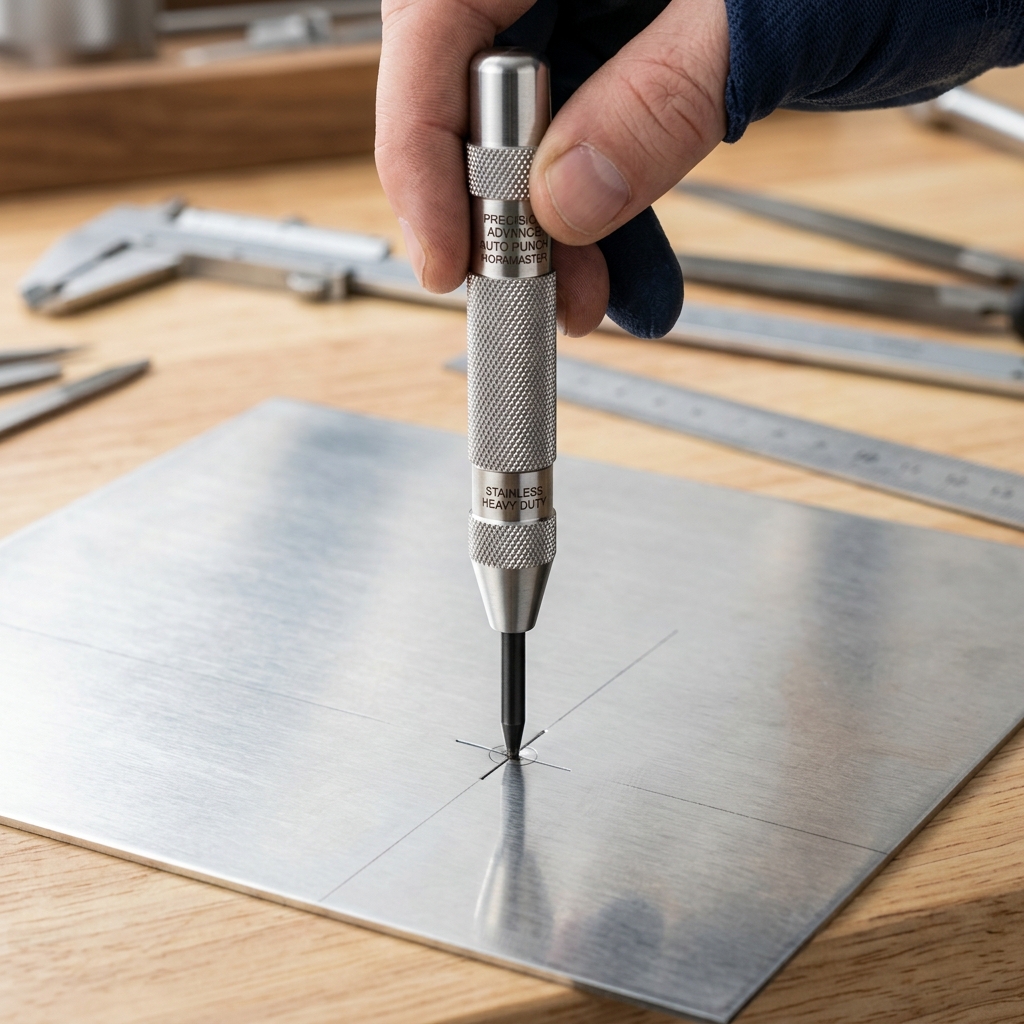
Spring-loaded hammer striking force dynamics determine punch depth. Analyze hardened steel tip longevity, adjustable strike controls, and slip-free drill centering.
- Rugged steel automatic center punch with adjustable striking force
- Internal spring-loaded hammer mechanism delivers punch impact automatically
- Knurled steel handle provides positive grip and prevents slipping under pressure
Force Dynamics & Precision
Automatic center punches allow fast, one-handed drilling alignments. Explore how spring-loaded hammer mechanics and tip metallurgy prevent drill bit walking on polished metals.
1. The Physics of Spring-Loaded Hammer Striking Force
Drilling into polished metals requires a starter dimple to prevent the drill bit from walking across the surface. An automatic center punch delivers this dimple using an internal spring-loaded hammer. Downward pressure on the handle compresses the main spring, storing potential energy. This energy remains stored until the trigger point is reached.
When the handle is pressed to its release point, an internal sear trips, releasing the spring tension. The hammer travels down, striking the anvil at the base of the tip. This impact transfers energy to the point, marking the metal substrate. The transfer of kinetic energy occurs almost instantaneously, concentrating the force over a microscopic area.
The entire cycle occurs in milliseconds, allowing for fast, one-handed operation. Tight tolerances inside the spring chamber prevent friction energy loss, ensuring consistent strikes. This mechanical design is the key to repeatable marking, which is necessary when prepping hundreds of layout holes on sheet metal.
If the internal hammer binds inside the body, the striking force will drop, producing faint marks. Precision-machined steel walls keep the hammer aligned during travel, minimizing friction. Regular cleaning and dry lubrication prevent debris buildup from clogging the mechanism, maintaining consistent strike energy.
By utilizing high-grade compression springs, manufacturers ensure consistent spring rates over years of use. Fatigue-resistant alloy steel springs prevent force degradation, maintaining strike performance. Spring durability is critical for layout tools that are subjected to thousands of compression cycles.
- Internal spring-loaded hammers deliver high striking force automatically without separate tools.
- Precision sears trigger the strike consistently at the same downward pressure threshold.
- Fatigue-resistant alloy springs prevent force loss, ensuring repeatable marking depths.
2. Hardened Steel Tip Metallurgy and Wear Resistance
The point of the center punch faces high stress during impact, especially on materials like stainless steel. If the tip is not sufficiently hard, it will dull immediately, losing its marking ability. Premium punch tips are made of hardened tool steel alloys, which are tempered to maintain their shape under repeat strikes.
Heat-treating tip alloys to high Rockwell hardness (typically 60 HRC or higher) ensures the point can indent tough metals. Tempered tips resist chipping, maintaining a sharp geometry over thousands of cycles. Removable tip designs allow for easy sharpening or replacement when the point eventually rounds.
Additionally, some industrial punches utilize carbide-tipped points for extreme durability. The connection between the carbide tip and the steel body must withstand high shock loads. Premium tip metallurgy is the foundation of long-term tool utility, preventing the point from flat-lining on alloy steels.
If the tip material is too brittle, the impact force can cause the point to fracture on hard castings. Controlled tempering cycles balance hardness and toughness, preventing breakage. Multi-alloy steel tips ensure optimal wear characteristics, allowing the tool to mark a variety of substrates.
By managing tip profiles, manufacturers ensure clean indentations. Sharply angled points (typically 90 degrees) create a wide, deep dimple that accepts large drill bit webs. Point geometry is key to slip-free starts, ensuring that the drill bit centers itself perfectly.
- Hardened tool steel tips resist wear, retaining sharp points over thousands of strikes.
- Removable tip designs allow fast, easy replacement or sharpening on grinding wheels.
- Tempered steel points balance hardness and toughness, preventing brittle fracturing.
3. Adjusting striking force: Knurled Cap and Sear Trip Calibration
Different layout materials require varying punch depths. An adjustable cap at the top of the punch handle allows the user to regulate the striking force. Screwing the cap down compresses the internal spring further, increasing the pressure required to trip the release sear and delivering a heavier blow.
Loosening the cap reduces spring pre-load, resulting in a lighter strike suitable for soft metals like aluminum or brass. This adjustment prevents thin sheets from warping or distorting under the impact. The cap thread pitch must be low enough to prevent settings from drifting during use.
The spring compression rate (k-constant) dictates how the force scales with cap rotation. A linear rate ensures that each half-turn of the cap adds a predictable amount of impact energy. High-quality punches calibrate this mechanism, ensuring that operators can adjust the strike depth without guessing.
- Adjustable caps allow matching striking force to wood, aluminum, or stainless steel hardness.
- Fine thread adjustments prevent cap drift, keeping the striking force calibrated.
4. Handle Ergonomics, Knurling Patterns, and Slip Prevention
Applying the downward pressure required to compress the internal spring can cause hand strain if the handle is slick. Knurled steel handles provide a secure grip, preventing hand slippage under high pressure. The knurling pattern must be deep enough to provide grip without irritating the skin.
A flared or knurled end cap provides a comfortable resting spot for the operator's palm. The diameter of the handle must be balanced; a handle that is too thin requires excessive grip force, while a handle that is too thick is difficult to hold. Finding the optimal diameter ensures comfortable, controlled strikes.
The friction coefficient of the handle knurling is key to preventing hand slippage when layout lines are marked in vertical orientations. Premium knurling patterns feature cross-hatched diamond shapes that lock into the skin's ridges, minimizing the downward force required to hold the tool straight. This safety design is critical on wet or oily jobsites.
- Deep handle knurling ensures positive grip, preventing slippage when hands are sweaty.
- Balanced steel handles improve tool control, ensuring perpendicular alignment.
5. Drill Bit Walking Dynamics on Polished Stainless Steel and Alloys
Drill bits have a flat chisel edge at the tip that does not cut wood or metal. If this chisel edge is placed on a flat, polished surface, it will walk across the surface instead of cutting. Creating a center punch mark is critical, as it provides a recess that accepts the chisel edge, keeping the bit centered.
Polished stainless steel is highly prone to drill bit walking because it is extremely hard and smooth. If the bit slips, it will score the polished surface, ruining the appearance of finished assemblies. Creating a deep, clean punch mark ensures the bit stays in place, preventing workpiece damage.
Furthermore, when the drill bit chisel edge contacts a flat surface, the rotational friction can cause the bit to flex. This flexing results in misaligned holes and can break small drill bits. A deep punch mark provides a mechanical key that locks the bit tip in place, ensuring that holes are drilled exactly on layout coordinates.
- Center punch dimples accept the drill bit chisel edge, preventing bit walk.
- Breaking the surface skin on stainless steel prevents work-hardening and preserves bits.
6. Manual vs Automatic Center Punches: Efficiency and Safety Audits
Manual center punches require the use of a hammer to strike the punch body. This two-handed operation is difficult when working on ladders or in confined spaces, where holding the punch and workpiece requires both hands. Automatic center punches allow for one-handed operation, keeping the other hand free for support.
Using manual punches also carries safety risks. A missed hammer strike can result in hand injuries, while excessive striking force can cause the punch tip to fracture. Automatic punches eliminate these risks by delivering a controlled, internal strike, preventing hand injuries and tool damage on the line.
In addition to speed, automatic punches offer superior consistency. The strike repeatability error (SRE) is virtually zero, as the internal hammer always strikes with the exact same force once the trigger point is reached. This consistency ensures that all layout markings are identical, which is essential for uniform hole depth in production setups.
- One-handed operation allows layout marking in awkward or hard-to-reach spaces.
- Controlled internal strikes eliminate hammer miss risks, improving jobsite safety.
7. Preventive Maintenance: Internal Cleaning, Lubrication, and Tip Resharpening
Preventive maintenance is critical for keeping an automatic center punch operating smoothly. Fine metal dust and wood particles can migrate into the spring chamber, mixing with grease to form an abrasive sludge. Disassembling the tool body and cleaning the internal components with a light solvent keeps the mechanism free of blockages.
From a mechanical physics perspective, the automatic center punch relies on the storage and rapid release of elastic potential energy governed by Hooke's Law. As the user presses down on the cap, they compress the main spring, storing potential energy equal to half the spring constant multiplied by the displacement squared. When the compression reaches the trigger threshold, the internal sear tilts, releasing the hammer. The stored potential energy is instantly converted into kinetic energy as the hammer accelerates toward the anvil. Upon impact, this kinetic energy is transferred as a shockwave through the tool steel tip, causing local plastic deformation on the metal surface. The adjustable cap directly alters the spring's initial compression, allowing the operator to fine-tune the peak force from light markings on copper to deep indents on steel.
Apply a thin film of dry PTFE lubricant to the internal hammer and release sear. Avoid using heavy wet oils, which attract debris and can cause the sear to slip or stick, leading to misfires. Worn springs can be replaced easily, restoring the punch's striking force and ensuring consistent layout marks.
The steel tip must be kept sharp to ensure clean indentations. Nicks or rounding on the point will cause the punch to slip on polished surfaces, increasing the risk of drill bit walking. Resharpening the tip on a grinding wheel or oilstone restores the sharp 90-degree angle, ensuring clean cuts.
When resharpening, keep the tip cool by dipping it in water regularly. Overheating the steel can draw the temper, reducing its hardness and making the point prone to rapid rounding. A properly sharpened and lubricated center punch is a reliable tool, providing clean marks and saving time.
- Dry PTFE lubricants keep internal hammers sliding smoothly without attracting grit.
- Water cooling during resharpening preserves the tip steel's HRC hardness.
- Regular internal solvent flushes remove metal layout dust, preventing misfires.
8. The Definitive Automatic Center Punch Buying Parameters
Selecting an automatic center punch requires reviewing spring capacity, adjustability, and tip metallurgy. Hardened steel tips (60 HRC or higher) are essential for marking tough materials like stainless steel without flattening. Look for punches with knurled steel bodies to ensure a secure grip and long-term durability on active jobsites.
Additionally, assess the adjustable stroke mechanism. Threaded caps allow you to dial in the striking force, making the tool compatible with both wood and hard alloy steels. The internal sear should be precision-ground to ensure repeatable trigger points, preventing misfires during layout runs.
Furthermore, make sure that the manufacturer offers replacement carbide or tool steel tips. The point of the punch is subject to intense wear, and being able to replace just the tip instead of buying a new tool saves money and keeps your layout kit active. High-quality punches feature standard thread sizes for fast tip swaps.
- Knurled steel bodies resist jobsite drops, protecting internal components.
- Precision-ground sears ensure the hammer releases at the same pressure threshold.
9. Metallurgical Standards and HRC Quality Certifications
In aerospace and precision manufacturing fields, layout tools must comply with strict metallurgical standards. Automatic center punch tips undergo hardness tests to verify they reach a minimum Rockwell C hardness (HRC) of 60. This hardness is required to indent structural steels without tip deformation. Premium tools are marked with heat-batch codes to verify alloy quality.
Furthermore, verifying HRC ratings prevents the use of brittle steel tips that can shatter under impact. Testing includes checking the tip core for toughness to ensure it resists shock loads. Using certified tool steel tips prevents material contamination on high-purity stainless steel fabrications, keeping assemblies compliant.
- Rockwell C hardness testing verifies punch tips meet aerospace-grade HRC limits.
- Traceable heat-batch codes guarantee consistent alloy composition and impact strength.
Professional Recommendation & Audit
For precise metal layout work and slip-free drilling setups, we highly recommend the Starrett 18A Automatic Center Punch with Adjustable Stroke. Its hardened steel tip, heavy knurled steel body, and adjustable internal spring-loaded hammer provide reliable, one-handed punch strikes on polished stainless steel.
Starrett 18A Automatic Center Punch with Adjustable Stroke
- Rugged steel automatic center punch with adjustable striking force
- Internal spring-loaded hammer mechanism delivers punch impact automatically
- Knurled steel handle provides positive grip and prevents slipping under pressure
- Hardened steel tip can be easily removed for sharpening or replacement
Technical Specifications & Product Data
| Specification | Value / Details |
|---|---|
| Brand | Starrett |
| List Price | $48.00 (USD) |
| Customer Rating | 4.8 / 5.0 (4,890 reviews) |
| ASIN / Identifier | B0006J4PXA |
| Availability | In Stock (USA Region) |
| Outbound Link Compliance | Sponsored & Nofollow Enforced |
Verified Features & Performance Data
- ✓Rugged steel automatic center punch with adjustable striking force
- ✓Internal spring-loaded hammer mechanism delivers punch impact automatically
- ✓Knurled steel handle provides positive grip and prevents slipping under pressure
- ✓Hardened steel tip can be easily removed for sharpening or replacement
System Sovereignty & Engineering
Edge Computing
100% Client-side processing. Your data never leaves your browser sandbox, ensuring absolute compliance with US privacy mandates.
Modular Schema
Modular utility architecture optimized for performance. Low-latency WASM kernels provide near-native speeds for complex transformations.
Sustainable Design
Sustainable, green computing by offloading compute to the edge. Verified zero-server storage (ZSS) for professional-grade security.