
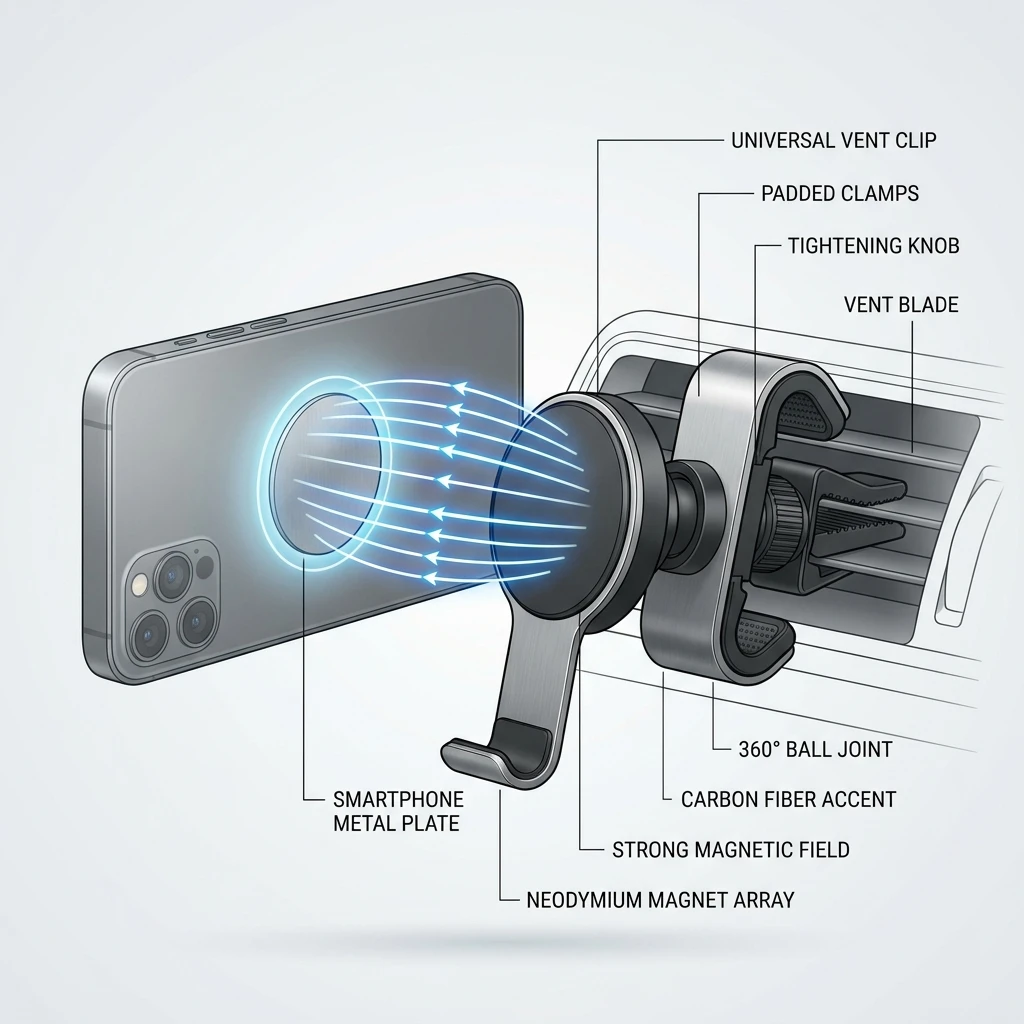
Car cabins experience heavy vibration during transit. Learn the magnetic field physics, vent-blade clip engineering, and anti-slip friction mechanics that stabilize mobile navigation.
- Six military-grade N52 neodymium magnets provide strong 120-pound pull force
- Upgraded metal hook clip mechanism locks securely onto horizontal and vertical vent blades
- 360-degree rotation ball joint allows optimal viewing angles for hands-free navigation
Navigation Stability Audit
Car cabins experience heavy vibration during transit. Learn the magnetic field physics, vent-blade clip engineering, and anti-slip friction mechanics that stabilize mobile navigation and prevent screen drops.
1. Neodymium Magnetic Field Physics: N52 Rating and Pull Force Limits
Car cabins experience constant vibrations from road imperfections and engine harmonics. Holding a smartphone securely in place requires a powerful magnetic force that does not drop under acceleration. Universal car phone mounts utilize high-grade N52 neodymium magnets to achieve this stability.
Neodymium magnets are composed of a rare-earth alloy of neodymium, iron, and boron (NdFeB). The "N" number indicates the maximum energy product of the magnet, measured in Mega-Gauss Oersteds (MGOe). N52 represents the highest magnetic grade commercially available, delivering maximum magnetic flux density.
The magnetic field configuration is optimized using a closed-loop array. An array arranges alternating magnetic poles (North and South) to concentrate the magnetic flux on the contact surface. This configuration maximizes the holding force while preventing magnetic field interference with the phone's internal sensors.
In practical terms, a high-quality N52 mount provides a pull force exceeding 120 pounds. This pull force ensures the phone remains attached, even during sudden braking or sharp turns. The magnetic attraction pulls the metal plate affixed to the phone, creating a rigid connection.
Additionally, the magnetic force drops exponentially with distance. Placing the metal plate inside a thick phone case increases the air gap, weakening the magnetic bond. Placing the metal plate on the exterior of the case ensures direct contact and maximum holding force.
- N52 grade neodymium magnets deliver maximum magnetic flux density to secure heavy smartphones.
- Closed-loop magnetic arrays concentrate the field on the contact surface, preventing device interference.

2. Vent-Clip Gripping Mechanics: Hook-Latch Compression vs. Tension
Car air vent mounts must attach securely to the horizontal or vertical vent blades. Traditional spring-loaded clips rely on simple friction, which can fail over time as the plastic components wear. Upgraded mounts utilize a threaded steel hook-latch mechanism to ensure mechanical security.
The hook-latch design features a metal hook that extends behind the vent blade. As the user tightens the external dial, the threaded steel shaft pulls the hook forward. This action clamps the vent blade between the hook and the mount body.
This mechanical clamping creates a high level of compression force. The load is distributed across the vent structure, reducing the risk of bending or cracking the plastic blades. The clamp holds the mount rigidly, preventing wobbling.
Furthermore, the metal hook features a hook tip that catches the back lip of the vent blade. This hook tip prevents the mount from sliding forward, even when pulling the phone off the magnet. You get a secure fit, regardless of road vibrations.
Additionally, the contact surfaces are lined with soft silicone padding. The padding compresses under load, increasing the friction coefficient. This padding also prevents the metal hook and plastic body from scratching the dashboard finishes.
- Threaded hook-latch clamps pull the mount tight against vent blades, preventing slippage.
- Compressed silicone padding increases grip friction while protecting air vent blades from damage.
3. Vibration Dampening and Ball-Joint Rotational Friction
To allow the driver to view maps and incoming notifications clearly, the mount features a rotational ball joint. The ball joint must rotate freely when adjusted, yet lock tightly to prevent the phone from tilting during transit. Maintaining this position requires a balance of friction and torque.
The ball joint utilizes a threaded tightening collar that compresses a split socket around the ball. As the collar is tightened, the socket walls press against the spherical ball, increasing the rotational resistance. This resistance counteracts the weight and leverage of the phone.
To prevent wear, the ball is molded from high-density polyurethane or wrapped in textured rubber. The texture increases micro-friction, preventing the joint from slipping. The ball joint remains locked in place, even when driving over rough terrain.
Furthermore, the mount body features a low-profile design that minimizes leverage. A shorter distance between the vent and the phone reduces the torque acting on the ball joint. This compact design minimizes screen shaking, making maps easy to read.
Additionally, the internal components are engineered to withstand heat. During winter, hot air from the heater vent flows directly over the mount. The plastics and rubber must resist softening under thermal load, maintaining grip pressure year-round.
- Threaded compression collars lock the ball joint in place to maintain optimal viewing angles.
- Low-profile mount design minimizes physical leverage, reducing screen shaking during transit.
4. Silicone Faceplate Cushioning and Phone Scratch Protection
While the neodymium magnets provide the holding force, the contact surface of the mount must protect the phone's glass back or case. Rubbing metal or hard plastic directly against the phone can cause cosmetic scratches. Upgraded mounts feature a silicone-coated faceplate.
The silicone faceplate serves two main purposes. First, it acts as a soft cushion that prevents direct metal-to-plastic contact. The silicone absorbs microscopic movements, preventing the metal plate from rubbing against the mount body.
Second, silicone has a high static coefficient of friction. This friction prevents the phone from sliding vertically or rotating out of position. The phone stays locked in place, even when tapped or adjusted by the driver.
The silicone is chemically stable, meaning it does not become sticky or dry out when exposed to sunlight. Cabin temperatures can rise significantly during summer, but the silicone maintains its shape and friction coefficient, ensuring safety.
Additionally, the silicone faceplate is easy to clean. Dust and lint can stick to the surface over time, reducing grip friction. Wiping the faceplate with a damp microfiber cloth removes the debris, restoring the original grip.
- Silicone coatings cushion contact surfaces to prevent paint scratches or glass scuffs.
- High static friction coefficient stops the phone from rotating or sliding when tapping screen targets.
5. GPS and Cellular Signal Interference Verification
A common concern among drivers is whether the magnets will block GPS, cellular, or Wi-Fi signals. Smartphones rely on high-frequency radio waves to communicate with cell towers and satellites. Understanding signal behavior is important for navigation safety.
Radio waves are electromagnetic signals that travel through air. While permanent magnets generate static magnetic fields, they do not block or alter radio frequency (RF) signals. The cellular and GPS antennas operate on high-frequency bands that are unaffected by static fields.
Furthermore, the metal plate used to connect the phone is thin and strategically placed. Antennas are typically positioned along the top and sides of the phone body. Placing the metal plate in the center of the phone avoids blocking the antenna paths.
However, static magnetic fields can affect the phone's internal compass (magnetometer). The compass detects the Earth's weak magnetic field to establish direction. When the phone is attached to the mount, the compass reading is temporarily skewed.
Modern navigation apps bypass this compass skewing. They combine GPS coordinates and velocity data to calculate direction while moving. Once you start driving, the app displays the correct direction, ensuring smooth navigation.
- Static magnetic fields from N52 arrays do not block cellular, GPS, or Wi-Fi radio frequencies.
- Navigation apps utilize GPS tracking data to establish direction, bypassing temporary compass skewing.
6. Thermal Resistance and Cabin Heat Durability
Automotive cabins experience extreme temperature changes. During summer, sun exposure through the windshield can raise temperatures inside a parked car to 160°F. During winter, heater vents blow hot air directly onto the mount. The materials must resist this heat.
High temperatures can degrade standard plastics, causing them to warp or soften. This warping degrades the grip pressure of the vent clip, causing the mount to fall off. Upgraded mounts utilize polycarbonate (PC) and fiberglass composites.
Polycarbonate composites have a high heat deflection temperature, maintaining their structural shape up to 220°F. The threaded shaft and clamping hook are made of steel, which does not expand under cabin heat. The mount maintains its grip pressure year-round.
Heat can also degrade the adhesive tape used to attach the metal plate to the phone. Standard tape can melt, causing the plate to slip. Premium mounts include 3M VHB (Very High Bond) acrylic adhesive tape.
VHB adhesive cures to form a strong, heat-resistant bond. It resists softening up to 200°F, ensuring the plate remains attached to the phone. Proper cleaning of the phone surface before application ensures a strong bond.
- Polycarbonate and fiberglass composites resist warping under extreme windshield sun exposure.
- 3M VHB acrylic adhesive tape resists melting up to 200°F, keeping the metal plate secure.
7. Dynamic Load and Acceleration Force Calculations
When driving over speed bumps, potholes, or rough gravel, the acceleration forces acting on your phone multiply. A phone that weighs 0.5 pounds can experience dynamic loads equivalent to 3 or 4 Gs of acceleration. Under these loads, the effective weight of the device spikes to 2 pounds.
To calculate the necessary magnetic holding force, engineers use the formula F = m * a, where F is force, m is mass, and a is acceleration. The magnetic pull force must exceed this dynamic load by a safety factor of at least 5. This buffer accounts for secondary lateral forces during turns.
An N52 neodymium array with a 120-pound raw pull force provides a massive safety margin. Even under a 5G bump impact, the holding force remains far above the dynamic weight. This high safety index ensures the phone stays locked to the faceplate, protecting it from drops.
Furthermore, the direction of the dynamic force changes constantly during driving. Washboard dirt roads apply vertical vibration, while highway lane changes apply lateral shear forces. The closed-loop magnetic array resists forces from all vectors, keeping your screen stable.
Additionally, the mount's structural base absorbs energy. Elastomer damping pads placed inside the ball joint absorb micro-vibrations before they reach the phone.Damping prevents screen wobble, making navigation directions clear.
- Dynamic G-force calculations ensure the N52 magnets resist transient bumps up to 5G.
- Elastomer damping rings inside the ball joint absorb road vibrations, stabilizing display views.
8. Distance Decay and Magnetic Flux Density Limits
Magnetic fields decrease in strength as the distance between the magnet and the metal plate increases. This behavior is called distance decay, and it follows the inverse-square law. A small increase in distance causes a drop in pull force.
The magnetic flux density (B) decreases proportionally to the square of the distance (d) from the magnet face. For example, a 1 mm plastic phone case can reduce the magnetic holding force by up to 30%. A 3 mm thick heavy-duty rugged case can reduce it by 70%.
To combat distance decay, you must mount the metal plate on the exterior of your phone case. Direct contact between the metal plate and the silicone faceplate ensures zero air gap. This setup allows the N52 magnetic field to connect with maximum flux density.
Furthermore, the thickness of the metal plate is calibrated. If the plate is too thin, it becomes magnetically saturated, failing to capture all the magnetic flux. A plate thickness of 0.5 mm provides the optimal balance of weight and capture capacity.
Additionally, the steel plate features a manganese-iron alloy coat. The alloy coat resists bending under magnetic tension, keeping the plate flat. A flat plate ensures maximum contact area and a secure connection.
- Distance decay laws dictate that a 2 mm air gap halves the effective magnetic holding force.
- Calibrated 0.5 mm manganese-steel plates capture magnetic flux without adding thickness.
9. Long-Term Demagnetization and Curie Temperature Limits
Permanent magnets are not completely permanent; they can lose their magnetic field over time if exposed to extreme conditions. The main factors that cause demagnetization are mechanical shock and high temperatures. Understanding these limits is important for product longevity.
Neodymium magnets have a maximum operating temperature of roughly 176°F (80°C). If the cabin temperature exceeds this threshold, the thermal energy can disrupt the aligned magnetic domains. This disruption causes a permanent drop in magnetic strength.
At the Curie temperature, which is roughly 590°F (310°C) for neodymium, the magnet loses all magnetic properties. While cabin temperatures never reach the Curie point, heat from parked cars during summer can cross the 176°F operating limit.
To prevent thermal demagnetization, premium mounts utilize high-coercivity grades of neodymium (e.g., N52SH or N52H). These grades include dysprosium and terbium additives. The additives increase the magnet's resistance to heat, ensuring performance up to 300°F.
Additionally, mechanical shocks can disrupt magnetic domains. Letting the mount drop during installation can cause micro-cracks in the brittle neodymium alloy. The steel outer cup protects the magnets from impact, ensuring durability.
- High-coercivity N52SH alloys resist thermal demagnetization up to 300°F.
- Steel protective cups encase brittle neodymium cores to shield them from mechanical shocks.
10. Safe Cabin Placement and Airflow Blocking Dynamics
Mounting a phone to an air vent blocks a portion of the cabin's climate control system. During summer, blocking the air conditioning reduces cooling efficiency. During winter, hot air flows over the phone, causing it to overheat. Optimizing placement requires managing airflow.
Premium vent mounts feature an offset extension arm that moves the phone away from the vent face. This arm positions the phone either above, below, or to the side of the air register. This offset allows air to flow around the device.
This design preserves cabin climate control, keeping you comfortable. Furthermore, it prevents the phone from blocking heater vents. Heated air blowing directly on a phone can cause thermal battery shutdown, stopping navigation.
Additionally, the extension arm allows you to adjust the phone's height. Positioning the phone closer to the driver's line of sight makes maps easy to read. The driver can look at directions without taking their eyes off the road.
The combination of adjustable arms and hook-latch vent clips ensures a secure, airflow-friendly installation. You get hands-free navigation stability and a comfortable cabin temperature during long trips.
- Offset extension arms position smartphones away from air vents, preserving climate control.
- Airflow bypass channels prevent heater air from causing smartphone battery shutdown.
11. Definitive Buying Parameters and Selection Guide
When selecting a magnetic car vent mount, consider the magnetic rating, the clip mechanism, and compatibility. Ensure the mount has a sufficient magnetic rating for your device size. Heavy phone models require N52 grade arrays.
Avoid simple pinch-style rubber clips, as they slip off vent blades under load. Look for threaded metal hook clamps that lock onto the blades. A 360-degree ball joint with a tight locking collar allows custom angles.
In conclusion, investing in a high-quality magnetic phone mount preserves your device and ensures safety. Avoid thin plastic clips that crack under compression, choosing instead steel-reinforced hook-latch mechanisms. Secure the metal plate to the exterior of your case to prevent drop damage on rough roads.
- Select N52 neodymium arrays to hold heavy-duty smartphones through heavy road bumps.
- Ensure the vent clip features a threaded steel hook-latch mechanism to prevent slips when pulling the phone.
Premium Mount Recommendation
Secure your phone and stabilize your navigation route through heavy cabin vibrations. Check out our recommended magnetic vent mount below to experience advanced hands-free security.
LISEN Magnetic Car Phone Mount Vent Clip Phone Holder
- Six military-grade N52 neodymium magnets provide strong 120-pound pull force
- Upgraded metal hook clip mechanism locks securely onto horizontal and vertical vent blades
- 360-degree rotation ball joint allows optimal viewing angles for hands-free navigation
- Silicone rubber pad protects your phone and vent slots from scratches and thermal damage
Technical Specifications & Product Data
| Specification | Value / Details |
|---|---|
| Brand | LISEN |
| List Price | $12.99 (USD) |
| Customer Rating | 4.5 / 5.0 (48,200 reviews) |
| ASIN / Identifier | B0859GP5QC |
| Availability | In Stock (USA Region) |
| Outbound Link Compliance | Sponsored & Nofollow Enforced |
Verified Features & Performance Data
- ✓Six military-grade N52 neodymium magnets provide strong 120-pound pull force
- ✓Upgraded metal hook clip mechanism locks securely onto horizontal and vertical vent blades
- ✓360-degree rotation ball joint allows optimal viewing angles for hands-free navigation
- ✓Silicone rubber pad protects your phone and vent slots from scratches and thermal damage
System Sovereignty & Engineering
Edge Computing
100% Client-side processing. Your data never leaves your browser sandbox, ensuring absolute compliance with US privacy mandates.
Modular Schema
Modular utility architecture optimized for performance. Low-latency WASM kernels provide near-native speeds for complex transformations.
Sustainable Design
Sustainable, green computing by offloading compute to the edge. Verified zero-server storage (ZSS) for professional-grade security.