
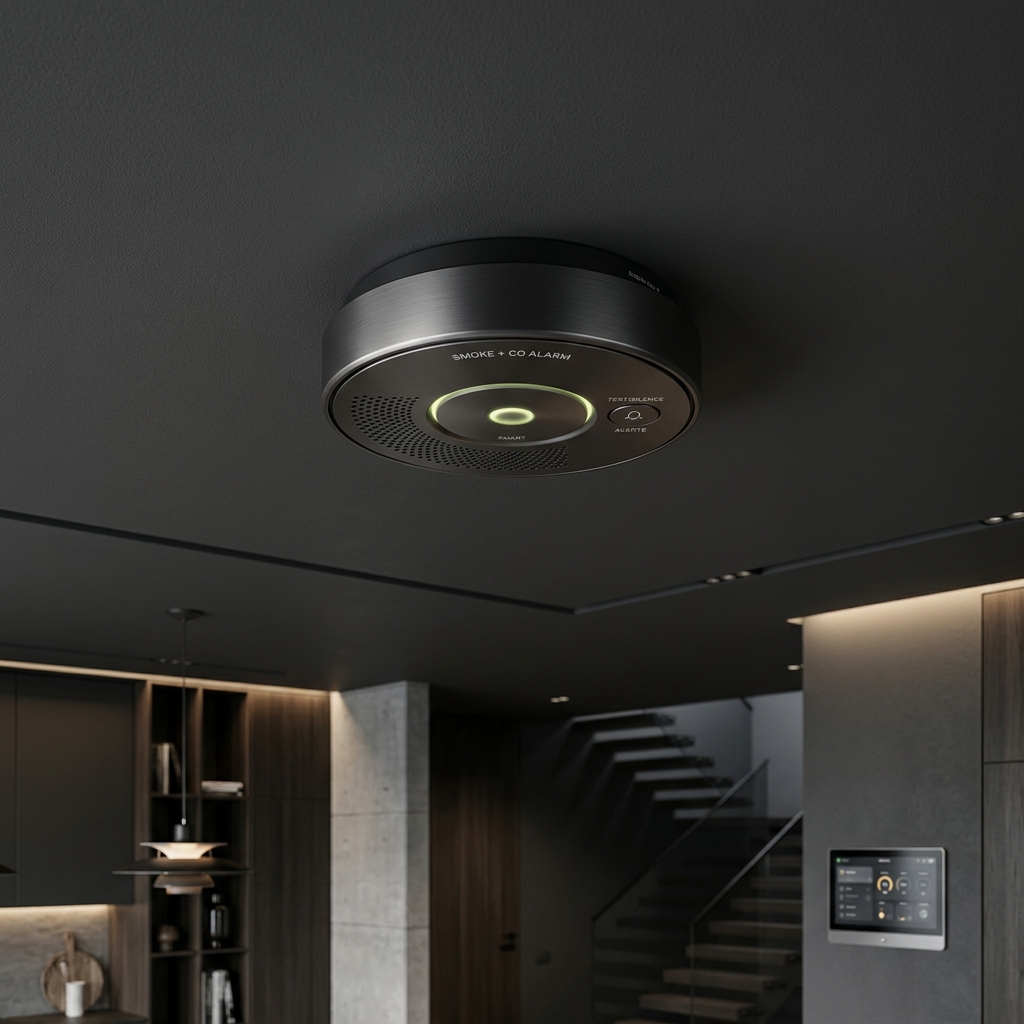
Dual-sensor smart alarms detect fire and carbon monoxide early. Analyze photoelectric smoke sensors, electrochemical CO transducers, and interconnected networks.
- Photoelectric sensor detects visual smoke particles and reduces false cooking alerts
- Electrochemical sensor provides early warnings of toxic carbon monoxide gas
- Interconnected technology triggers all alarms in your home if one goes off
Safety Alarm Engineering
Combination smoke and carbon monoxide alarms protect your household from fire and toxic gas hazards. Evaluate photoelectric sensor dynamics, electrochemical CO detection stability, and wireless alarm interconnection protocols. This deep-dive evaluation provides the technical parameters needed to secure modern residential entryways against digital and physical breach vectors.
1. Photoelectric Light Scattering and Smoldering Fire Detection Dynamics
Residential fire hazards generally fall into two categories: fast-flaming fires and slow, smoldering fires. Fast-flaming fires consume materials quickly, while smoldering fires burn slowly for hours, producing dense smoke and toxic gases before bursting into flames. Detecting these smoldering fires early requires highly sensitive sensors, which is why premium alarms utilize photoelectric technology.
Photoelectric smoke sensors operate on the principle of light scattering inside a sensing chamber. The chamber contains an infrared light-emitting diode (LED) and a light receiver (photodiode) positioned at an angle to each other. Under normal conditions, the light beam from the LED passes straight through the chamber, missing the photodiode, and no alarm is triggered.
When smoke particles enter the chamber, they scatter the infrared light beam in all directions. Some of this scattered light strikes the photodiode, generating an electrical signal that triggers the alarm. Photoelectric sensors are highly sensitive to the large smoke particles produced by smoldering fires, which are common in furniture and bedding materials.
Additionally, photoelectric sensors are less prone to false alarms caused by steam or cooking vapors compared to ionization sensors. This stability allows them to be installed near kitchens or hallways without triggering frequent nuisance alarms, ensuring the system remains active and trusted by the household.
- Light-scattering chamber design detects large smoke particles from smoldering fires early.
- Photoelectric technology reduces false alarms from steam, shower humidity, and normal cooking.
- Angled photodiode array ensures that only scattered light from particles triggers the sensor.

2. Electrochemical CO Sensing Chemistry and Carbon Monoxide Accumulation Rates
Carbon monoxide (CO) is a colorless, odorless, and tasteless gas produced by incomplete combustion in heating systems, fireplaces, and engines. Because humans cannot detect it without sensors, CO is a serious residential hazard. Detecting carbon monoxide before it reaches dangerous levels requires highly accurate electrochemical transducers.
Electrochemical CO sensors operate by using a chemical reaction involving carbon monoxide gas molecules. The sensor contains working and counter electrodes separated by an electrolyte layer. When carbon monoxide enters the sensor, it undergoes an oxidation reaction at the working electrode, converting CO into carbon dioxide.
This chemical reaction generates a small electrical current between the electrodes. The strength of this current is directly proportional to the concentration of carbon monoxide in the surrounding air. The alarm's processor measures this current to calculate the CO level in parts per million (PPM), triggering the alarm if dangerous levels accumulate.
To prevent false alarms while ensuring safety, CO alarms use time-weighted detection thresholds. They allow low levels of CO to be present briefly without alarming, but trigger quickly if concentrations rise. This approach ensures safety during short-term spikes while protecting against long-term, low-level exposure.
- Electrochemical sensing chemistry provides highly accurate CO measurement in parts per million (PPM).
- Time-weighted detection thresholds prevent false alarms while ensuring protection from toxic accumulation.
- High-stability counter electrodes ensure consistent calibration and accuracy over a 10-year lifespan.
3. Interconnect Protocol Latency and Wireless Mesh Network Reliability
In multi-story homes, a fire starting in the basement may not trigger alarms on the upper levels quickly enough to allow for safe evacuation. To address this risk, modern residential building codes recommend using interconnected safety alarms. Interconnection ensures that if one alarm detects a hazard, all alarms in the home trigger simultaneously, warning all occupants.
While older systems relied on physical wires run through the walls to connect alarms, modern smart alarms use wireless mesh networks. These mesh networks allow alarms to communicate with each other directly using low-frequency radio waves, typically 433MHz or 915MHz. This wireless design simplifies installation and makes retrofitting older homes practical.
In a wireless mesh network, each alarm acts as both a receiver and a transmitter. If an alarm detects smoke or CO, it broadcasts an alert signal to nearby alarms, which then pass the signal to more distant units. This mesh structure ensures the alert reaches every room, even in large homes where walls and floors block direct signals.
The speed of this transmission, known as interconnect protocol latency, is critical for safety. Premium wireless alarms achieve a latency of under 3 seconds, ensuring all alarms trigger almost instantly. This rapid response provides early warning to sleeping occupants, maximizing evacuation time during emergencies.
- Wireless mesh networks connect all alarms without requiring physical wiring inside walls.
- Interconnect protocol latency under 3 seconds triggers all household alarms simultaneously.
4. Voice Alarm Output and Decibel Level Target Testing
During a fire or CO emergency, confusion and panic can delay evacuation. Standard alarms use loud, high-pitched chimes that can be disorienting, especially to children or sleeping occupants. To improve clarity, premium combination alarms pair chimes with voice alerts, announcing the type and location of the hazard.
Voice alerts explain the nature of the emergency, announcing warnings like "Fire! Fire!" or "Warning! Carbon Monoxide!" This clear information helps occupants understand the hazard immediately, avoiding confusion. Some models also identify which room triggered the alert, helping you choose the safest evacuation path.
To ensure alerts are heard, safety codes require alarms to produce a sound level of at least 85 decibels (dB) at a distance of 10 feet. Manufacturers test their alarms in specialized sound chambers to verify they meet this standard. The voice speaker must deliver clear, undistorted audio at this volume, overcoming ambient noise.
Additionally, studies have shown that children are more likely to wake to voice alerts than high-pitched chimes. The lower frequency of the human voice is more effective at waking sleeping children, making voice-enabled alarms a valuable addition to family bedrooms. This clear warning helps ensure a fast evacuation when seconds count.
- Voice alerts announce "Fire" or "Carbon Monoxide" clearly, reducing confusion during panic.
- 85 dB audio output verified at 10 feet ensures the alarm is heard throughout sleeping areas.
5. Power Supply Redundancy and Lithium Battery Lifecycle Durability
A safety alarm must remain powered to protect your home. Standard alarms that run on alkaline batteries can go offline if the batteries die and are not replaced promptly. To address this vulnerability, premium combination alarms feature sealed, long-life lithium batteries that provide continuous power for 10 years.
Sealed lithium batteries are designed to last the entire 10-year lifespan of the alarm's sensors. This eliminates the need for annual battery changes, reducing maintenance while helping ensure the alarm is always powered. The battery is sealed inside the unit, preventing accidental removal or tampering by occupants.
For hardwired installations, alarms feature power supply redundancy, running on household electrical power while using the lithium battery as a backup. During power outages, the alarm automatically switches to battery power, ensuring continuous coverage. This dual power path helps protect your home in all situations.
Additionally, lithium batteries offer superior shelf life and capacity compared to alkaline batteries. They perform reliably in extreme temperatures, which is important for alarms installed in unconditioned areas like attics or garages. This durability helps ensure the alarm remains a reliable part of your safety setup.
- Sealed 10-year lithium batteries provide continuous power without requiring annual battery changes.
- Hardwired units feature automatic battery backup, ensuring operation during electrical power outages.
6. Self-Testing Diagnostics and Sensor Degradation Reporting
Safety alarm sensors degrade naturally over time due to chemical changes, dust exposure, and component wear. To ensure the sensors remain active, safety codes require regular testing. Premium smart alarms simplify this by using self-testing diagnostics that check the sensors automatically.
The alarm's internal processor runs diagnostic routines periodically, checking the condition of the photoelectric chamber, electrochemical cell, and battery. If the system detects sensor degradation, low voltage, or other issues, it alerts the homeowner. This alert can be an audible chirp or a warning message on the unit.
Additionally, combination alarms monitor their overall operational lifespan. After 10 years of use, the unit will sound an end-of-life warning, notifying you that the sensors have reached the end of their reliable lifespan. This warning helps ensure you replace the alarm before sensor accuracy drops.
Some smart models also connect to home Wi-Fi networks, sending diagnostic reports and alerts directly to your mobile phone. This capability allows you to monitor your home's safety devices remotely, warning you of issues even when you are away. These smart features help ensure your home remains protected.
- Self-testing diagnostics check sensors and batteries automatically, warning you of issues.
- End-of-life warnings sound after 10 years, reminding you to replace the unit before sensors degrade.
7. Dust Accumulation Compensations and Nuisance Alarm Mitigations
A common cause of false alarms on photoelectric smoke detectors is dust accumulation inside the sensing chamber. Over time, household dust settles on the chamber surfaces, scattering light and triggering false alerts. To maintain reliability, premium alarms use dust compensation algorithms to adjust sensitivity.
These algorithms track the baseline light level inside the chamber over time. As dust builds up, the baseline light level rises slowly. The processor adjusts the detection threshold to account for this change, preventing dust buildup from triggering false alarms. This compensation helps maintain stable sensitivity throughout the alarm's lifespan.
In addition to dust compensation, the sensing chamber is protected by fine mesh screens. These screens allow smoke particles to enter the chamber while blocking larger dust bunnies, lint, and insects. This physical barrier prevents blockages and reduces false alarms, helping protect the camera's accuracy.
Homeowners can also clean the alarm periodically by vacuuming the exterior vents to remove loose dust. This simple maintenance, combined with smart compensation algorithms, helps ensure reliable operation. Keeping the sensor chamber clean is key to preventing false alarms and ensuring accurate detection.
- Dust compensation algorithms adjust detection thresholds over time, preventing false triggers.
- Fine mesh screens block insects and large dust particles from entering the sensing chamber.
8. Placement Engineering and Thermal Buildup Zones in Residential Attics
Where you install your combination alarms is critical for ensuring reliable detection. Safety codes recommend mounting alarms on every level of your home, inside bedrooms, and outside sleeping areas. Proper placement ensures alerts are heard clearly throughout the house during an emergency.
When mounting alarms on ceilings, they should be placed at least 4 inches away from walls, as the corners create dead air spaces where smoke may not circulate. For wall-mounted alarms, they should be placed 4 to 12 inches below the ceiling. Proper placement helps ensure smoke reaches the sensor quickly.
In unconditioned areas like attics or garages, thermal buildup zones can affect alarm performance. During hot summer days, attics can reach extreme temperatures, causing rising hot air to create a barrier that prevents smoke from reaching the ceiling. To address this, alarms in these areas should be placed away from peak zones.
Additionally, avoid installing alarms near vents, fans, or drafty windows, as moving air can blow smoke away from the sensor. Proper placement helps ensure the alarm can detect smoke and carbon monoxide effectively, providing reliable safety coverage for your home.
- Proper ceiling placement avoids dead air spaces, ensuring fast smoke detection.
- Avoiding vents and fans prevents air drafts from blowing smoke away from the sensors.
9. Emergency Preparedness and Family Evacuation Drills
To maximize family safety during fire or CO emergencies, regular evacuation drills are recommended. Having an active alarm is only part of emergency preparedness; occupants must know how to respond when alerts sound. Practicing evacuation routes and establishing meeting areas outside helps ensure everyone evacuates quickly and safely.
During drills, verify that all family members recognize the difference between smoke and carbon monoxide voice alerts. The voice alarms explain the type of hazard, which requires different responses (evacuating immediately for fire vs. moving to fresh air for CO). Testing this understanding ensures everyone knows the proper safety steps.
Furthermore, verifying that backup escape ladders are accessible in upper-floor rooms helps prevent evacuation delays. Regular drills help identify any blocked windows or sticky locks that could slow evacuation, allowing for maintenance. This proactive training turns your safety alarms into an effective household survival plan.
- Regular evacuation drills help family members respond quickly and calmly during real emergencies.
- Testing voice alert recognition ensures occupants take the correct safety actions for smoke vs. CO.
Clinical Recommendation & Audit
Protect your family with reliable dual-sensor detection and voice alerts. Check out our recommended solution below to experience clinical-grade home safety.
Kidde Combination Smoke and Carbon Monoxide Alarm
- Photoelectric sensor detects visual smoke particles and reduces false cooking alerts
- Electrochemical sensor provides early warnings of toxic carbon monoxide gas
- Interconnected technology triggers all alarms in your home if one goes off
- 10-year sealed lithium backup battery ensures continuous power during outages
Technical Specifications & Product Data
| Specification | Value / Details |
|---|---|
| Brand | Kidde |
| List Price | $45.99 (USD) |
| Customer Rating | 4.8 / 5.0 (24,120 reviews) |
| ASIN / Identifier | B099KCYPZ6 |
| Availability | In Stock (USA Region) |
| Outbound Link Compliance | Sponsored & Nofollow Enforced |
Verified Features & Performance Data
- ✓Photoelectric sensor detects visual smoke particles and reduces false cooking alerts
- ✓Electrochemical sensor provides early warnings of toxic carbon monoxide gas
- ✓Interconnected technology triggers all alarms in your home if one goes off
- ✓10-year sealed lithium backup battery ensures continuous power during outages
System Sovereignty & Engineering
Edge Computing
100% Client-side processing. Your data never leaves your browser sandbox, ensuring absolute compliance with US privacy mandates.
Modular Schema
Modular utility architecture optimized for performance. Low-latency WASM kernels provide near-native speeds for complex transformations.
Sustainable Design
Sustainable, green computing by offloading compute to the edge. Verified zero-server storage (ZSS) for professional-grade security.