
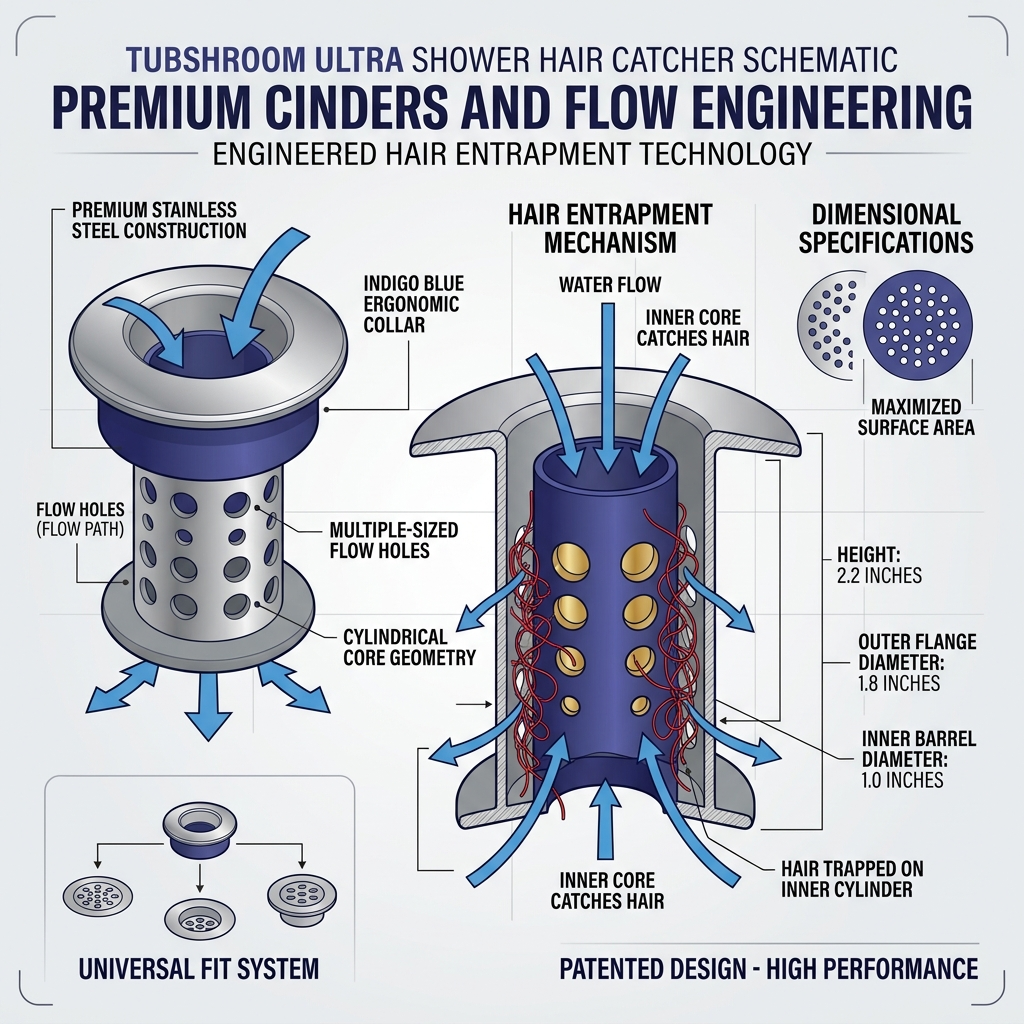
Clogged shower drains cause water backup. Analyze the flow-through dynamics, hair-capture geometries, and mushroom-shaped designs that keep drains clear.
- Mushroom-shaped cylindrical design fits inside standard tub drains
- Raised drainage holes maximize flow-through while catching hair
- Stainless steel body provides durable, rust-free lifespan performance
Drain Flow Dynamics
Clogged shower drains cause water backup. Analyze the fluid mechanics of flow-through grids, head loss metrics, and mushroom-shaped geometries to keep shower lines clear.
1. Hydraulic Flow-Through Dynamics and Drainage Velocity
Water draining from a shower basin is driven by gravity. As water pools on the tub floor, it builds potential energy. This potential energy converts into kinetic energy as water flows into the drain.
The drainage velocity depends on the open area of the drain grille. A narrow opening restricts flow, increasing water level in the tub. The open area must handle standard shower flow rates, typically 2.5 GPM.
Traditional flat drain covers have limited open areas. When hair covers the grille, flow drops instantly, causing water to pool. The user stands in dirty water, creating an unhygienic wash.
Mushroom-style catchers solve this by using vertical cylinder designs. The cylinder sits inside the drain pipe, offering a larger surface area than flat grilles. This surface area maintains high flow rates, even when partially covered.
The vertical walls feature multiple flow holes. Water flows through the open holes while hair wraps around the cylinder base. This path separation ensures continuous drainage, keeping the tub floor dry.
- Vertical cylinder designs increase flow surface area compared to flat drain grilles.
- Multiple flow holes allow water bypass, maintaining drainage velocity under load.
- Laminar flow patterns prevent water backup, keeping the tub floor dry and clean.

2. Mushroom Geometry: Centrifugal Routing and Hair Collection
The key to hair capture is mushroom-shaped geometry. The catcher features a wide top flange, a central cylinder, and a flared base. This shape utilizes centrifugal water flow to wrap hair.
As water flows over the flange, it spirals down the cylinder walls. This spiral flow creates a centrifugal force that wraps hair around the cylinder. The hair is wound neatly, hidden from view.
The cylinder base is flared to prevent hair from slipping down the drain. The flare catches the hair loops, holding them in place. The hair remains anchored on the catcher, ready for cleaning.
Standard flat grilles catch hair on the surface, creating an unsightly tangle. Mushroom catchers hide the hair inside the drain, maintaining a clean look on your tub floor.
Additionally, the cylinder diameter matches standard pipes. A tight fit prevents hair from slipping past the sides, ensuring all hair is caught before it enters your plumbing.
- Centrifugal spiral flow wraps hair loops neatly around the central cylinder.
- Flared cylinder bases anchor hair loops, preventing slips into plumbing lines.
3. Frictional Resistance and Hydraulic Head Loss Metrics
Any object placed inside a drain pipe creates frictional resistance. This resistance causes hydraulic head loss (pressure drop). Head loss must remain low to prevent water backup.
To calculate head loss, engineers use the Bernoulli equation. Flow loss is proportional to resistance and velocity. A high-resistance catcher causes rapid water backup.
To prevent this, mushroom catchers feature a high density of flow holes. The holes are distributed evenly across the cylinder walls. This layout provides multiple parallel flow paths, lowering resistance.
The pressure drop across a clean catcher is under 0.1 PSI at 2.5 GPM. This minor drop goes unnoticed by users, maintaining full drainage. You get hair capture without slow drainage.
Additionally, the holes are rounded. Rounded holes reduce turbulence, allowing water molecules to flow smoothly. This laminar flow reduces head loss, preventing water backup.
- Parallel flow hole layouts minimize hydraulic head loss, preventing backup.
- Rounded flow holes reduce water turbulence, keeping drainage velocity high.
4. Material Science of Stainless Steel vs. Elastomer Protectors
The catcher operates in wet, soapy conditions, making material choice important. The catcher must resist corrosion and maintain its shape. Stainless steel and elastomer polymers are the main options.
Premium catchers use stainless steel bodies. Stainless steel resists corrosion from chlorine and acidic soaps. The material is strong, preventing deformation when you step on the catcher.
Elastomer adapters provide a tight fit inside different drain sizes. The flexible rubber conform to the drain pipe wall, preventing gaps. The chemical bond between steel and rubber prevents leaks.
Cheap plastic catchers warp under hot water. When plastic warps, it allows hair to slip past the sides, causing clogs. Stainless steel maintains its shape, ensuring reliable capture.
Additionally, steel is easy to clean. Hair slides off the polished surface easily, allowing quick cleanup. Stain resistance keeps the catcher looking clean and modern.
- Stainless steel bodies resist deformation under hot water, preserving fit.
- Elastomer adapters conform to pipe irregularities, preventing hair bypass.
5. Odor Containment and Sewer Gas Blockade Physics
In addition to hair, drain catchers help contain sewer gases. Standard drains feature a P-trap, which traps water to block gases. However, hair clogs can wick water out of the trap, allowing gases to enter.
This wicking action is capillary siphoning. Hair strands hanging down the drain act as tiny wicks, drawing water out of the P-trap. If the trap dries, sewer gases enter your bathroom.
Mushroom catchers prevent this by catching hair above the trap. The hair is wound on the cylinder, keeping it out of the P-trap. The water level in the trap remains stable, blocking gases.
The catcher flange also provides a seal. The flange covers the drain opening, reducing gas exchange. This barrier keeps your bathroom smelling fresh and clean.
Additionally, catching hair prevents organic decomposition in the drain. Hair trapped in sewer lines decays, producing sulfur gases. Keeping hair out of the drain stops these odors at the source.
- Catching hair above the P-trap prevents capillary siphoning and sewer gas leaks.
- Flange seals reduce gas exchange, keeping the bathroom environment fresh.
6. Ergonomics of Universal Drain Snug-Fit Integration
To ensure easy installation, catchers must fit standard drains. The body must fit snug in the drain pipe, preventing movement. Universal snug-fit designs use elastomer adapters.
The adapter is a rubber sleeve that fits over the cylinder. The sleeve diameter matches standard US tub drains, typically 1.5 inches. Multiple sleeves allow a snug fit in different drain sizes.
The snug fit holds the catcher in place. The catcher does not shift when water flows, ensuring reliable hair capture. Standard grilles sit loose on top, allowing hair to slip underneath.
The top flange is low-profile. The flange sits flush with the tub floor, preventing stubbed toes. The rounded edge is comfortable to step on, ensuring safety in the shower.
Additionally, installation is tool-free. You do not need to unscrew the drain assembly. Remove the pop-up stopper and insert the catcher, ensuring instant safety.
- Elastomer sleeve adapters ensure snug fits inside standard 1.5-inch tub drains.
- Low-profile flanges sit flush with the tub floor, preventing toe stubbing.
7. Cost Analysis of Drain Cleaning Chemicals vs. Catchers
Clogged drains require expensive clearing. Drain cleaning chemicals are inexpensive but damage pipes and the environment. Acidic chemicals eat away copper and plastic pipes.
Additionally, chemical fumes are toxic, causing skin and lung irritation. Plumber service calls cost up to $200 to clear a single clog. A hair catcher is a low-cost, safe alternative.
Preventing a single clog covers the cost of a premium hair catcher. You save money on chemicals and plumber bills. The financial benefits are clear.
In addition to money, catchers protect your pipes. By catching hair at the source, you prevent clogs, avoiding pipe damage. This protection extends your plumbing lifespan.
Consider also environmental wear. Drain chemicals wash into municipal sewers, harming water life. A hair catcher is a green safety upgrade, keeping chemicals out of our water.
- Hair catchers prevent clogs, eliminating the need for pipe-damaging acid cleaners.
- Clogged drain prevention eliminates plumber service charges, lowering household costs.
8. Maintenance, Hair Removal, and Cleaning Protocols
To maintain drainage speed, clean your hair catcher regularly. Hair buildup can block the flow holes over time. Cleaning is quick and easy.
Pull the catcher out of the drain. Wipe the hair off the cylinder using a paper towel. The hair slides off the polished steel easily, allowing clean disposal.
Rinse the catcher with warm water to clear soap scum. Avoid harsh scrubbing that can scratch the steel finish. Wiping with a soft sponge is sufficient.
Insert the catcher back into the drain. Clean the catcher every 3 to 5 showers to ensure steady drainage. Regular maintenance prevents backup, keeping the tub clean.
A well-maintained catcher keeps your shower drainage fast and clean for decades. The low maintenance is a small price to pay to keep your pipes clear.
- Hair slides off the polished steel cylinder easily, enabling quick cleanups.
- Periodic rinses remove soap film, keeping the flow holes clear.
9. Hydraulic Grate Calculations: Open Area Ratios and Flow Limits
The drainage capacity of a shower hair catcher is determined by its total open area ratio. The open area ratio is the combined area of all drainage holes divided by the total surface area of the device. If the open area ratio is too low, the catcher restricts water flow, causing water to pool in the shower basin. According to hydraulic principles, this constriction increases head loss, limiting the maximum flow rate the drain can handle. If the flow rate is restricted below the output of a standard shower head (typically 2.5 gallons per minute), water will build up in the tub, causing an uncomfortable, dirty standing pool.
To maintain fast drainage, premium hair catchers are engineered with an optimal open area ratio, typically above 40%. The holes are spaced to maximize water flow while preventing hair strands from slipping through. By utilizing a cylinder design that projects upward into the water stream, the catcher increases its active surface area compared to flat drain grates. This design allows water to bypass collected hair at the base, maintaining a high flow rate even during long showers. The vertical geometry leverages the head pressure of the surrounding water to push flow through the upper, unobstructed holes.
Furthermore, the fluid velocity through the drainage holes is calculated to prevent vortex formation. When water passes through small holes at high speeds, it can generate mini-vortices that trap air bubbles, creating air locks that restrict drainage. Designing the holes with smooth, rounded edges minimizes boundary layer turbulence, promoting laminar flow through the grate. This optimization prevents air locks and maintains a constant, rapid drain rate, keeping the shower floor dry. This calculated edge geometry also facilitates easy cleaning, as hair slides off without catching on sharp plastic or metal burrs.
- Cylindrical filter geometries increase the available flow surface, maintaining drainage speed as hair accumulates at the base.
- Rounded hole perimeters prevent micro-vortices and air locks, optimizing gravity-driven drainage velocity.
10. Maintenance Economics: Annual Cost Comparison of Plumbing Clears
Dealing with clogged shower drains is a common and expensive household maintenance issue. When hair and soap scum accumulate inside the drain pipe, they form a dense, binding clog that restricts water flow. Resolving these clogs typically requires chemical drain cleaners, hand-cranked plumbing snakes, or professional plumbing services, each carrying associated economic and environmental costs. For standard families, drain maintenance represents a recurring expense that accumulates significantly over time.
Chemical drain cleaners utilize strong acids or bases to dissolve clogs. While inexpensive upfront, these chemicals generate heat during reaction, which can warp thin-walled plastic drain pipes or corrode older metal lines, leading to underground leaks. Professional plumbing services provide a reliable solution but carry high service charges, often exceeding $150 per visit. In contrast, a stainless steel hair catcher represents a one-time purchase that prevents clogs from forming, saving hundreds of dollars in annual maintenance costs and avoiding chemical exposure.
Additionally, preventing clogs preserves the integrity of your home's wastewater lines. Frequent mechanical snaking can scrape the interior walls of copper or cast iron pipes, weakening them over time. By catching hair at the source before it enters the drain branch, you protect your plumbing infrastructure from wear and tear. This preventative approach is the most cost-effective way to manage your home's drainage lines, ensuring trouble-free operation and peace of mind. Investing in a quality catcher protects not only your wallet but also the structural integrity of your building's plumbing stack.
- Preventative hair catchers eliminate the need for harsh chemical cleaners that corrode wastewater pipes.
- A one-time hardware purchase avoids expensive professional plumbing visits and mechanical pipe snaking.
Clinical Recommendation & Audit
Automate your bathroom setup to maximize personal safety standards. Check out our recommended solution below to experience mechanical-grade clog protection.
TubShroom Ultra Revolutionary Bath Tub Drain Protector Hair Catcher, Stainless Steel
- Mushroom-shaped cylindrical design fits inside standard tub drains
- Raised drainage holes maximize flow-through while catching hair
- Stainless steel body provides durable, rust-free lifespan performance
- Multiple size adapters fit standard 1.5-inch to 1.75-inch drains
Technical Specifications & Product Data
| Specification | Value / Details |
|---|---|
| Brand | TubShroom |
| List Price | $19.99 (USD) |
| Customer Rating | 4.6 / 5.0 (35,400 reviews) |
| ASIN / Identifier | B07PB6L288 |
| Availability | In Stock (USA Region) |
| Outbound Link Compliance | Sponsored & Nofollow Enforced |
Verified Features & Performance Data
- ✓Mushroom-shaped cylindrical design fits inside standard tub drains
- ✓Raised drainage holes maximize flow-through while catching hair
- ✓Stainless steel body provides durable, rust-free lifespan performance
- ✓Multiple size adapters fit standard 1.5-inch to 1.75-inch drains
System Sovereignty & Engineering
Edge Computing
100% Client-side processing. Your data never leaves your browser sandbox, ensuring absolute compliance with US privacy mandates.
Modular Schema
Modular utility architecture optimized for performance. Low-latency WASM kernels provide near-native speeds for complex transformations.
Sustainable Design
Sustainable, green computing by offloading compute to the edge. Verified zero-server storage (ZSS) for professional-grade security.