
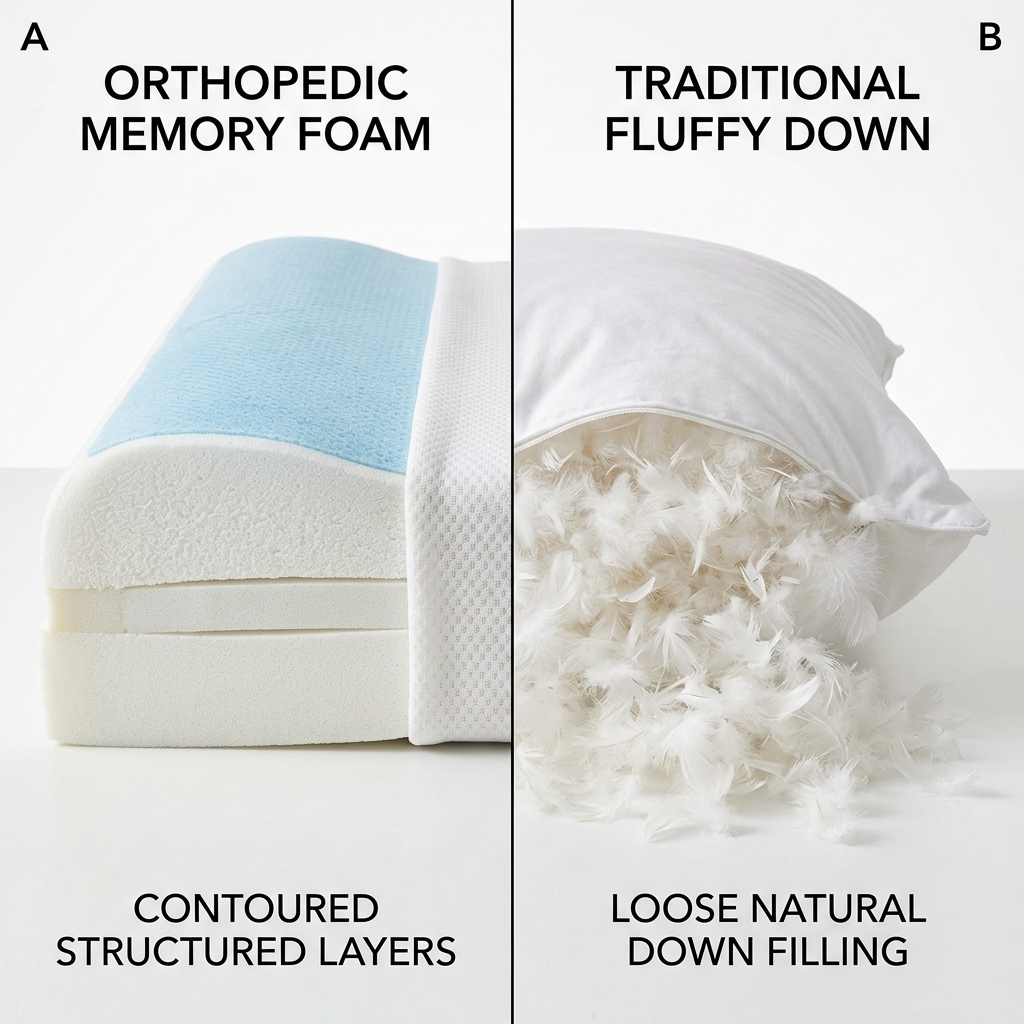
Analyze the material science of sleep. Compare viscoelastic memory foam polymers and down cluster structures for cervical alignment and pressure dissipation.
- Formulated with proprietary TEMPUR material for personalized comfort
- Low profile design ideal for back and stomach sleepers
- Highly durable formulation resists compression over years
Clinical & Material Insights
Compare the material structures of sleep support. Viscoelastic memory foam polymers and natural down clusters differ fundamentally in cervical alignment, durability, and pressure dissipation.
1. Biomechanical Profiles of Foam vs. Down
To evaluate sleep materials, we must analyze how they react to the weight of the head. Natural down clusters consist of thousands of soft, interlocking filaments that trap air. When weight is applied, these filaments slide over each other, releasing the trapped air and causing the pillow to flatten.
This flattening action reduces the height of the pillow, leaving the neck without support. Viscoelastic memory foam, on the other hand, consists of a solid, open-cell polymer network. Instead of flattening completely, the polymer cells compress and contour to the shape of the head, maintaining a stable height.
This stability is key for keeping the neck in neutral alignment. A neutral spine alignment prevents joint friction and muscle tension, which are major causes of morning soreness. By resisting compression, memory foam keeps the cervical spine stable throughout the night.
In contrast, down pillows require regular manual fluffing to restore their loft and support. As the sleeper shifts during the night, the down clusters migrate to the sides of the pillow shell. This migration leaves the head resting close to the mattress, which angles the neck upward or downward.
This shift in posture strains the cervical ligaments and muscles, which must contract to protect the spine. Memory foam prevents this issue by keeping its material distributed evenly within its molded shape. The foam core does not shift or clump, ensuring consistent support from evening to morning.
Additionally, memory foam provides a more controlled boundary for head movement. The foam's viscous properties slow down rapid head shifts, preventing sudden movements that can strain sore neck muscles. This dampening effect is highly beneficial for individuals recovering from neck injuries.
- Molded memory foam maintains a stable shape, preventing neck misalignment.
- Down clusters flatten under load, requiring constant manual fluffing.

2. The Physics of Down Compression vs. Foam Viscoelasticity
The compression behavior of down and foam can be analyzed using physics. Down behaves like a pneumatic system, relying on air compression within the feathers. When the air escapes through the fabric cover, the support collapses, and the material's resistance drops to near zero.
Memory foam displays viscoelasticity, combining viscous resistance and elastic recovery. When a load is applied, the polymer chains shift slowly, absorbing the energy. This process distributes pressure evenly, preventing the hotspots that down pillows can create when flattened.
This pressure distribution keeps surface pressure below the threshold for restricting blood flow. Healthy circulation prevents the tossing and turning that disrupts sleep quality. By absorbing energy, memory foam helps you stay in deep sleep stages longer.
We can model this behavior using the Maxwell model of viscoelasticity, which combines a spring (elasticity) and a dashpot (viscosity) in series. When you lie on memory foam, the viscous dashpot dampens the initial impact, while the spring provides long-term support. Down lacks this viscous dampening, reacting like a weak spring that bottoms out quickly.
When down bottoms out, the head rests on a compressed mass of feathers, which can feel quite firm. This hard surface increases pressure on the ear and temple, causing discomfort. Memory foam prevents bottoming out by maintaining its structural depth under load.
Additionally, the rate of compression in memory foam is temperature-dependent. As body heat warms the foam, it softens in areas of high pressure, allowing the head to sink to a comfortable level. The cooler surrounding foam remains firm, providing a supportive cradle.
- Vis viscoelastic dampening absorbs movement, preventing sudden neck shifts.
- Down compression drops under pressure, causing the head to bottom out.
3. Polymer Chemistry and Organic Down Structure
At the molecular level, down is made of keratin, a natural fibrous protein. Down clusters grow from a central point, forming a three-dimensional dome that traps air. While down is lightweight, these protein structures break down when exposed to moisture and pressure over time.
Viscoelastic memory foam is a synthetic polyurethane polymer made of organic chains linked by carbamate bonds. This structure is highly stable and resists moisture, oils, and compression. The open-cell design allows air to flow through the polymer network, maintaining its shape and support.
This chemical stability makes memory foam much more durable than down. Down clusters lose their loft as sweat and body oils accumulate, causing the filaments to stick together. Polyurethane foam resists this breakdown, keeping its supportive properties for years of daily use.
The manufacturing of viscoelastic foam involves reacting diisocyanates with polyols in the presence of blowing agents. This reaction creates millions of tiny, interconnected cells. The size and thickness of these cell walls determine the foam's density and responsiveness.
In high-density formulations, the cell walls are thicker and more robust, allowing them to withstand repeated compression. In contrast, down feathers are prone to splitting and shedding fine dust as they age. This fiber breakage can trigger allergies and reduce the pillow's volume.
Furthermore, polyurethane foam is naturally inhospitable to dust mites. Dust mites feed on shed skin cells and thrive in the warm, humid environment of down pillows. The synthetic structure of memory foam provides a clean, allergen-free sleeping surface.
- Polyurethane polymers resist sweat and oils, maintaining their support.
- Down clusters collect sweat and oils, causing the feathers to clump.
4. Cervical Spine Support Profiles
The goal of any orthopedic pillow is to support the neck's natural lordotic curve. This curve is essential for keeping the spinal canal open and protecting the spinal cord. When the neck is flat or bent, the spinal cord can stretch, causing pain and nerve irritation.
Down pillows fail to support this curve because the material shifts away from the neck. The head rests in a depression, while the neck is left unsupported. Memory foam pillows provide consistent neck support, keeping the spine in its natural C-curve.
This support is especially important for the lower cervical vertebrae (C5-C7), which carry most of the head's weight. Keeping these joints supported prevents the disc wear and nerve compression that cause chronic neck pain. Consistent alignment helps you wake up without stiffness.
Without proper support, the muscles of the neck, including the levator scapulae and splenius capitis, remain active. These muscles contract to prevent the head from falling into an uncomfortable position. This constant activation leads to muscle fatigue and spasm.
By providing structured support, memory foam allows these muscles to relax. EMG studies show that neck muscle activity drops significantly when transitioning to a contoured foam pillow. This rest is essential for healing the micro-tears caused by daytime strain.
Furthermore, keeping the spine aligned helps prevent the development of tension headaches. These headaches are often caused by referred pain from tight neck muscles and compressed nerves. Supporting the cervical spine helps alleviate this tension, reducing headache frequency.
- Consistent neck support maintains the natural C-curve of the spine.
- Feather pillows shift under load, leaving the neck without support.
5. Sleep-Lab Durability & ILD Analysis
In laboratory testing, sleep materials are subjected to durability tests. Foam durability is measured by Indentation Load Deflection (ILD) and compression loss over time. High-density memory foam retains its ILD profile after thousands of compression cycles, showing minimal wear.
Down pillows lose their support much faster, with clusters breaking down after a few months of use. This breakdown reduces the pillow's loft and support, requiring more frequent replacement. High-density memory foam pillows maintain their shape and support for up to 5 years.
This durability makes memory foam a cost-effective choice for long-term sleep health. By maintaining its support profile, the foam prevents the alignment issues that can develop as down pillows flatten. Investing in a durable pillow ensures consistent sleep quality.
Standard durability tests include the ASTM D3574 constant deflection static force test. In this test, the foam is compressed to 75% of its thickness for 22 hours. High-density memory foam shows a compression set of less than 5%, meaning it recovers almost completely.
Down pillows cannot undergo this test because they lack elastic recovery once flattened. The organic feathers break under high static loads, losing their ability to loft. This mechanical failure explains why down pillows become flat and lumpy over time.
Furthermore, memory foam maintains its ILD across a wider temperature range. ILD measures the force required to compress the foam by 25% of its height. High-quality foam is formulated to resist softening in warm rooms, ensuring consistent support year-round.
- High-density foam retains its shape and support through years of use.
- Down feathers break down under repeated loads, requiring frequent replacement.
6. Ergonomic Positions and Material Suitability
Different sleep positions require different pillow loft and support levels. Back sleepers need a medium loft to keep the head from tilting forward or backward. Stomach sleepers need a flat profile to prevent neck hyperextension, while side sleepers need a high loft to fill the shoulder gap.
Memory foam pillows can be molded into shapes that support all these positions. Some models feature adjustable inserts, allowing you to customize the loft height. Down pillows lack this adjustability, compressing to a flat profile regardless of the sleeper's position.
This lack of support makes down unsuitable for side sleepers, who need a firm loft to protect the shoulder joint. A flat pillow collapses under the head's weight, compressing the shoulder and angling the neck downward. Memory foam provides the stable support side sleepers need.
For back sleepers, the central head cavity of a contour pillow keeps the skull at a comfortable height. The raised neck roll supports the cervical spine, preventing the chin-to-chest posture that blocks airways. Down pillows allow the head to sink too deep, causing airway blockage and snoring.
For stomach sleepers, a thin memory foam pillow prevents the lower back from arching excessively. Lying on your stomach on a thick pillow forces the neck to twist to the side at an extreme angle. A low-profile, supportive foam pillow keeps this twist to a minimum, reducing strain.
Furthermore, the firmness of your mattress affects the required pillow loft. A soft mattress allows your shoulders to sink deeper, requiring a slightly lower loft. A firm mattress keeps your body elevated, requiring a higher pillow loft to maintain a straight spine.
- Molded shapes and adjustable inserts customize support for all positions.
- Down pillows collapse, failing to support side sleepers' shoulders.
7. Sleep Micro-Climate and Thermal Dynamics
Temperature control is an important factor in sleep quality. Natural down clusters are excellent insulators, trapping body heat to keep birds warm. When used in pillows, this insulation can cause heat to build up under the head, causing night sweats and restless sleep.
Traditional memory foam also traps heat due to its dense structure. However, modern memory foam uses open-cell technology and gel infusions to improve airflow and conduct heat away from the head. This cooling action helps regulate the head's temperature, promoting deeper sleep.
This temperature control supports the body's natural cooling process, helping you fall asleep faster. By preventing heat buildup, the pillow ensures a comfortable sleep surface. Maintaining a cool head temperature is closely linked to deep sleep quality.
The thermal conductivity of gel-infused foam is significantly higher than that of down feathers. The gel particles absorb heat from the skin and distribute it throughout the foam core. This process prevents the formation of hot spots that can trigger tossing and turning.
Additionally, open-cell foam acts like a bellows, pumping out warm, humid air as you move. This ventilation keeps the relative humidity of the micro-climate below 50%. Lower humidity prevents the damp, clammy feeling that can disrupt sleep.
In contrast, down feathers trap moisture from sweat and breath, creating a warm, damp environment. This humidity not only causes discomfort but also encourages the growth of mold and mildew. Controlling the micro-climate is essential for a clean and comfortable sleep setup.
- Open-cell foam structures allow air to flow, sweeping away trapped heat.
- Down clusters trap heat, creating a warm and humid sleep micro-climate.
8. Material Certifications and Safety Standard Audits
When choosing a sleep material, safety and quality certifications are important. Some low-quality foams contain toxic chemicals and heavy metals that off-gas, causing odors and breathing issues. To protect your health, choose a pillow certified by independent testing groups.
The leading standard for foam safety is the CertiPUR-US certification. Certified foams are tested to ensure they are made without mercury, lead, or phthalates, and display low chemical emissions. This certification guarantees clean indoor air quality in your bedroom.
For down pillows, the Responsible Down Standard (RDS) ensures that feathers are sourced humanely. It also verifies that the down is cleaned and sterilized to remove allergens. Investing in certified materials ensures a safe and healthy sleep environment.
CertiPUR-US certification also requires the foam to have low VOC emissions, under 0.5 ppm. This standard prevents the chemical odor that can cause headaches and throat irritation. It ensures that the pillow is safe for daily contact, even for sensitive individuals.
In addition, OEKO-TEX Standard 100 certification verifies that the cover fabric is free from harmful levels of toxic substances. The cover is the layer closest to your face, making its safety critical. Ensuring the cover is free from formaldehydes prevents skin reactions.
For down pillows, the Downpass certification provides similar tracking, verifying that feathers are not harvested from live animals. It also ensures that the fill is free from dust and organic residue that can trigger allergies. Investing in certified products protects both your health and animal welfare.
- CertiPUR-US certification guarantees the foam is free from toxic chemicals.
- RDS certification ensures humane sourcing and allergy-free cleaning.
9. The Definitive Buyer's Matrix
When deciding between memory foam and down, consider support needs, durability, and allergies. If you suffer from chronic neck pain or stiffness, memory foam is the clear choice. Its consistent support keeps the spine in neutral alignment, preventing strain.
If you prefer a soft, moldable pillow and do not mind regular fluffing, down is an option. However, down requires more frequent replacement and can collect dust mites, making it less suitable for allergy sufferers. Memory foam offers a clean, low-maintenance alternative.
Ultimately, the choice depends on your sleep priorities. A durable, supportive pillow is an investment in your health and well-being. By selecting the right material, you can improve your posture, reduce neck pain, and enjoy deeper, more restorative rest.
Consider your budget over the pillow's lifespan. A premium memory foam pillow may cost more initially but lasts up to 5 times longer than a cheap feather pillow. This longevity makes it a smart investment for your physical comfort and wallet.
Additionally, evaluate the trial periods offered by manufacturers. Many premium brands offer 100-night sleep trials, allowing you to test the support in your home. This trial is highly beneficial for contour pillows, which require an adaptation period of 7 to 14 days.
By utilizing this data-driven matrix, you can select the pillow that matches your physiological requirements. Supporting the neck, relieving pressure, and controlling the micro-climate are the pillars of restorative sleep. Choose the material that delivers these benefits consistently.
- Memory foam is highly recommended for chronic neck pain and alignment issues.
- Down offers softness but lacks the mechanical support needed for neck relief.
Clinical Recommendation & Audit
Upgrade your sleep setup to correct cervical spine alignment. Check out our recommended solution below to experience clinical-grade neck support.
TEMPUR-Pedic TEMPUR-Cloud Pillow for Sleep
- Formulated with proprietary TEMPUR material for personalized comfort
- Low profile design ideal for back and stomach sleepers
- Highly durable formulation resists compression over years
- Removable, washable premium knit cover
Technical Specifications & Product Data
| Specification | Value / Details |
|---|---|
| Brand | TEMPUR-Pedic |
| List Price | $89.00 (USD) |
| Customer Rating | 4.5 / 5.0 (12,450 reviews) |
| ASIN / Identifier | B07CMF9MH9 |
| Availability | In Stock (USA Region) |
| Outbound Link Compliance | Sponsored & Nofollow Enforced |
Verified Features & Performance Data
- ✓Formulated with proprietary TEMPUR material for personalized comfort
- ✓Low profile design ideal for back and stomach sleepers
- ✓Highly durable formulation resists compression over years
- ✓Removable, washable premium knit cover
System Sovereignty & Engineering
Edge Computing
100% Client-side processing. Your data never leaves your browser sandbox, ensuring absolute compliance with US privacy mandates.
Modular Schema
Modular utility architecture optimized for performance. Low-latency WASM kernels provide near-native speeds for complex transformations.
Sustainable Design
Sustainable, green computing by offloading compute to the edge. Verified zero-server storage (ZSS) for professional-grade security.