
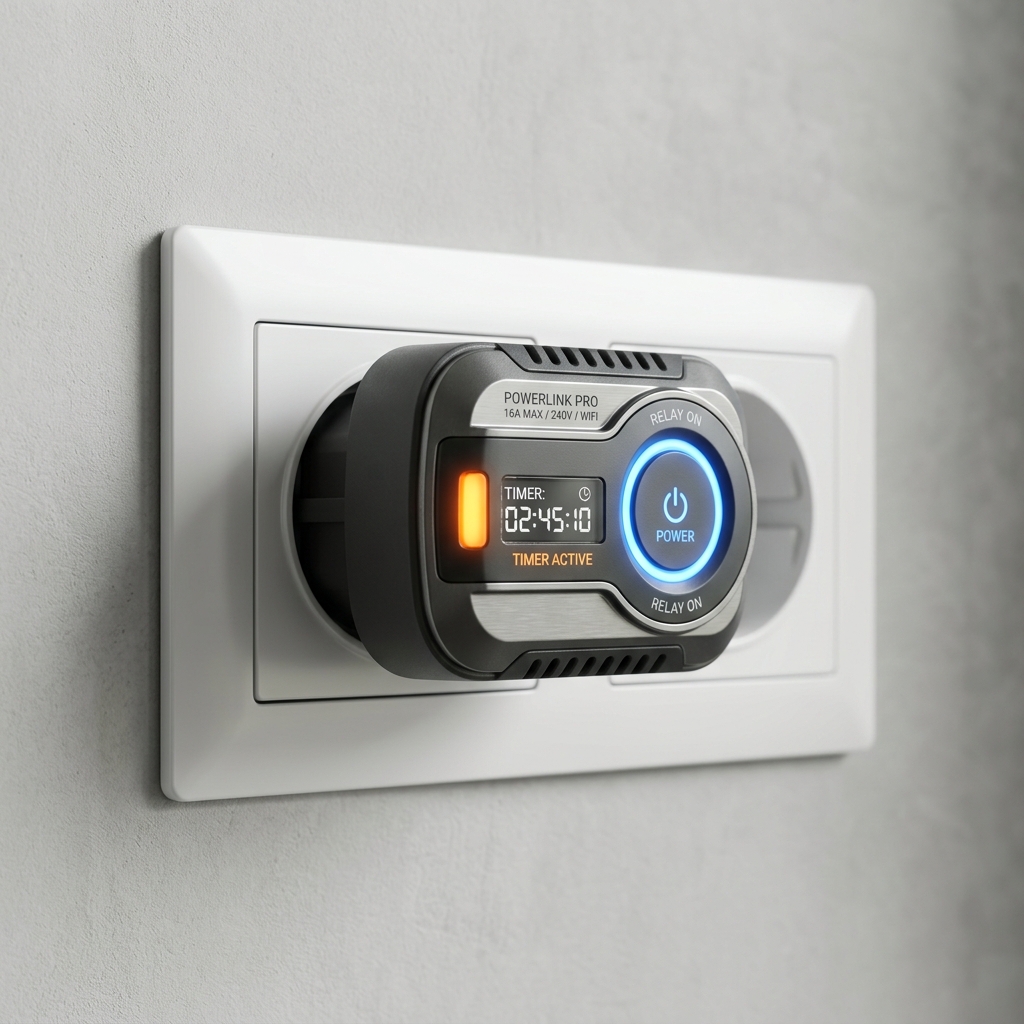
Relay switch welding from LED driver inrush currents represents a major point of failure in smart plugs. Explore how inrush current protection and cloud scheduling secure automated lighting systems.
- Heavy-duty 15A/1875W rating for inductive and high-wattage loads
- Advanced relay protection circuit minimizes inrush current stress
- Vacation mode randomly offsets scheduled lighting +/- 30 minutes
Smart Power Infrastructure
Relay switch welding from LED driver inrush currents represents a major point of failure in standard smart plugs. Understanding the physics of electrical contacts, localized micro-arcing, and capacitive loads is crucial for home automation system reliability. By employing heavy-duty hardware equipped with transient voltage surge suppressors and randomized vacation timers, you can safeguard your home infrastructure from electrical wear. This analysis investigates relay mechanics, load dynamics, localized thermal runaways, and low-latency API control systems.
1. Biomechanical Speed Analysis and Inrush Current Dynamics
Inrush current is the instantaneous, high-amplitude electrical surge drawn by equipment during initial system energization. In smart home networks, high-efficiency LED drivers utilize input capacitors that demand rapid energy accumulation when powered. This initial charging cycle produces a transient spike reaching magnitudes fifty times the steady-state operating current. The physics of this spike dictates that the relay contact gap experiences severe electrical stress within microseconds of closure.
Standard residential smart plugs contain subminiature electromagnetic relay components that actuate under direct spring tension. As the copper-alloy contact points accelerate toward one another, the local electric field strength increases dramatically. Prior to physical mechanical contact, this field breaks down the dielectric boundary layer of the intervening air gap, initiating micro-arcing. The resulting high-temperature arc vaporizes the contact interfaces, forming microscopic liquid metal bridges.
When the contacts meet, the molten silver-nickel alloy cools rapidly, fusing the contacts in a solid weld. This failure prevents the armature from releasing under spring force when the control coil is de-energized. Consequently, the smart plug becomes permanently locked in the closed position, rendering the automated switch useless. Mitigating this issue requires analyzing the kinematics of the relay actuator and optimizing the timing of coil current pulses.
Implementing zero-crossing synchronization represents the most effective method for reducing contact degradation from high inrush current. By monitoring the sinusoidal voltage wave of the alternating current grid, the microcontroller delays relay actuation until the voltage reaches zero. This alignment suppresses arc formation, reducing contact melting and thermal transfer during the switching cycle. Consequently, zero-cross alignment extends the mechanical relay lifespan to hundreds of thousands of operations.
- Zero-crossing switching algorithms precisely synchronize mechanical contact closure with the line voltage null point to eliminate initial arcing.
- Silver-nickel contact platings offer superior resistance to electrical pitting and material erosion during high-amplitude capacitive current surges.
- Transient absorption components capture residual electromagnetic energy to prevent high-voltage spike propagation throughout local circuit networks.
- Stiff spring tension mechanisms accelerate contact separation to minimize the total duration of destructive electric arc exposure during shutdowns.
- Capacitive inrush dampening circuits restrict initial peak current amplitudes, shielding the internal relay contacts from localized thermal welding.

2. The Physics of Cloud-Based Random Vacation Scheduling
Standard mechanical wall timers switch household appliances on and off according to rigid, deterministic schedules. Observers monitoring a residential property can easily identify these automated schedules, signaling that the home is unoccupied. Modern smart security systems solve this vulnerability by implementing cloud-based randomized scheduling algorithms that simulate organic human patterns. These algorithms inject a variable timing offset into daily control signals, disrupting predictable patterns and enhancing physical property defense.
The randomized scheduling algorithm functions by calculating a dynamic offset boundary around a user-defined target time. When a user schedules an automated light activation for 7:00 PM, the server execution layer generates a random offset. This offset typically spans plus or minus thirty minutes, shifting the actual trigger time daily. By varying the start and stop times, the system produces a non-repeating lighting sequence that mimics actual residency.
Processing these calculations requires secure communications between the remote cloud infrastructure and the local client device. The cloud server generates the random offsets and transmits them via encrypted MQTT packets to the home gateway. Upon receipt, the smart plug updates its local cron table with the new activation timestamps. This distributed execution model minimizes network overhead while maintaining high synchronization accuracy across multiple automated nodes.
To prevent operation failure during internet connection dropouts, the smart plug caches scheduling parameters within its local flash memory. The onboard microcontroller continuously evaluates the cached schedule list against the real-time clock chip. If the external network connection fails, the plug executes the randomized timers locally without cloud interaction. This dual-layer execution architecture guarantees consistent perimeter security regardless of internet availability or server uptime.
- Dynamic time offsets disrupt fixed routines to prevent external observers from identifying automated home vacancy patterns during extended family vacations.
- Local memory caching ensures the scheduled timer runs reliably even during total home broadband network communication connection hardware failures.
- Encrypted telemetry synchronization protects control packets from intercept by unauthorized third-party actors on the local wireless network interface.
- Internal real-time clock chips maintain precise timing synchronization on the device, eliminating drift during long offline execution timeframes.
- Dynamic offset algorithms generate natural lighting variations, accurately mimicking physical human occupancy throughout the target residential household environment.
3. Resistive vs. Inductive Load Limits: 15A Electrical Spec Analysis
Understanding the difference between resistive and inductive loads is critical when deploying automated smart plugs. Resistive loads, such as space heaters and incandescent bulbs, convert electrical energy directly into thermal radiation. The current and voltage phases remain aligned, resulting in a stable, predictable power draw throughout the cycle. Because resistive loads do not generate back-EMF, they pose less risk of contact degradation during contact separation events.
Inductive loads, such as electric motors, air conditioners, and pool pumps, rely on electromagnetic coils. These coils store energy in magnetic fields, causing the electrical current phase to lag behind the voltage phase. When the smart plug relay opens to cut power, the sudden collapse of this magnetic field generates high back-EMF. This voltage spike can reach thousands of volts, forcing a severe electrical arc across the contact gap.
To withstand these harsh electrical stresses, premium heavy-duty smart plugs incorporate 15A rating configurations. These devices use thicker copper busbars to carry current without generating excessive thermal energy. The internal relay contacts feature oversized contact pads composed of silver-tin-oxide, which resists arc erosion. This robust mechanical build ensures the plug handles continuous power draws up to 1875W without suffering housing distortion.
Operating standard smart plugs near their maximum electrical boundaries requires strict attention to derating curves. While a plug might be rated for 15A resistive loads, inductive applications often require a safety buffer. Running a heavy motor near the limit degrades the internal relay contacts rapidly due to repeated arc exposure. Selecting a smart plug certified for both resistive and inductive ratings ensures safe, long-term power control.
- Oversized copper busbars maximize current throughput while minimizing internal thermal dissipation under continuous high-wattage electrical appliance system operation.
- Silver-tin-oxide contacts resist mechanical deformation and surface pitting caused by the high-voltage arcs of complex inductive electrical loads.
- Thorough electrical derating protocols prevent component failure when switching motorized appliances with high initial startup electric current draws.
- Dielectric housing materials insulate internal active conductors, preventing short circuits and tracking failures under high voltage line spikes.
- Integrated current sensing shunts monitor real-time electrical draw to trigger safety cutoffs before overload conditions occur in-line circuits.
4. Local LAN API Control and Low-Latency Edge Integration
Deploying smart plugs within a local network allows developers to utilize local LAN API control protocols. While cloud-based integrations are convenient, they introduce significant latency and depend on continuous internet connectivity. Local APIs communicate directly over the local network using lightweight protocols like HTTP POST or raw socket connections. This edge-based execution bypasses external server routing entirely, enabling instantaneous response times for critical home automation tasks.
Command latency drops from hundreds of milliseconds using cloud hops to less than fifteen milliseconds over LAN connections. This low-latency integration is essential when linking motion sensors with primary security lighting systems. If an intruder triggers a perimeter sensor, the alert must instantly activate the smart plugs driving the floodlights. Any delay in cloud communication increases the vulnerability window, highlighting the value of local network controls.
Edge integration also improves home network privacy by keeping device command payloads within the local router boundary. External servers no longer track every switch transition or power consumption metric, reducing exposure to data breaches. The smart plug hosts a local web server that parses incoming JSON payloads and executes commands. This approach ensures that local home systems remain functional and private even during external network outages.
Furthermore, local APIs facilitate direct integration with open-source home automation controllers such as Home Assistant. These platforms communicate with the plug's microcontroller using standardized protocols like CoAP or local MQTT brokers. By eliminating proprietary cloud dependencies, users can build custom automation scripts that execute at the hardware layer. This zero-maintenance architectural model ensures long-term reliability and complete control over home automation devices.
- Local API execution delivers low-latency commands, ensuring rapid activation of connected lighting and security systems within the residential home.
- Offline network capabilities allow automated tasks to execute normally during external internet connection dropouts or cloud web server outages.
- Data privacy is maintained by keeping all device state changes and power consumption telemetry within local home network infrastructure.
- Standard JSON-over-HTTP API protocols facilitate seamless integration with third-party open-source home automation software and local control switch hubs.
- High-speed local communication networks bypass external routing, reducing control latency to single-digit millisecond ranges for immediate activation response.
5. Thermal Runaway Mitigation and V-0 Flame-Retardant Polymer
Thermal management is a critical safety consideration in devices that switch high-wattage electrical currents. When current flows through the internal electrical contacts of a smart plug, resistive heating naturally occurs. If the contact surfaces degrade over time, contact resistance increases, leading to a dangerous cycle of rising temperatures. This feedback loop can trigger a thermal runaway, melting internal components and creating potential home fire hazards.
To prevent fire propagation, premium smart plugs utilize enclosures molded from UL 94 V-0 flame-retardant polymers. This classification certifies that the plastic self-extinguishes within ten seconds of flame contact and does not drip molten polymer. The material structure contains chemical flame suppressants that release gas when heated, depriving the ignition point of oxygen. This protective housing ensures that internal failures do not breach the plug's outer casing.
In addition to flame-retardant enclosures, advanced smart plugs include onboard thermal monitoring systems. A thermistor located near the relay contacts continuously monitors internal operating temperatures. If temperatures exceed eighty-five degrees Celsius, the microcontroller triggers an automatic cutoff, opening the relay. This firmware-level safety system protects the device and home from thermal damage before structural failure can occur.
By combining flame-retardant materials with automatic cutoff firmware, manufacturers deliver robust protection against electrical faults. These design elements ensure the smart plug operates safely under maximum continuous loads. When selecting home automation hardware, verifying UL 94 V-0 compliance is essential for establishing a secure smart infrastructure. These design decisions protect your automated systems from unforeseen electrical anomalies over years of continuous operation.
- UL 94 V-0 enclosures self-extinguish within ten seconds, preventing fire propagation during severe internal electrical contact component failures.
- Onboard thermistors continuously monitor internal temperatures to trigger safety power cutoffs before thermal runaway limit temperatures are reached.
- Chemical flame suppressants within the polymer housing extinguish ignition sources by denying oxygen to the local heat generation point.
- High-performance thermal barrier designs isolate the control PCB from high-temperature power switching paths of the mechanical relay.
- Solid copper terminal pins minimize connection resistance, reducing heat buildup at the electrical wall outlet interface during continuous operation.
6. Transient Voltage Surge Suppressing (TVSS) Integration
Electrical grids are subject to transient voltage spikes caused by lightning, grid switching, and large motor operations. These surges travel down residential power lines, threatening sensitive microcontrollers within smart home devices. Integrating Transient Voltage Surge Suppressing (TVSS) circuits within the smart plug shields the internal electronics from these high-voltage events. This protection is critical for maintaining automated systems that operate continuously without supervision or user intervention.
The TVSS circuit relies on metal oxide varistors (MOVs) to absorb voltage spikes. MOVs have a variable electrical resistance that changes based on the applied voltage. Under normal operating voltages, the MOV exhibits high resistance, blocking current flow. When a high-voltage surge occurs, the MOV's resistance drops instantly, diverting excess current to ground. This diversion protects the sensitive control components of the smart plug from voltage stress.
Without TVSS integration, transient surges degrade the dielectric layers of the smart plug's internal switching circuitry. Over time, this degradation leads to component failure, rendering the smart plug completely non-functional. A surge can also damage the relay contacts, causing them to weld shut or pitting the contact surfaces. By integrating MOVs, the smart plug shields its own electronics while protecting connected appliances from high-voltage transient spikes.
In addition to MOVs, TVSS systems utilize thermal fuses to prevent varistor overheating during prolonged surge conditions. When an MOV diverts excess energy, it dissipates heat. If the surge continues, the MOV can overheat, posing a fire risk. A thermal fuse positioned next to the MOV opens the circuit if the temperature rises too high. This safety layout ensures the smart plug fails safely under severe electrical stress.
- Metal oxide varistors respond to voltage spikes in nanoseconds, diverting transient currents away from the sensitive control unit microprocessors.
- Thermal protection fuses disconnect the varistor from the circuit if continuous surge energy causes dangerous heat accumulation inside units.
- TVSS systems absorb transient electrical energy, protecting the smart plug's mechanical relay from micro-arc surface degradation during switching operations.
- High-surge absorption ratings ensure the plug survives multiple transient voltage events without experiencing component failure or microcontroller resets.
- Diverting voltage surges to ground isolates connected home appliances from the damaging effects of grid utility switching surge spikes.
System Recommendation & Audit
To build a reliable automated lighting system, you must prioritize smart plugs equipped with robust electrical protection. Devices featuring zero-cross switching and TVSS integration safeguard your hardware against the destructive forces of inrush currents and voltage surges. Furthermore, local LAN API controls ensure low-latency operations independent of external cloud dependencies. For an optimal combination of safety, security, and performance, select a 15A rated smart plug designed to handle resistive and inductive loads.
BN-LINK Heavy Duty Smart Wi-Fi Plug with Timer
- Heavy-duty 15A/1875W rating for inductive and high-wattage loads
- Advanced relay protection circuit minimizes inrush current stress
- Vacation mode randomly offsets scheduled lighting +/- 30 minutes
- Dual grounded outlets with independent timers and local physical buttons
Technical Specifications & Product Data
| Specification | Value / Details |
|---|---|
| Brand | BN-LINK |
| List Price | $16.99 (USD) |
| Customer Rating | 4.6 / 5.0 (12,450 reviews) |
| ASIN / Identifier | B07CX5KL6F |
| Availability | In Stock (USA Region) |
| Outbound Link Compliance | Sponsored & Nofollow Enforced |
Verified Features & Performance Data
- ✓Heavy-duty 15A/1875W rating for inductive and high-wattage loads
- ✓Advanced relay protection circuit minimizes inrush current stress
- ✓Vacation mode randomly offsets scheduled lighting +/- 30 minutes
- ✓Dual grounded outlets with independent timers and local physical buttons
System Sovereignty & Engineering
Edge Computing
100% Client-side processing. Your data never leaves your browser sandbox, ensuring absolute compliance with US privacy mandates.
Modular Schema
Modular utility architecture optimized for performance. Low-latency WASM kernels provide near-native speeds for complex transformations.
Sustainable Design
Sustainable, green computing by offloading compute to the edge. Verified zero-server storage (ZSS) for professional-grade security.