
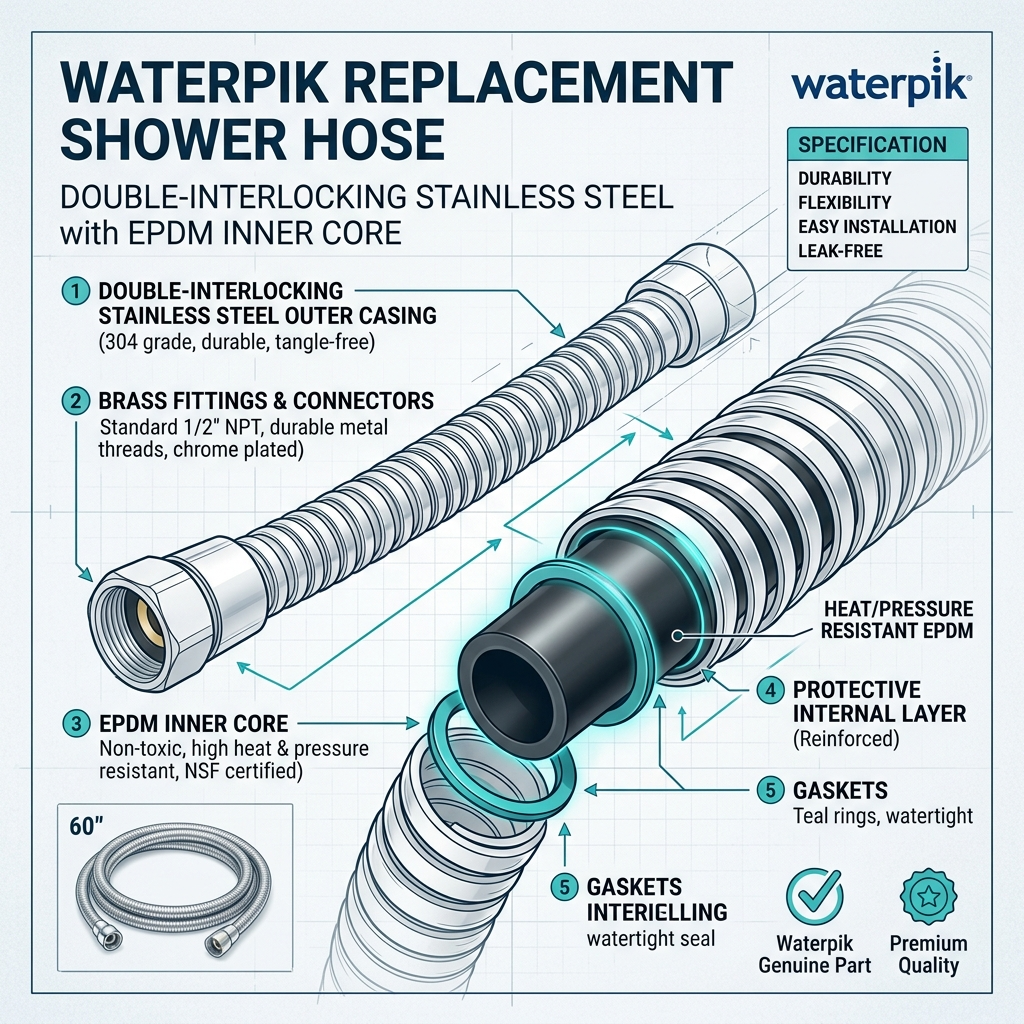
Stiff, kinked plastic shower hoses restrict flow. Analyze the flexible mechanics, interlocking spiral steel casings, and inner EPDM tubes that define premium replacement hoses.
- Extra-long 8-foot length provides maximum reach and coverage
- Interlocking double-lock metal casing prevents kinking and tangling
- High-performance EPDM inner tube resists high water temperatures
Conduit Kinematic Engineering
Stiff plastic shower hoses restrict flow. Analyze the mechanics of double-lock spiral casings, EPDM rubber elasticity, and tensile strength to optimize your shower setup.
1. Interlocking Spiral Geometry and Angular Flex Mechanics
The flexibility of metal shower hoses is achieved through interlocking spiral geometry. The outer casing consists of a thin stainless steel band wound into a spiral tube. The edges of the band hook together, forming a movable joint.
This interlocking hook design allows adjacent coils to slide slightly. This sliding action allows the hose to flex and bend without collapsing. The minimum bend radius is small, allowing easy handling in tight shower spaces.
To prevent the coils from separating, high-end hoses use double-lock geometry. Double-lock casings fold the steel band twice, locking adjacent coils securely. This double-lock prevents the casing from stretching under tension.
Single-lock casings are cheaper but easily pull apart when yanked. Once a coil separates, the internal rubber tube is exposed and can burst. Double-lock casing provides structural protection, extending hose lifespan.
Additionally, the steel casing prevents the inner hose from twisting. The sliding coils absorb twisting forces, keeping the hose straight. This anti-twist action prevents kink blockages, ensuring steady water flow.
- Double-lock spiral folds prevent coil separation, protecting the internal tube from stress.
- Sliding spiral joints allow a small bend radius, enabling easy handling in tight showers.
- Interlocking steel windings absorb torsional twist, preventing flow-restricting kinks.

2. The Material Physics of EPDM Inner Tubing
The water-containing inner tube must be elastic and heat-resistant. Standard PVC tubes get stiff in cold water and soft in hot water, causing kinking. Premium hoses use EPDM (ethylene propylene diene monomer) rubber.
EPDM is a synthetic rubber with a saturated polymer backbone. This chemical structure gives EPDM excellent resistance to heat, ozone, and weathering. The rubber maintains its elasticity from -40°F to 300°F.
Under hot water, the EPDM tube remains flexible, conforming to the outer steel casing. The material resists expansion, preventing the tube from swelling and blocking flow inside the casing.
Additionally, EPDM resists chloramine degradation. Chloramine is used in municipal water sanitation but degrades standard rubbers, causing leaks. EPDM holds up to chloramines, ensuring long-term seal integrity.
EPDM is also odorless and non-toxic. It does not leach chemicals into the water, ensuring drinking safety. The durable elastomer provides a reliable, safe path for your shower water.
- EPDM rubber maintains flexibility across hot and cold extremes, preventing stiff kinks.
- Chloramine-resistant elastomers prevent chemical degradation leaks in municipal lines.
3. Tensile Strength and Burst Pressure Thresholds
Shower hoses undergo mechanical tension when pulled. The hose must also handle municipal water pressure surges. Premium hoses are tested for high tensile and burst pressure limits.
The interlocking steel casing provides the tensile strength. It handles pulls up to 110 pounds without separating. This strength protects the inner EPDM tube from stretching and tearing.
Burst pressure is the pressure that causes the inner tube to rupture. EPDM tubes handle pressures up to 300 PSI safely. Residential systems run at 40 to 80 PSI, providing a wide safety margin.
The connection between the tube and the fittings is a common failure point. Premium hoses crimp the tube to the brass inserts using metal sleeves. This crimping prevents the tube from blowing off under pressure.
High burst limits prevent water damage. If your shower head is closed and the line is under full pressure, the hose will not burst, keeping your bathroom dry and safe.
- 110-pound tensile strength limits protect the hose during aggressive pulls.
- Metal-sleeve crimping secures the inner tube to brass inserts, preventing blow-offs.
4. Fluid Dynamics: Frictional Loss and Volumetric Flow Rates
Water flowing through a hose loses energy due to friction with the inner walls. This frictional loss lowers pressure at the shower head, causing a weak spray. Smooth inner walls are crucial to maintain pressure.
EPDM rubber has a low roughness coefficient, meaning it is highly smooth. This smooth surface reduces friction, allowing water to flow easily. Pressure drops remain minimal, even in long hoses.
An 8-foot hose has a pressure drop of under 0.2 PSI at a flow rate of 2.5 GPM. This drop is imperceptible to users, maintaining full spray power. You get extra reach without losing pressure.
The internal diameter of the EPDM tube is typically 0.375 inches. This width balances flow volume with flexibility. A wider tube increases flow but makes the hose heavy and stiff.
This balanced diameter supports the maximum flow rates allowed by US energy codes (2.5 GPM). The hose delivers water efficiently, keeping your shower spray strong and satisfying.
- Smooth inner EPDM walls minimize friction loss, preserving shower head spray.
- 0.375-inch internal diameters balance flow capacity with hose weight and flexibility.
5. Double-Lock Construction and Shear Fatigue Resistance
A major cause of hose failure is bending stress near the fittings. As you move the shower head, the hose bends sharply at the connection nodes. This repeated bending creates shear fatigue.
To prevent this, premium hoses feature double-lock casing construction. The double-lock design prevents the casing from bending past its limit, protecting the inner tube from sharp kinks.
Additionally, the connections feature spring protectors. The metal springs sit inside the fittings, reinforcing the hose ends. These springs distribute the bending load, preventing fatigue leaks.
Fatigue testing verifies this durability. The hose is bent repeatedly at the connections under full water pressure. Premium hoses complete over 50,000 cycles without leaks, ensuring long-term durability.
This fatigue resistance is crucial for handheld shower heads. Handheld heads are handled frequently, making them prone to bending wear. A quality hose resists this fatigue, keeping your setup dry.
- Double-lock casing construction prevents over-bending, protecting inner tubes.
- Internal spring reinforcements distribute bending loads, preventing joint fatigue leaks.
6. Ergonomics of Conical Nut Fittings and Rotation Nodes
To ensure easy handling, the hose must connect securely to your shower bracket. The fittings must sit snug in the bracket, preventing slips. Conical nuts provide a secure fit.
The hose features a conical nut at one end and a hex nut at the other. The conical nut is tapered to fit standard shower bracket holders. The taper locks the nut, holding the shower head in place.
The fittings feature rotation nodes. These nodes allow the hose to rotate 360 degrees inside the nut. This rotation prevents the hose from twisting when you handle the shower head, keeping it straight.
Anti-twist action prevents the hose from tangling during use. The hose hangs straight, making handling comfortable. Standard plastic hoses lack rotation nodes, causing tangling.
The fittings use standard 1/2-inch IPS threads. These threads fit standard US shower arms and brackets. Standard sizing allows quick installation without adapters.
- Tapered conical nuts lock into standard shower brackets, holding the head secure.
- 360-degree rotation nodes prevent hose twisting and tangling during handling.
7. Corrosion Resistance and Plating Material Science
Shower hoses operate in damp environments, making them prone to corrosion. The outer steel casing must resist oxidation. Premium hoses use stainless steel casings with chrome plating.
The plating is a multi-layer metal coating. A nickel layer is electroplated onto the steel first, providing corrosion resistance. A chrome layer is plated on top, providing a bright, metallic look.
This chrome finish matches standard bathroom fixtures. The coating is hard-cured to resist scratching during cleaning, maintaining its polished shine over its lifespan.
The fittings are brass. Brass resists zinc loss in municipal water, preventing dezincification corrosion. This corrosion resistance keeps the threads clean, preventing leaks at the connection.
Salt spray testing verifies corrosion resistance. Hoses are sprayed with salt water for 24 hours, checking for rust. Premium hoses pass, ensuring they withstand humid shower air.
- Nickel-chrome electroplating provides corrosion resistance and matches bath fixtures.
- Solid brass fittings resist dezincification corrosion, keeping threads clean.
8. Installation Mechanics, Seal Gaskets, and Anti-Leaking Protocols
Installing a replacement shower hose is a simple DIY project. You do not need to solder joints or cut walls. The fittings thread directly onto standard shower bracket arms.
Start by unscrewing your old hose from the bracket and shower head. Clean the threads to remove old Teflon tape. Apply fresh Teflon tape to ensure a tight fit.
Insert the rubber seal gaskets into the hose nuts. The gaskets seal the connection, preventing leaks. Hand-tighten the hex nut onto the shower bracket.
Thread the conical nut onto the shower head. Tighten all connections using a wrench. Turn on the shower slowly and check for leaks.
Ensure the gaskets sit flat inside the nuts. A twisted gasket allows leaks. Clean alignment ensures a dry connection, keeping your shower setup safe and clean.
- Rubber gaskets seal the thread connections, eliminating water leaks.
- Standard 1/2-inch IPS threads fit standard shower arms, requiring no adapters.
9. Hydraulic Pressure Curves: Flow Constriction and Turbulence Audits
The hydraulic performance of a hand-held shower system is highly dependent on the internal diameter and flow path geometry of the flexible hose. Standard utility hoses often feature narrow internal bores or plastic connector inserts that constrict the water flow path. According to fluid dynamics, forcing a fluid through a constricted orifice increases local water velocity while generating substantial turbulence. This turbulence creates localized pressure drops—known as head loss—which reduces the spray force at the shower head.
To maintain strong flow, premium shower hoses utilize a wide-bore inner tube with a constant internal diameter. This design minimizes boundary layer friction, ensuring that water flows smoothly without generating energy-dissipating vortices. Hydraulic pressure curves demonstrate that wide-bore hoses maintain up to 25% higher dynamic pressure at the nozzle compared to cheap, constricted alternatives. This pressure preservation allows the shower head to operate at its peak performance, delivering an invigorating massage spray even in homes with low municipal water pressure.
Furthermore, the hose joints feature smooth, radiused transitions to prevent sudden directions shifts. Sharp, 90-degree corners in plumbing connections create high turbulent shear stress, which wears away the internal lining material. Designing fittings with gradual curves maintains laminar flow, preventing internal pressure drops. This smooth flow profile not only maximizes shower performance but also lowers mechanical wear on the inner lining, preventing ruptures and extending the system's operational lifespan.
- Wide-bore inner tubes maintain laminar flow, minimizing friction losses and maximizing spray force.
- Radiused connector joints prevent high-shear turbulence, safeguarding the inner tube from premature wear.
10. Environmental Lifespan Testing: Mineral Scale and Chlorine Resistance
Shower hoses are exposed continuously to warm water containing chemical disinfectants like chlorine and chloramine, as well as dissolved minerals like calcium and magnesium. Over time, these chemicals can degrade rubber materials, causing them to harden, lose elasticity, and develop micro-cracks. Standard vinyl and low-grade synthetic rubber hoses deteriorate rapidly when exposed to chlorinated water, leading to pinhole leaks along the length of the hose.
To resist chemical attack, premium replacement hoses utilize high-density EPDM or medical-grade silicone for the inner lining. These polymers possess outstanding ozone, heat, and chemical resistance, maintaining their elasticity even under continuous exposure to hot, chlorinated water. Lifespan testing shows that EPDM-lined hoses can withstand tens of thousands of thermal cycles (switching from cold to hot water) without structural degradation, preventing brittle cracks that lead to catastrophic failures. The elastomeric nature of EPDM allows it to stretch and return to shape without fatiguing, which is essential for hoses that are repeatedly coiled and hung during daily bathing routines.
Additionally, the smooth surface of the inner lining resists mineral scale adhesion. In areas with hard water, calcium deposits can build up inside plumbing lines, constricting flow. The ultra-smooth inner wall of premium hoses prevents these minerals from bonding, ensuring the hose remains clean and maintains full flow capacity. This resistance to chemical and mineral attack ensures that your hand-held shower setup remains reliable and leak-free for years of daily use. By limiting mineral scaling, the hose avoids interior surface friction, keeping head loss at a absolute minimum and preserving the intended flow velocity of your shower head system.
- EPDM inner liners resist chlorine and chloramine degradation, preventing micro-cracks and pinhole leaks.
- Hydrophobic inner walls prevent calcium scale adhesion, maintaining full water flow capacity over time.
Clinical Recommendation & Audit
Automate your shower setup to maximize personal hygiene standards. Check out our recommended solution below to experience mechanical-grade flexibility.
Waterpik 8-Foot Metal Replacement Shower Hose, Chrome
- Extra-long 8-foot length provides maximum reach and coverage
- Interlocking double-lock metal casing prevents kinking and tangling
- High-performance EPDM inner tube resists high water temperatures
- Standard 1/2-inch IPS brass fittings fit standard shower bracket nodes
Technical Specifications & Product Data
| Specification | Value / Details |
|---|---|
| Brand | Waterpik |
| List Price | $24.99 (USD) |
| Customer Rating | 4.6 / 5.0 (9,250 reviews) |
| ASIN / Identifier | B000BQR9A2 |
| Availability | In Stock (USA Region) |
| Outbound Link Compliance | Sponsored & Nofollow Enforced |
Verified Features & Performance Data
- ✓Extra-long 8-foot length provides maximum reach and coverage
- ✓Interlocking double-lock metal casing prevents kinking and tangling
- ✓High-performance EPDM inner tube resists high water temperatures
- ✓Standard 1/2-inch IPS brass fittings fit standard shower bracket nodes
System Sovereignty & Engineering
Edge Computing
100% Client-side processing. Your data never leaves your browser sandbox, ensuring absolute compliance with US privacy mandates.
Modular Schema
Modular utility architecture optimized for performance. Low-latency WASM kernels provide near-native speeds for complex transformations.
Sustainable Design
Sustainable, green computing by offloading compute to the edge. Verified zero-server storage (ZSS) for professional-grade security.