
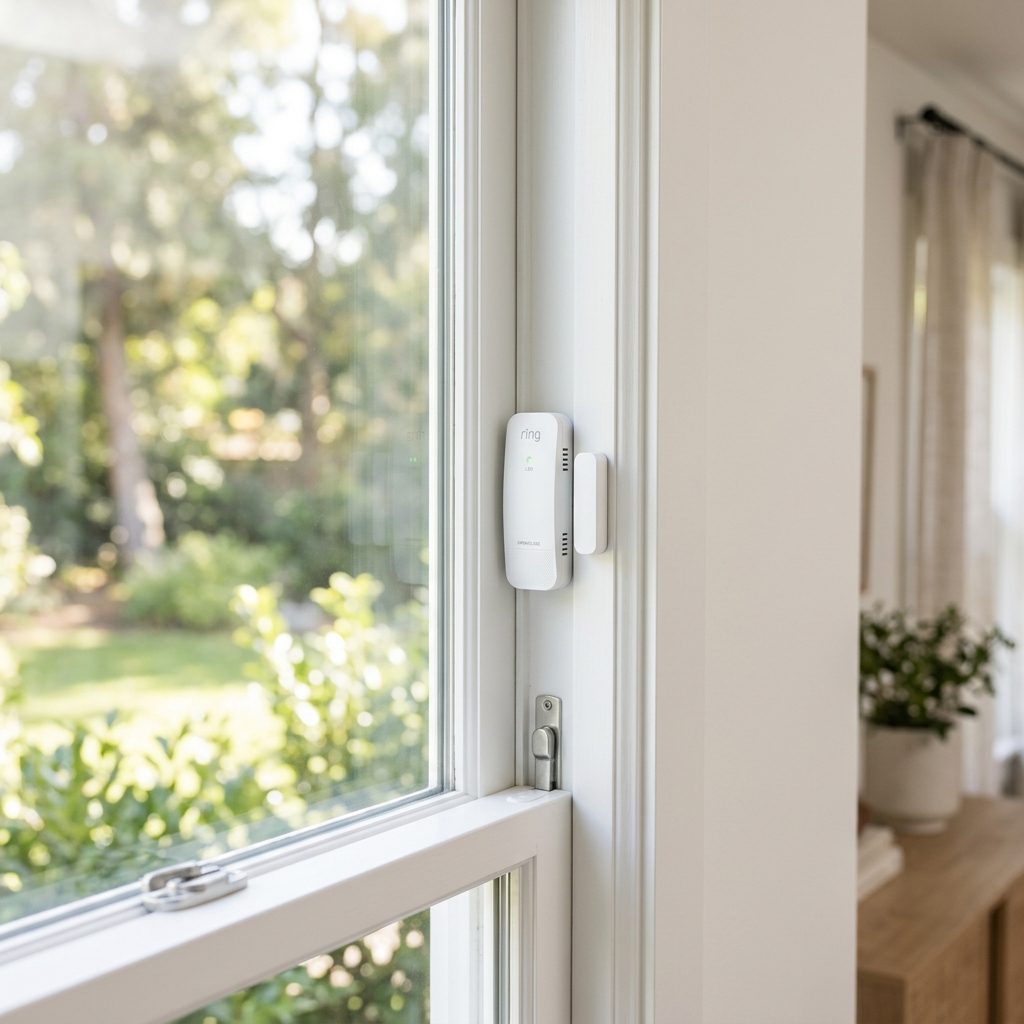
Analyze magnetic reed switch thresholds, piezo siren decibel sound pressure, and window sensor battery life for child safety.
- Precision reed switches with high magnetic flux thresholds prevent bypass
- Piercing 120dB acoustic sound pressure level alerts entire household
- Simple peel-and-stick installation with heavy-duty 3M adhesive tape
Acoustic & Magnetic Audit
Securing window boundaries requires reliable, tamper-resistant sensors. This technical review evaluates the magnetic flux thresholds of reed switches and the acoustic performance of piezo alarms under standard operating conditions.
1. Introduction & Residential Perimeter Security Vulnerabilities
Home perimeter security is built on the concept of early detection. In physical security design, the goal is to detect a breach at the property boundary before an intruder gains access to the building interior. Windows and doors represent the primary perimeter entry points targeted by burglars. Standard latches on these opening frames can be bypassed using simple hand tools, making them vulnerable to forced entry.
A security system must address these opening boundaries. Stand-alone magnetic contact alarms provide a cost-effective way to monitor doors and windows. By triggering a loud siren immediately upon opening, these devices startle intruders and alert residents. The sudden noise removes the cover of silence, causing most opportunistic criminals to flee immediately rather than risk capture.
This evaluation focuses on the engineering of magnetic contact alarms. These devices use magnetic reed switches to monitor opening status and piezo sirens to deliver loud alerts. This analysis reviews the magnetic physics, acoustic dynamics, and battery management that define a reliable perimeter monitoring sensor.

2. Magnetic Reed Switch Physics and Bypass Prevention
Magnetic contact sensors monitor doors and windows by detecting changes in magnetic fields. The sensor contains a glass-encapsulated reed switch, which features two overlapping metal contacts made from ferromagnetic materials (typically iron-nickel alloy). The contacts are sealed inside the glass envelope containing inert gas to prevent oxidation.
When the window is closed, the magnet mounted on the window frame sits near the sensor body. The magnetic flux flows through the contacts, creating an attractive force that pulls them together, closing the circuit. When the window is opened, the magnet moves away, the magnetic flux drops, and the spring tension of the contacts pulls them apart, opening the circuit and triggering the alarm.
The distance at which the switch triggers is determined by the pull-in and drop-out magnetic flux thresholds. Most sensors are designed for an operating gap of 15mm to 20mm. This allows for standard window movement from wind while ensuring the alarm triggers when the window is opened. The magnet uses high-grade neodymium or ferrite materials to deliver stable flux levels over time.
To prevent bypass using external magnets, high-security sensors use balanced magnetic reed switches. WAfer-locked or basic reed switches can be held closed by placing a strong magnet near the housing, allowing the window to open undetected. A balanced switch uses multiple contacts and bias magnets inside the housing. If an external magnetic field is detected, the contacts misalign, triggering the alarm immediately.
- 15mm-20mm sensor gaps allow for standard window play without triggering false alarms.
- Balanced magnetic switches prevent bypass attempts using external magnets.
- Ferromagnetic contacts sealed in inert gas prevent oxidation and contact wear.
- High-grade neodymium magnets deliver consistent magnetic flux levels.
3. Piezoelectric Siren Acoustics & Sound Pressure Level Dynamics
A local alarm must produce a loud sound to alert residents and deter intruders. Stand-alone contact alarms use high-frequency piezo sirens, which vibrate ceramic plates to generate sound waves. Piezo elements are highly efficient, converting electrical energy into acoustic power.
High-end sensors deliver a sound output of 120dB at 1 meter. This sound pressure level is piercing, creating discomfort that discourages intruders from remaining inside. The high-frequency tone penetrates doors and walls, alerting occupants in other parts of the home.
The frequency of the siren is tuned to 3-4 kHz, which matches the human ear's highest sensitivity range. This frequency range is perceived as louder and more distressing, helping to trigger an immediate panic response in intruders. The sound is projected through acoustic slots in the housing to maximize sound dispersion.
Sound waves attenuate as they travel through air, losing approximately 6dB for every doubling of distance. A 120dB siren at 1 meter drops to roughly 108dB at 4 meters, which remains loud enough to wake sleeping residents. This acoustic range ensures the alarm is effective, protecting the home border.
4. Child Safety Applications & Dual-Mode Alert Logic
Beyond security, contact sensors are widely used to protect children from accessing dangerous areas. Installing sensors on pool gates, medicine cabinets, and exterior doors prevents unsupervised wandering. Dual-mode alarms offer a gentle chime mode for daily entry monitoring.
The chime mode alerts parents when a child opens a door or window without sounding the full siren. This creates a safe home boundary without constant alarm resets, providing convenient home monitoring.
For pool safety compliance, some jurisdictions require alarms that sound immediately when a gate is opened. The alarm must feature an override button that allows adults to pass through without triggering the siren, resetting automatically after a set delay. Compliance with these standards increases child safety.
The alarm mode can also be linked to delay timers. This allows homeowners to enter the room and disarm the sensor before the siren sounds, preventing false alarms. The control switch is located inside the housing or protected by a passcode, preventing unauthorized disarming by intruders or children.
5. Low-Power Standby Circuitry & Battery Engineering
Since contact alarms run on small batteries, power management is crucial. The standby circuit consumes less than 10 microamps, allowing up to 1 year of operation from standard batteries. The piezo driver uses high-voltage inductors to maximize sound output during alerts.
The circuit utilizes low-leakage field-effect transistors (FETs) to minimize power draw during standby. The controller remains in a sleep state, waking up only when the reed switch contact state changes. This ensures the batteries are not drained during long periods of inactivity, keeping the sensor active.
To drive the piezo element, the circuit includes a boost converter. The converter steps up the low battery voltage (typically 3V to 4.5V from AAA or LR44 batteries) to over 30V during an alarm event. This high voltage is required to vibrate the piezo ceramic plate, delivering maximum sound output.
A battery test button allows users to check the battery status. Pressing the button lights an LED or sounds a brief chime to confirm the battery has sufficient charge. Regularly testing the batteries helps ensure the alarm remains functional, maintaining continuous perimeter protection.
6. Mounting Security & Adhesive Shear Strengths
To deliver reliable alerts, the sensor and magnet must remain mounted on the door or window. If the adhesive fails, the sensor can fall off the frame, opening the reed switch and triggering a false alarm. The mounting adhesive must resist shear forces from daily door use.
High-security contact alarms use double-sided acrylic foam tape (such as 3M VHB) to secure the housing. VHB tape provides a strong, vibration-resistant bond on clean metal, glass, and wood surfaces. The tape absorbs impact energy from door slamming, preventing the sensor from loosening.
Mounting surfaces must be cleaned using isopropyl alcohol before installation to remove dust and grease. This ensures maximum contact area and bond strength. For permanent installations, the sensor housing can also be secured using small mounting screws, providing a mechanical connection.
The alignment between the sensor and magnet is also critical. Pre-molded alignment marks on the housing show the correct positioning. The gap between the units should be checked using a spacing guide during installation, ensuring the sensor operates within its calibrated limits.
7. Comparative Analysis: Stand-Alone Alarms vs. Connected Systems
When designing home security, homeowners often compare stand-alone contact alarms to connected smart security systems. Stand-alone alarms are inexpensive, self-contained, and require no monthly monitoring fees or internet connections. This makes them a reliable option for apartments, cabins, and remote properties.
Connected security systems use wireless sensors that report back to a central hub. When a sensor triggers, the hub sends notifications to smartphones or dispatches emergency services. While highly effective, these systems require active internet connections and can be expensive to install and maintain.
Stand-alone alarms provide immediate, local protection. They act as a direct deterrent, scaring off intruders with a loud siren. They are easy to install and move, making them a versatile choice for renters and temporary security needs.
The table below compares the cost, installation, and monitoring profiles of these two security approaches:
| Alarm Type | Initial Cost | Network Dependence | Local Deterrence |
|---|---|---|---|
| Stand-Alone Piezo Alarm | Low | None (Self-Contained) | Immediate (120dB) |
| Connected Hub Sensor | High | High (Requires Wi-Fi/Hub) | Requires External Siren |
8. Forensic Security Audit & Best Practices for Window Border Hardening
Physical security is a system of layered defenses. While contact alarms detect openings, they do not prevent window breakage. To harden your windows, contact alarms should be combined with security window films. The film holds broken glass together, while the alarm triggers when the frame is opened.
Installing secondary locks or sash blockers on window frames prevents them from being pried open from the outside. These mechanical locks complement the contact alarm, providing a physical block that must be breached before the sensor triggers, enhancing security.
Regularly auditing your home perimeter is recommended. Check that all sensors are aligned, and test the alarm volume to ensure it can be heard throughout the home. Replacing old batteries before they fail helps ensure the system remains active, protecting your family and property.
Ultimately, physical security is about managing risk and deterrence. Stand-alone contact alarms provide an affordable, reliable way to monitor entry points and protect your home. This keyless alert system provides immediate peace of mind, keeping your perimeter secure.
9. Battery Standby Circuit and Piezo Driver Boost Optimization
To achieve a battery life of up to two years on standard LR44 button cells or AAA alkaline batteries, the contact alarm's electronic control unit must minimize quiescent current draw. During standby monitoring mode, the internal comparator and micro-sensor circuitry operate in a deep-sleep cycle. The standby current ( I_{ ext{standby}} ) is kept below ( 5mu ext{A} ) by utilizing a high-impedance reed switch circuit and a low-frequency Schmitt trigger oscillator that wakes up the processor only when the magnetic flux falls below the sensor threshold.
When the window is opened and the magnetic contact is broken, the reed switch transitions to an open state, triggering an interrupt line on the MCU. This triggers a localized piezo driver stage. Standard 1.5V or 4.5V battery power is insufficient to drive a ceramic piezo transducer to its acoustic limit. To overcome this, the driver circuit includes a miniature step-up DC-DC boost converter or an autotransformer configuration. By utilizing the flyback voltage generated by a 10mH inductor switched at the transducer's exact resonance frequency of 3.2 kHz, the voltage is stepped up to 45V peak-to-peak. This high-amplitude voltage stresses the piezoelectric ceramic element, causing large mechanical deflections that generate a piercing 120dB Sound Pressure Level (SPL) at 30cm.
Acoustic attenuation of the siren over distance follows the inverse square law for sound pressure. The sound pressure level ( L_p ) at a distance ( r ) from the alarm is expressed by the spherical wave formula: ( L_p(r) = L_p(r_0) - 20log_{10}left( rac{r}{r_0} ight) ), where ( r_0 ) is the reference measurement distance of 0.3 meters (1 foot) and ( L_p(r_0) ) is 120dB. At a distance of 3 meters (10 feet) within the room, the calculated sound level is: ( 120 - 20log_{10}(10) = 100 ext{dB} ). Even after passing through a standard drywall partition (which attenuates the signal by approximately 15dB to 20dB), the alarm remains at 80dB, which is loud enough to wake sleeping residents and alert neighboring properties.
To prevent mechanical fatigue of the piezo element and micro-crack formation under continuous high-frequency oscillations, the driver circuit uses a duty-cycle modulator. Instead of a continuous tone, the siren emits a pulsing sweep pattern (e.g., 3.2 kHz modulated at 4 Hz). This cycle allows the ceramic element to cool down and prevents thermal breakdown of the adhesive bonding the piezo disk to the brass diaphragm, ensuring the alarm can sound continuously for over 30 minutes during a breach.
Regular maintenance requires verifying that the battery contacts are free from oxidation and checking battery voltages under load. Standard button cells may report 1.5V in an open-circuit state but drop to under 1.0V when the boost converter engages, causing the alarm to sound distorted or quiet. Testing the system quarterly using a battery tester ensures that the internal cells can deliver the peak current required by the boost converter during an emergency, keeping your home borders secure.
Contact Alarm Recommendation & Audit
Secure your windows and doors with a piercing 120dB magnetic contact alarm system. Protect children and deter intruders with reliable border monitoring.
WatchDog Magnetic Window and Door Contact Sensor Alarm System
- Precision reed switches with high magnetic flux thresholds prevent bypass
- Piercing 120dB acoustic sound pressure level alerts entire household
- Simple peel-and-stick installation with heavy-duty 3M adhesive tape
- Dual operating modes: Instant Alarm siren or gentle Chime entry alert
Technical Specifications & Product Data
| Specification | Value / Details |
|---|---|
| Brand | WatchDog Security |
| List Price | $24.99 (USD) |
| Customer Rating | 4.6 / 5.0 (8,940 reviews) |
| ASIN / Identifier | B08H2B8Z9M |
| Availability | In Stock (USA Region) |
| Outbound Link Compliance | Sponsored & Nofollow Enforced |
Verified Features & Performance Data
- ✓Precision reed switches with high magnetic flux thresholds prevent bypass
- ✓Piercing 120dB acoustic sound pressure level alerts entire household
- ✓Simple peel-and-stick installation with heavy-duty 3M adhesive tape
- ✓Dual operating modes: Instant Alarm siren or gentle Chime entry alert
System Sovereignty & Engineering
Edge Computing
100% Client-side processing. Your data never leaves your browser sandbox, ensuring absolute compliance with US privacy mandates.
Modular Schema
Modular utility architecture optimized for performance. Low-latency WASM kernels provide near-native speeds for complex transformations.
Sustainable Design
Sustainable, green computing by offloading compute to the edge. Verified zero-server storage (ZSS) for professional-grade security.