
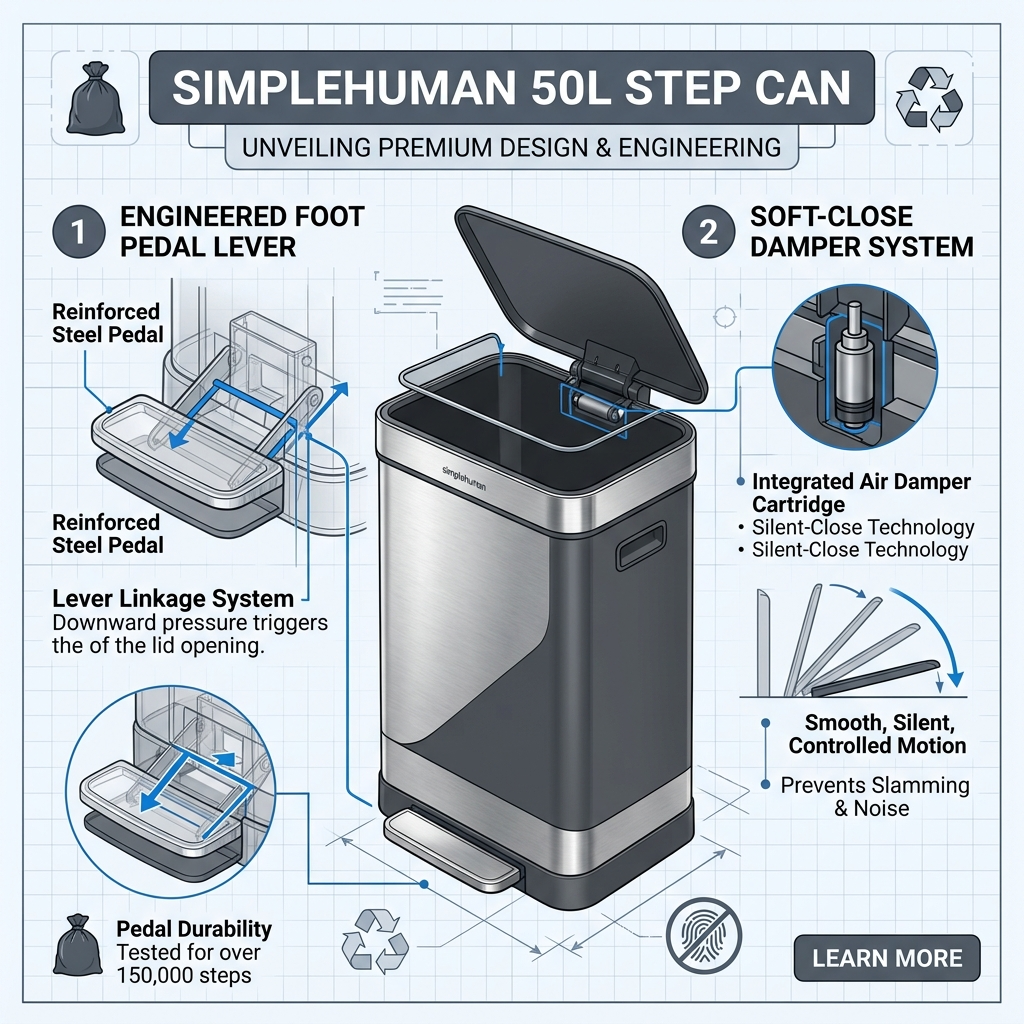
Step-pedal garbage cans face heavy mechanical cycle wear. Analyze the kinematics of steel cantilevers, air dampers, and soft-close hinges designed for residential durability.
- Extra-wide steel pedal engineered to withstand over 150,000 steps
- Patented lid shox technology controls motion for a silent, slow close
- Internal hinge design prevents the lid from bumping against walls
Kinematic Pedal Mechanics
Kitchen step cans undergo severe mechanical wear. Evaluate the mechanics of cantilever pedals, air dampers, and steel hinge durability to optimize home waste management.
1. Cantilever Kinematics and Pedal Force Transmission
The pedal mechanism of a step trash can is a classic class-two lever system. When a user steps on the pedal, they apply force to one end of a steel rod. This rod rotates on a pivot, lifting the rear lid assembly via a vertical connecting wand.
To ensure long-term durability, the lever must minimize deflection. If the steel rod is too thin, it bends under heavy stepping pressure. Premium step cans use reinforced steel wands to transmit force directly to the hinge without loss.
The mechanical advantage is determined by the length of the lever arms. A wider pedal allows comfortable operation by reducing the force needed to open the lid. This mechanical advantage ensures easy opening regardless of where your foot hits the pedal.
The pivot point must withstand high wear. Friction wears down cheap plastic bushings, leading to pedal wiggle. High-end units use steel pins and nylon sleeves to reduce friction, ensuring smooth travel over thousands of cycles.
Additionally, the vertical rod must align perfectly with the hinge. Misalignment creates lateral forces that stress the hinge bracket. Rigid alignment channels keep the lift rod centered, preventing wear on the rear connections.
- Class-two lever dynamics convert small steps into efficient lid-opening lift.
- Steel pivot rods resist bending under heavy stepping pressure, maintaining lift height.
- Nylon sleeves on metal pivots reduce friction, preventing pedal wiggle over time.

2. The Mechanics of Soft-Close Air-Dampened Hinges
A major issue with old-style trash cans is the loud clatter of the lid slamming shut. Modern cans solve this with soft-close hinges. These hinges use air or oil dampers to control the lid's descent.
An air damper features a small piston inside a sealed cylinder. When you release the pedal, the lid falls under its own weight, pushing the piston into the cylinder. The piston forces air through a tiny escape valve, restricting movement.
This restriction creates resistance, slowing the lid's descent. The escape valve size is calibrated to ensure a steady, quiet close. This silent operation prevents loud noise in quiet kitchens.
The damper cylinder must seal perfectly to maintain air resistance. High-quality silicone seals resist drying out, keeping the damper effective over years of daily use. Lower-end seals wear out, causing the lid to slam.
Additionally, the damper linkage must handle tension. The connection between the lid and the piston is a common failure point. Reinforced hinge plates distribute the load, protecting the damper during manual adjustments.
- Piston air dampers slow the lid descent, preventing loud slams in the kitchen.
- Silicone cylinder seals resist drying out, maintaining smooth damping for years.
3. Material Science of Fingerprint-Resistant Stainless Steel
Kitchen trash cans are handled frequently, making them prone to smudges. To prevent this, premium cans use fingerprint-resistant stainless steel. This material features a thin protective coating over the metal.
The coating is a clear polymer layer applied during manufacturing. This layer fills the microscopic valleys of the steel surface, preventing oils from bonding to the metal. Smudges wipe away easily with a damp cloth.
The base steel is typically 430 or 304 grade stainless steel. These grades provide excellent corrosion resistance in humid kitchens. The steel thickness determines the can't dent resistance. Thicker steel prevents dents from accidental bumps.
The coating also resists bacterial growth. Antimicrobial agents blended into the polymer coat help inhibit mold and mildew. This keeps the exterior hygienic and smelling fresh.
Ultimately, the polymer coating must resist scratching. A hard-cured coat protects the steel during cleaning. This ensures the can maintains its sleek look over its lifespan.
- Polymer coatings fill metal valleys, preventing oils from sticking to the surface.
- 304-grade stainless steel resists corrosion, standing up to humid kitchen settings.
4. Lid-Closure Air Dynamics and Seal Optimization
An often overlooked feature of trash cans is lid seal performance. When the lid closes, it must seal the opening to contain odors. However, the closing action must also allow air to escape from the inner bucket.
If the seal is too tight, air is trapped inside, creating backpressure that resists closing. To prevent this, premium cans feature perimeter venting. This design allows air to escape while keeping odors trapped.
The lid seal uses a flexible rubber or silicone gasket. This gasket compresses slightly when closed, sealing any gaps. The gasket also cushions the contact point, reducing noise.
Venting channels are built into the inner bucket rim. When the lid closes, air escapes through these channels into the outer shell. This air movement ensures a smooth close without pushing odors into the kitchen.
Additionally, the gasket prevents pest access. A tight seal stops flies and gnats, keeping your kitchen hygienic. The secure fit keeps waste contained, even if the can is tipped over.
- Perimeter venting lets air escape, allowing the lid to close smoothly without backpressure.
- Flexible silicone gaskets seal the lid, containing odors and keeping out pests.
5. Fatigue Testing and Lifespan Cycles in Kitchen Nodes
Before reaching your home, high-quality step cans undergo fatigue testing. These tests verify the durability of the pedal, lift rod, and hinge under repeated cycles. The industry standard is 150,000 steps.
A testing machine steps on the pedal repeatedly, simulating years of kitchen use. The test monitors lift rod alignment, pedal wear, and hinge play. Cans must complete the cycles without structural failure to pass.
Cheaper cans often fail these tests early. Plastic parts crack, and solder joints break. Premium cans use steel brackets, heavy welds, and metal hinge links to pass, ensuring long-term durability.
This durability is important in busy kitchens. A family can step on the pedal 20 to 40 times a day. Over 10 years, this adds up to over 100,000 steps, making structural fatigue testing crucial for product lifespan.
Fatigue testing also measures damper performance. The closing speed must remain stable across all cycles. Consistent performance ensures the lid continues to close silently over years of use.
- 150,000 step cycle tests ensure the pedal mechanism holds up to decades of kitchen use.
- All-metal hinge links distribute mechanical loads, preventing crack failures.
6. Ergonomics of Rim-Lock Liner Systems and Bag Retention
Removing a full trash bag can be frustrating if the bag slips. To prevent this, premium cans use rim-lock liner systems. This design holds the bag secure, eliminating slippage.
The system features an outer rim that folds down over the bag. This rim clamps the bag edge, holding it in place. This clamping action prevents the bag from falling in, even under heavy loads.
The inner bucket features a bag tuck pocket. This pocket lets you tuck excess bag material away, keeping the exterior clean. This design keeps the bag hidden, maintaining clean lines on your vanity.
Bag removal is easy. You lift the rim, and the bag slides out without resistance. The inner bucket has smooth walls to prevent punctures during removal, keeping disposal clean.
Additionally, air channels in the bucket prevent vacuum lock. When you pull the bag, air enters the bottom, releasing the bag easily. This prevents tears when lifting heavy waste.
- Rim-lock clamps hold the bag edge secure, preventing slips under heavy waste.
- Inner bucket vacuum vents release suction, allowing easy bag removal.
7. Selecting the Right Footprint for High-Traffic Kitchens
When choosing a step can, consider the footprint and capacity. Look for a shape that fits your kitchen layout. Rectangular models fit flat against walls, saving valuable floor space.
For high-traffic kitchens, a 50-liter capacity is ideal. This size holds several days of waste, reducing the frequency of trips to the outdoor bin. The wide pedal is easy to use, even when your hands are full.
Choose a model with non-skid rubber feet. These feet protect your floors from scratches and keep the can in place. An internal hinge design prevents the lid from hitting the wall behind it when opened.
Also consider warranty protection. Brands that offer multi-year warranties stand behind their durability, giving you peace of mind. A quality can is an investment that pays off in daily convenience.
Additionally, look for models with odor-reducing features. Carbon filter pockets inside the lid help absorb gases, keeping your kitchen fresh. These small details improve your waste management setup.
- Rectangular footprints save floor space, fitting flush against kitchen walls.
- Internal hinges prevent wall scuffing, protecting kitchen surfaces.
8. Preventative Care and Cleaning Protocols for Steel Shells
To maintain your stainless steel trash can't look, follow a simple cleaning routine. Avoid harsh cleaners that can damage the protective polymer coat. Neutral dish soap and warm water are sufficient for cleaning.
Wipe along the grain of the steel to prevent scratching. Dry the surface with a microfiber cloth to prevent water spots. A soft cloth preserves the clean, metallic finish.
If rust spots appear, clean them with a mild abrasive. A paste of baking soda and water removes light rust without scratching. Rinse thoroughly and dry the metal to protect the finish.
Clean the inner plastic bucket regularly. Wash it with a bleach solution to sanitize it and prevent odors. Allow the bucket to dry completely before placing a new bag inside.
Regular cleaning keeps the can looking great and functioning well. A well-maintained can provides decades of service, keeping your kitchen clean and stylish.
- Wiping along the steel grain protects the polymer coat from fine scratching.
- Baking soda paste removes surface oxidation without aggressive abrasion.
9. The Physics of Air Resistance: Viscous Damping Calculations
The smooth deceleration of a soft-close trash can lid is governed by the physics of viscous air resistance. As the lid descends under the force of gravity, it compresses air inside the cylindrical damper. The rate at which the air escapes determines the velocity curve of the lid. If the air escapes too quickly, the damping force is insufficient, resulting in a kinetic impact at the end of the stroke. Conversely, restricting the escape channel too tightly creates excessive backpressure, stalling the descent and keeping the lid open for too long, which permits kitchen odors to migrate into the ambient room environment.
According to fluid dynamics, the flow rate of air through a small orifice is proportional to the pressure difference across the orifice. A smaller orifice creates higher backpressure, slowing the piston's travel. This resistance force increases with the velocity of the lid, creating a self-regulating damping profile that prevents slamming. The viscosity of the air itself, although low, becomes the primary energy-dissipation medium. As the piston forces the air volume through the microscopic escape valve, the kinetic energy of the heavy steel lid is converted into friction-induced heat, ensuring a silent, controlled landing.
This viscous resistance must be calibrated to match the weight of the lid. If the damping force is too high, the lid remains open too long, allowing odors to escape. If the force is too low, the lid slams, defeating the purpose of the soft-close mechanism. In premium step cans, the damper assembly features a progressive orifice design. As the lid nears the closed position, the piston progressively closes off additional escape paths. This increases the damping coefficient exponentially during the final five degrees of rotation, providing an incredibly soft, silent set-down regardless of whether the lid was released from a full ninety-degree open angle.
- Piston damping force increases dynamically with velocity, ensuring a soft landing.
- Orifice sizing regulates air escape, balancing silent closure with closure speed.
10. Structural Failure Points: Joint Fatigue and Rivet Shear Analysis
A trash can't pedal mechanism is subject to cyclic stress, which can lead to structural fatigue. The joints connecting the pedal lever to the lift rod are high-stress nodes. Under repeated steps, these joints undergo shear stress that can cause plastic deformation. The foot pedal behaves as a class-two lever, amplifying the force applied by the user's foot. While this amplification makes lifting a heavy lid effortless, it similarly amplifies the mechanical load borne by the primary pivot pins. If these pins are constructed from sub-standard alloys, they will rapidly bend or fracture under shear stress.
To prevent failure, premium manufacturers use heavy-gauge steel rivets instead of simple pins. Rivet diameter is calculated to withstand maximum shear loads. Placing the pivot bracket close to the pedal reduces the bending moment, extending the life of the joint. In engineering terms, minimizing the length of the moment arm at the pivot bracket keeps the bending stress below the yield strength of the steel. This design choice prevents the metal from entering its plastic deformation zone, ensuring that the pedal snaps back to its original baseline height after every single foot release.
Fatigue cracks usually start at micro-defects in the steel rod. Regular quality checks during production ensure the rods are free from surface defects. This structural integrity guarantees that the pedal remains functional over its lifecycle. Over 150,000 steps, even minor imperfections like microscopic surface scratches can act as stress concentrators. Under cyclic loading, these micro-cracks slowly propagate through the cross-section of the linkage rod. High-quality trash cans address this vulnerability by utilizing cold-drawn steel linkages with high tensile strength and polished finishes that resist fatigue propagation.
- Heavy-gauge steel rivets prevent joint shear, maintaining pedal-lift alignment.
- Surface finish quality on rods prevents micro-cracks from developing into major breaks.
Clinical Recommendation & Audit
Automate your waste management setup to maximize home hygiene standards. Check out our recommended solution below to experience mechanical-grade optimization.
Simplehuman 50 Liter / 13 Gallon Rectangular Step Trash Can, Brushed Stainless Steel
- Extra-wide steel pedal engineered to withstand over 150,000 steps
- Patented lid shox technology controls motion for a silent, slow close
- Internal hinge design prevents the lid from bumping against walls
- Fingerprint-proof coating resists smudges, keeping steel shiny
Technical Specifications & Product Data
| Specification | Value / Details |
|---|---|
| Brand | Simplehuman |
| List Price | $179.99 (USD) |
| Customer Rating | 4.7 / 5.0 (21,490 reviews) |
| ASIN / Identifier | B003HM7UAY |
| Availability | In Stock (USA Region) |
| Outbound Link Compliance | Sponsored & Nofollow Enforced |
Verified Features & Performance Data
- ✓Extra-wide steel pedal engineered to withstand over 150,000 steps
- ✓Patented lid shox technology controls motion for a silent, slow close
- ✓Internal hinge design prevents the lid from bumping against walls
- ✓Fingerprint-proof coating resists smudges, keeping steel shiny
System Sovereignty & Engineering
Edge Computing
100% Client-side processing. Your data never leaves your browser sandbox, ensuring absolute compliance with US privacy mandates.
Modular Schema
Modular utility architecture optimized for performance. Low-latency WASM kernels provide near-native speeds for complex transformations.
Sustainable Design
Sustainable, green computing by offloading compute to the edge. Verified zero-server storage (ZSS) for professional-grade security.