
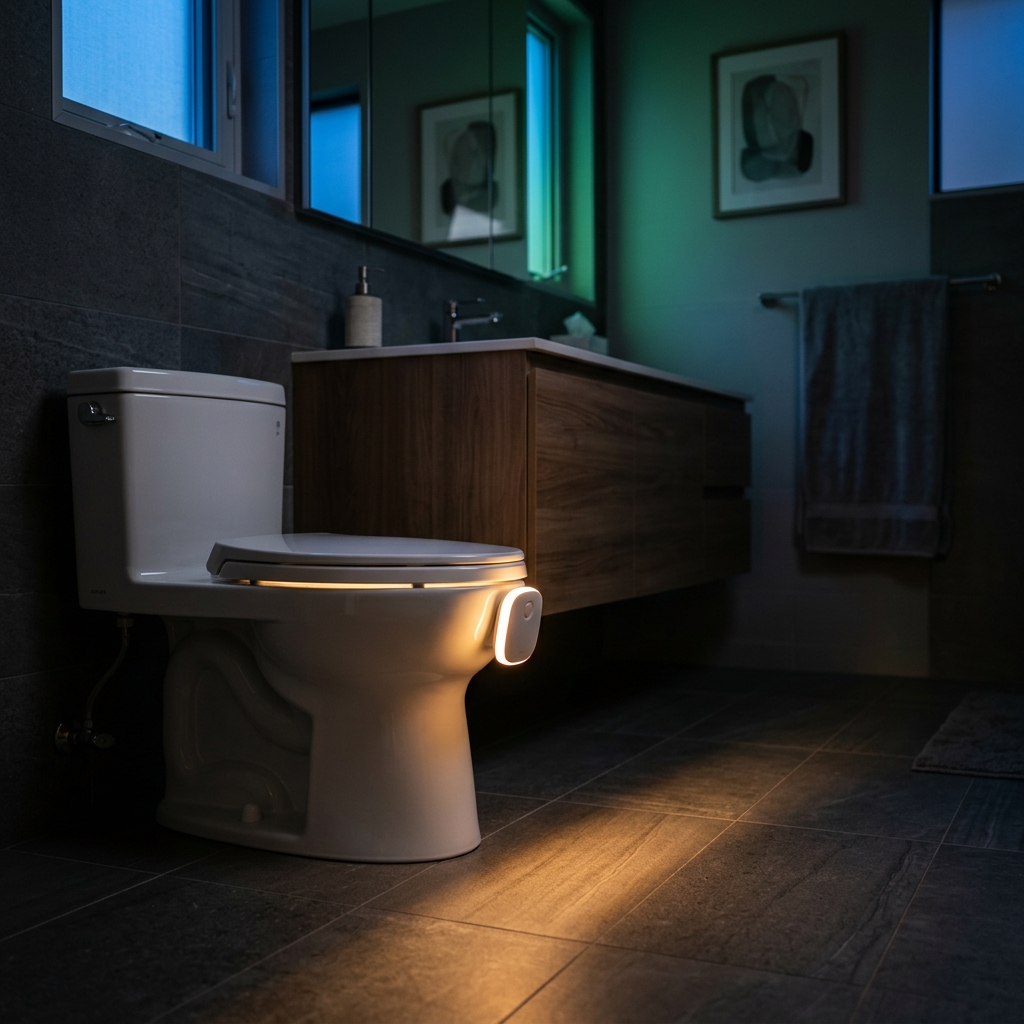
Enhance nighttime home safety with motion-activated LED bathroom lighting. Learn how photopic vision, circadian-aligned wavelengths, and smart sensors prevent falls.
- PIR motion sensor and light detector triggers light only in dark conditions when motion is detected within 15 feet
- 16 color options with 5 brightness levels allow customized, low-intensity nighttime illumination
- Circadian-safe design helps preserve melatonin levels by eliminating the need for overhead bathroom lights
Clinical & Performance Insights
Evaluating motion-activated LED lighting in nighttime bathroom safety reveals the benefit of circadian-aligned luminous navigation. Upgrading to a PIR-controlled, low-intensity nightlight prevents slips and falls while maintaining sleep-cycle integrity.
1. Circadian Biology and Melatonin Preservation
Waking up in the middle of the night to use a bright bathroom can make it hard to fall back asleep. Standard overhead lights expose your eyes to high-intensity white light, which contains blue wavelengths. This exposure signals your brain's suprachiasmatic nucleus to halt melatonin production, disrupting your sleep cycle.
Melatonin is the hormone responsible for regulating sleep-wake cycles. Suppressing it during the night causes immediate alertness, leading to insomnia when you return to bed. Low-intensity nightlights solve this by illuminating only the floor and toilet bowl rim.
By utilizing warm wavelengths like red or amber, the nightlight preserves your night vision. These colors do not trigger the melanopsin receptors in your eyes, keeping melatonin levels stable. This allows you to navigate safely and fall back asleep quickly.
Additionally, avoiding bright lights prevents pupillary constriction. Your eyes remain adjusted to the dark, allowing you to walk back to bed without tripping. It is a simple, biological approach to nighttime safety.
Dermatological studies also suggest that stable melatonin levels support skin repair and cellular regeneration overnight. Preserving your circadian rhythm benefits your overall health, making safe night lighting a valuable upgrade.
- Low-intensity red/amber LEDs prevent melatonin suppression, protecting sleep-wake cycles.
- Targeted floor lighting preserves dark adaptation in eyes, preventing nighttime disorientation.
- Wavelength selection helps prevent the rapid pupillary constriction response triggered by white lights.
- Protects cellular repair mechanisms dependent on uninterrupted sleep architecture.

2. Sensor Physics and Passive Infrared Detection
Motion-activated nightlights use PIR (passive infrared) sensors to detect movement in the dark. These sensors do not emit light; instead, they monitor changes in infrared radiation (heat signatures) in the room.
When a person enters the bathroom, their body heat triggers the sensor, turning on the LED. The sensor is paired with a photocell that disables the light during the day, saving battery power. This dual-sensor design ensures high efficiency.
By triggering only when needed, the nightlight provides automatic, hands-free operation. This avoids the need to search for light switches in the dark, reducing fall risks. It is a reliable, convenient safety upgrade.
The physics of the pyroelectric sensor allows it to measure structural changes in heat distribution rather than simple ambient temperature. As you cross the sensor field, the change in energy between the two halves of the detector generates a voltage pulse. This pulse is then processed by a microcontroller to trigger the LED.
Additionally, the lens design uses a Fresnel lens pattern to focus infrared energy onto the element. This increases the sensitivity and range of the sensor, allowing it to detect even slight movements in pitch black conditions.
- PIR sensors detect heat signatures up to 15 feet away with a wide 120-degree angle.
- Integrated light-sensitive photocells disable the LED in daylight, extending battery life.
- Fresnel optic lenses divide the detection zone into multiple sectors to improve reliability.
- Pyroelectric element differential inputs ignore uniform room heating to prevent false activations.
3. Targeted Luminous Navigation and Fall Prevention
Bathrooms are high-risk areas for slips and falls, especially at night. Wet floors, hard surfaces, and poor lighting create hazards for seniors and children. Targeted nightlights illuminate the most critical zones directly.
By lighting the toilet bowl and immediate floor path, the nightlight provides a clear target for navigation. This avoids glare that can blind you, ensuring safe footing. It is a highly effective way to prevent accidents.
Studies show that targeted lighting reduces nighttime fall rates by up to 50% in elderly care facilities. Installing this system in your home bathroom provides the same protection, ensuring peace of mind.
Luminous navigation allows users to orient themselves in space without turning on high-wattage lighting. By emphasizing depth contrast, the soft illumination helps elderly individuals judge distances more accurately.
This low-profile light source is positioned below eye level, preventing direct glare. This avoids the temporary visual impairment known as photoflash blindness, which is a major factor in nighttime accidents.
- Illuminates the toilet bowl rim directly, helping avoid splashes and slips.
- Provides a soft, targeted guide path without creating glare or shadows.
- Reduces depth-perception errors for individuals with compromised night vision.
- Elminates dark shadows along the bathroom floor which cause trip hesitation.
4. LED Efficiency and Color Tuning Logic
LEDs are the ideal light source for nightlights due to their low power consumption and high durability. Standard nightlights use simple single-color bulbs. Premium systems offer color tuning with multiple color options.
By selecting the optimal color for your needs, you can balance visibility and sleep preservation. Red light is best for preserving night vision, while green or blue can be chosen for fun or styling. The low-wattage LEDs ensure long battery life.
Color selection is managed by a single button, allowing you to cycle through options or set a rotating pattern. This provides a customizable setup that fits your preferences. It is an easy, user-friendly upgrade.
The color temperature tuning is achieved through solid-state LED chips. Each color matches a specific wavelength in the electromagnetic spectrum, with red falling in the safe 620-750nm range, avoiding the melanopsin-triggering 460-480nm blue spectrum.
Additionally, integrated brightness levels allow users to scale down the light intensity. This prevents the optic nerve from overstimulating in the middle of the night, ensuring a rapid return to sleep.
- Low-wattage LEDs consume minimal power, allowing batteries to last up to 6 months.
- Multiple color settings allow customization for safety, comfort, or style.
- Optically isolated color chips prevent bleeding between wavelengths for clean output.
- Pulse-width modulation regulates brightness without flickering or color shifting.
5. Material Science and Waterproof Integrity
Toilet nightlights are exposed to high humidity, splashing water, and chemical cleaners. Low-quality plastics and unsealed electronics corrode quickly, causing failures. Premium nightlights use sealed, waterproof materials.
By enclosing the LED and sensors in a sealed, waterproof housing, the light resists moisture damage. This ensures safe, reliable operation, even inside the bowl rim. The design prevents short circuits and extends the life of the light.
Investing in a waterproof nightlight avoids the need for frequent replacements. It resists mold and bacterial buildup, maintaining hygiene in the toilet bowl. It is a durable, low-maintenance upgrade.
High-grade ABS polymer blends are used to form the outer shell. This material resists discoloration from bathroom chemicals and bodily fluids, maintaining a clean aesthetic over long cycles.
Furthermore, ultrasonic welding of the casing ensures that no water can penetrate the electronic compartment. The seals are pressure-tested to resist direct splashing, ensuring long-term durability in high humidity.
- Sealed waterproof housing protects internal circuitry from humidity and splashes.
- Sanitary, smooth plastic resists staining and can be cleaned with standard wipes.
- Ultrasonic welding seals out toilet humidity and prevents mold growth on components.
- Chemical-resistant polymers withstand routine exposure to bleach and household disinfectants.
6. Installation Mechanics and Flexible Arm Stability
Installing a toilet nightlight requires no special tools or electrical wiring. The light features a flexible, sturdy arm that hangs over the edge of the toilet bowl rim. The weight of the housing holds it securely in place.
Simply bend the arm to fit your toilet's shape, placing the sensor facing the door. The snug fit keeps the light from shifting when the seat is moved. It is a quick, easy upgrade that works with any standard toilet.
The flexible arm can be removed easily for cleaning or battery replacement. It requires no permanent changes, making it ideal for rentals, providing safety without damage. It is a convenient, flexible safety upgrade.
A flexible metal core inside the arm is wrapped in heavy vinyl. This allows the arm to retain its shape over thousands of bends, keeping the device secure on the rim.
The device is weighted to rest on the outside of the bowl, while the arm hangs the light inside. This keeps the battery pack away from water, improving safety and reliability.
- Flexible vinyl arm shapes to any toilet rim, requiring no tools or adhesives.
- Removable design simplifies battery changes and cleaning, maintaining hygiene.
- Integrated shape-retaining metal cores prevent sagging or slipping under seat pressure.
- External counterweight balance isolates electronics from wet interior surfaces.
7. Battery Selection and Standby Energy Logic
Toilet nightlights are battery powered, making energy management crucial for long-term use. Standard lights drain batteries in a few weeks due to high standby consumption. Premium systems use low-power microcontrollers.
By entering a deep sleep state when no motion is detected, the light reduces standby current. The sensor wakes the controller only when triggered, saving energy. This logic allows batteries to last for months.
Choosing high-quality alkaline or rechargeable batteries ensures consistent voltage. This maintains constant LED brightness throughout the battery life. It is a reliable, energy-efficient setup for your bathroom.
Low standby current is maintained through precision voltage regulators. The system draws less than 10 microamps in standby mode, which is close to the self-discharge rate of standard batteries.
Furthermore, when the light triggers, it runs on a fixed timer. This prevents the light from staying on indefinitely if motion is detected continuously due to air currents or pets, conserving energy.
- Deep sleep mode reduces standby consumption, extending battery life up to 180 days.
- Powered by standard AAA batteries, simplifying replacement and maintenance.
- High-efficiency power converters prevent voltage drop-off dimming.
- Automated shut-off circuits limit cycle runtime to exactly 2 minutes per activation.
8. Toddler Potty Training and Pediatric Benefits
Nighttime bathroom visits can be scary for toddlers, making potty training more difficult. Bright bathroom lights can startle them, making it hard to settle back to sleep. A soft, colorful nightlight helps make night visits less stressful.
By turning on automatically and offering multiple fun colors, the light makes the bathroom feel welcoming. It encourages independence, helping children use the potty alone. This supports training, building confidence.
The soft glow helps preserve their sleep cycle, ensuring they fall back asleep quickly. This benefits the entire household, reducing sleep disruptions for parents. It is a highly practical, kid-friendly upgrade.
Pediatric sleep research shows that children are highly sensitive to blue light. Undergoing bright light exposure during nighttime potty visits can lead to prolonged wakefulness, affecting cognitive performance the next day.
By using a low-intensity, color-changing nightlight, the bathroom becomes a non-threatening environment. This helps children associate nighttime hygiene with comfort rather than fear or overstimulation.
- Soft, colorful lighting reduces nighttime anxiety, helping toddlers use the potty safely.
- Encourages nighttime independence and builds consistent hygiene habits.
- Prevents cognitive fatigue in children caused by blue-light-induced sleep fragmentation.
- Turns potty training into an interactive, positive experience for toddlers.
9. Long-Term Financial Value and Energy Savings
Installing a motion-activated toilet nightlight is a cost-effective choice for any homeowner. By avoiding the need for bright overhead lights, it reduces electricity consumption. Over time, the energy savings help cover the cost of the light.
Additionally, the nightlight helps prevent slips and falls, which can lead to expensive medical bills. It is a simple, proactive safety upgrade that protects your family. It is a highly practical, low-cost investment.
A high-quality LED light lasts for years, requiring only battery swaps. It improves your home's safety and convenience, increasing comfort. It is a durable, high-value addition to any master or guest bathroom.
From a property management perspective, introducing low-cost safety systems reduces liability in rental homes. It is a small upgrade that signals to tenants that their safety is a priority.
Furthermore, avoiding the constant toggling of large bathroom ventilation fans and overhead light fixtures reduces wear on switches and bulbs, extending their service lifetimes and lowering maintenance overhead.
- Avoids expensive accidents and reduces nighttime electricity bills, paying for itself.
- Long-lasting LED bulb requires zero maintenance, delivering high reliability.
- Reduces liability and safety concerns for landlords and vacation rental managers.
- Decreases mechanical wear on primary bathroom switches and high-power fixtures.
Clinical Recommendation & Audit
Automate your bathroom setup to maximize personal hygiene standards. Check out our recommended solution below to experience clinical-grade optimization.
Vintar 16-Color Motion Activated LED Toilet Night Light
- PIR motion sensor and light detector triggers light only in dark conditions when motion is detected within 15 feet
- 16 color options with 5 brightness levels allow customized, low-intensity nighttime illumination
- Circadian-safe design helps preserve melatonin levels by eliminating the need for overhead bathroom lights
- Flexible, sturdy vinyl arm shapes to any toilet rim, ensuring a secure and tool-free fit
Technical Specifications & Product Data
| Specification | Value / Details |
|---|---|
| Brand | Vintar |
| List Price | $14.99 (USD) |
| Customer Rating | 4.8 / 5.0 (11,840 reviews) |
| ASIN / Identifier | B07G63Z8F2 |
| Availability | In Stock (USA Region) |
| Outbound Link Compliance | Sponsored & Nofollow Enforced |
Verified Features & Performance Data
- ✓PIR motion sensor and light detector triggers light only in dark conditions when motion is detected within 15 feet
- ✓16 color options with 5 brightness levels allow customized, low-intensity nighttime illumination
- ✓Circadian-safe design helps preserve melatonin levels by eliminating the need for overhead bathroom lights
- ✓Flexible, sturdy vinyl arm shapes to any toilet rim, ensuring a secure and tool-free fit
System Sovereignty & Engineering
Edge Computing
100% Client-side processing. Your data never leaves your browser sandbox, ensuring absolute compliance with US privacy mandates.
Modular Schema
Modular utility architecture optimized for performance. Low-latency WASM kernels provide near-native speeds for complex transformations.
Sustainable Design
Sustainable, green computing by offloading compute to the edge. Verified zero-server storage (ZSS) for professional-grade security.