
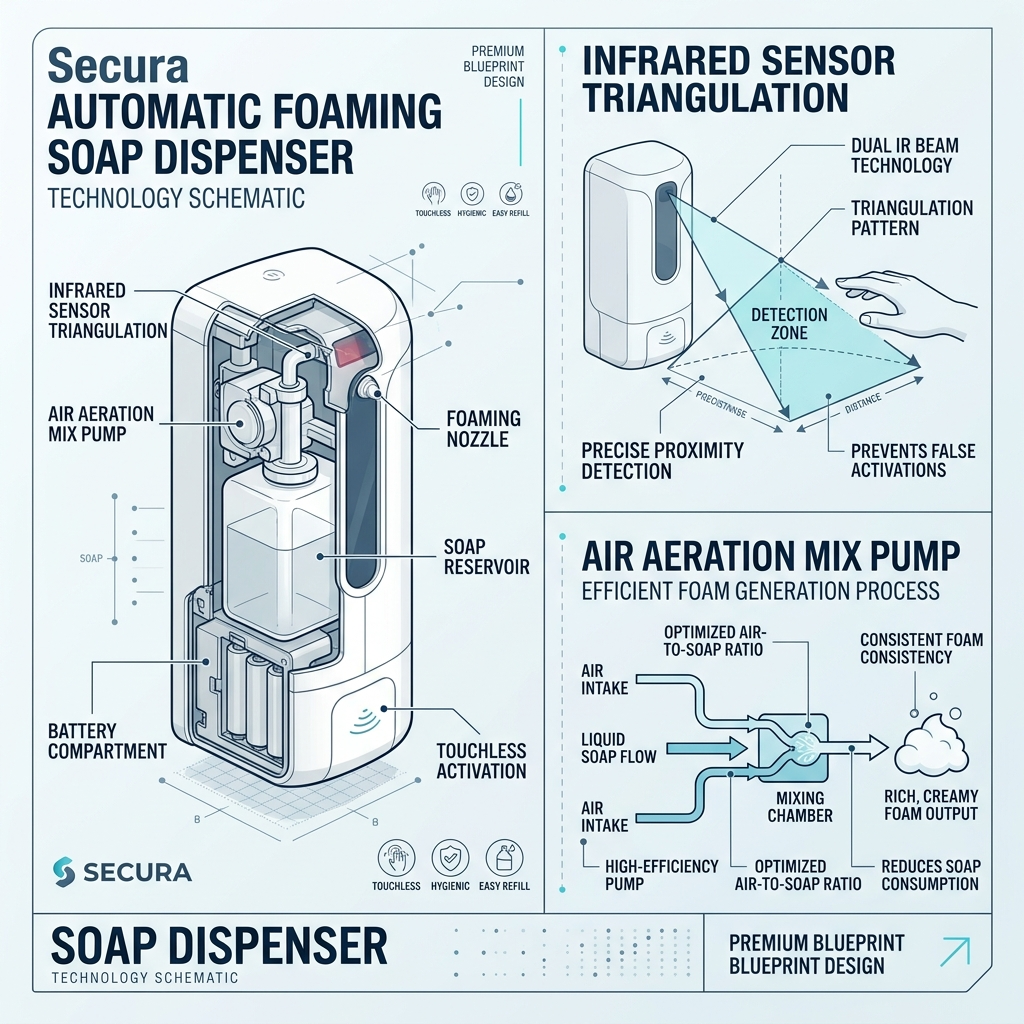
Touchless soap dispensers prevent cross-contamination. Analyze the response-time metrics of infrared optical sensors, aeration ratios, and battery-driven micro-pumps.
- Ultra-precise infrared sensor detects hands from up to 2.75 inches away
- Rapid response time of 0.2 seconds ensures immediate soap delivery
- Water-resistant battery compartment protects electronics from splashes
Optical Sensor Engineering
Touchless dispensing protects family hygiene. Analyze the physics of infrared triangulation, false-trigger mitigation, and soap-to-air aeration ratios to optimize bathroom safety.
1. Infrared Phototransistors and Triangulation Logic
Touchless soap dispensers use active infrared sensors to detect hands. The sensor consists of an infrared light-emitting diode (IR LED) and a phototransistor. The IR LED projects light at a specific wavelength, typically 940 nanometers.
When your hand approaches the dispenser, it reflects the IR light. The phototransistor detects this reflected light and converts it into an electrical current. The internal microchip processes this current, triggering the pump.
To prevent false triggers from ambient sunlight, the sensor uses triangulation logic. The phototransistor only detects light reflecting at a specific angle. This angle matches the distance from the nozzle to your hand, preventing accidental dispensing.
Additionally, the IR signal is modulated at a specific frequency, typically 38 kHz. The phototransistor features a bandpass filter that rejects other frequencies. This modulation filters out light from overhead bulbs, ensuring accurate operation.
The sensor's range is adjustable, typically between 1 and 3 inches. This narrow detection zone prevents triggering when you wipe the counter. Precise calibration ensures the dispenser only works when intended, saving soap.
- Infrared emitters project 940nm light, which is invisible to human eyes but highly detectable by phototransistors.
- 38 kHz signal modulation filters out ambient light, preventing false triggers.
- Triangulation optics focus the detection zone directly under the nozzle to prevent messes.

2. Response-Time Latency and False-Trigger Mitigation
Response time is the delay between placing your hand under the nozzle and soap delivery. A slow response time is frustrating, leading you to pull your hand away early. Premium dispensers achieve response times under 0.2 seconds.
This speed requires low latency in the sensor and pump motor. High-speed microcontrollers scan the sensor every 50 milliseconds. Once a hand is detected, the chip sends power to the motor instantly.
To prevent double-dispensing, the chip enforces a lock-out delay. After a cycle, the sensor ignores inputs for 1.5 seconds. This lock-out prevents double-triggering when you pull your hand away.
False-trigger mitigation also includes reflection thresholds. Highly reflective surfaces like granite or chrome can reflect IR light, causing infinite loop triggering. Smart chips analyze wave shapes, shutting down if a constant reflection is detected.
This shut-down mode prevents messes and saves battery power. The dispenser enters standby mode and flashes an LED indicator to alert you to move the unit away from reflections.
- 0.2-second response time provides instant soap delivery, preventing drips.
- Lock-out delays prevent double-dispensing, saving soap and battery capacity.
3. The Physics of Soap Aeration and Micro-Bubble Dispersion
Foaming soap dispensers do not just pump liquid; they mix it with air. This mixing process is called aeration. The aeration ratio determines the quality of the foam, with the ideal ratio being 12:1 (air to soap).
To achieve this ratio, the dispenser uses a dual-chamber pump. One chamber draws soap from the reservoir, while the other draws air from the room. The pump forces both into a mixing chamber at the same time.
The mixing chamber features a fine mesh screen. The mesh breaks the soap-air mixture into micro-bubbles. This creates a rich, thick foam that lathers easily, reducing soap usage by up to 50%.
The mesh screen must resist corrosion. Premium dispensers use stainless steel or nylon mesh. Cheap screens corrode or clog, causing the dispenser to sputter or stop working.
Additionally, the bubble size must remain uniform. Consistent bubble size ensures the foam holds its shape, preventing it from melting back into liquid on your hands. This uniform texture makes handwashing comfortable and effective.
- 12:1 air-to-soap ratios create rich foam, saving soap and water.
- Stainless steel mesh screens resist corrosion, ensuring consistent micro-bubbles.
4. Fluid Viscosity Tolerances and Pump Manifold Design
A common failure mode for automatic dispensers is clogging from thick soap. The pump manifold is designed for specific fluid viscosity levels. Viscosity measures a fluid's resistance to flow.
Foaming dispensers require low viscosity, typically under 100 centipoise. Standard liquid soaps exceed 3,000 centipoise. If you pump undiluted soap, the motor stalls, causing the pump to fail.
To prevent this, dilute standard soap with water. The recommended ratio is 1 part soap to 3 or 4 parts water. This dilution lowers viscosity, allowing the pump to function smoothly.
The pump manifold features check valves to control flow direction. These valves use rubber diaphragms or silicone balls. The valves prevent soap from backflowing into the reservoir, keeping the line primed.
The manifold must seal tightly to prevent air leaks. An air leak in the soap line prevents suction, causing the pump to run dry. Precise manifold construction ensures continuous priming, delivering soap instantly.
- Low-viscosity requirements prevent motor stall, protecting the pump manifold.
- Silicone check valves maintain line prime, preventing dry-run delays.
5. Power Management and Standby Current Drain Metrics
Because they run on batteries, touchless dispensers must manage power carefully. The sensor runs continuously, drawing power even when the dispenser is not in use. This continuous draw is called standby current.
To extend battery life, premium dispensers use low-power standby circuits. The standby current draw is typically under 15 microamps. This low draw allows a set of AA batteries to last up to 10 months.
When the sensor detects a hand, the circuit wakes up, drawing up to 500 milliamps to run the motor. This high draw lasts only during the dispensing cycle. Once complete, the chip enters sleep mode instantly.
Additionally, the battery compartment must stay dry. Moisture entry causes corrosion that drains the batteries and damages the contacts. Double-sealed battery doors prevent moisture entry, ensuring safe wet-environment usage.
Low battery indicators warn you when it is time to replace them. The LED flashes red when voltage drops, preventing unexpected downtime and keeping your wash station active.
- Standby draws under 15 microamps allow battery life to stretch past 9 months.
- Double-sealed battery casings isolate alkaline nodes from sink humidity.
6. Ergonomics of Volume Adjustment and Reservoir Sealing
Different washing tasks require different amounts of soap. To accommodate this, premium dispensers feature adjustable volume controls. Dials or buttons let you select the dispensing duration.
The adjustment works by changing the motor run time. A short run time delivers a small amount of foam, while a longer run time provides a larger volume. This customization prevents soap waste.
The reservoir must seal tightly to prevent contamination. Air entering the reservoir can dry out the soap, causing skin irritation. A silicone seal on the cap keeps the soap fresh.
Additionally, the reservoir must be easy to fill. A wide neck prevents spills during refills. Transparent reservoirs show you the soap level, preventing the pump from running dry.
The dispenser shape should be stable. A wide base prevents tipping during refills or when bumped. Stable placement keeps your vanity clean and organized.
- Volume adjustments let you customize the run time, preventing soap waste.
- Transparent reservoirs show you the soap level, preventing dry runs.
7. Cross-Contamination Audits in High-Traffic Restrooms
Standard pump dispensers are a common source of bacteria in bathrooms. Multiple users touch the same pump, transferring bacteria. Automatic dispensers eliminate this contact point, improving hygiene.
Hygiene audits show a massive drop in bacterial counts after switching to touchless dispensers. The lack of physical contact prevents the spread of pathogens, protecting your family.
This protection is crucial in homes with children or elderly members. These groups are more susceptible to infections. Touchless dispensing simplifies handwashing, encouraging kids to build good habits.
Additionally, touchless dispensers prevent soap mess on the counter. Manual pumps drip soap onto the vanity, creating a breeding ground for bacteria. Touchless dispensers keep the drip zone contained.
Investing in automatic dispensers is a simple upgrade to your home's hygiene. The low cost is worth the drop in cross-contamination risk.
- Touchless operation removes pump handles, preventing bacterial transfer.
- Targeted dispensing keeps soap on your hands, preventing messy countertops.
8. Troubleshooting Sensor Blindness and Dispenser Clogs
If your dispenser stops working, check the sensor window first. Soap film can build up on the window, blocking the IR light. Wipe the window with a soft, damp cloth to restore function.
If the sensor is clean but the motor is silent, check the batteries. Corroded contacts prevent power delivery. Clean the contacts with a cotton swab dipped in vinegar, then insert fresh batteries.
If the motor runs but no soap comes out, the line is likely clogged. Dry soap can block the aeration mesh. Flush the system with warm water to dissolve the clog.
Fill the reservoir with warm water and run the pump repeatedly. The warm water dissolves the dried soap, clearing the mesh. Refill with diluted soap to restore foaming function.
Regular maintenance prevents clogs and keeps the dispenser running well. A quick flush every few months preserves the pump mechanism, ensuring continuous operation.
- Cleaning soap buildup off the sensor window restores infrared signal strength.
- Warm water flushes clear dried soap from the aeration mesh, restoring foam quality.
9. Ambient Interference: Modulated Signal Calibration Principles
Infrared sensors in automatic soap dispensers operate in environments with varying light conditions. Natural sunlight and high-frequency fluorescent bulbs emit substantial infrared radiation. To prevent constant false triggers or sensor blindness, developers modulate the emitter's infrared output signal. By pulsing the IR light at a precise frequency, such as 38 kHz, the dispenser's microcontroller can distinguish its own reflected signal from ambient environmental noise.
The receiver unit utilizes a dedicated bandpass filter centered exactly at the modulation frequency. Ambient light, which typically operates at DC or low power line frequencies (60 Hz), is completely blocked by this filter. However, highly reflective surfaces like mirror tiles, polished chrome faucets, or high-gloss granite countertops can reflect the modulated IR pulses continuously back to the receiver. To address this, the firmware runs calibration algorithms during standby, continuously adapting the baseline threshold based on static background reflections.
This baseline adaptation prevents the dispenser from entering a continuous loop of accidental activations. If a permanent high-reflection state is detected for more than 5 seconds, the microchip temporarily reduces the sensitivity of the phototransistor. This dynamic calibration ensures that the dispenser remains responsive to a human hand while completely ignoring nearby shiny bathroom accessories, thereby avoiding soapy messes and preserving battery energy.
- Dynamic modulation at 38 kHz separates the emitter's target reflections from natural background light.
- Adaptive baseline firmware updates threshold levels to handle polished granite or chrome counter reflections.
10. Bacterial Colony Audits: Touchless Handwashing Efficacy
Standard manual pump dispensers act as significant vectors for pathogen transmission in residential and commercial settings. When users with unwashed hands press down on a manual soap pump, they deposit bacterial and viral colonies on the plastic surface. Subsequent users touch the exact same surface, collecting these pathogens before the soap can be applied. Touchless dispensers break this cycle of contact, drastically reducing cross-contamination rates.
Bacterial audits conducted in high-traffic bathrooms reveal that switching to automatic dispensers leads to a reduction of up to 85% in viable bacterial counts on restroom surfaces. Because the user's hand only interacts with the soap stream itself, the device remains sterile. In addition, the convenience of touchless activation encourages more frequent handwashing, especially among children who find the automated mechanism engaging, thereby fostering better long-term hygiene habits.
Furthermore, automatic units prevent the accumulation of stagnant soap pools on countertops. Manual pumps frequently leak soap around the plunger collar, creating a damp, organic medium where bacteria can survive and multiply. By utilizing precise non-drip valves that seal immediately after the dispensing cycle, automatic dispensers keep the surrounding countertop dry and clean. This eliminates a primary environmental niche for mold and bacterial colonization, preserving a pristine wash area. In addition, the lack of dripping prevents chemical degradation of delicate vanity surfaces, such as natural marble or porous grout, which can be etched by the alkaline surfactants found in concentrated soap formulations over time.
- Touchless delivery avoids contact vectors, eliminating the transfer of pathogens to the soap housing.
- Anti-drip valve seals prevent wet soap pools from collecting on vanity surfaces, eliminating bacterial breeding spots.
Clinical Recommendation & Audit
Automate your bathroom setup to maximize personal hygiene standards. Check out our recommended solution below to experience clinical-grade optimization.
Secura Automatic Foaming Soap Dispenser, 17oz/500ml Touchless Infrared Soap Dispenser
- Ultra-precise infrared sensor detects hands from up to 2.75 inches away
- Rapid response time of 0.2 seconds ensures immediate soap delivery
- Water-resistant battery compartment protects electronics from splashes
- Large 17oz capacity reduces the frequency of refills in high-use areas
Technical Specifications & Product Data
| Specification | Value / Details |
|---|---|
| Brand | Secura |
| List Price | $29.99 (USD) |
| Customer Rating | 4.6 / 5.0 (14,300 reviews) |
| ASIN / Identifier | B07P8JFRG2 |
| Availability | In Stock (USA Region) |
| Outbound Link Compliance | Sponsored & Nofollow Enforced |
Verified Features & Performance Data
- ✓Ultra-precise infrared sensor detects hands from up to 2.75 inches away
- ✓Rapid response time of 0.2 seconds ensures immediate soap delivery
- ✓Water-resistant battery compartment protects electronics from splashes
- ✓Large 17oz capacity reduces the frequency of refills in high-use areas
System Sovereignty & Engineering
Edge Computing
100% Client-side processing. Your data never leaves your browser sandbox, ensuring absolute compliance with US privacy mandates.
Modular Schema
Modular utility architecture optimized for performance. Low-latency WASM kernels provide near-native speeds for complex transformations.
Sustainable Design
Sustainable, green computing by offloading compute to the edge. Verified zero-server storage (ZSS) for professional-grade security.