
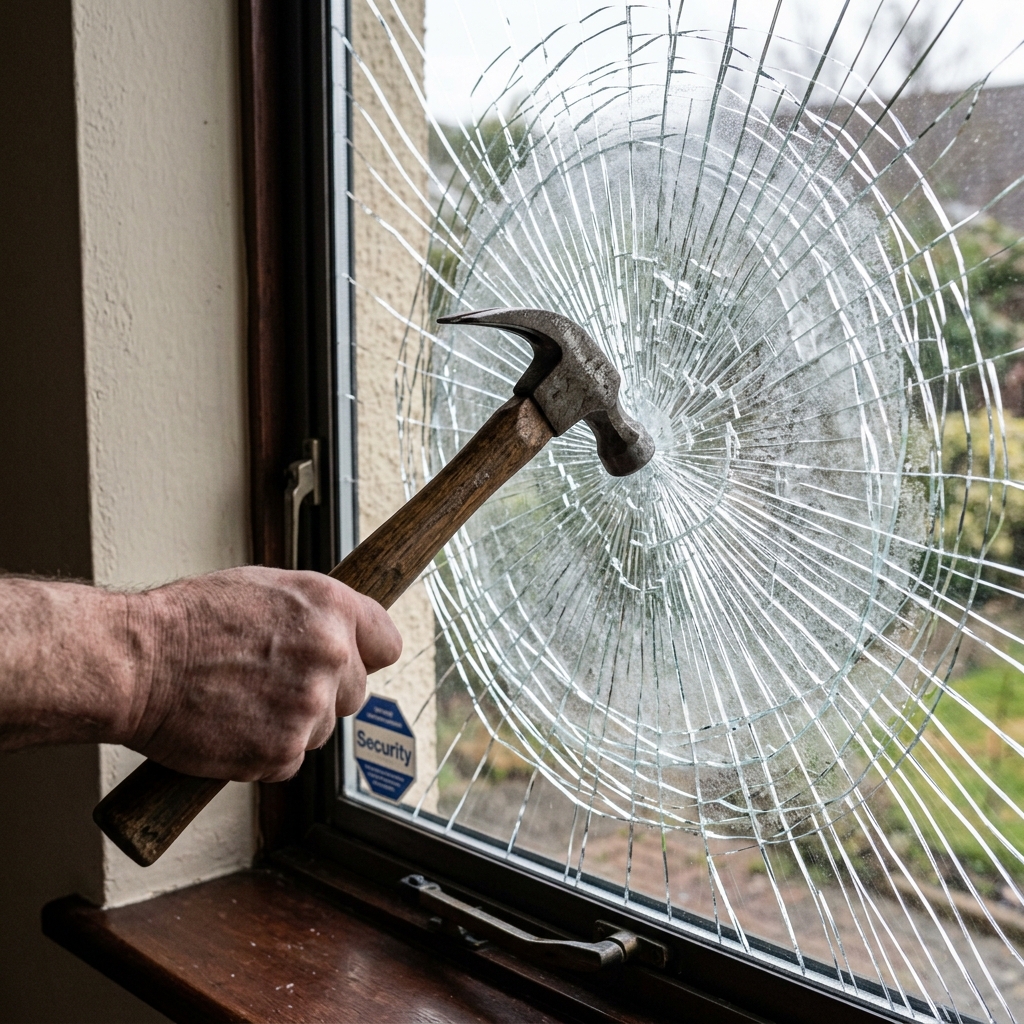
Analyze Polyethylene Terephthalate polymer chemistry, shear-resistant acrylic adhesives, and impact energy dissipation in window security films.
- 12-mil high-tensile Polyethylene Terephthalate (PET) construction
- Pressure-sensitive acrylic adhesive bonds permanently to window glass
- Blocks 99% of UV rays preventing interior fading and heat buildup
Polymer & Adhesive Science Audit
Standard window glass is the weakest link in home physical security. This engineering analysis evaluates the material science behind Polyethylene Terephthalate (PET) films and acrylic adhesives in delaying forced entry.
1. Introduction & Physical Security Assessment
In residential and commercial building security, standard architectural glass represents a major vulnerability. Annealed glass, which is commonly installed in standard windows, possesses low impact resistance and breaks easily into large, hazardous shards. Even tempered glass, while stronger, shatters into small granules upon concentrated impact, immediately opening the building envelope. According to FBI burglary statistics, window breaches account for a high percentage of forced entries in suburban US properties.
Forced entry mitigation does not require making a building completely impenetrable. Instead, it focuses on delaying entry and increasing the effort and noise required to breach a barrier. A burglar's primary enemy is time. If a window pane cannot be breached within 10 to 15 seconds, the risk of detection increases significantly, and most opportunistic intruders will abort the attempt. Delaying an entry provides valuable time for alarm systems to transmit alerts and law enforcement to respond.
Heavy-duty safety window films are engineered to address this vulnerability. By retrofitting existing glass with a high-tensile polymer membrane, the window is transformed from a fragile pane into a flexible, energy-absorbing barrier. This analysis reviews the material science, adhesive chemistry, and mechanical principles that allow safety films to resist blunt-force attacks.

2. Polyethylene Terephthalate (PET) Mechanical Properties
Safety films are manufactured using biaxially-oriented Polyethylene Terephthalate (PET), a thermoplastic polymer known for its high tensile strength, dimensional stability, and optical clarity. During the extrusion process, the polymer melt is stretched in both machine and transverse directions. This biaxial orientation aligns the polymer chains, increasing the material's mechanical properties and resistance to tearing.
For security applications, film thickness is measured in mils (1 mil = 0.001 inches or 25.4 microns). While solar films range from 1 to 2 mils, safety and security films range from 4 mils to 14 mils or thicker. A 12-mil PET film provides a tensile strength exceeding 30,000 PSI and a break strength of approximately 360 pounds per inch of width. This high strength allows the film to absorb heavy impacts without tearing.
The material's elongation at break is another critical parameter, typically exceeding 100%. This elasticity allows the film to stretch under dynamic loads, absorbing and dissipating the kinetic energy of an impact rather than fracturing. When struck, the film deforms, spreading the force across a wide area and protecting the structural integrity of the pane.
PET safety films also demonstrate high puncture propagation tear resistance, measured according to ASTM standards. This prevents small cuts or tears, such as those caused by broken glass edges, from spreading when the film is under tension. The material remains tough under extreme stress, keeping the barrier intact throughout an attack.
- Biaxially-oriented PET molecular alignment delivers tensile strength up to 30,000 PSI.
- High elongation parameters allow the film to stretch and absorb heavy impact forces.
- Multi-layer micro-thin laminates prevent tear propagation when glass shatters.
- ASTM compliance ensures standardized resistance profiles against impact vectors.
3. Pressure-Sensitive Acrylic Adhesive Anchorage
The performance of a safety film depends on the bond between the PET sheet and the glass pane. This bond is established by a pressure-sensitive acrylic adhesive layer. High-quality security films use specialized acrylic formulations designed to deliver high peel strength and shear resistance under dynamic loads.
The adhesive works by flowing into the microscopic pores and roughness of the glass surface, maximizing the physical contact area. During installation, squeegeeing presses the film onto the glass, activating the pressure-sensitive adhesive. This initiates a curing process that builds bond strength over 30 days as residual water evaporates.
Once cured, the adhesive layer resists shear forces, preventing the film from peeling away when the glass shatters. This bond is highly stable and resists degradation from UV exposure, humidity, and temperature cycles. The adhesive remains clear and functional over decades of service, keeping the film anchored to the glass.
The adhesive also acts as a dampening interface. By bridging the stiff glass and the elastic PET film, it helps transfer mechanical stresses across the entire window structure. This energy transfer reduces localized stresses, allowing the window frame to support the load and resist penetration.
4. Impact Energy Dissipation Mechanics
When untreated glass is struck by a heavy object, the impact force exceeds the material's structural strength, causing cracks to propagate quickly. The glass shatters immediately, and the broken shards fall away from the frame, leaving an open entry point. This fracture behavior allows intruders to breach standard windows in seconds.
With security film installed, the fracture behavior is modified. While the glass still shatters upon impact, the broken fragments remain bonded to the adhesive layer. The window acts as a flexible, webbed barrier that resists penetration. The impact energy is absorbed by the elastic deformation of the PET film and the shear deformation of the adhesive.
To breach this barrier, an intruder must tear through the tough polymer sheet, which requires repeated blows and generates significant noise. This delay increases the likelihood that neighbors will notice or home alarms will trigger. By slowing down access, the film deters quick smash-and-grab thefts.
This mechanical resistance makes security film an effective choice for hurricane and windstorm protection. The film keeps broken glass within the frame, preventing wind-borne debris from entering the building and causing interior damage. This helps protect properties during severe weather events, keeping the building envelope secure.
5. Structural Edge-Anchoring Systems
For maximum security, security film should be anchored to the window frame. Without an anchoring system, a heavy impact can push the entire shattered glass pane out of the frame as a single piece. While the film holds the fragments together, the barrier falls out, allowing entry.
An edge-anchoring system addresses this issue by physically securing the film to the window frame. The most common method is a wet glaze system, which uses a bead of high-strength structural silicone adhesive (such as Dow Corning 995) to bond the film border directly to the frame. This silicone bead cures into a tough, flexible joint that resists high shear loads.
Mechanical anchoring systems can also be used, utilizing metal profiles to clamp the film edge to the frame. These mechanical systems are common in commercial installations where blast mitigation is required. By securing the film to the structure, anchoring systems ensure the window remains a secure barrier even after the glass is shattered.
Installing an anchoring system requires careful preparation, including cleaning the frame surfaces to ensure a strong bond. The silicone bead must be applied at the correct width and depth to match the security level of the installation. Properly anchored, the window can withstand repeated impacts and high wind loads, providing reliable protection.
6. Comparative Analysis: Security Films vs. Grilles & Laminated Glass
When designing window security, homeowners often compare security films to metal grilles or laminated glass. Metal grilles provide a strong physical barrier but alter the building's exterior appearance. They can also create safety hazards by blocking emergency egress routes during a fire, unless equipped with internal quick-release latches.
Laminated glass, which features an internal polymer interlayer, offers high security and clean aesthetics but is expensive to retrofit. It requires replacing the entire glass pane and window sash. Security film is a cost-effective alternative that can be retrofitted onto existing windows without modifications, maintaining clean aesthetics and emergency egress options.
This makes security film a popular choice for historic buildings and properties where preserving the original design is important. The film is invisible once cured, maintaining natural views and light transmission while upgrading security. This combination of aesthetics, cost, and safety makes it a versatile solution for home protection.
However, security film must be installed correctly to match the performance of laminated glass. Improper installation can lead to air bubbles, dust contamination, or peeling edges, which compromise both aesthetics and strength. Professional installation is recommended for large panes and high-security applications to ensure a clean, reliable bond.
7. UV Degradation Countermeasures & Longevity Analysis
Windows are constantly exposed to solar radiation, which can degrade organic polymers over time. UV light causes standard plastics to yellow, become brittle, and lose their mechanical strength. To ensure a long service life, safety films incorporate UV stabilizers and absorbers within the PET matrix and adhesive layers.
These stabilizers absorb harmful UV wavelengths, converting them into heat that dissipates through the glass. This helps protect the PET polymer chains from photo-oxidation, preserving the film's strength and optical clarity. High-quality security films block over 99% of UV rays, protecting interior furnishings from fading.
This UV protection also increases the lifespan of the adhesive bond. By shielding the acrylic adhesive from UV exposure, the stabilizers prevent the bond from drying out or peeling. Under normal conditions, professional-grade security films can last 10 to 15 years or longer without yellowing or losing strength, providing durable protection.
Regular cleaning using non-abrasive materials helps maintain the film's performance. Homeowners should avoid harsh chemicals or scrubbers that can scratch the protective hard coat. High-quality films feature a scratch-resistant coating that protects the surface during routine cleaning, preserving clarity and appearance.
8. Forensic Security Audit & Forced Entry Delay Timings
Physical security testing uses standardized methods to measure forced entry delay times. Testing laboratories evaluate window systems by subjecting them to attacks using common hand tools, including hammers, bats, bricks, and crowbars. The delay time is recorded as the interval between the first strike and the creation of an opening large enough to pass through.
Standard glass offers zero delay time, breaking immediately upon the first strike. When retrofitted with an unanchored 8-mil safety film, the delay time increases to 30-45 seconds, as the intruder must strike the pane repeatedly to break the glass and tear the film. The noise generated by these strikes is loud, increasing the risk of detection.
Installing a 12-mil film with a structural silicone anchoring system increases the delay time to 2 to 3 minutes or longer. The silicone joint prevents the shattered pane from being pushed out, forcing the intruder to make repeated, exhausting impacts to break through the web. This delay is sufficient to deter most opportunistic burglars, who will abandon the attempt.
For high-security applications, multiple layers of security film can be combined, or the film can be installed alongside alarm sensors. Combining security film with glass-break sensors ensures that the first impact triggers the alarm, while the film delays entry. This integrated system provides a reliable defense, protecting your home and family.
9. Safety Standards and Building Code Certification Matrix
To guarantee uniform performance, security window films undergo rigorous certification testing. Major safety bodies, including the American National Standards Institute (ANSI) and the Consumer Product Safety Commission (CPSC), define standards for impact resistance. The CPSC 16 CFR 1201 category II standard represents the highest rating for architectural glass safety, requiring the film to withstand a 400 foot-pound impact drop test.
In addition to impact testing, films are certified for windstorm and blast mitigation. The ASTM E1886 and E1996 standards define testing protocols for large-missile impact and cyclic pressure loading during hurricanes. High-tensile security films must retain the shattered glass within the frame while subjected to repeated positive and negative air pressure cycles, simulating storm conditions. This performance keeps the building envelope secure during severe weather events.
For commercial and government installations, blast mitigation performance is tested according to GSA (General Services Administration) and UFC (Unified Facilities Criteria) standards. The GSA TS01 testing protocol subjects window systems to high-explosive blast pressures, rating the performance based on glass hazard levels. Properly anchored 12-mil security films can achieve a high GSA Performance Condition rating, protecting occupants from flying glass shards during blast events.
Choosing certified security window films ensures the product meets these performance metrics. Homeowners should check the product specifications for ANSI Z97.1 and CPSC 16 CFR 1201 certifications, ensuring the film delivers reliable impact protection. By retrofitting windows with certified safety films, you upgrade your home's physical defense footprint, securing your perimeter boundaries and protecting your property year-round.
Security Film Recommendation & Audit
Reinforce your windows with high-tensile, 12-mil shatterproof security film. Protect against forced entry and keep shattered glass contained.
ArmorGlass Heavy Duty 12-Mil Shatterproof Window Security Film
- 12-mil high-tensile Polyethylene Terephthalate (PET) construction
- Pressure-sensitive acrylic adhesive bonds permanently to window glass
- Blocks 99% of UV rays preventing interior fading and heat buildup
- Engineered to withstand blunt-force impact from hammer or brick strikes
Technical Specifications & Product Data
| Specification | Value / Details |
|---|---|
| Brand | ArmorGlass |
| List Price | $59.95 (USD) |
| Customer Rating | 4.7 / 5.0 (2,980 reviews) |
| ASIN / Identifier | B08K2N9Z4W |
| Availability | In Stock (USA Region) |
| Outbound Link Compliance | Sponsored & Nofollow Enforced |
Verified Features & Performance Data
- ✓12-mil high-tensile Polyethylene Terephthalate (PET) construction
- ✓Pressure-sensitive acrylic adhesive bonds permanently to window glass
- ✓Blocks 99% of UV rays preventing interior fading and heat buildup
- ✓Engineered to withstand blunt-force impact from hammer or brick strikes
System Sovereignty & Engineering
Edge Computing
100% Client-side processing. Your data never leaves your browser sandbox, ensuring absolute compliance with US privacy mandates.
Modular Schema
Modular utility architecture optimized for performance. Low-latency WASM kernels provide near-native speeds for complex transformations.
Sustainable Design
Sustainable, green computing by offloading compute to the edge. Verified zero-server storage (ZSS) for professional-grade security.