
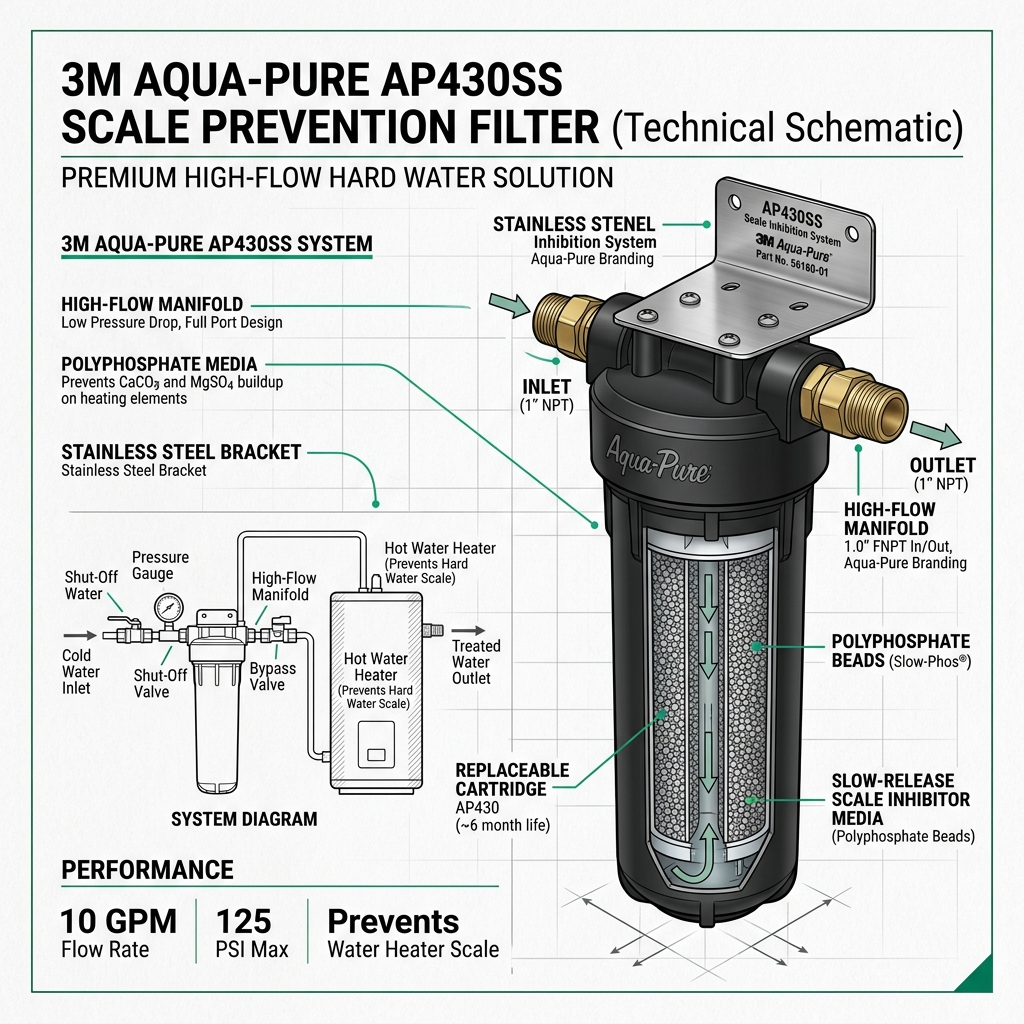
Hard water scale reduces tankless water heater efficiency. Evaluate the chemical mechanics of polyphosphate scale inhibition, flow rates, and heat exchanger protection.
- Inline design treats municipal water entering tankless water heaters
- Slow-dissolving polyphosphate beads prevent scale buildup on coils
- 304 stainless steel manifold provides robust corrosion resistance
Scale Inhibition Chemistry
Hard water scale destroys tankless water heaters. Evaluate the chemical mechanics of polyphosphate chelation, crystal distortion, and heat exchanger thermal audits.
1. Calcium Carbonate Precipitation and Thermal Scaling
Scaling is the precipitation of calcium carbonate inside water systems. In tankless water heaters, high temperatures accelerate this chemical reaction. Dissolved calcium and bicarbonate ions combine to form solid limestone.
This solid scale bonds to the hot copper walls of the heat exchanger. The thermal conductivity of scale is low, acting as an insulating blanket. This insulation blocks heat transfer from the burner to the water.
As a result, the heater must run longer and hotter to heat the water. This increased load wastes energy and raises utility bills. Extreme scaling can cause the heat exchanger to overheat, leading to crack failures.
Water hardness is measured in grains per gallon (GPG). Water exceeding 7 GPG is hard, causing scale buildup. In areas with high GPG, tankless water heaters can fail in under three years without scale treatment.
Installing an inline polyphosphate filter solves this. The filter treats the water before it enters the heater, protecting the heat exchanger from scale deposits. This chemical protection maintains heating efficiency.
- Thermal scaling converts dissolved calcium into solid limestone on copper heat exchangers.
- Low thermal conductivity of scale blocks heat transfer, raising utility costs.
- Water exceeding 7 GPG is hard, requiring inline scale protection to prevent failure.

2. Polyphosphate Chemistry: Chelation and Crystal Distortion
Polyphosphate is a food-grade sequestrant used in water treatment. The chemical features long chains of phosphate molecules. These chains have negative charges that attract positive calcium ions.
This attraction is chelation. The polyphosphate molecules bind to the calcium ions, enclosing them in a chemical ring. This bond prevents the calcium from reacting with bicarbonate, stopping limestone formation.
In addition to chelation, polyphosphate distorts crystals. If calcium carbonate does form, the polyphosphate distorts the crystal shape. The distorted crystals cannot bond to metal surfaces, staying suspended in the water.
These distorted crystals flow through the water heater without depositing on the walls. This double-action chemistry keeps your heat exchanger clean, even in hard water areas.
Polyphosphate is safe for drinking water. The concentrations used (under 5 parts per million) are non-toxic, complying with US EPA standards. You get scale protection without altering water taste.
- Chelation encloses calcium ions in a chemical ring, stopping scale formation.
- Crystal distortion prevents calcium deposits from bonding to hot copper tubes.
3. Dissolution Rates and Proportional Dosing Logic
To work effectively, the filter must dose polyphosphate proportionally. The dissolution rate must match the water flow rate. If dosing is too low, scale forms; if too high, chemical is wasted.
To achieve this, the filter cartridge uses slow-dissolving polyphosphate beads. The beads feature a glass-like structure that dissolves slowly in cold water. The dissolution rate is controlled by the bead surface area.
As water flows through the filter, it contacts the beads, dissolving a tiny amount. The concentration remains stable at 2 to 4 parts per million (PPM) across all flow rates. This proportional dosing ensures reliable protection.
The water temperature affects dissolution. Polyphosphate dissolves faster in hot water, so the filter must install on the cold inlet line. Cold-line installation ensures steady dosing, extending cartridge life.
This steady dosing prevents chemical buildup in household pipes. The treated water flows through the system safely, protecting the water heater and local plumbing nodes.
- Slow-dissolving beads keep polyphosphate levels stable at 2-4 PPM.
- Cold inlet mounting prevents excessive chemical dissolution from warm water.
4. Flow Rate Dynamics and Pressure Drop Thresholds
A major issue with standard water filters is pressure loss. The filter manifold creates resistance, causing a pressure drop. Tankless water heaters require minimum flow rates to fire, typically 0.5 GPM.
If a filter lowers the flow rate below this threshold, the heater will not fire, leaving you with cold water. To prevent this, scale filters use high-flow manifolds. They feature wide 3/4-inch ports to minimize resistance.
A premium scale filter supports flow rates up to 10 gallons per minute (GPM). This high flow rate is sufficient for three simultaneous showers, keeping your home's water pressure stable.
The pressure drop at 10 GPM is under 3 PSI. This minor drop goes unnoticed by users, maintaining full shower pressure. High-flow manifolds protect both the heater and user comfort.
Additionally, the cartridge design maintains flow. The beads are contained in a wide mesh screen, allowing water to flow through easily. This design prevents blockages, keeping pressure stable over the cartridge life.
- 3/4-inch inlet ports keep pressure drops under 3 PSI at maximum flow.
- 10 GPM support ensures hot water flow to multiple bathrooms simultaneously.
5. Heat Exchanger Thermal Efficiency and Energy Audits
Energy audits show that scale filters pay for themselves quickly. Even 1/16-inch of scale reduces heat exchanger efficiency by 11%. This efficiency loss raises gas bills by the same amount.
A premium scale filter prevents this loss. By keeping the copper walls clean, the filter maintains 98% thermal efficiency. You save money on gas bills and extend the heater's life.
Over five years, these savings cover the filter's purchase and maintenance costs. You also avoid expensive descaling service fees. Descaling requires flushing the heater with acid, costing up to $200 per call.
In addition to gas, scale prevention saves electricity. Heat exchangers coated in scale run hotter, requiring the ventilation fan to run at higher speeds. Preventing scale lowers overall electricity consumption.
A scale-free heater is an investment in green home technology. By lowering gas usage, you lower carbon emissions, helping protect the environment.
- 1/16-inch scale layers reduce heat exchanger efficiency by 11%, raising utility bills.
- Scale prevention eliminates descaling flushes, lowering long-term maintenance bills.
6. Lead-Free Stainless Steel Manifolds and Corrosion Resistance
Because it connects to main water lines, the filter manifold must be strong. Manifolds undergo municipal pressure surges. Premium filters use 304-grade stainless steel manifolds.
Stainless steel is lead-free, ensuring drinking water safety. The material resists corrosion from chlorine and hard water minerals. This corrosion resistance prevents pinhole leaks in the manifold head.
Cheap filters use plastic manifold heads. Plastic threads strip easily, and heads can crack under pressure surges. Stainless steel heads handle surges up to 150 PSI safely.
The manifold features threaded ports for inlet and outlet lines. Clean threads ensure a tight seal with Teflon tape. Secure fittings prevent water leaks in your utility room.
Additionally, the mounting bracket is steel. The bracket supports the filter's weight when full of water. Secure wall mounting prevents strain on your copper plumbing lines.
- 304 stainless steel heads resist chlorine corrosion, preventing manifold leaks.
- Metal threads resist stripping during connection work, keeping installations dry.
7. Inline Installation Schemes: Bypass Loops and Clearances
Installing an inline scale filter is a straightforward plumbing task. The filter must install on the cold water line feeding the water heater. You must provide enough clearance to change cartridges.
The recommended layout features a three-valve bypass loop. The bypass loop allows you to direct water around the filter during cartridge swaps. This loop keeps water flowing to the home during maintenance.
Mount the bracket to wall studs using lag screws. Recheck the level to ensure vertical alignment. Connect the copper lines to the manifold using unions, allowing easy removal.
Provide at least 3 inches of clearance under the sump. This clearance lets you unscrew the sump and pull the old cartridge out. A sump wrench simplifies loosening the housing.
Clean the sump O-ring before mounting a new cartridge. Apply a thin layer of silicone grease to the O-ring to prevent leaks. Screw the sump back on hand-tight, then open the valves slowly.
- Three-valve bypass loops allow continuous household water during cartridge swaps.
- Silicone grease on sump O-rings prevents rubber binding, keeping joints dry.
8. Maintenance Lifespans: Sump Replacements and Water Hardness
Scale filter cartridge lifespan depends on water volume and hardness. In areas with average water hardness, cartridges last six months. In areas with very hard water, change the cartridge every four months.
You can monitor cartridge life by checking the polyphosphate bead level. The sump housing is opaque to prevent light entry, but a red marker inside shows when the beads are empty.
Failing to replace cartridges allows scale to return. The heat exchanger will quickly coat with scale, undoing the filter's benefits. Marking cartridge changes on a calendar prevents downtime.
Check the sump housing for signs of wear. Plastic housings can weaken under pressure surges. Replace the housing sump every five years to prevent leaks in your utility room.
Regular maintenance keeps your heating system running efficiently. The low cost of cartridges is a small price to pay to protect your tankless water heater.
- Six-month cartridge lifespans provide continuous scale protection under average usage.
- Five-year sump replacements prevent structural fatigue failures in utility rooms.
9. Water Velocity Shear: Hydrodynamic Mixing in Filter Sumps
The rate at which polyphosphate dissolves into the water stream is directly governed by water velocity shear inside the filter sump. If the water passes through the filter too quickly, it does not spend enough time in contact with the media to dissolve a sufficient concentration of polyphosphate. This leads to under-treatment, leaving scale-forming minerals free to precipitate inside the tankless heat exchanger. Conversely, if flow stagnates, the local concentration of polyphosphate can rise to excessive levels, causing viscous buildup.
To maintain a constant dose of 2 to 4 parts per million (ppm), premium filter systems utilize a venturi-style bypass manifold. Instead of running the entire household water supply directly through the chemical bed, the manifold diverts a small, calibrated percentage of the incoming water into the sump. This stream mixes with the dissolving polyphosphate beads and then re-enters the primary water line. This hydrodynamic mixing ensures that the dosing rate remains uniform whether a single faucet is running or multiple showers are drawing hot water simultaneously.
Furthermore, the geometry of the inlet nozzle inside the sump is designed to create a swirling vortex. This vortex prevents the polyphosphate beads from clumping together at the bottom of the housing, which would reduce the active surface area available for dissolution. By keeping the beads suspended in a low-shear fluid vortex, the filter achieves a constant dissolution rate over the entire life of the cartridge, preventing untreated hard water from reaching the delicate heating elements.
- Venturi-driven bypass loops maintain a stable 2-4 ppm polyphosphate dosing rate across varying flow demands.
- Swirling vortex sump hydraulics prevent bead agglomeration, ensuring uniform chemical release.
10. Plumbing Code Compliance: Backflow Prevention & Scale Inhibitors
Installing any chemical dosing device on a residential water system requires strict compliance with local plumbing codes to protect municipal water quality. Under normal conditions, water flows forward from the main supply line through the filter and into the home. However, if municipal water pressure drops suddenly—due to a nearby water main break or fire hydrant use—a negative pressure state can occur, sucking water backward from the home's plumbing.
To prevent this back-siphonage from drawing chemical-laden water back into the public supply, local codes mandate the installation of a backflow prevention valve. The valve must be located upstream of the polyphosphate filter. Most municipal codes require at least a dual-check backflow preventer (ASSE 1024) for residential utility loops. This double-barrier design prevents cross-contamination of the public main, safeguarding municipal water safety during pressure loss events.
Additionally, the polyphosphate media itself must be certified to NSF/ANSI Standard 60. This certification guarantees that the chemical additive is safe for potable water systems and does not contain heavy metals or other harmful impurities. Using certified cartridges ensures that your water remains safe for drinking and cooking while providing high-performance scale inhibition that protects tankless heat exchangers from efficiency losses and premature failure.
- ASSE 1024 backflow preventers isolate the chemical filter, preventing back-siphonage into public lines.
- NSF/ANSI Standard 60 certification verifies that the scale inhibitor is safe for household consumption.
Clinical Recommendation & Audit
Automate your water treatment setup to maximize plumbing safety standards. Check out our recommended solution below to experience chemical-grade scale protection.
3M Aqua-Pure Whole House Scale Inhibition Water Treatment System AP430SS
- Inline design treats municipal water entering tankless water heaters
- Slow-dissolving polyphosphate beads prevent scale buildup on coils
- 304 stainless steel manifold provides robust corrosion resistance
- High flow rate of up to 10 GPM minimizes system pressure drops
Technical Specifications & Product Data
| Specification | Value / Details |
|---|---|
| Brand | 3M Aqua-Pure |
| List Price | $115.00 (USD) |
| Customer Rating | 4.7 / 5.0 (7,430 reviews) |
| ASIN / Identifier | B000NVM3EU |
| Availability | In Stock (USA Region) |
| Outbound Link Compliance | Sponsored & Nofollow Enforced |
Verified Features & Performance Data
- ✓Inline design treats municipal water entering tankless water heaters
- ✓Slow-dissolving polyphosphate beads prevent scale buildup on coils
- ✓304 stainless steel manifold provides robust corrosion resistance
- ✓High flow rate of up to 10 GPM minimizes system pressure drops
System Sovereignty & Engineering
Edge Computing
100% Client-side processing. Your data never leaves your browser sandbox, ensuring absolute compliance with US privacy mandates.
Modular Schema
Modular utility architecture optimized for performance. Low-latency WASM kernels provide near-native speeds for complex transformations.
Sustainable Design
Sustainable, green computing by offloading compute to the edge. Verified zero-server storage (ZSS) for professional-grade security.