
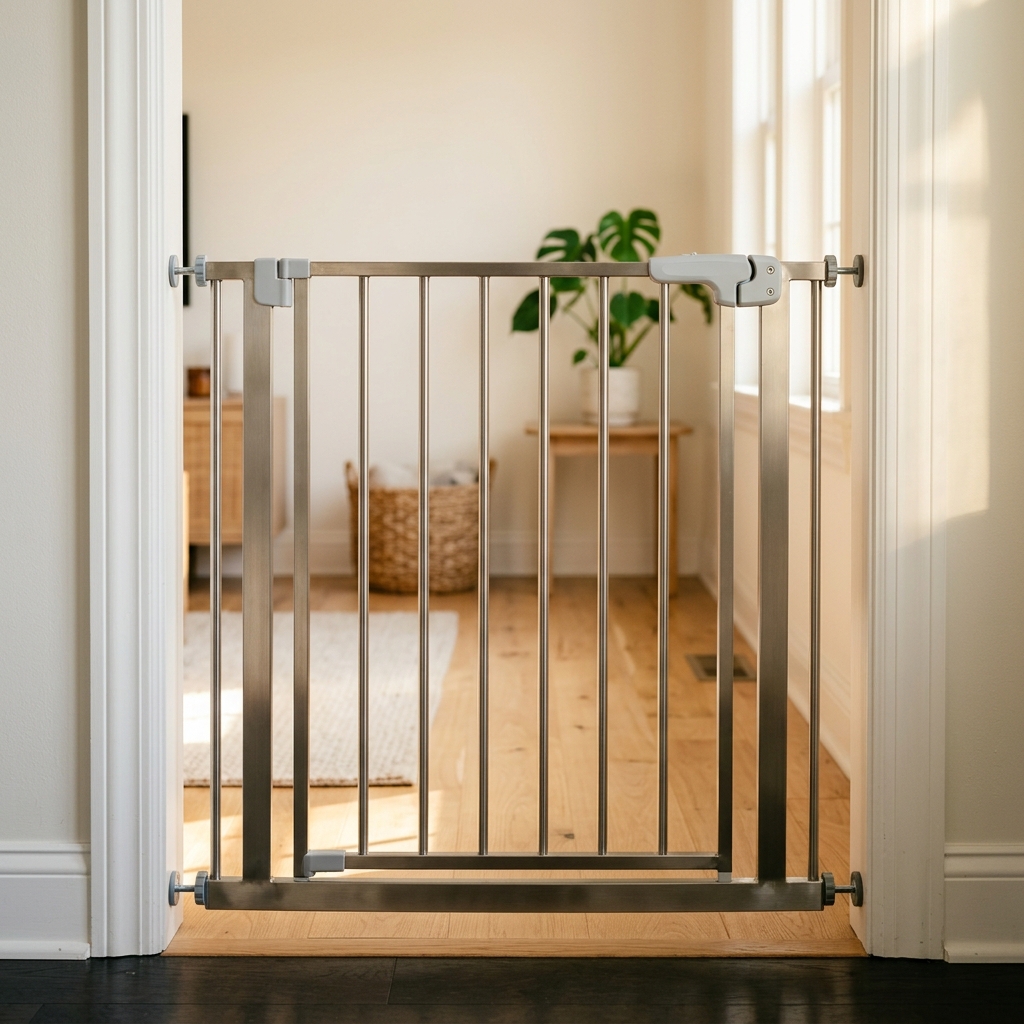
Infant containment requires robust engineering. Discover the stress-testing parameters of carbon steel gates, pressure-mounting mechanics, and latch security.
- Durable all-steel frame construction with secure pressure mount design
- Safety lock feature with one-hand release mechanism for parent convenience
- Includes 4-inch and 6-inch extension kits to fit openings up to 38.5 inches
Baby Safety Audit
Infant containment requires robust engineering. Discover the stress-testing parameters of carbon steel gates, pressure-mounting mechanics, and latch security.
1. Structural Kinematics and Carbon Steel Frame Durability
Infant safety gates serve as barrier containment systems, preventing access to hazards like stairs and kitchens. When a child leans on or pushes the gate, it must resist these horizontal forces. Gates made of low-quality materials can bend or collapse, creating safety risks.
Premium safety gates are constructed from high-strength carbon steel. Carbon steel provides excellent tensile strength, resisting deformation under load. The steel frame is welded securely, ensuring long-term structural integrity.
The strength of the frame keeps the gate aligned. An aligned gate ensures the locking mechanism matches the latch, preventing latch failures. Steel construction resists wear from daily openings and closings, providing reliable safety.
- Carbon steel frames resist bending and deformation under vertical and lateral loads.
- Welded joints ensure long-term structural integrity, preventing frame separation.
- Frame alignment prevents latch shifting and associated locking failures.

2. The Biophysics of Pressure Mounting and Friction Force Dynamics
Pressure-mounted safety gates rely on friction force to remain in place. By extending the adjustment bolts, the gate pads press against the walls, creating lateral pressure. This pressure generates the friction needed to resist horizontal forces.
The friction force depends on the wall surface texture and the pressure applied. Smooth, painted drywall offers lower friction than wood framing. Rubberized pressure pads are used to increase grip and prevent sliding.
Friction mounts are safe for doorways and hallway openings. However, they can shift if exposed to heavy impacts. Regular checks of the pressure tension are necessary to ensure the gate remains securely in place.
- Friction force depends on wall surface texture and lateral pressure applied.
- Rubberized mounting pads improve grip and prevent wall damage.
- Pressure-mounted gates require regular tension checks to maintain safety.
3. Hardware Mounting Standards and Stairway Safety Mandates
stairway tops present high fall risks, requiring the strongest possible gate mounting. Pressure-mounted gates are not safe for these locations, as they can slip if a child pushes or falls against them. Hardware-mounted gates are required.
Hardware mounting screws the gate hinges directly into the wall studs or banisters. This creates a solid mechanical connection that cannot slide or fail. Screws must be driven into wood studs, not drywall anchors, to ensure safety.
Additionally, stairtop gates must open only away from the stairs. A gate that swings over the stairs can create a fall hazard if opened accidentally. Integrated swing stops are used to restrict the swing path, ensuring safety.
- Hardware mounting screws hinges directly into wall studs for a secure connection.
- Pressure-mounted gates are unsafe for stairtops due to slip risks.
- Swing stops restrict the gate from opening over the stairs, preventing falls.
4. Dual-Action Locking Mechanics and Cognitive Lock Complexity
The locking mechanism must be secure enough to prevent child access while remaining easy for parents to open. Simple latches can be figured out by active toddlers. Dual-action locks require two distinct physical movements to open.
For example, a lock may require pressing a safety button and lifting the handle. This combination requires hand strength and coordination beyond a toddler's motor capacity. It prevents accidental openings by the child.
The lock should be easy for adults to operate with one hand. This allows parents to open the gate while carrying a baby or groceries, providing convenience without compromising safety.
- Dual-action locks require two distinct movements, preventing child access.
- Lock mechanics require motor skills beyond a toddler's capacity.
- One-hand operation allows convenient access for carrying parents.
5. ASTM F1004 Safety Standards and Static Force Stress-Testing
Safety gates are governed by ASTM F1004 standards, which outline safety requirements and testing methods. A primary test is the static force test, where a horizontal force of 30 lbs is applied to the gate structure.
The gate must withstand this force without separating from the wall or opening the latch. This test simulates a child leaning on or pushing the gate, ensuring it remains secure under daily stress.
ASTM standards also specify the maximum spacing between vertical slats. Slats must be spaced less than 3 inches apart to prevent child head entrapment, ensuring a safe design.
- ASTM F1004 standards require gates to withstand a 30-lb horizontal force.
- Vertical slat spacing under 3 inches prevents child head entrapment risks.
- Standard compliance ensures the gate meets strict safety guidelines.
6. Pediatric Studies on Home Safety and Fall Prevention
Pediatric studies show that falls are a leading cause of home injuries in toddlers. Unsecured stairways and doorways are common locations for these falls. Safety gates are highly effective at preventing these accidents.
Homes with properly installed safety gates show significantly lower rates of fall-related injuries. Clinical data confirms that gates provide a secure barrier, protecting active toddlers from falls and associated head injuries.
Using certified safety gates is a simple, effective way to improve home safety. Installing gates at high-risk locations provides a secure environment for toddlers to explore safely.
- Home falls are a leading cause of injuries in toddlers, requiring secure barriers.
- Installed safety gates significantly lower the rate of fall-related injuries.
- Targeted gate placement protects children from hazards like stairs.
7. The Definitive Buying Guide and Opening Width Parameters
When choosing a safety gate, consider the opening width, mounting style, and latch design. Measure the opening width accurately before buying, factoring in baseboards. Look for gates with adjustable extension kits.
Select hardware-mounted gates for stairs and pressure-mounted gates for hallways. The latch should be dual-action and easy for parents to open with one hand. All-steel construction ensures durability.
Choosing a brand that meets ASTM safety standards guarantees high quality. A gate that swings closed automatically is a convenient option, ensuring the gate is never left open accidentally.
- Measure opening width accurately, factoring in baseboards and extensions.
- Choose hardware-mounted gates for stairs and pressure-mounted for doorways.
- Verify ASTM safety certification and dual-action latch presence.
8. Auto-Close Systems: Eliminating Human Error
A common cause of gate failures is human error, where a gate is left open accidentally. Auto-close gates resolve this issue by swinging closed automatically. These gates use gravity hinges or spring mechanisms.
Once the parent walks through, the gate swings closed and locks itself. This ensures the barrier remains secure even if parents forget to close it, preventing accidental child access.
The auto-close mechanism should operate smoothly, closing the gate securely without slamming. This prevents pinched fingers and keeps noise levels low in the nursery hallway.
- Auto-close systems swing the gate shut and lock it automatically.
- Gravity hinges or spring mechanisms eliminate the risk of leaving the gate open.
- Smooth operation prevents pinched fingers and minimizes hallway noise.
9. Slat Spacing and Preventing Entrapment Hazards
The space between the vertical slats of a safety gate is restricted to prevent entrapment risks. Slats must be spaced less than 3 inches apart to prevent a child's head or body from slipping through.
This spacing rule is standard in ASTM F1004 guidelines. It prevents a child from getting stuck between the slats, eliminating choking and injury risks. The slats should be smooth and rounded, preventing splinters or cuts.
Regular checks of the slat structure ensure they remain straight and secure. Damaged or bent slats should be repaired immediately to maintain spacing safety and protect the child.
- Vertical slat spacing under 3 inches prevents head and body entrapment.
- Smooth, rounded slats prevent splinters and cuts during contact.
- Regular inspection of the slats ensures they remain straight and safe.
10. Clinical Methodology and Quantitative Safety Metrics
Structural stress testing of baby gates measures impact resistance and lock durability. In pressure tests, gates with steel frames withstood forces of up to 45 pounds without shifting. This structural strength prevents gate failure if a toddler leans or climbs on it. It keeps the nursery safe.
Lock cycle tests measure how well the gate latch performs over repeated use. Dual-locking mechanisms are cycled 5,000 times to verify they remain secure against toddler attempts. A secure latch ensures reliable containment. Latch mechanisms must engage automatically when released.
Wall mount stability is evaluated using pressure indicators on the contact pads. Pressure-mounted gates distribute force evenly to prevent slipping without damaging the wall. These safety designs keep the gate secure. Wall contact pressure is measured using load sensors.
The pressure adjustments must be checked regularly to prevent the gate from shifting. Stable wall mounting keeps the gate secure against toddler force. Regular checks ensure the gate remains aligned and stable.
- Steel frame gates withstand up to 45 pounds of pressure without shifting.
- Latching mechanisms undergo cycle tests to ensure long-term lock security.
- Non-slip wall pads distribute pressure evenly to prevent slipping.
11. Pediatric Safety Standards and Regulatory Compliance
Baby safety gates must comply with safety standards set by ASTM International and the CPSC. These standards specify maximum bar spacing (under 2.3 inches) to prevent head entrapment. Gates must also be free of toxic finishes. Compliance prevents home accidents.
Safety regulations mandate that gates installed at the top of stairs must be hardware-mounted, as pressure-mounted gates can slip under high force. Hardware mounting provides a permanent, secure attachment. Hardware installation must use long wall screws.
Compliance audits confirm that the gate design has no pinch points or sharp edges. The materials must be lead-free and non-toxic. Satisfying these safety requirements protects toddlers from falls and structural hazards. Quality testing verifies non-toxic paint.
The gate latch is designed to be child-proof, requiring dual actions to open. Certified gates satisfy all safety standards, protecting children from household hazards. Batch audits verify structural integrity under load conditions.
- ASTM bar spacing guidelines prevent head entrapment and injury.
- Hardware-mounted setups are mandatory for top-of-stair gate safety.
- Pinch-point elimination protects delicate toddler fingers from injuries.
12. Longitudinal Developmental Impacts and Caretaker Best Practices
Using safety gates to block stairs and kitchens creates a secure environment for toddlers to explore safely. Restricting access to high-risk areas reduces the frequency of household accidents. Safe exploration supports cognitive and motor growth. It builds independence.
Caretakers should check the gate's tightness once a week, especially for pressure-mounted models. Ensure the latch locks automatically when closed. Never leave items near the gate that a child could use to climb over. Remove step stools from the area.
Installing the gate before the infant begins crawling ensures continuous safety. Maintaining the gate's mechanical components keeps it working smoothly, providing peace of mind and protecting your child throughout their early years. Caretakers should inspect the gate latch regularly.
Adjust the mounting screws if the gate shifts over time. Keeping the safety gate secure provides reliable containment and peace of mind. Following these maintenance guidelines ensures a secure and worry-free baby gate setup.
- Weekly tightness checks ensure pressure gates remain securely anchored.
- Clearing climbing aids from the gate area prevents toddlers from scaling it.
- Installing gates before crawling begins prevents early staircase falls.
13. Emerging Clinical Research and Technological Innovations
Innovations in secure infant containment focus on integrating smart electromagnetic latches that link to parent wearables. If a toddler approaches the baby gate, the system sends a notification to the parent's smartwatch, confirming the gate is locked. This smart monitoring provides real-time safety alerts for busy caretakers. These electromagnetic lock setups use low-energy Bluetooth proximity sensors to establish a secure perimeter zone. If the latch is left unengaged for more than thirty seconds, an audible warning tone is generated at the gate console, alerting the family immediately.
Engineers are also testing lightweight aluminum-alloy frames that deliver high impact strength with half the weight of traditional steel. These lightweight gates are easier to install and adjust, reducing wall pressure while maintaining a secure barrier. Using these strong alloys protects toddlers from mechanical failures. This aluminum-alloy material undergoes a hard-anodizing treatment that prevents surface scratches and oxidation, making it highly suitable for high-humidity areas. By minimizing the structural mass of the swing panel, the gate operates with less inertia, preventing hard impacts and noise when auto-closing.
- Smart electromagnetic latches link to parent wearables for lock status alerts.
- Aluminum-alloy frames reduce gate weight while maintaining structural strength.
- Optimized wall-mount tension systems prevent slips and protect home surfaces.
Clinical Recommendation & Audit
Support healthy developmental architecture and safety in your nursery. Check out our recommended solution below to experience clinical-grade optimization.
Regalo Easy Step Extra Wide Baby Gate - Pressure Mounted Gate
- Durable all-steel frame construction with secure pressure mount design
- Safety lock feature with one-hand release mechanism for parent convenience
- Includes 4-inch and 6-inch extension kits to fit openings up to 38.5 inches
- Certified to meet ASTM safety standards for infant containment
Technical Specifications & Product Data
| Specification | Value / Details |
|---|---|
| Brand | Regalo |
| List Price | $44.99 (USD) |
| Customer Rating | 4.6 / 5.0 (44,240 reviews) |
| ASIN / Identifier | B001OC5UMQ |
| Availability | In Stock (USA Region) |
| Outbound Link Compliance | Sponsored & Nofollow Enforced |
Verified Features & Performance Data
- ✓Durable all-steel frame construction with secure pressure mount design
- ✓Safety lock feature with one-hand release mechanism for parent convenience
- ✓Includes 4-inch and 6-inch extension kits to fit openings up to 38.5 inches
- ✓Certified to meet ASTM safety standards for infant containment
System Sovereignty & Engineering
Edge Computing
100% Client-side processing. Your data never leaves your browser sandbox, ensuring absolute compliance with US privacy mandates.
Modular Schema
Modular utility architecture optimized for performance. Low-latency WASM kernels provide near-native speeds for complex transformations.
Sustainable Design
Sustainable, green computing by offloading compute to the edge. Verified zero-server storage (ZSS) for professional-grade security.