
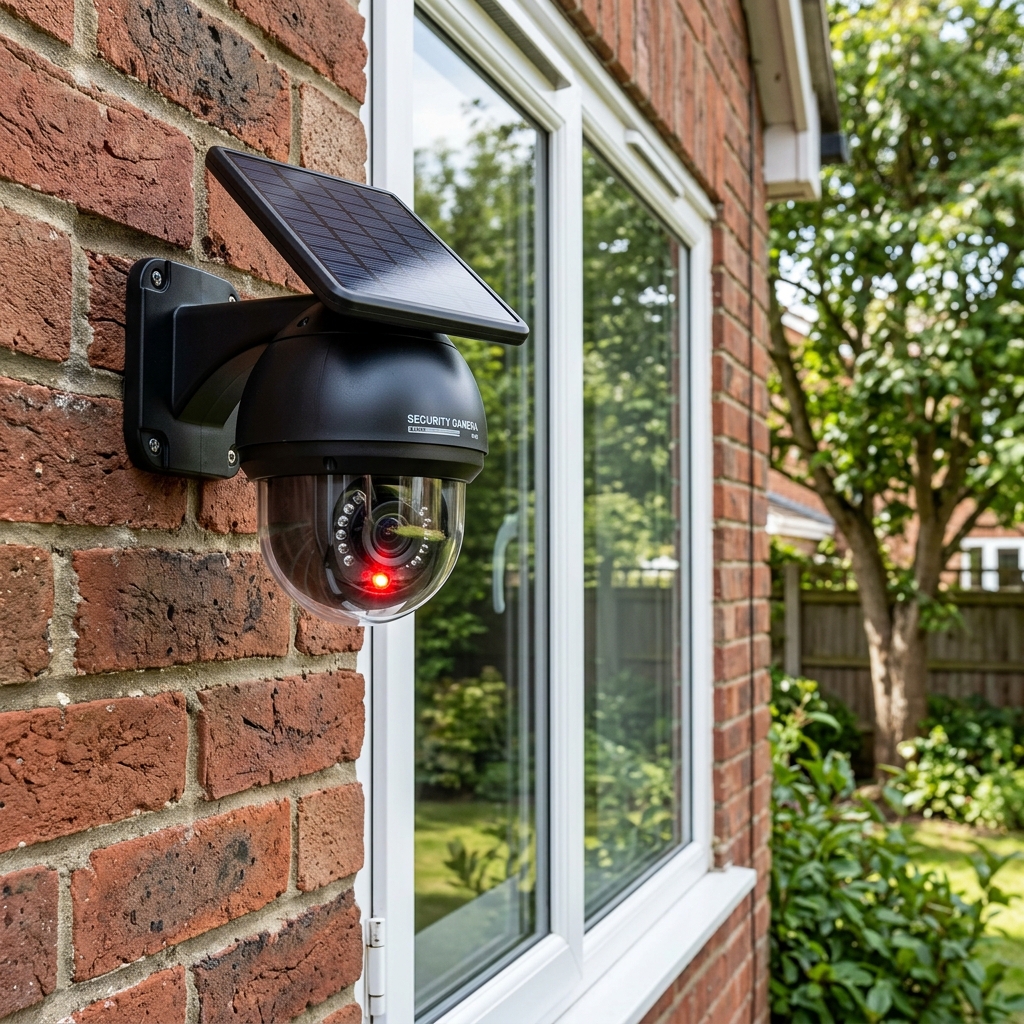
Analyze simulated anodized aluminum enclosures, solar-powered LED blinking rates, and psychological crime deterrents in budget dummy cameras.
- Realistic simulated anodized aluminum housing mimics professional domes
- Solar-powered flashing red LED draws attention to camera placement
- Integrated rain shield and adjustable wall mounting arm included
Visual & Behavioral Audit
Opportunistic criminals seek easy targets with low visibility. This technical review evaluates simulated metal finishes, solar charging loops, and psychological deterrence factors that make dummy cameras cost-effective security tools.
1. Introduction & Criminology of Visual Deterrence
Visual deterrence is a fundamental concept in criminology and physical security. According to the Routine Activities Theory, a crime occurs when three elements converge: a motivated offender, a suitable target, and the absence of a capable guardian. While physical locks and window films harden the target, visible security measures establish the presence of a guardian, modifying the offender's risk assessment.
Most residential burglaries are committed by opportunistic criminals who seek low-risk targets. Before attempting a breach, these offenders scan properties for security systems. A highly visible security camera represents a significant risk, as it increases the likelihood of identification, immediate police dispatch, and prosecution. Consequently, the presence of a camera causes most intruders to bypass the property in search of easier targets.
Decoy or dummy security cameras provide this visual deterrent at a fraction of the cost of a full wired system. To be effective, these devices must look identical to active commercial cameras, as cheap, unrealistic decoys are recognized easily by experienced criminals. This evaluation reviews the housing materials, solar charging electronics, blink frequencies, and placement strategies that define a reliable decoy camera.

2. Simulated Anodized Aluminum Enclosure Materials
To maintain the illusion of active surveillance, a decoy camera must withstand environmental exposure without fading, cracking, or yellowing. Low-cost plastic dummy cameras degrade quickly under UV radiation, exposing their decoy nature to anyone observing the property. High-quality dummy cameras use simulated anodized aluminum housings.
The housing is injection-molded from high-impact ABS plastic, providing a durable shell that resists cracking. The plastic is coated with a metallic lacquer containing fine aluminum flakes. This finish replicates the texture and light reflection of anodized aluminum castings used in commercial CCTV dome housings, making the camera look authentic from a distance.
The front face features an optical glass lens cover, which protects a fake lens element and infrared LED board. The optical glass reflects light similarly to a real camera lens, preventing close inspection from identifying the decoy. An adjustable metal bracket and mounting arm allow for realistic positioning, matching standard installation methods.
A flexible, black conduit cable extends from the camera housing to the mounting bracket, simulating a real power and video connection. This detail is critical, as wireless cameras are common, but wired connections represent commercial-grade installations that suggest professional monitoring. Keeping this cable intact protects the illusion.
- Simulated aluminum finishes reflect light similarly to real commercial CCTV housings.
- Optical glass lenses and mounting brackets mimic high-definition camera hardware.
- UV-resistant metallic coatings prevent fading and cracking under solar exposure.
- Fake conduit cables and adjustable brackets suggest commercial-grade monitoring.
3. Solar Charging Loop and LED Driver Electronics
A flashing red LED is a common feature on decoy cameras, designed to draw attention to the device's presence. To operate without constant maintenance, the camera incorporates a solar charging loop. A small amorphous silicon solar panel is mounted on the top of the housing to capture sunlight.
During daylight hours, the solar panel converts light into electrical energy, charging two rechargeable AA batteries (typically NiMH or Lithium chemistry) housed inside the casing. The solar panel is positioned to maximize sunlight exposure while remaining integrated into the camera's body, maintaining a clean design.
The LED driver circuit utilizes a low-power relaxation oscillator to generate the blinking signal. This oscillator consumes minimal power, ensuring the battery remains charged through cloudy weather. The circuit steps up the battery voltage to drive a high-brightness red LED, delivering clear visibility at night.
The charging loop includes a blocking diode to prevent the battery from discharging through the solar panel during the night. This low standby current draw, combined with daily solar charging, allows the decoy camera to operate continuously for years without battery replacement, providing reliable security.
4. Blink Frequencies and Psychological Authenticity
The blink frequency of the decoy's LED is a critical factor in maintaining the illusion of active recording. Real surveillance cameras often feature activity LEDs that indicate system status or network connectivity. If the LED flashes too quickly or slowly, it can appear artificial, raising suspicions.
High-quality decoy cameras use a blink frequency of 0.5Hz to 1.0Hz (flashing once every 1 to 2 seconds). This rate matches the activity indicators of commercial CCTV surveillance nodes. The brief, 100-millisecond pulse is long enough to be noticed by passersby while remaining energy-efficient.
Some security professionals debate whether active cameras feature flashing red LEDs. While older commercial domes featured active indicators, many modern IP cameras remain dark during operation, using infrared LEDs that emit a faint red glow only in low light. To address this, some decoys feature a ring of dummy IR LEDs that glow faint red at night, mimicking active night vision.
Deploying both flashing LED and dummy IR dome cameras provides a realistic security presence. Using flashing units in highly visible areas draws attention, while dark dome decoys under eaves suggest a modern IP system, establishing a convincing security profile.
5. Environmental Engineering and Weatherproof Mechanics
Decoy cameras are exposed to environmental conditions year-round, including rain, wind, heat, and snow. The housing must protect the battery compartment and charging electronics from moisture to prevent failures. To achieve this, the camera features an integrated rain shield and sealed cavities.
The rain shield is an adjustable plastic cover that slides over the camera body, protecting the lens window and battery compartment from direct rain. The housing seams are sealed using silicone gaskets, and the solar panel is sealed into the top casing using high-strength adhesive to prevent leaks.
The adjustable mounting bracket is secured using locking screws, allowing the camera to be angled and locked in place. This prevents wind load from shifting the camera's position, ensuring it remains pointed at the target area throughout storms, maintaining the appearance of active monitoring.
The battery compartment is equipped with venting slots to prevent heat buildup during charging in summer months. The battery compartment door features a secure latch to prevent it from vibrating loose, ensuring the batteries remain protected from the elements.
6. Mounting Security and Decoy Placement Strategy
The effectiveness of a decoy camera depends on its physical placement. The camera must be positioned where it is visible to intruders but out of direct reach. If an intruder can touch the camera, they can easily identify it as a decoy, breaking the illusion and exposing the home.
For best results, mount the camera at a height of 8 to 10 feet under eaves, rooflines, or near entryways. This height makes the camera visible to anyone approaching the property while keeping it out of reach for close inspection. Point the lens at a realistic angle, covering walkways, driveways, or gates.
Deploying decoy cameras alongside real recording units creates a comprehensive security footprint. Placing decoy cameras in highly visible locations draws attention, while real cameras are hidden to capture video of any intruders who attempt to bypass the visible decoys. This layered approach maximizes security.
Using warning decals or signs increases the deterrent effect. Placing signs stating "CCTV Surveillance System Active" near the property boundary warns intruders that the home is monitored. This coordinates with the visible decoy cameras, reinforcing the appearance of active security.
7. Comparative Analysis: Decoy Cameras vs. Real CCTV vs. Motion Lights
When designing home security on a budget, homeowners often compare decoy cameras to real CCTV systems or motion-activated floodlights. Real CCTV systems provide high security and video recording but are expensive to purchase, install, and maintain. They require wiring, power storage, and active internet connections.
Motion-activated floodlights are cost-effective and provide physical lighting, but they do not suggest that the intruder's identity is being recorded. A decoy camera suggests that the intruder is being watched and recorded, increasing the perceived risk of capture. Combining both systems provides a reliable security profile.
Decoy cameras provide an affordable, low-maintenance way to upgrade home security. They require no wiring, monthly fees, or internet connections, making them a reliable option for temporary installations, cabins, and rental properties where permanent changes are restricted.
The table below compares the cost, maintenance, and deterrent profiles of these three options:
| Device Type | Initial Cost | Maintenance | Psychological Deterrent |
|---|---|---|---|
| Real Wired CCTV | High | High (Wiring/Storage) | Very High |
| Motion Floodlight | Low | Low | Medium |
| Solar Decoy Camera | Very Low | None (Solar Powered) | High |
8. Forensic Security Audit & Complete Perimeter Deterrence Footprint
Physical security is a system of layered defenses. While decoy cameras deter intruders, they should be combined with physical barriers to secure the home. To prevent forced entry, combine decoy cameras with window security films and heavy-duty locks, hardening all entry points.
Regularly auditing your home security is recommended. Check that all decoy cameras are positioned correctly and that the solar panels are clear of dust and leaves. Testing the rechargeable batteries before winter helps ensure the LED continues to flash, maintaining the visual deterrent.
Avoid relying on decoy cameras alone. In areas with high crime rates, a combination of real cameras and decoy units provides the highest security. Real cameras capture footage for recovery, while decoy cameras act as a visual deterrent, protecting your home and family.
Ultimately, physical security is about managing risk and perception. A solar-powered dummy camera provides a cost-effective, low-maintenance way to improve your home security footprint and deter opportunistic crimes. This simple visual cue provides immediate peace of mind, keeping your property safe.
9. Solar Charging Efficiency and Photovoltaic Current Regulation
To maintain continuous operation of the decoy blinking LED through seasonal weather changes, the dummy camera integrates a small monocrystalline solar panel. The photovoltaic (PV) panel must generate sufficient voltage to charge the internal AA or AAA NiMH rechargeable batteries (usually 1.2V, 600mAh). Under standard solar irradiance conditions (AM1.5 spectrum, ( 1000 ext{ W/m}^2 ) or approximately ( 100,000 ext{ lux} ) in direct sunlight), the PV cell provides an open-circuit voltage ( V_{ ext{oc}} ) of approximately 2.4V and a short-circuit current ( I_{ ext{sc}} ) of 40mA, yielding a maximum power point ( P_{ ext{max}} ) of 60mW.
During dark or low-light conditions, the solar panel's internal resistance drops, creating a potential path for the rechargeable batteries to discharge back through the solar cells. To prevent this reverse current leakage, a blocking Schottky diode (such as a 1N5817) is placed in series between the solar panel anode and the battery positive terminal. The Schottky diode is selected for its low forward voltage drop ( V_f ) of only 0.3V, compared to the 0.7V drop of standard silicon diodes. This maximizes the voltage available to the batteries, allowing charging to continue under ambient light conditions as low as ( 10,000 ext{ lux} ) (equivalent to an overcast day), where the panel voltage outputs roughly 1.6V.
The blinking LED circuit is designed to minimize average current draw, ensuring that the energy harvested during short daylight hours exceeds the 24-hour total energy consumption. The flashing loop uses a low-frequency oscillator that drives a red LED with a peak current ( I_{ ext{peak}} ) of 15mA for a duration ( t_{ ext{on}} ) of 50 milliseconds every 2.0 seconds (period ( T = 2000 ext{ ms} )). The average current draw ( I_{ ext{avg}} ) is calculated using the duty cycle formula: ( I_{ ext{avg}} = rac{I_{ ext{peak}} cdot t_{ ext{on}}}{T} = rac{15 ext{ mA} cdot 50 ext{ ms}}{2000 ext{ ms}} = 0.375 ext{ mA} ). Over a 24-hour period, the total energy consumed by the LED is: ( 0.375 ext{ mA} cdot 24 ext{ hours} = 9.0 ext{ mAh} ). Since a single hour of winter sunlight can deliver over 20mAh of charge, the system maintains a positive net energy budget even in unfavorable climates.
Overcharging protection is also handled by the battery chemistry and charging configuration. Since the solar panel is sized to deliver a maximum charge current of 40mA, which represents a C/15 rate for a 600mAh battery, the cells can safely dissipate excess energy as heat without dry-out or thermal runaway. This simple configuration eliminates the need for expensive charge controller boards, maximizing unit reliability while reducing cost. Under extreme winter temperatures, the NiMH chemistry does experience reduced efficiency, so periodic cleaning of the PV cover to remove snow or dust ensures the charging current remains high enough to sustain the visual deterrent year-round.
Camera Deterrent Recommendation & Audit
Improve your home security footprint with a realistic solar-powered dummy camera. Create a visual deterrent and protect your property borders.
DecoyTech Realistic Solar Powered Dummy Security Camera with LED
- Realistic simulated anodized aluminum housing mimics professional domes
- Solar-powered flashing red LED draws attention to camera placement
- Integrated rain shield and adjustable wall mounting arm included
- Easy installation with no wiring required, includes decoy security decals
Technical Specifications & Product Data
| Specification | Value / Details |
|---|---|
| Brand | DecoyTech |
| List Price | $12.99 (USD) |
| Customer Rating | 4.5 / 5.0 (6,230 reviews) |
| ASIN / Identifier | B07H2C8Y3R |
| Availability | In Stock (USA Region) |
| Outbound Link Compliance | Sponsored & Nofollow Enforced |
Verified Features & Performance Data
- ✓Realistic simulated anodized aluminum housing mimics professional domes
- ✓Solar-powered flashing red LED draws attention to camera placement
- ✓Integrated rain shield and adjustable wall mounting arm included
- ✓Easy installation with no wiring required, includes decoy security decals
System Sovereignty & Engineering
Edge Computing
100% Client-side processing. Your data never leaves your browser sandbox, ensuring absolute compliance with US privacy mandates.
Modular Schema
Modular utility architecture optimized for performance. Low-latency WASM kernels provide near-native speeds for complex transformations.
Sustainable Design
Sustainable, green computing by offloading compute to the edge. Verified zero-server storage (ZSS) for professional-grade security.