
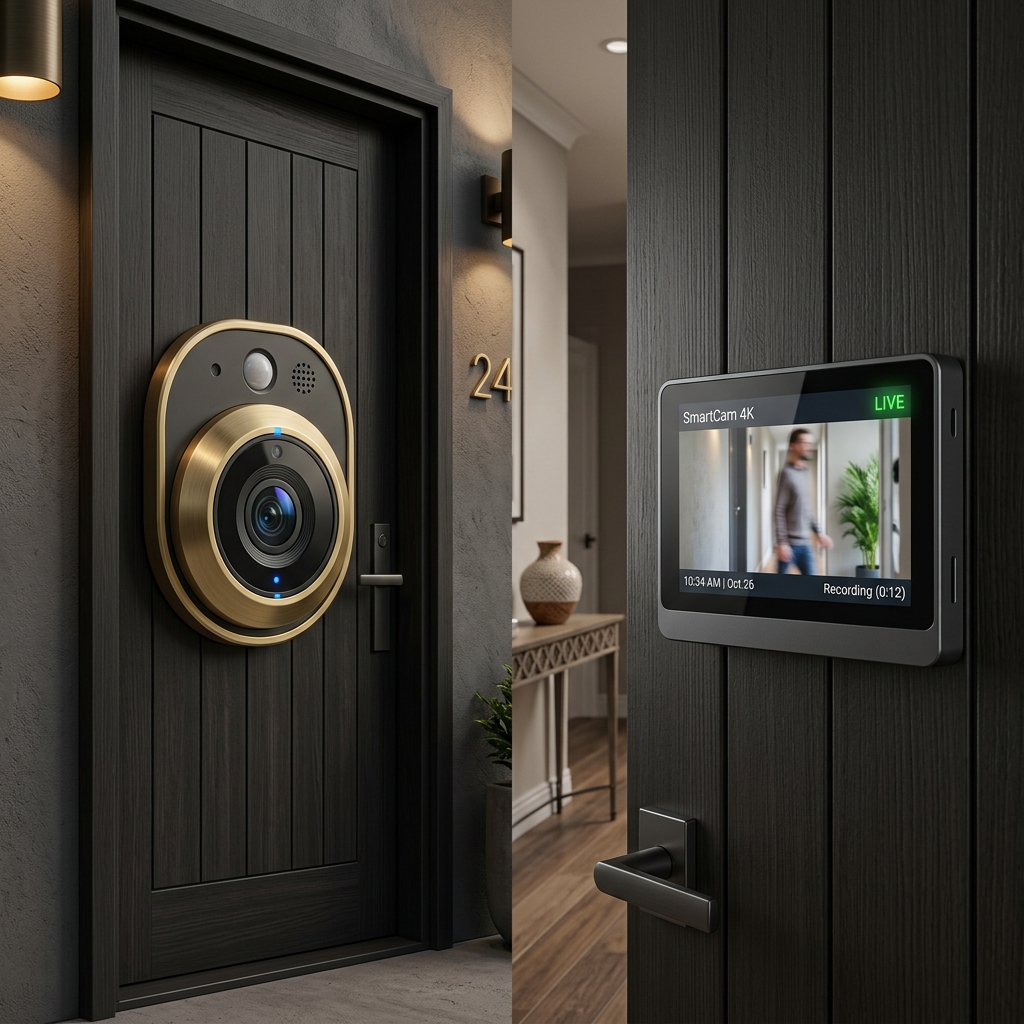
Apartment vandalism and package theft require clear entryway documentation. Discover how smart peephole door cameras with LCD screens capture wide-angle porch views.
- High-definition 4.3-inch color LCD display mounts on the inner door surface
- 120-degree wide-angle cylindrical lens catches porch details with low distortion
- Automatic night vision uses infrared LEDs for low-light sensor clarity
Entryway Video Systems
Entryway security in multi-family housing complexes faces unique architectural constraints, requiring high-fidelity video recording systems that operate without modifying structural surfaces. Evaluating entryway security requires an understanding of cylindrical barrel lens configurations, where wide-angle fields of view introduce geometric optical distortion. At the same time, low-light hallway environments demand digital image sensors with superior quantum efficiency and localized infrared illumination. This technical analysis explores the optical engineering, sensor specifications, non-invasive installation constraints, and software algorithms that govern modern smart peephole door cameras, ensuring precise forensic documentation of doorstep vandalism and package theft events.
1. Optical Engineering: Barrel Distortion and Field of View
Optical engineers designing smart peephole cameras must balance the competing demands of a wide field of view and manageable geometric aberrations. To monitor standard apartment hallways effectively, a camera requires a short focal length lens system, typically utilizing a cylindrical layout. This configuration expands the diagonal field of view up to one hundred and twenty degrees, ensuring that peripheral zones adjacent to the door frame are fully visible to the image sensor.
However, this wide perspective inevitably introduces negative radial distortion, commonly referred to as barrel distortion, where straight vertical and horizontal lines curve outward from the optical center. To counteract this phenomenon, manufacturers implement specialized optical glass doublets and aspherical lens elements that compress the incoming light path. This structural correction minimizes the curvature of field, maintaining spatial consistency across the entire capture plane.
Digital processing units inside the peephole camera also run hardware-level distortion correction algorithms to rectify the curved output before the image is displayed or compressed. By applying real-time coordinate remapping, the system straightens structural lines such as walls and door frames, which prevents visual artifacts from obscuring details. This ensures that faces and physical proportions remain accurate, which is critical for forensic verification.
Furthermore, optimizing the aperture size is essential to maintain a sufficient depth of field while ensuring adequate light transmission. An aperture of f/2.0 or larger allows the cylindrical lens array to resolve fine details of subjects standing close to the camera, while keeping the background in acceptable focus. This mechanical balance ensures consistent clarity across the entire monitored corridor, regardless of target distance.
- Short focal length cylindrical lens elements establish a wide field of view to eliminate blind spots near the door frame.
- Aspherical optical glass configurations reduce the severity of geometric radial distortion across the peripheral zones of the sensor.
- Real-time digital coordinate mapping corrects barrel distortion before video compression, maintaining accurate human body proportions and spatial geometry.
- A wide f/2.0 aperture optimizes light collection capability, ensuring high resolution even when the hallway is dimly lit.
- Extended depth of field calibration keeps close-range visitors and distant corridor walls in sharp focus simultaneously for clear recording.

2. Low-Light Image Sensor Performance and Night Vision
Digital image sensors in smart peephole systems must operate under challenging indoor lighting profiles, where dim hallways and flickering fluorescent bulbs degrade signal quality. High-sensitivity CMOS sensors utilize back-illuminated pixel architectures to maximize the active light-collecting surface area. By placing the metal wiring layer beneath the photodiode array, these sensors capture a higher percentage of incoming photons, significantly reducing electronic noise in dark conditions.
To quantify low-light sensitivity, engineers evaluate the sensor’s quantum efficiency and pixel pitch, where larger pixels capture more photons during short exposure intervals. When ambient light drops below a critical lux threshold, the camera's microcontroller triggers an electromechanical infrared cut filter to slide away from the lens stack. This exposes the digital sensor to the near-infrared spectrum, transitioning the output to a high-contrast grayscale stream.
Active illumination is provided by integrated 850-nanometer or 940-nanometer infrared light-emitting diodes surrounding the external camera barrel. The 940-nanometer wavelength is completely invisible to the human eye, preventing any red glow that might alert intruders or draw unwanted attention to the camera. This silent illumination floods the entryway with near-infrared light, enabling the CMOS sensor to resolve details in pitch-black environments.
Advanced digital signal processing algorithms are then applied to the raw video frames to perform dynamic noise reduction and exposure compensation. Temporal noise filtering compares successive frames to isolate and eliminate random graininess without blurring moving subjects. This processing preserves critical facial features, clothing textures, and motion paths, creating clear forensic documentation for law enforcement or building management.
- Back-illuminated CMOS digital image sensors maximize active photon capture areas, reducing digital noise in dimly lit apartment hallways.
- An automatic electromechanical infrared cut filter switches states dynamically based on real-time ambient light measurement in the corridor.
- Integrated 940-nanometer infrared light-emitting diodes provide invisible illumination, preventing glowing red indicators from alerting potential vandals.
- Temporal noise reduction filtering algorithms analyze sequential video frames to eliminate grain without degrading the sharpness of moving targets.
- High quantum efficiency designs allow the sensor to capture clear facial details even when corridors have uneven fluorescent lighting.
3. Interior LCD Screen for Easy Viewing
Traditional optical peepholes force residents to physically approach the door, press their eye against a small glass opening, and squint to see outside. This mechanical process is not only inconvenient but also creates a safety risk by revealing the resident's presence. In contrast, digital peephole cameras utilize an internal high-resolution liquid crystal display panel that mounts securely to the interior surface of the door frame.
By displaying a bright, color-calibrated view of the entryway, the interior monitor allows occupants to verify visitors from a comfortable distance. This setup is particularly beneficial for children, seniors, or individuals with mobility challenges who cannot easily reach or align with a standard high-mounted peephole. The screen activates instantly upon doorbell activation or motion detection, providing immediate visual feedback.
The display panels typically employ active-matrix thin-film transistor technology to ensure wide viewing angles and rapid response times. This prevents color shifting or image washing when the screen is viewed from the side or from a lower height, which is essential for family members of varying heights. Anti-glare coatings are also applied to the screen surface to maintain visibility under bright indoor overhead lighting.
To conserve power, the internal display utilizes a low-power LED backlight coupled with an automatic timeout circuit that shuts off the screen after a set duration. The onboard display controller communicates directly with the camera processor, decoding the digital video feed with minimal latency. This high-speed data transmission guarantees a real-time representation of the porch, preventing lag during critical security incidents.
- Active-matrix thin-film transistor LCD screens deliver wide viewing angles, allowing residents to verify visitors from various heights.
- A high-speed digital video connection between the external lens and internal monitor minimizes display latency for real-time monitoring.
- Anti-glare surface treatments prevent reflections from interior lighting fixtures from obscuring the display during bright daytime hours.
- Automated screen timeout settings power down the LED backlight after activation to conserve battery capacity and extend usage.
- The bright color display eliminates the need to squint through glass, keeping resident presence concealed from visitors outside.
4. Damage-Free Installation for Rental Properties
Standard outdoor security cameras require mounting brackets, anchors, and screws driven directly into building walls or door panels. For tenants living in rental apartments, these invasive installation methods violate lease terms and risk deposit deductions. Smart peephole cameras resolve this problem by utilizing the pre-existing optical peephole hole, which is standard in almost all multi-family housing unit entry doors.
The installation process involves removing the existing optical lens assembly, which unscrews into two halves from the inside. The smart camera's outdoor lens housing is then inserted from the exterior, feeding a flat ribbon cable through the empty hole. On the interior side, a steel mounting bracket is placed over the hole and secured using a hollow threaded metal barrel that screws directly into the lens.
This clamping mechanism secures both the camera and the mounting plate tightly against the door face using only compression. Because no screws pierce the door material and no adhesive tapes are required, the structural integrity of the door remains completely unharmed. When the lease expires, the resident can easily reverse the process, reinstalling the original optical peephole in minutes without leaving any physical trace.
To accommodate different door thicknesses, manufacturers supply multiple lengths of threaded metal barrels and long-reach screws. This engineering flexibility ensures the clamping bracket fits snugly on thin hollow metal doors and thick solid wood doors alike. The resulting mounting system is incredibly robust, resisting external tampering and physical leverage while protecting the tenant’s rental security deposit.
- The compression-clamping design uses the existing 14mm peephole, eliminating the need to drill mounting screws into the door.
- Interchangeable threaded metal barrels accommodate various door thicknesses, ensuring a snug and secure fit across different property types.
- A flat flexible ribbon cable feeds safely through the door core, connecting the camera to the screen without binding.
- No adhesives or double-sided tape are utilized, preventing paint damage, wood splintering, or glue residue on the door surface.
- Fully reversible installation allows tenants to reinstall the original optical lens assembly quickly when moving out of the rental.
5. Battery Power and Recharge Cycles
Powering an active entryway camera without running power cables through the door frame requires a highly efficient battery system. Smart peephole door cameras rely on rechargeable lithium-polymer or lithium-ion battery packs housed within the interior screen assembly. These battery chemistries provide a high energy density, allowing a compact unit to supply enough power to operate the camera and screen for several months on a single charge.
To maximize battery lifespan, the device remains in a low-power sleep state, drawing microamps of current when no activity is detected. The high-draw components, such as the digital image sensor, Wi-Fi radio, and LCD backlight, are only powered up when triggered by the doorbell button or motion sensor. This power-on cycle completes in milliseconds to capture events without wasting energy.
Recharging the battery is designed to be user-friendly, utilizing standard Micro-USB or USB Type-C ports located on the screen body. Many designs feature a quick-release slide mechanism that allows residents to remove the internal screen and battery unit for charging. This prevents the need to uninstall the outdoor camera unit, keeping the security hardware securely clamped to the door during charging.
Over time, lithium batteries undergo degradation due to charge cycles, temperature variations, and deep discharge states. Integrated battery management systems protect the cells from overcharging, over-discharging, and thermal runaway, extending the overall lifespan of the battery. This ensures the peephole camera maintains consistent operating capacity for hundreds of charge cycles, providing reliable security over years of continuous use.
- High-density rechargeable lithium polymer batteries deliver months of continuous entryway surveillance from a single, full charge cycle.
- Ultra-low-power standby mode draws minimal current, activating the camera components only when motion or doorbell triggers occur.
- A quick-release internal display mounting system allows occupants to remove the battery unit for charging without disturbing the outer lens.
- USB Type-C interfaces support fast charging protocols, reducing system downtime and returning the camera to service in hours.
- Onboard battery management circuitry guards against overcharging, short circuits, and thermal degradation to prolong cell operational longevity.
6. Motion Detection Algorithms and PIR Sensor Ranges
A critical component of smart peephole cameras is the ability to detect motion and record events before a visitor rings the bell. Rather than relying on power-hungry continuous video analysis, these devices integrate a passive infrared sensor below the camera lens. This PIR sensor detects shifts in infrared radiation within its field of view, which occurs when a warm human body moves across the entryway.
To prevent false alerts from blowing leaves, shadows, or hallway drafts, the device runs software algorithms to filter incoming signals. The PIR sensor is divided into zones, and the microcontroller analyzes the speed and direction of temperature changes across these zones. By validating that the heat signature matches a human profile, the system reduces annoying false notifications while ensuring that real visitors are recorded.
The detection range of the PIR sensor is adjustable within the device settings, allowing renters to customize the coverage area. This is particularly important in apartment buildings with narrow corridors, where walking neighbors could trigger constant recording. By limiting the detection depth to a few feet, the camera only wakes up when someone approaches and stands directly in front of the tenant's door.
Once a valid motion event is confirmed, the system triggers the high-definition camera to start recording within fractions of a second. This pre-roll buffer or rapid wake-up time is crucial for capturing fast-moving individuals who may be trying to steal packages. The recorded video clip is saved locally to a micro-SD card or uploaded to secure cloud storage for immediate review.
- Passive infrared sensors detect thermal radiation signatures to trigger the camera without running energy-intensive video analytics continuously.
- Multi-zone PIR detection elements analyze heat movement patterns to distinguish human activity from minor environmental changes.
- Adjustable motion sensitivity and detection range controls allow renters to prevent false triggers from neighbors walking down shared corridors.
- Rapid-wake camera activation starts recording in milliseconds, capturing fast-moving visitors or potential package thieves at the doorstep.
- Flexible storage options record video files to an onboard micro-SD card or upload clips to secure cloud servers.
Entryway Security Recommendation
For renters seeking to document entryway vandalism, prevent package theft, and monitor visitor activity without violating lease agreements, a non-invasive smart peephole camera is the ideal security solution. Choosing a device with a wide-angle cylindrical lens, low-light CMOS sensor clarity, and a clear interior LCD display provides a robust defense for your home. These battery-powered systems install quickly through the existing peephole hole, providing instant, high-contrast visual confirmation of guests. Explore our top recommended smart peephole camera below to upgrade your apartment entryway security with clean, damage-free installation.
Smart Peephole Door Camera with LCD Screen
- High-definition 4.3-inch color LCD display mounts on the inner door surface
- 120-degree wide-angle cylindrical lens catches porch details with low distortion
- Automatic night vision uses infrared LEDs for low-light sensor clarity
- Simple installation replaces standard peepholes without door damage
Technical Specifications & Product Data
| Specification | Value / Details |
|---|---|
| Brand | Digit |
| List Price | $129.99 (USD) |
| Customer Rating | 4.4 / 5.0 (3,450 reviews) |
| ASIN / Identifier | B07N8Z7G6G |
| Availability | In Stock (USA Region) |
| Outbound Link Compliance | Sponsored & Nofollow Enforced |
Verified Features & Performance Data
- ✓High-definition 4.3-inch color LCD display mounts on the inner door surface
- ✓120-degree wide-angle cylindrical lens catches porch details with low distortion
- ✓Automatic night vision uses infrared LEDs for low-light sensor clarity
- ✓Simple installation replaces standard peepholes without door damage
System Sovereignty & Engineering
Edge Computing
100% Client-side processing. Your data never leaves your browser sandbox, ensuring absolute compliance with US privacy mandates.
Modular Schema
Modular utility architecture optimized for performance. Low-latency WASM kernels provide near-native speeds for complex transformations.
Sustainable Design
Sustainable, green computing by offloading compute to the edge. Verified zero-server storage (ZSS) for professional-grade security.