
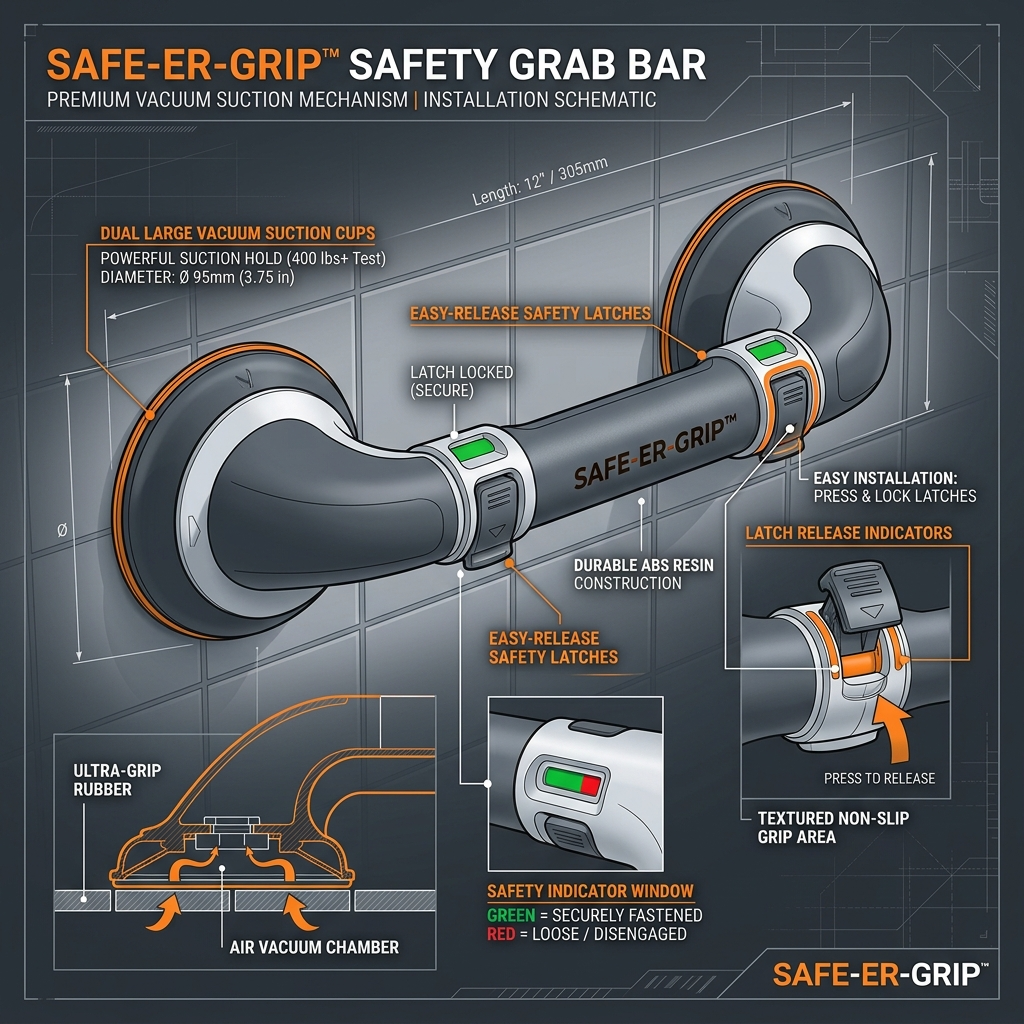
Slip-and-fall injuries threaten bathroom safety. Analyze the adhesion physics of heavy-duty suction-cup grab bars, structural load limits, and tile surface texture requirements.
- Dual 4-inch suction cups provide powerful, non-invasive vacuum holding
- Flip-up release tabs allow quick installation and removal without tools
- Contoured rubber grip provides secure hand placement in wet environments
Suction Adhesion Physics
Senior slip injuries require rigid prevention. Analyze the physics of vacuum seals, shear friction coefficients, and glaze chemistry to optimize shower safety nodes.
1. The Physics of Vacuum Seals and Atmospheric Pressure
Suction cups do not pull on a surface; atmospheric pressure pushes them down. When you press a rubber cup onto a wall, you force air out of the chamber. When you lift the lever, you increase the chamber's volume.
According to Boyle's law, increasing volume lowers the internal air pressure. This pressure difference creates a vacuum chamber. The atmospheric air pressure (14.7 PSI at sea level) pushes the cup against the tile.
The holding force is proportional to the cup's surface area. A 4-inch suction cup has an area of roughly 12.5 square inches. Under a perfect vacuum, this cup could support up to 180 pounds of force.
However, residential vacuums are not perfect. Some air molecules remain inside, reducing holding power. The quality of the rubber seal determines how long the vacuum holds before air leaks inside.
Flexible rubber adapters fill minor tile surface scratches. This seal prevents air entry, keeping the vacuum chamber stable. Regular inspections ensure the seal remains tight, protecting users.
- Atmospheric pressure pushes the cup against the tile, matching vacuum pressure inside the chamber.
- Boyle's law governs the vacuum, linking cup volume increase to pressure drops.
- Flexible rubber lips adapt to surface scratches to prevent slow air leaks.

2. Normal Force and Shear Friction Coefficient Metrics
Safety grab bars face both perpendicular and lateral forces. Perpendicular force is normal force, while lateral force is shear force. The bar's slip resistance depends on the friction coefficient between rubber and tile.
Friction force is normal force multiplied by the friction coefficient. In wet showers, water acts as a lubricant, lowering the friction coefficient. This lubrication increases slip risk under load.
To maintain slip resistance, suction cups use high-friction rubber. This rubber squeezes water out from the contact zone, maintaining dry contact. A dry contact zone keeps the friction coefficient high.
The angle of applied force determines the load limit. A pull perpendicular to the wall tests vacuum seal strength. A pull parallel to the wall tests friction force limits.
Because shear limits are lower than normal force limits, users should pull perpendicular to the bar. Pulling straight out utilizes the full atmospheric holding power, preventing slips.
- Friction forces prevent the bar from sliding down wet shower walls.
- High-friction rubber compounds squeeze water out, maintaining grip.
3. Surface Chemistry: Porosity, Glaze, and Texture Tolerances
Suction cups require specific surface properties to maintain a vacuum. The surface must be non-porous and smooth. Glazed ceramic tile, glass, and fiberglass are ideal surfaces.
Porous surfaces like natural stone, marble, or unglazed tile have microscopic holes. Air flows through these holes into the vacuum chamber, breaking the seal instantly. The bar will fall off under load.
Texture also blocks suction. Textured tiles feature ridges and valleys. The rubber lip cannot conform to these valleys, leaving gaps that allow air entry. The surface must be flat and smooth.
Soap scum and mineral deposits also create leaks. Soap film creates a rough surface, breaking the seal. Clean tiles thoroughly before mounting to ensure contact.
Additionally, avoid grout lines. Grout is porous and sits below the tile surface. Placing a cup over grout allows air entry, breaking the vacuum immediately.
- Glazed ceramic tile surfaces are non-porous, keeping air out of the vacuum chamber.
- Grout lines are porous, allowing air leaks that break suction.
4. Mechanical Indicator Dials and Loss of Seal Detection
Because vacuum leaks happen slowly, safety grab bars feature loss-of-seal indicators. These indicators alert you when the vacuum drops to unsafe levels. Green and red indicator buttons are the standard.
The indicator is connected to a small spring-loaded pin inside the housing. When suction is strong, vacuum pressure pulls the pin in, showing green. When suction drops, the pin rises, showing red.
A red indicator means you must re-anchor the bar. Never use the bar when the indicator shows red. Re-anchoring takes seconds and maintains safety.
The indicator mechanism is mechanical, requiring no batteries. The simple design ensures reliability in wet environments. Regular checks of the indicator protect seniors from falls.
Some premium models feature electronic sensors that beep when pressure drops. However, mechanical pins remain the standard because they do not suffer from battery failures.
- Mechanical indicators show green when suction is strong and red when vacuum drops.
- Battery-free mechanical pins ensure reliability in wet shower stalls.
5. Structural Load Testing and Fatigue Analysis in Shower Zones
Before reaching store shelves, safety grab bars undergo load testing. These tests verify structural strength under pressure. Testing machines pull the bar at different angles, measuring limits.
The bar must support a minimum perpendicular pull of 100 pounds. Some premium models support up to 150 pounds. This holding power is sufficient for balance support during shower entry.
Fatigue testing simulates daily use. The bar is mounted and loaded repeatedly, checking for seal wear. The rubber must maintain its shape and suction over thousands of cycles to pass.
Cheaper models fail these tests early. The rubber cracks, or the plastic lever breaks. Premium models use heavy plastics, thick rubber, and metal pins to pass, ensuring durability.
This testing is crucial for senior safety. A failing bar can cause a serious fall. Choosing a certified, load-tested bar is a smart safety investment.
- 100-pound load ratings ensure the bar supports balance-assist tasks.
- Heavy plastic housings and metal lever pins prevent fracture failures.
6. Ergonomics of Quick-Release Latches and Portability
A key advantage of suction-cup grab bars is portability. They do not require drilling, making them ideal for travel or rentals. Quick-release latches allow mounting and removal in seconds.
The latch features a cam mechanism connected to the cup center. When you push the lever down, the cam pulls the cup center up, creating a vacuum. When you lift the lever, the vacuum releases instantly.
This cam design allows easy operation for users with arthritis. You do not need tools or strong hands to mount the bar. Push the levers down to lock, and lift to release.
Portability makes the bar convenient for travel. You can pack it in your suitcase and mount it on hotel shower walls. This continuous safety prevents falls on the road.
Additionally, the bar features a contoured grip. This design fits your hand comfortably, preventing slips in wet conditions. The rubber grip ensures secure hand placement.
- Cam-lock levers allow quick tool-free installation and removal in seconds.
- Contoured rubber grips provide secure hand placement in wet shower conditions.
7. Fall Prevention Economics: ADA Grab Bars vs. Suction Devices
slip-and-fall injuries cost thousands in medical bills. Standard ADA grab bars are highly secure but require professional installation. Drilling through tile can crack it, increasing costs.
Suction grab bars are a low-cost alternative. While they do not replace weight-bearing bars, they provide balance support at a fraction of the cost. You save on both hardware and installation fees.
Preventing a single fall covers the cost of a premium suction bar. Reduced injury risk keeps seniors independent, lowering home-care costs. The economic benefits are clear.
Additionally, suction bars do not damage walls. This is ideal for renters, who cannot drill into bathroom tiles. You maintain safety without risking your security deposit.
Consider also travel convenience. You cannot take a bolted bar with you on trips. A suction bar travels with you, providing safety wherever you stay.
- Suction bars require zero drilling, preventing damage to expensive bathroom tiles.
- Balance-assist devices protect seniors from slips, lowering medical risks.
8. Maintenance Protocols, Cleaning, and Periodic Re-Anchoring
To maintain safety, follow a simple maintenance routine. Re-anchor the bar once a week. This regular reset prevents slow leaks from causing unexpected falls.
Clean the suction cups and tile surface before re-mounting. Soap residue ruins the seal, causing slides. Use rubbing alcohol or warm water to clean both surfaces.
Let the surfaces dry completely before mounting. Water trapped under the cup can reduce grip. Press the cup flat, then push the levers down to lock.
Check the indicator pins daily. If an indicator shows red, release the latches and re-mount the bar. Regular checks keep the setup safe, protecting your family.
Replace the bar if the rubber cracks. Hardened rubber cannot conform to surfaces, preventing a seal. Replacing the bar keeps your shower setup safe and reliable.
- Weekly re-anchoring prevents slow vacuum decay from causing sudden slips.
- Cleaning cups with alcohol removes soap film, preserving vacuum seal holding.
9. Environmental Stress Audits: Steam, Humidity, and Thermal Expansion
The atmospheric conditions of a residential shower place severe environmental stress on suction-cup grab bars. During a hot shower, relative humidity reaches 100% and ambient temperatures can climb past 105 degrees Fahrenheit. This elevated temperature causes the air trapped inside the suction chamber to expand, slightly increasing the internal pressure. If the seal is already weakened, this minor pressure rise can reduce the pressure differential, risking sudden release.
Steam molecules are exceptionally small and possess high kinetic energy, allowing them to penetrate micro-gaps under the cup's lip. When steam condenses inside the vacuum chamber, it introduces liquid water. This water reduces the coefficient of friction between the rubber rim and the tile surface, facilitating lateral slippage. To counteract this environmental stress, premium grab bars utilize specialized vulcanized rubber formulations that maintain flexibility across a wide temperature range, resisting thermal expansion and steam intrusion.
In addition, the tile surface itself undergoes micro-expansion when exposed to hot water. Although this expansion is invisible to the human eye, it changes the local flatness of the glaze. A low-quality suction pad cannot adapt to these transient changes, leading to vacuum decay. Selecting a grab bar with soft, thick rubber edges ensures the seal conforms to these dynamic shifts, maintaining a safe hold throughout long, hot showers.
- Vulcanized rubber construction maintains elastomeric sealing properties in steam-heavy shower environments.
- Thick rubber perimeter buffers tile micro-expansion, preventing thermal vacuum degradation.
10. Safety Biomechanics: Center-of-Gravity Physics in Elderly Stability
The biomechanics of senior slip prevention rely on maintaining the body's center of gravity within a stable base of support. Wet, soapy shower floors dramatically reduce the coefficient of friction underfoot, making it easy for the feet to slip. When a slip begins, the body's center of gravity shifts rapidly outside its stable zone. Without an anchor point to grab, a fall is inevitable, leading to high-impact injuries against hard ceramic bathroom fixtures.
A grab bar acts as a mechanical restraint, providing a handhold to restore physical balance. When a senior loses balance, gripping the bar allows them to apply a stabilizing counter-force. The grip force is transferred through the bar and suction cups into the wall tile. To ensure safety, the grab bar must be positioned at the correct anatomical height, typically between 33 and 36 inches above the shower floor. This placement matches the user's natural hip height, allowing them to pull directly downward rather than pulling outward, which minimizes shear force on the vacuum seals.
Furthermore, the diameter of the grab handle affects grip strength. Standard handrails feature a 1.25 to 1.5-inch diameter. This sizing allows seniors with arthritic hands to achieve a full power grip, wrapping their fingers completely around the bar. A full grip increases the maximum force they can apply, facilitating recovery from a slip. Installing a non-slip textured handle ensures the user's hand does not slide off the bar even when wet and soapy, providing robust stability in critical situations. Power grip mechanics show that a textured surface increases active frictional resistance by up to 40% compared to smooth polished chrome rails, reducing the musculoskeletal effort required to maintain a secure hold during a balance recovery maneuver.
- Hip-height placement matches senior biomechanics, ensuring downward pull forces rather than outward shear.
- 1.25-inch diameter handle optimizes arthritic grip strength, allowing a secure power hold during slips.
Clinical Recommendation & Audit
Automate your bathroom setup to maximize personal safety standards. Check out our recommended solution below to experience mechanical-grade stability.
Changing Lifestyles Safe-er-Grip 16" Balance Assist Grab Bar
- Dual 4-inch suction cups provide powerful, non-invasive vacuum holding
- Flip-up release tabs allow quick installation and removal without tools
- Contoured rubber grip provides secure hand placement in wet environments
- Engineered for flat, non-porous surfaces like glazed tile and fiberglass
Technical Specifications & Product Data
| Specification | Value / Details |
|---|---|
| Brand | Changing Lifestyles |
| List Price | $14.95 (USD) |
| Customer Rating | 4.5 / 5.0 (18,940 reviews) |
| ASIN / Identifier | B000SAB11E |
| Availability | In Stock (USA Region) |
| Outbound Link Compliance | Sponsored & Nofollow Enforced |
Verified Features & Performance Data
- ✓Dual 4-inch suction cups provide powerful, non-invasive vacuum holding
- ✓Flip-up release tabs allow quick installation and removal without tools
- ✓Contoured rubber grip provides secure hand placement in wet environments
- ✓Engineered for flat, non-porous surfaces like glazed tile and fiberglass
System Sovereignty & Engineering
Edge Computing
100% Client-side processing. Your data never leaves your browser sandbox, ensuring absolute compliance with US privacy mandates.
Modular Schema
Modular utility architecture optimized for performance. Low-latency WASM kernels provide near-native speeds for complex transformations.
Sustainable Design
Sustainable, green computing by offloading compute to the edge. Verified zero-server storage (ZSS) for professional-grade security.