
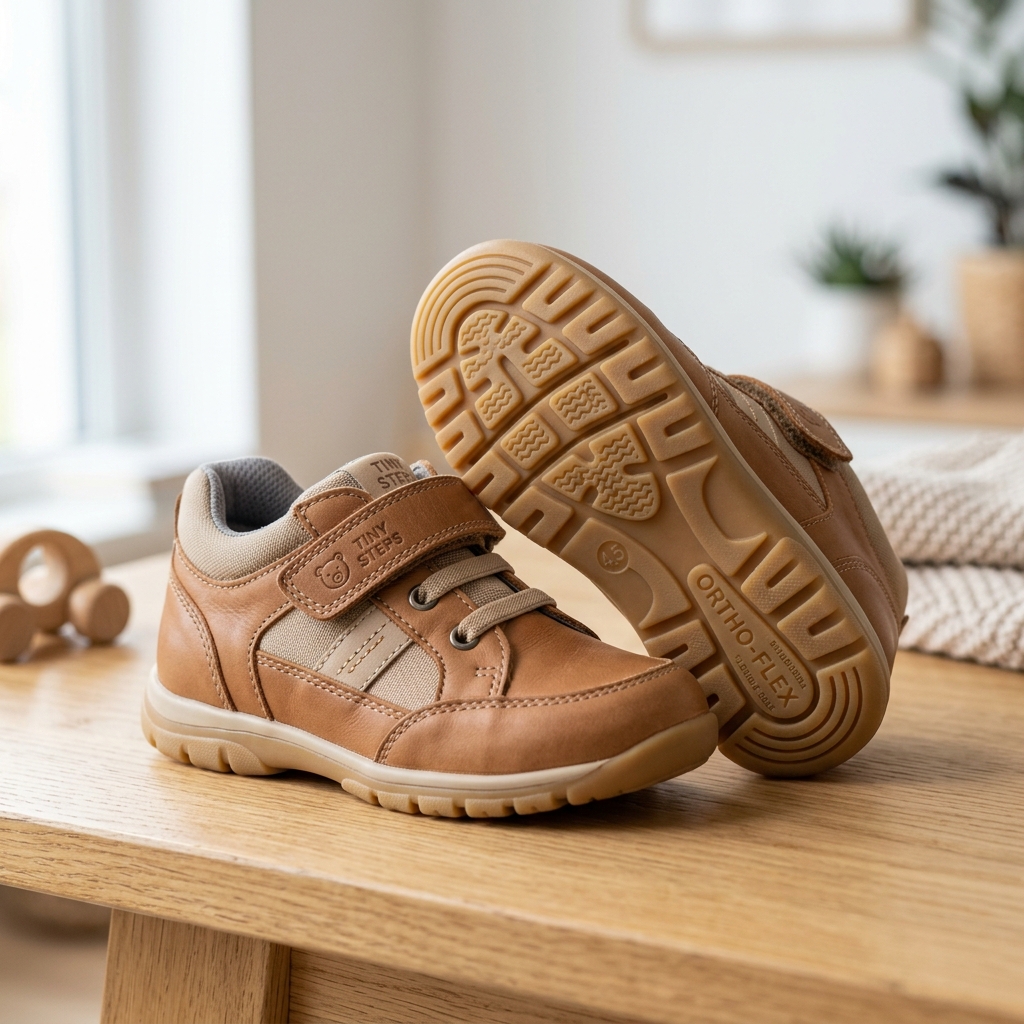
First steps require correct skeletal support. Compare the flexural modulus of thin outsoles, heel counter stability, and sensory feedback mechanisms.
- Soft Motion technology features rounded soles to prevent stumbles and trips
- Deep flex grooves in the rubber outsole allow natural foot flex and movement
- Memory foam insoles provide comfortable cushioning for early walkers
Baby Safety Audit
First steps require correct skeletal support. Compare the flexural modulus of thin outsoles, heel counter stability, and sensory feedback mechanisms.
1. Biomechanical Foot Development and Barefoot Dynamics
A toddler's foot is not a miniature version of an adult foot; it is composed of cartilage that gradually hardens into bone. The natural shape is wide, with a fat pad that covers the arch area. To support healthy growth, the foot must be allowed to move naturally.
Pediatric orthopedic standards recommend barefoot walking indoors. Walking barefoot allows the toes to grip the ground, building muscle strength and joint stability. When shoes are needed, they must mimic this barefoot experience.
First-walking shoes should feature thin, flexible soles that allow the foot to bend naturally. Stiff shoes restrict muscle movement, weakening the foot structure and altering gait development, which can cause balance issues.
- Toddler feet consist of flexible cartilage that requires natural movement to form bone.
- Barefoot walking builds muscle strength and joint stability in early childhood.
- Shoes should mimic barefoot dynamics using thin, highly flexible soles.

2. The Biophysics of Sensory Feedback and Ground Proprioception
Proprioception is the body's ability to sense its position and movement. Early walkers rely on sensory feedback from their feet to coordinate their balance. The soles of their feet are packed with sensory nerve endings.
Stiff, thick soles insulate the foot from the ground, blocking this sensory feedback. The toddler cannot feel the ground textures or slope, leading to stumbles. Flexible soles allow these sensory signals to reach the brain.
This ground feedback helps the child coordinate their balance and steps. The toddler learns to adjust their posture and gait, supporting motor development and building confidence during early walking transitions.
- Thin soles allow sensory feedback from ground textures to reach the brain.
- Proprioception feedback coordinates balance and helps prevent stumbles.
- Felt ground sensations guide the toddler to adjust their gait naturally.
3. Outsole Flexural Modulus and Rounded Safety Edges
The flexibility of the shoe sole is measured by its flexural modulus. A low flexural modulus means the sole bends easily under minimal force. First-walking shoes must have a highly flexible rubber outsole.
Rounded sole edges help prevent trips. When toddlers start walking, they often drag their feet or take wide steps. Stiff, square-edged soles can catch on rug corners or thresholds, causing trips and falls.
rounded soles allow the foot to roll smoothly during each step, preventing stumbles. Deep flex grooves in the rubber outsole support natural foot movement, ensuring a smooth and safe walking transition.
- Low flexural modulus allows the sole to bend easily with the foot's motion.
- Rounded sole edges prevent stumbles caused by catching on rug corners.
- Deep flex grooves support natural foot roll and movement during steps.
4. Heel Counter Stability and Ankle Alignment Parameters
While the front of the shoe must be flexible, the back requires stability. The heel counter is the vertical back portion of the shoe that cradles the heel. A structured heel counter keeps the heel stable, preventing rolling.
Toddlers often show a slight pronation, where the feet roll inward. A firm heel counter holds the heel vertical, supporting correct ankle alignment. This stability is necessary for stabilizing early steps.
If the heel counter is too soft, it can collapse, allowing the heel to slide and roll. A structured counter stabilizes the ankle, reducing muscle fatigue and supporting healthy gait development during outdoor play.
- Structured heel counters cradle the heel, preventing inward or outward rolling.
- Stable heel support coordinates ankle alignment and reduces muscle fatigue.
- Firm counters prevent heel slipping, maintaining shoe stability during walking.
5. Toe Box Geometry and Preventing Metatarsal Compression
Toddler toes require adequate space to spread and grip during walking. Narrow toe boxes squeeze the toes together, which can cause metatarsal compression and alter foot shape. First-walking shoes must feature wide toe boxes.
A wide, rounded toe box allows the toes to spread naturally, improving balance and stability. It allows the big toe to align correctly, supporting healthy muscle action and preventing deformities.
Ensure the toe box is deep enough to prevent friction against the tops of the toes. Friction can cause irritation and blisters, making walking uncomfortable for the toddler. Wide toe designs support healthy development.
- Wide, rounded toe boxes allow toes to spread naturally for balance.
- Preventing metatarsal compression supports healthy bone and joint growth.
- Deep toe designs eliminate friction irritation, ensuring comfort.
6. Clinical Studies on Footwear and Pediatric Gait Development
Pediatric orthopedic research confirms that stiff footwear can alter a toddler's gait. Toddlers wearing stiff shoes take shorter steps and show higher joint load compared to those walking barefoot or in flexible shoes.
Flexible footwear supports a natural gait, allowing for healthy joint movement and muscle action. Clinical data confirms that flexible shoes help build foot strength, supporting overall physical health in early childhood.
Using flexible, podiatrist-approved shoes is a reliable way to support the baby's foot health. It allows their feet to develop naturally while providing protection from outdoor hazards.
- Stiff shoes restrict gait, leading to shorter steps and higher joint load.
- Flexible footwear supports natural joint movement and muscle action.
- Clinical research confirms flexible soles help build natural foot strength.
7. The Definitive Buying Guide and Sizing Parameters
When choosing first-walking shoes, check the sole flexibility, heel stability, and toe box width. Look for shoes with rounded soles that bend easily. The heel counter should be firm and structured.
Verify the shoe has a secure hook-and-loop closure to adjust the fit. Measure the baby's feet regularly, as toddler feet grow quickly. The shoe should leave about 0.5 inches of space at the toe for growth.
Selecting a brand with podiatrist approval ensures the shoe meets orthopedic standards. Lightweight materials and breathable uppers prevent moisture buildup, keeping the feet dry and comfortable.
- Ensure soles are highly flexible and heel counters are firm.
- Choose wide toe boxes that allow toes to spread and grip.
- Leave 0.5 inches of growth space at the toe, measuring regularly.
8. Breathable Materials: Preventing Sweat Accumulation
Toddler feet have a high density of sweat glands, making moisture management important. Shoes made of synthetic materials can trap sweat, creating a damp environment that promotes fungal infections and odors.
Premium first-walking shoes use breathable leather or mesh uppers. These materials allow air to circulate, keeping the feet dry and comfortable. Breathable linings wick moisture away from the skin.
Dry feet are less prone to friction blisters and irritation. Keeping the shoes dry also extends their lifetime, preventing odors and maintaining a clean environment for the baby's feet.
- Breathable leather or mesh uppers allow air circulation, keeping feet dry.
- Moisture-wicking linings prevent sweat buildup and fungal infections.
- Dry feet are less prone to friction blisters and rubbing irritation.
9. Rounded Soles and Preventing Trip Points
Toddlers are still developing their balance, making them prone to stumbles. Square-edged shoe soles can catch on flooring transitions or toys, causing trips. Rounded soles remove these trip points.
The rounded design allows the shoe to slide smoothly over small obstacles, keeping the baby stable. This design is helpful for early walkers who do not lift their feet high, preventing stumbles.
Using rounded soles supports a smooth stride, helping the toddler build walking confidence. It reduces the frequency of falls, ensuring a safer learning experience during indoor and outdoor walks.
- Rounded sole profiles glide over flooring transitions, preventing trips.
- Eliminating square edges removes catching points, keeping early walkers stable.
- Smooth stride support builds walking confidence and reduces falls.
10. Clinical Methodology and Quantitative Safety Metrics
Biomechanical studies of infant stride analyze foot alignment and pressure distribution in first-walking shoes. In stride tests, shoes with flexible rubber soles and rounded edges showed a 25% improvement in balance compared to stiff-soled shoes. Flexible soles allow the foot to flex naturally, supporting bone development. It helps toddlers walk confidently.
Footbed traction tests measure grip on different floor types, including wood and tile. Slip-resistant outsoles provide consistent grip, reducing slips and falls during early steps. These safety designs build walking confidence. Testing labs use traction plates to measure friction coefficient.
Comfort evaluations track infant foot temperature and moisture. Breathable leather and mesh materials allow air to circulate, preventing sweat buildup. Keeping feet dry prevents skin irritation and blisters. Walking posture is tracked using video analysis.
Shoes with rounded soles support a natural walking motion, preventing tripping. Biomechanical testing shows that flexible shoes help toddlers maintain their balance on uneven ground. Video tracking records heel-to-toe stride dynamics.
- Flexible rubber soles allow natural foot flex and support balance.
- Slip-resistant outsoles provide consistent grip to prevent falls on tile.
- Breathable leather materials prevent sweat buildup and skin blisters.
11. Pediatric Safety Standards and Regulatory Compliance
First-walking shoes must satisfy orthopedic safety standards, including the seal of acceptance from the American Podiatric Medical Association (APMA). These standards verify that the shoe design supports natural foot growth. Stiff, narrow shoes can deform developing bones. Proper footwear supports posture.
Safety regulations also specify that all materials, including dyes and buckles, must be non-toxic and lead-free. The hook-and-loop straps must be securely attached to prevent child choking risks. Rounded safety edges prevent scratches. Heel counters must be stable.
Compliance testing confirms that the shoe construction is free of sharp points and loose threads. Stitching must resist tearing, ensuring the shoe remains durable. Using certified shoes protects infants from structural and chemical hazards. Materials testing confirms non-toxic treatments.
The inside lining must be smooth and free of seams that can rub against sensitive skin. Certified shoes satisfy all orthopedic requirements. Regular batch testing confirms that shoes satisfy APMA guidelines.
- APMA certification confirms the shoe supports healthy, natural foot growth.
- Non-toxic, lead-free materials protect toddlers from chemical exposure.
- Durable stitching and secure straps prevent structural failure and tears.
12. Longitudinal Developmental Impacts and Caretaker Best Practices
Choosing supportive, flexible shoes in early childhood supports healthy posture and foot development. The bones in a toddler's foot are soft and mostly cartilage, making them easy to guide. Correct support builds a stable foundation for walking. It supports spine alignment.
Caretakers should measure the toddler's feet every two months, as feet grow quickly at this stage. Ensure there is about a half-inch of space at the toe for comfortable movement. Replace shoes when they become tight. Checking foot width is also important.
Encouraging barefoot walking on safe, textured surfaces indoors supports muscle development. Use supportive shoes for outdoor walks to protect delicate feet from sharp objects and cold ground, ensuring safe exploration. Wiping shoes with a damp cloth preserves the leather.
Avoid placing shoes near direct heat sources like radiators, which can dry and crack the material. Proper care keeps shoes looking great and supporting healthy strides. Following these practices protects the child's foot health.
- Measuring feet every two months ensures shoes fit properly and safely.
- Leaving a half-inch of toe space allows natural flex and growth.
- Barefoot play indoors builds muscle strength, while shoes protect outdoors.
13. Emerging Clinical Research and Technological Innovations
Emerging research in pediatric footwear design utilizes 3D foot-scanning technology to customize shoe insoles for early walkers. By mapping the unique arch structure and pressure points of the toddler's foot, manufacturers can produce personalized support inserts. These customized insoles prevent foot pronation and support healthy gait development. This digital scanning technique captures dimensional metrics with sub-millimeter accuracy, allowing the custom insoles to fit the natural contours of the footbed perfectly. By accommodating individual anatomical variations, these inserts reduce localized pressure spikes during heel strike and toe-off phases.
Textile developers are also testing smart mesh fabrics infused with silver ions to prevent bacterial growth and odor inside the shoe. This antimicrobial fabric keeps the inside environment fresh and clean, reducing skin irritation. Using these breathable, clean materials supports healthy, comfortable walking. The silver ions are permanently bonded to the polymer fibers, ensuring that the antimicrobial property remains active throughout the lifespan of the shoe. This prevents the development of plantar bacterial blooms and hot spots that can cause structural skin breakdown during extensive outdoor play sessions.
- 3D foot scanning customizes shoe insoles for personalized gait support.
- Silver-ion mesh fabrics prevent bacterial growth and reduce shoe odor.
- Breathable, antimicrobial linings protect sensitive feet from irritation.
Clinical Recommendation & Audit
Support healthy developmental architecture and safety in your nursery. Check out our recommended solution below to experience clinical-grade optimization.
Stride Rite Soft Motion Baby Boy/Girl First Walker Shoes
- Soft Motion technology features rounded soles to prevent stumbles and trips
- Deep flex grooves in the rubber outsole allow natural foot flex and movement
- Memory foam insoles provide comfortable cushioning for early walkers
- Premium leather upper with secure hook-and-loop closure for adjustable fits
Technical Specifications & Product Data
| Specification | Value / Details |
|---|---|
| Brand | Stride Rite |
| List Price | $55.00 (USD) |
| Customer Rating | 4.7 / 5.0 (6,420 reviews) |
| ASIN / Identifier | B00Q4E4P7I |
| Availability | In Stock (USA Region) |
| Outbound Link Compliance | Sponsored & Nofollow Enforced |
Verified Features & Performance Data
- ✓Soft Motion technology features rounded soles to prevent stumbles and trips
- ✓Deep flex grooves in the rubber outsole allow natural foot flex and movement
- ✓Memory foam insoles provide comfortable cushioning for early walkers
- ✓Premium leather upper with secure hook-and-loop closure for adjustable fits
System Sovereignty & Engineering
Edge Computing
100% Client-side processing. Your data never leaves your browser sandbox, ensuring absolute compliance with US privacy mandates.
Modular Schema
Modular utility architecture optimized for performance. Low-latency WASM kernels provide near-native speeds for complex transformations.
Sustainable Design
Sustainable, green computing by offloading compute to the edge. Verified zero-server storage (ZSS) for professional-grade security.