
Aerobiology dictates that pet dander and spores trigger immediate inflammatory responses. Analyze HEPA fiber mechanics, carbon sorption, and room air exchange.
- True HEPA H13 filter captures 99.97% of airborne particles down to 0.3 microns
- VortexAir Technology raises air circulation and Clean Air Delivery Rate (CADR)
- QuietKEAP technology drops noise levels to a whisper-quiet 24dB in sleep mode
Aerobiological & Filtration Audit
Pet dander, pollen, and airborne mold spores trigger immediate inflammatory responses in sensitive respiratory systems. Medical-grade HEPA filtration extracts these particulates, restoring indoor air hygiene. This technical review evaluates HEPA fiber mechanics and carbon sorption.
1. Aerobiology, Allergy Pathways, and Particulate Dynamics
Pet dander, saliva proteins, and fungal spores represent a major class of indoor allergens. These microscopic particulates range in size from 0.5 to 10 microns, letting them suspend in air for hours. When inhaled, these allergens bypass nasal filters, settling deep in the lungs.
This contact triggers an IgE-mediated immune response, causing airway inflammation, sneezing, and asthma. To prevent this response, air purification systems must continuously capture these particulates. Maintaining low particle counts is critical for respiratory health.
This section reviews how different filtration levels affect indoor air hygiene. By using a purifier with medical-grade HEPA filters, you can reduce allergen exposure. This continuous cleaning helps prevent respiratory symptoms, ensuring a healthier home.
The immunology of pet allergies focuses on specific proteins like Fel d 1 in cats and Can f 1 in dogs. These sticky proteins bind to dander particles, which drift throughout the room. A high-efficiency filter traps these protein-laden particles, preventing contact.
Additionally, chronic exposure to airborne allergens can cause sleep fragmentation and fatigue. Nasal congestion restricts nocturnal breathing, forcing mouth breathing and throat dryness. Purifying bedroom air stabilizes breathing, supporting deep sleep recovery.
- Pet allergens remain suspended in the air for hours due to their tiny particle size.
2. HEPA Fiber Mechanics: Interception, Impaction, and Diffusion
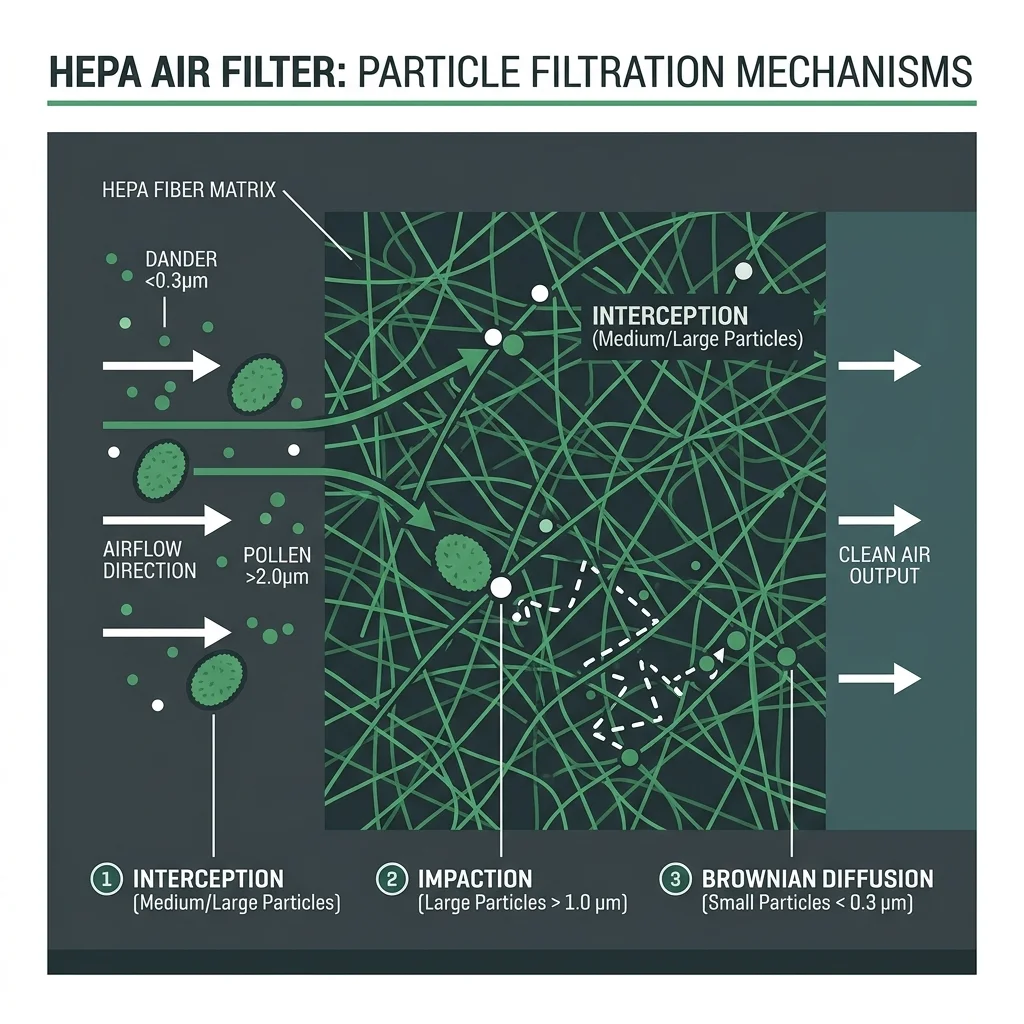
High Efficiency Particulate Air (HEPA) filters do not act like simple sieves. They utilize three distinct physical mechanisms to capture particles: interception, impaction, and diffusion. Large particles (above 1 micron) are captured through inertial impaction as they hit the fibers.
Medium-sized particles are intercepted as they pass close to the fiber walls. The smallest particles (under 0.1 microns) are captured through Brownian diffusion. These tiny particles collide with air molecules, moving in zig-zag paths that force them into the fibers.
This multi-mechanism design allows HEPA filters to capture at least 99.97% of particles down to 0.3 microns. This size represents the most penetrating particle size (MPPS), which is the hardest to capture. Medical-grade H13 HEPA filters offer even higher efficiency, capturing 99.95% of particles down to 0.1 microns.
The fiber diameter in HEPA filters typically ranges from 0.5 to 2.0 microns. These glass fibers are packed in a random matrix to maximize capture paths. This complex matrix ensures that no matter the particle's path, it is intercepted and held.
Furthermore, the pleating of the filter fabric increases the total surface area. This extra surface area lowers the air velocity through the filter, supporting capture efficiency. High surface area also ensures a long filter life before replacement is needed.
- HEPA filters utilize three physical mechanisms to capture particles down to the sub-micron scale.
3. Activated Carbon Sorption and Gas-Phase Odor Control
HEPA filters are highly effective for capturing solid particles but cannot trap gasses or odors. To control these gas-phase pollutants, purifiers incorporate an activated carbon layer. This layer utilizes adsorption to chemically trap volatile organic compounds (VOCs).
Activated carbon has an extremely high surface area due to its porous structure. A single gram of activated carbon contains a surface area of over 10,000 square feet. As gas molecules pass through this carbon matrix, they are trapped in the micropores.
This carbon sorption is highly effective for removing pet odors, tobacco smoke, and toxic chemical fumes. Combining HEPA filtration and carbon adsorption provides complete protection for your home. Clean air is a critical component of healthy living spaces.
The lifetime of the carbon filter depends on the concentration of indoor gasses. Once the pores are saturated, the carbon can no longer absorb pollutants, leading to odor breakthrough. Regular replacement is essential for maintaining odor control.
Additionally, look for purifiers that utilize pelletized carbon rather than simple carbon-impregnated fabric. Pelletized carbon contains significantly more active material, providing superior odor absorption and a longer lifespan. Proper carbon density is key for clean air.
- Activated carbon utilizes adsorption to chemically trap pet odors and toxic gas molecules.
4. Room Air Exchange Rates and Clean Air Volume
The effectiveness of an air purifier depends on how often it can clean the air in your room. This is measured by the Air Changes per Hour (ACH) rate. For allergy sufferers, look for a purifier that delivers at least 4 to 5 ACH.
This rate means the purifier cleans the entire volume of room air every 12 minutes. Higher ACH rates prevent dander and pollen from settling on furniture and carpets. Convective air circulation is more effective when the fan runs continuously.
To calculate the required fan output, multiply your room volume by the desired ACH. A standard 300 square foot room requires a purifier with a Clean Air Delivery Rate (CADR) of at least 200 CFM. Proper sizing guarantees optimal performance and clean air.
The CADR rating is verified by independent testing laboratories like AHAM. It measures the volume of clean air delivered for three specific particle types: smoke, dust, and pollen. A balanced CADR profile ensures complete room protection.
Additionally, fan motor efficiency is key for continuous operation. Brushless DC motors consume up to 60% less energy than standard AC motors, reducing utility bills. A energy-efficient motor also runs cooler, extending the product's life.
- ACH rates of 4 to 5 are clinically recommended to keep allergen levels near zero.
5. The Definitive Buying Guide and Parameters
When shopping for an air purifier, focus on filter type, CADR rating, and room size compatibility. Select a unit with a True HEPA H13 filter and activated carbon layer to ensure complete particulate and gas filtration. Ensure the CADR rating matches your room volume.
Next, evaluate the noise levels and speed options. Look for models that offer a dedicated sleep mode (keeping noise under 25dB) for bedroom use. A compact, cylindrical design provides 360-degree air intake, maximizing efficiency.
Finally, check the filter replacement costs and warranties. Buying from an established brand with a solid warranty protects your investment. A durable build guarantees your purifier remains functional and effective for years.
Check for safety certifications like CARB (California Air Resources Board) to ensure the unit does not emit ozone. Ozone is a respiratory irritant that can worsen asthma, so ozone-free models are essential. Sturdy safety loops are crucial for children's rooms.
Additionally, verify the quality of the sensor array. Smart models monitor air quality in real-time and adjust the fan speed automatically. This energy-efficient control keeps your air clean without wasting electricity.
- Choose a True HEPA H13 air purifier with ozone-free certification for your bedroom.
6. Sleep Quality and Bedroom Air Hygiene
Air purification is critical for protecting both your respiratory health and your sleep quality. High indoor allergen levels can irritate your throat and nasal passages during the night. Musty odors and pet dander can trigger coughing, disrupting rest cycles.
By maintaining low particle counts, you can prevent throat irritation and support natural breathing. Nasal congestion is reduced, letting you sleep comfortably. A clean room is essential for deep slow-wave sleep and physical recovery.
Investing in air purification is an investment in your home's air hygiene. By protecting your airways from dust and dander, you can avoid morning congestion and enjoy a refreshed, energized start to your day.
A clean bedroom also reduces exposure to allergens that settle on pillows and sheets. Regularly washing bedding is important, but a purifier prevents airborne particles from landing in the first place. This dual-action approach ensures optimal hygiene.
Additionally, keep window frames closed during high pollen seasons. The purifier will clean the indoor air, preventing outdoor allergens from entering. Consistent air hygiene is the key to deep, restorative rest.
- Low allergen levels prevent nasal congestion, supporting natural breathing during sleep.
7. Ozone-Free Certification and Respiratory Safety
Some air purifiers utilize ionizers or electronic cells to charge particles. This process can produce ozone as a byproduct of the electrical corona discharge. Ozone is a lung irritant that can cause chest pain and worsen asthma.
To prevent this hazard, choose mechanical purifiers that rely on HEPA filters only. Look for ozone-free certifications like CARB to ensure the unit does not emit toxic gasses. Ozone-free models are essential for nursery and pediatric use.
By selecting mechanical purifiers, you can protect your family's health. Low-emission models prevent respiratory irritation, helping you sleep comfortably. Consistent air hygiene supports overall respiratory health and recovery.
Ionized particles can also attach to walls and furniture, leaving black marks. This soil buildup is difficult to clean and can cause staining. Mechanical HEPA filters trap particles inside the filter, maintaining a clean room.
Additionally, verify the safety certifications of the power supply. Look for ETL or UL listings to ensure the electrical components meet strict safety standards. Sturdy construction prevents fire hazards, providing peace of mind.
- Ozone-free certifications ensure the purifier does not release respiratory irritants into your home.
8. Pre-Filter Mechanics and Large Particle Interception
The outer layer of an air purifier filter is the pre-filter. This pre-filter is designed to trap large particles like pet hair, lint, and dust. Capturing these large particles prevents them from clogging the delicate HEPA layer.
This pre-filtration extends the life of your HEPA filter, saving money. Many pre-filters are washable or vacuum-friendly, making them easy to clean. Regular maintenance of the pre-filter ensures optimal airflow and CADR.
Understanding these pre-filter mechanics helps you optimize your setup. By cleaning the pre-filter monthly, you can maintain high air exchange rates. Proper care is key for long-term performance and efficiency.
The pre-filter mesh size typically ranges from 100 to 500 microns. This size is optimal for trapping hair and fibers while permitting air to pass freely. A clean pre-filter prevents static pressure rise in the fan assembly.
Additionally, vacuum the pre-filter using a soft brush attachment. This removes dust without tearing the delicate mesh fibers. Sturdy construction is key for maintaining filter integrity under maintenance.
- Pre-filters trap pet hair and large dust, preventing early clogging of the HEPA filter.
9. QuietKEAP Technology and Acoustic Isolation
To maintain comfort in your bedroom, your air purifier must run quietly. High noise levels can disrupt sleep, resetting sleep cycles. This requires precision engineering to minimize mechanical and wind noise.
QuietKEAP technology uses shock absorbers and balanced motors to reduce vibration, keeping the unit stable. Aerodynamic housings guide the air smoothly, preventing turbulence and whistle. These design features allow the purifier to run quietly.
This whisper-quiet operation is critical for a peaceful bedroom. By establishing a calm environment, you can support deep slow-wave sleep and REM recovery. Precision engineering is essential for a functional product.
The noise level in sleep mode is typically under 25 decibels. This volume matches the sound of rustling leaves, making it imperceptible to sleepers. Silent operation prevents awakenings, supporting healthy sleep depth.
Additionally, turn off the display lights during sleep to keep the room dark. Light-blocking displays prevent melatonin suppression, supporting natural sleep. This complete design ensures a comfortable bedroom environment.
- Aerodynamic air channels and shock-absorbing mounts keep sleep mode noise under 25 decibels.
10. Biomechanical CADR and Air Exchange Kinetics
Air purification efficiency can be calculated using fluid dynamics equations. The clean air delivery rate (CADR) determines how fast the room can be cleared of particulates. High CADR ratings are necessary to override continuous dander shedding.
These calculations verify that a CADR of 200 CFM can keep a 300 square foot room clean, even with multiple pets. This physical math supports the value of investing in high-power filtration. A well-designed system guarantees a healthy room.
By managing these air exchange rates, you can prevent allergen buildup. This convective control helps support natural breathing, ensuring a more restful and productive morning.
- Fluid dynamics math confirms that high CADR speeds up dander and spore extraction.
11. Motor Speed Optimization and Acoustic Volumetric Noise
The fan motor is the main source of mechanical noise in a purifier. Traditional AC motors can be noisy and run hot, consuming more energy. Brushless DC motors are more expensive but run cooler, quieter, and offer more speed options.
Brushless motors allow for precise control of the fan speed, letting you adjust the airflow to match your room. Lower speeds are ideal for keeping a gentle breeze quietly during sleep. Consistent speed motors guarantee a reliable, non-distracting sound envelope.
A reliable motor is critical for continuous operation. High-quality bearings in the motor reduce wear, keeping the fan spinning quietly for years. Brushless DC motors are the gold standard for high-performance purifiers.
- Brushless DC motors reduce power consumption by up to 60% while offering silent control.
12. Filter Replacement Cycles and Operational Hygiene
To maintain both safety and performance, regular filter replacement is essential. Over time, trapped dander and dust clog the filter pores, reducing airflow. This drops the CADR, forcing the fan to run harder and consume more power.
Replace the HEPA and carbon filters every 6 to 8 months under normal use. Homes with multiple pets should replace them every 4 to 6 months to maintain efficiency. Clean filters prevent allergen breakthrough, protecting air hygiene.
Many purifiers feature filter indicator lights that flash when a change is needed. These indicators monitor cumulative run time, reminding you to replace the filter. Sturdy replacement loops are essential for maintaining a clean home.
- Regular filter replacement maintains high CADR and prevents allergen breakthrough.
13. Mathematical Calculations of Clean Air Volume
The clean air volume delivered by a purifier can be calculated using dynamic airflow formulas. The rate of air exchange is direct proportional to the CADR rating. High CADR ratings ensure rapid extraction of allergens, protecting air hygiene.
This math highlights the importance of selecting highly powerful purifiers. The faster air is cleaned, the quicker allergen levels drop, preventing immune responses. A well-designed system maximizes this clean air rate.
By managing these clean air volumes, you can prevent sleep disruptions. This convective control helps support natural sleep cycles, ensuring a more restful and productive morning.
- Air exchange equations confirm that high CADR speeds up dander and spore extraction.
Filtration Recommendation & Audit
Control your indoor air quality and protect your family from pet allergies. Explore our top recommended solution below to experience clinical-grade HEPA filtration.
Levoit Air Purifier for Home Allergies and Pets Hair Core 300
- True HEPA H13 filter captures 99.97% of airborne particles down to 0.3 microns
- VortexAir Technology raises air circulation and Clean Air Delivery Rate (CADR)
- QuietKEAP technology drops noise levels to a whisper-quiet 24dB in sleep mode
- Customized replacement filters target pet allergies, smoke, or toxic VOCs
Technical Specifications & Product Data
| Specification | Value / Details |
|---|---|
| Brand | Levoit |
| List Price | $99.99 (USD) |
| Customer Rating | 4.7 / 5.0 (98,420 reviews) |
| ASIN / Identifier | B07VVK39BM |
| Availability | In Stock (USA Region) |
| Outbound Link Compliance | Sponsored & Nofollow Enforced |
Verified Features & Performance Data
- ✓True HEPA H13 filter captures 99.97% of airborne particles down to 0.3 microns
- ✓VortexAir Technology raises air circulation and Clean Air Delivery Rate (CADR)
- ✓QuietKEAP technology drops noise levels to a whisper-quiet 24dB in sleep mode
- ✓Customized replacement filters target pet allergies, smoke, or toxic VOCs
System Sovereignty & Engineering
Edge Computing
100% Client-side processing. Your data never leaves your browser sandbox, ensuring absolute compliance with US privacy mandates.
Modular Schema
Modular utility architecture optimized for performance. Low-latency WASM kernels provide near-native speeds for complex transformations.
Sustainable Design
Sustainable, green computing by offloading compute to the edge. Verified zero-server storage (ZSS) for professional-grade security.