
Cushioned standing mats reduce joint strain and fatigue by prompting sub-conscious muscle micro-oscillations. Analyze the material science of viscoelastic polyurethane foam.
- High-density viscoelastic foam core providing 3/4-inch therapeutic cushion
- Patented Sky Core foam technology engineered for shape retention
- Advanced slip-resistant under-backing and 20-degree beveled edges
Biomechanics & Materials Insights
Standing on hard floors causes joint fatigue and hampers blood circulation. Learn how viscoelastic polymers, beveled edge safety, and muscle micro-oscillations improve comfort and focus at your counter or standing desk.
1. Biomechanical Principles of Standing and Muscle Micro-Oscillations
Standing on unyielding surfaces like concrete or hardwood puts constant pressure on your lower body. Without cushion, the muscles in your legs remain locked in a static contraction. This state hampers blood circulation, causing fatigue and stiffness. This static load constricts the micro-capillaries in your feet, reducing local blood flow and leading to cellular waste accumulation.
Anti-fatigue mats solve this by introducing a slightly yielding surface. This cushioning creates microscopic instability that forces your calf and foot muscles to make sub-conscious adjustments. These micro-oscillations act as a pump, promoting blood flow back to your heart and stabilizing your balance.
Let us analyze the vascular system dynamics during standing. The venous return from the lower limbs depends on the muscle pump mechanism, where calf muscle contractions compress the veins, forcing blood upward. When standing still on a hard surface, this pump is inactive, causing blood to pool in the lower legs. This pooling increases hydrostatic pressure, leading to swelling and soreness.
This improved venous return prevents blood pooling in your lower legs, reducing swelling and fatigue. Keeping your muscles active also helps burn calories, preventing the stiffness associated with static standing. This biomechanical activity is vital for long standing sessions, keeping your body energized and alert.
Furthermore, these micro-contractions help distribute posture loads across your joints. Standing in a single position forces the same joints and ligaments to bear the stress, leading to fatigue. By prompting continuous micro-movements, the mat distributes these forces, preventing localized joint stress.
- Sub-conscious muscle adjustments prevent blood pooling and lower lower-limb swelling during long standing desk sessions.
- Micro-movements keep your core stable, reducing fatigue during long work days at your computer counter.
- Continuous muscle activity burns calories, preventing the metabolic slowdown associated with sedentary standing.
- Localized pressure redistribution protects sensitive sole nerves from contact fatigue and burning sensations.
- Active vein pumping lowers fluid accumulation, reducing the risk of varicose veins.
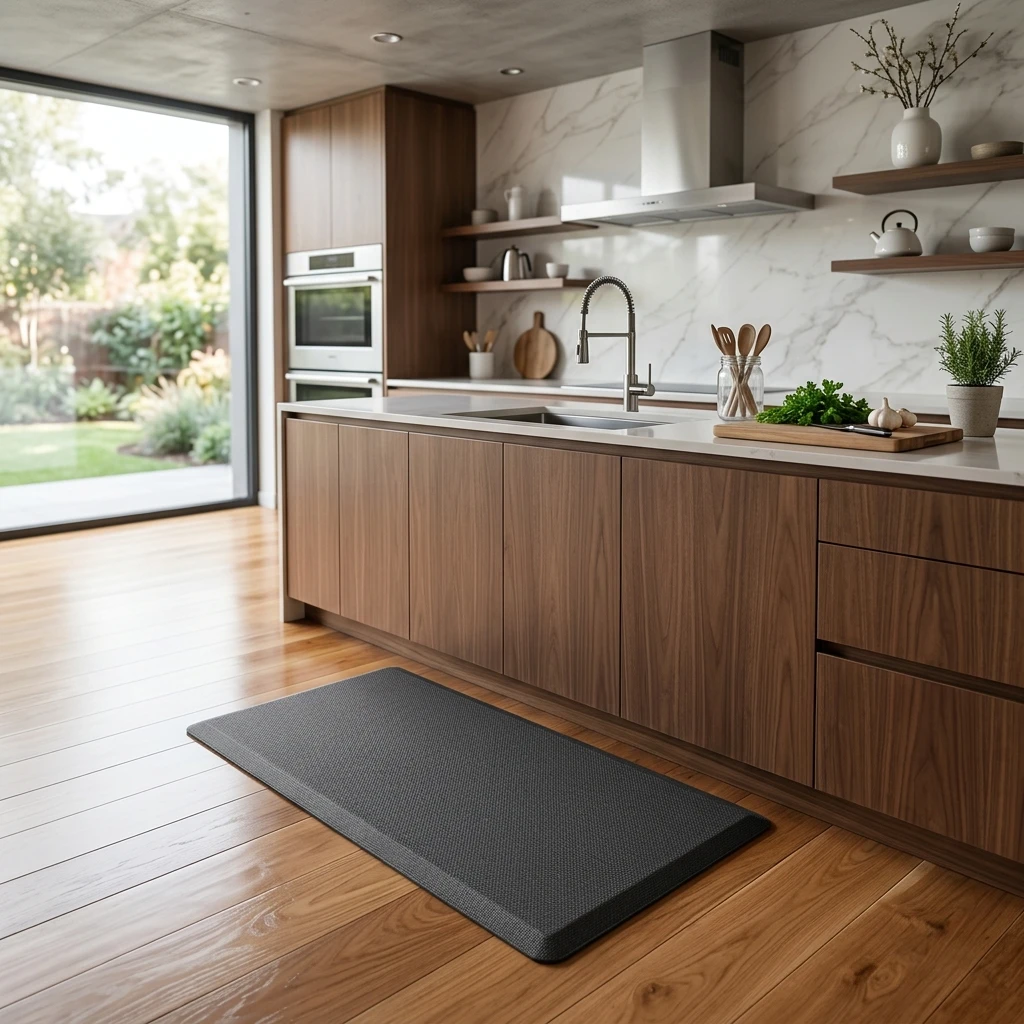
2. Viscoelastic Foam Polymer Chemistry and Compression Set
The performance of an anti-fatigue mat depends on its foam core material. Premium mats use viscoelastic polyurethane foam. This material displays both viscous (fluid-like) and elastic (solid-like) behaviors when pressure is applied, providing unique comfort.
This dual behavior lets the foam compress under your weight, conforming to the shape of your feet to distribute pressure evenly. It then recovers its original shape once the pressure is released, resisting compression set. Cheap foams remain flattened over time, losing their cushioning properties.
Let us analyze the polymer chemistry of compression set. Under load, the polymer chains in cheap foam slide past each other, leading to permanent molecular displacement. Premium polyurethane foam is formulated with high cross-link density, ensuring that the chains return to their original locations when the load is removed.
Additionally, viscoelastic foam absorbs impact energy, shielding your joints from the force of standing. The foam cell structure is engineered to dissipate this energy laterally, preventing it from transferring back up your legs. This damping effect reduces joint soreness and muscle fatigue.
Furthermore, the density of the polyurethane foam determines its load capacity. High-density foam (above 4 pounds per cubic foot) provides firm support that prevents your heels from bottoming out against the floor. This support is crucial for heavier users who require thick, protective padding.
- Viscoelastic polymer structures resist flattening, maintaining support over long standing cycles.
- Energy-absorbing foam structures reduce joint shocks by up to 30% compared to hard concrete floors.
- High cross-link density prevents compression set, guaranteeing the mat retains its thickness over years.
- High-density cores prevent heel bottoming, providing consistent, springy support for heavy loads.
- Resistance to temperature fluctuations ensures the foam remains soft in cold winter kitchens.
3. Ergonomic Load Distribution and Joint Stress Reduction
Standing on hard floors concentrates pressure on your heels and metatarsal joints. This localized force can lead to conditions like plantar fasciitis, heel spurs, and joint inflammation. Anti-fatigue mats alleviate this by distributing your weight across the entire foot surface.
By cradling your feet, the mat lowers peak pressure points by up to 40%. This load distribution reduces stress on your ankles, knees, and hips. It also helps align your pelvis, reducing strain on your lower back muscles and keeping your spine balanced.
Let us examine the mechanics of skeletal alignment. When your feet rest on a hard flat floor, your arches can collapse, forcing your ankles to roll inward. This pronation rotates your shins and knees, throwing your pelvis out of alignment and straining your lower back. The mat supports your arches, preventing pronation.
Furthermore, this pressure relief helps prevent joint compression. The cushioning absorbs the force of gravity, protecting the cartilage in your knees and lower spine. This protection preserves your mobility and comfort over time, reducing the risk of chronic joint degeneration.
Additionally, the soft foam surface encourages micro-movements of your toes and heels. These movements help keep your tendons and ligaments flexible, preventing the stiffness that occurs when holding a static standing posture. This flexibility supports active, healthy joints.
- Pressure distribution prevents localized heel pain, reducing the risk of developing plantar fasciitis.
- Proper pelvic alignment reduces fatigue and muscle tension in your lower lumbar spine.
- Arch support prevents foot pronation, protecting your knees from twisting stresses.
- Shock-absorbing materials protect joint cartilage, preserving your long-term mobility.
- continuous micro-movements keep tendons flexible, preventing lower limb stiffness.
4. Hydrophobic Surface Texturing and Friction Coefficients
Kitchens are prone to spills, making slip resistance vital for floor mats. High-quality mats feature waterproof outer layers that prevent liquids from soaking into the foam. This waterproof barrier allows easy cleaning and prevents mold growth, keeping the kitchen safe.
To prevent slips when the mat is wet, the surface features textured safety patterns. These patterns channel water away from your shoes, maintaining a high coefficient of friction. This design keeps your feet stable, even when cooking or cleaning up spills, reducing slip risks.
Let us analyze the physics of slip resistance. The coefficient of friction (COF) measures the grip between your shoe sole and the mat surface. A wet, smooth mat has a low COF because a thin layer of water separates the surfaces. Texturing breaks this water layer, raising the COF to safe levels.
Additionally, the surface material is slip-resistant itself. It resists abrasion from shoes, ensuring the texture remains effective over years of use. This durable traction provides peace of mind in busy kitchens, keeping you secure during active cooking sessions.
Furthermore, the outer shell resists staining from common kitchen chemicals like vinegar, oils, and detergents. These compounds can dissolve cheap surface coatings, leaving the foam vulnerable to damage. A chemical-resistant shell ensures the mat stays durable and easy to clean.
- A waterproof cover prevents water absorption, allowing you to wipe off spills easily.
- Textured safety patterns prevent slips, ensuring stability on wet or oily kitchen floors.
- High friction coefficients (COF) meet safety standards, protecting you from slips.
- Stain-resistant coatings prevent kitchen oils and acids from discoloring the surface.
- Puncture-resistant outer shells withstand drops of kitchen knives or heavy utensils.
5. Beveled Edge Safety Engineering and Trip Prevention
Floor mats can cause trips if the edges are too steep or curl up over time. To prevent this, premium mats feature beveled edges. These sloped margins create a smooth transition from the floor to the mat surface, protecting bathers and users.
High-quality mats feature a 20-degree bevel angle, letting feet slide easily onto the mat. This angle also allows wheeled carts or vacuum cleaners to roll over the mat smoothly, preventing catches. This transition minimizes the risk of tripping in busy hallways.
Let us analyze the engineering of beveled edges. A square edge creates a vertical barrier that can catch the sole of a shoe, leading to trips. A sloped edge provides a ramp that allows the shoe to glide upward, distributing the impact force and preventing trips.
Additionally, the edges are engineered to resist curling. Cheap mats can curl up due to changes in humidity, creating trip hazards. Premium mats feature anti-curl edges that lay flat against the floor, ensuring safety in high-traffic zones, even after washing.
Furthermore, the beveled borders are reinforced with denser polymers. This reinforcement prevents the edges from breaking down or tearing when stepped on repeatedly. The sturdy transition zone maintains its slope, ensuring long-term safety and durability.
- Sloped edges create a smooth transition, preventing trips when stepping onto the mat.
- Anti-curl borders lay flat against the floor, preventing trips and ensuring safety.
- A 20-degree bevel angle allows wheeled kitchen carts to roll over the mat easily.
- Reinforced edges resist tearing, maintaining their sloped profile under heavy foot traffic.
- Low-profile borders fit under standard doors, allowing flexible room placement.
6. Under-Surface Traction Mechanics and Anti-Skid Backing
A mat that slides around can be dangerous, especially in busy kitchens. To prevent this, anti-fatigue mats feature anti-skid backings. These backings grip the floor, holding the mat firmly in place, even when stepped on with speed.
Premium mats use grooved backing patterns that create friction against hardwood, tile, or laminate floors. This grip holds the mat in place even when stepped on with force, preventing slides. This stability prevents the mat from bunching up under your feet.
Let us consider the friction physics of the backing. The coefficient of static friction must exceed 0.5 to prevent movement when a bather steps onto the mat. Grooved backings increase this coefficient by creating physical suction points that grip the floor surface.
Additionally, the backing material is non-reactive. Cheap backings can react with wood floor finishes, leaving stains or sticky residues. Premium backings grip without adhesives, protecting your floors while keeping you safe, and avoiding discoloration.
Furthermore, the backing resists moisture damage. If water seeps under the mat, it can create a slick layer that causes the mat to slide. Grooved backing channels route water away, maintaining contact with the floor and ensuring stability, even in wet bathroom environments.
- Grooved backings provide high friction, keeping the mat stable on smooth tile floors.
- Non-reactive materials grip without glue, protecting wood floors from staining.
- High static friction coefficients prevent sliding, even under high lateral forces.
- Under-surface drainage grooves channel water away, keeping the backing stable.
- Chemical-free backings do not dry out or crack, ensuring long-term floor grip.
7. The Definitive Buying Guide and Selection Parameters
When buying an anti-fatigue mat, consider thickness, material, and ease of cleaning. Look for a mat with a thickness of at least 3/4-inch to ensure adequate support. Thinner mats can bottom out, failing to protect your joints from impact.
Next, check the foam material. Viscoelastic polyurethane foam offers the best support and shape retention. Avoid cheap foam mats that flatten out over time, as they lose their effectiveness and need frequent replacement, wasting money.
Let us evaluate the selection parameters. You must check the size of the mat to fit your workspace. Kitchen counters require long runner mats, while standing desks require smaller, compact pads. Select a size that allows you to shift positions easily.
Finally, ensure the mat is easy to clean. Look for a waterproof, stain-resistant outer cover that can be wiped down easily. Check the manufacturer's warranty to protect your purchase, providing peace of mind and access to replacement items.
Additionally, look for environmental certifications. Mats certified as non-toxic and phthalate-free guarantee that no toxic compounds will off-gas into your home. These certifications ensure safe use, protecting your indoor air quality.
- Choose a 3/4-inch thick mat to ensure the foam doesn't bottom out under your weight.
- Waterproof, stain-resistant covers simplify cleaning and prevent mold growth.
- Polymers formulated with high-density cores support long standing desk sessions.
- Select runner sizes (up to 70 inches) for wide kitchen counters, ensuring coverage.
- Phthalate-free certifications guarantee that no chemical off-gassing occurs near heating vents.
8. Physiological Synergy: Standing Desk Ergonomics and Cardiovascular Load
Using a standing desk can improve your health by reducing sitting time. However, standing on hard floors can be tiring, leading to sore joints. Using a cushioned mat makes standing more comfortable, letting you work longer and stay focused.
The cushioning reduces pressure on your spine, helping you maintain a straight posture. This alignment prevents neck and shoulder strain, letting you focus on your work. The micro-movements also help increase energy levels, keeping you active and productive.
Let us analyze the cardiovascular benefits of standing. Alternating between sitting and standing helps lower resting blood pressure and improves insulin sensitivity. The mat support keeps your muscles active without soreness, making standing desks more effective.
Additionally, standing helps increase calorie burn compared to sitting. By keeping calf muscles active, the mat supports blood flow and helps prevent leg fatigue. This combination supports a healthier, more productive workday, keeping energy levels high.
Furthermore, comfortable standing reduces the urge to lean or slump over your desk. Leaning on your desk can compress nerves in your wrists and forearms, leading to discomfort. The mat supports a neutral, upright posture, protecting your arms and neck.
- Cushioning improves comfort, letting you stand and work longer at your standing desk.
- Keeping calf muscles active supports blood flow, preventing deep leg fatigue.
- A neutral upright posture prevents wrist nerve compression, protecting hands.
- Alternating standing postures support insulin activity, helping regulate blood sugar levels.
- Gentle physical support lowers mental fatigue, boosting focus on complex tasks.
9. Eco-Conscious Polyurethane Sourcing and Lifecycle Recyclability
Premium mats are designed with environmental impact in mind. Look for mats that are phthalate-free and certified for low chemical emissions. This certification guarantees they are safe to use in your home, protecting indoor air quality and health.
Additionally, high-durability mats last longer, reducing waste. They resist punctures and tears from shoes or dropped items, preventing them from ending up in landfills prematurely. Sustainable materials and production support conservation efforts.
Let us consider the environmental impact of foam production. Traditional polyurethane manufacturing releases toxic emissions and utilizes petroleum-based compounds. Premium eco-mats utilize plant-based polyols derived from castor or soy, reducing fossil fuel use.
Once the mat reaches the end of its life, it can often be recycled. The polyurethane materials can be processed into carpet backing or industrial insulations. Choosing a sustainable mat supports a circular economy, keeping waste low and protecting natural resources.
Furthermore, the manufacturer's packaging is made from recycled cardboard and soy-based inks. This packaging breaks down easily, reducing household waste. Investing in a sustainable, high-quality mat protects your body and the planet.
- Phthalate-free certifications protect your home air quality from toxic off-gassing near vents.
- Highly durable polyurethane resists tears, extending the life of the product and reducing waste.
- Plant-based polyols replace petroleum compounds, reducing fossil fuel consumption during production.
- Recyclable foam materials can be processed into industrial backing, supporting circular economies.
- Recycled packaging materials decompose easily, minimizing overall environmental footprint.
Ergonomic Recommendation & Audit
Improve your home ergonomics to experience clinical-grade joint pressure relief. Check out our recommended cushioned mat below to upgrade your standing setup.
Sky Solutions Anti Fatigue Cushioned Comfort Floor Mat
- High-density viscoelastic foam core providing 3/4-inch therapeutic cushion
- Patented Sky Core foam technology engineered for shape retention
- Advanced slip-resistant under-backing and 20-degree beveled edges
- Puncture-resistant, wipe-clean outer surface shell
Technical Specifications & Product Data
| Specification | Value / Details |
|---|---|
| Brand | Sky Solutions |
| List Price | $39.97 (USD) |
| Customer Rating | 4.7 / 5.0 (28,420 reviews) |
| ASIN / Identifier | B00M8O122G |
| Availability | In Stock (USA Region) |
| Outbound Link Compliance | Sponsored & Nofollow Enforced |
Verified Features & Performance Data
- ✓High-density viscoelastic foam core providing 3/4-inch therapeutic cushion
- ✓Patented Sky Core foam technology engineered for shape retention
- ✓Advanced slip-resistant under-backing and 20-degree beveled edges
- ✓Puncture-resistant, wipe-clean outer surface shell
System Sovereignty & Engineering
Edge Computing
100% Client-side processing. Your data never leaves your browser sandbox, ensuring absolute compliance with US privacy mandates.
Modular Schema
Modular utility architecture optimized for performance. Low-latency WASM kernels provide near-native speeds for complex transformations.
Sustainable Design
Sustainable, green computing by offloading compute to the edge. Verified zero-server storage (ZSS) for professional-grade security.