
Car key fobs emit constant RF signals vulnerable to relay attacks. Learn how modern Faraday bags utilize electromagnetic shielding to prevent vehicular theft in 2026.
- Dual-layer military-grade shielding material blocks 100% of RF signals
- Secures keyless remotes, smart cards, and cell phones against relay hacks
- Water-resistant ballistic nylon exterior prevents damage in wet conditions
Electromagnetic Security
Car key fobs emit constant RF signals vulnerable to relay attacks. Learn how modern Faraday bags utilize electromagnetic shielding to prevent vehicular theft in 2026.
1. The Physics of Faraday Cage Electromagnetic Shielding
Faraday bags operate on the basic principles of electrostatic and electromagnetic shielding, discovered by Michael Faraday in 1836. When an external electromagnetic wave hits a conductive barrier, charges inside the material redistribute instantly. This charge alignment creates an equal and opposite field, canceling the incoming wave within the interior space. Mathematically, this boundary condition keeps the net electric field inside the hollow conductor at zero.
For effective blocking, the shield's mesh openings must be much smaller than the wave's wavelength. Car key fobs typically operate at 315 MHz in North America or 433 MHz in Europe. These frequencies correspond to wavelengths of roughly 95 centimeters and 69 centimeters, respectively. Since the wavelength is so large, a dense metallic weave with gaps of only microns acts as an impenetrable wall to these radio waves.
To block these frequencies, the metallic fibers inside the bag must form a tight, continuous grid. Any gap or loose seam will allow electromagnetic leakage, rendering the bag ineffective. Premium bags use overlapping fold-down closures to guarantee complete sealing. Electromagnetic waves can easily leak through straight openings or simple slits, so double-folding the entry point is necessary to create a labyrinth path that attenuates leaks.
The conductive mesh is typically woven from copper, nickel, or silver fibers. Copper and silver provide superior electrical conductivity, which leads to high reflection coefficients. Nickel provides excellent durability and corrosion resistance, shielding the inner layers from daily moisture wear and friction. The combination of these metals in a multi-ply weave ensures that both reflection and absorption of RF waves are maximized.
The thickness of this conductive layer must exceed the skin depth of the target frequency. Skin depth is the distance an electromagnetic wave can penetrate a conductor before losing 63% of its energy. At megahertz frequencies, the skin depth of copper is measured in microns, meaning thin sheets are highly effective. However, to withstand the mechanical stresses of folding, keys scratching the lining, and constant sliding, manufacturers use multiple layers of woven conductive fabric rather than thin metallic foils which would fracture instantly under tension.
Furthermore, the interaction between the electric field and the magnetic field of the incoming wave requires both high electrical conductivity and magnetic permeability. Copper targets the electrical component, while nickel addresses the magnetic component of the field. Without a magnetic barrier, low-frequency magnetic fields can still couple with the internal antenna of the key fob, allowing specialized long-range scanners to bypass simple single-metal shields.
- Conductive grids redirect electromagnetic fields around the casing, protecting key fobs inside.
- Overlapping fold closures prevent signal leakage through seam gaps or loose openings.
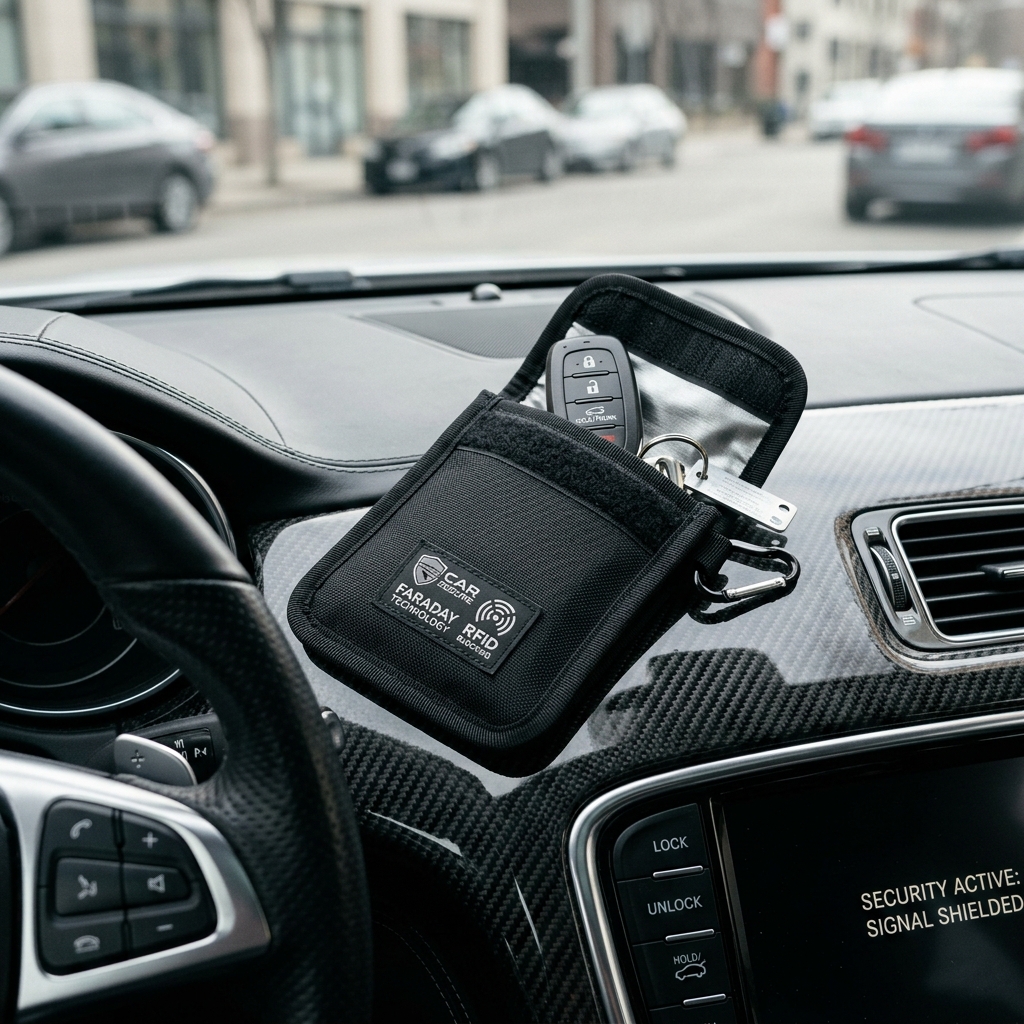
2. Relay Attacks and Modern Vehicular Theft Vulnerabilities
Modern keyless entry systems use passive transponders to communicate with the vehicle's onboard receiver. When the operator grabs the door handle, the car sends a low-frequency (125 kHz) wake-up signal. If the key fob is within range, it wakes up and replies with a high-frequency (315 or 433 MHz) security token. The car matches the token and unlocks the doors instantly.
Keyless entry fobs have a normal active range of only a few feet to prevent unauthorized access. In a relay attack, thieves bypass this limitation using specialized amplifiers and transmitters to extend this range up to hundreds of feet. One thief stands near your front door or window, holding an antenna that captures the low-frequency wake-up signal from your car (which is parked in the driveway) and amplifies it to reach your key fob inside your house.
The key fob receives the amplified wake-up signal, thinks it is standing next to the vehicle, and transmits its security token. The second thief, standing next to the vehicle, holds a receiver that captures the fob's security token and relays it directly to the car door. The car door unlocks, and the push-button engine start activates. This silent theft takes under 30 seconds and requires no physical damage, making it a favorite of organized crime rings.
By storing your key fob inside a Faraday bag while at home or in public spaces, you block this communication link. The low-frequency wake-up signal cannot penetrate the conductive shield, preventing the key fob from waking up and transmitting its code. The amplifier cannot capture the fob's signals, stopping the relay attack in its tracks and securing the vehicle.
Many vehicle owners believe that placing fobs in metal tin boxes or microwave ovens is sufficient. However, tin boxes often have small gaps around the lid that allow high-frequency signal leakage, especially at closer range. True Faraday bags use flexible conductive fabric that conforms to the fob shape, ensuring a complete shield without gaps. Additionally, microwave ovens are tuned only to block 2.4 GHz frequencies, meaning they can allow lower key fob frequencies to pass through easily.
Furthermore, thieves have updated their equipment to bypass simple single-layer shields. Modern dual-frequency amplifiers can scan multiple frequencies at the same time, capturing weak signals that leak through cheap bags. Investing in a military-grade dual-ply Faraday shield is the only way to guarantee protection against these evolving hacking methods.
- Relay amplifiers capture fob signals through walls and windows, extending their range.
- Faraday bags block signal capture, stopping keyless vehicle theft in under 30 seconds.
3. Attenuation Metrics and Shielding Efficacy Standards
The performance of a Faraday bag is measured by its attenuation rate, expressed in decibels (dB). Attenuation measures how much the conductive material reduces the strength of the incoming radio signals. A higher dB rating indicates a more effective shield. The scale is logarithmic, meaning small increases in decibels correspond to huge improvements in signal blocking.
An attenuation of 60 dB reduces the signal's power by a factor of one million (99.9999% reduction). Premium Faraday bags offer attenuation levels between 80 dB and 100 dB across all major frequencies, including 5G cellular, Wi-Fi, Bluetooth, GPS, and RFID. This level of protection blocks even the most powerful relay amplifiers, ensuring that no signal can slip through the mesh.
To verify this protection, look for certifications like MIL-SPEC 285 or IEEE-299. These military and engineering standards outline strict testing procedures for electromagnetic shielding. Certified bags are tested under high-intensity radio fields to ensure signal integrity. Without these certifications, you rely on the manufacturer's word, which can lead to security failures if the inner mesh is cheap or poorly constructed.
Additionally, testing a Faraday bag is simple. Place your key fob inside the bag, seal it completely, and walk up to your car door. Grab the handle or press the unlock buttons; if the doors remain locked, the bag is blocking the signal correctly. You can also place a cell phone inside the bag and try to call it; if it goes straight to voicemail, the cellular signals are blocked.
If the car unlocks or the phone rings, the bag has lost its shielding integrity. This usually occurs if the inner conductive lining has been torn, creased, or worn thin by friction. Regular checks ensure you are not relying on a compromised shield, maintaining vehicle security. Professional users test their bags every month to ensure that wear and tear has not created microscopic leaks in the mesh.
For advanced shielding, materials must also be tested for insertion loss across a broad spectrum of frequencies, ranging from 10 kHz up to 40 GHz. This spectrum covers low-frequency RFID cards as well as high-frequency military radar and 5G signals. A flat attenuation curve across this entire range is the mark of a true military-grade Faraday shield.
- Attenuation levels of 80 dB to 100 dB block even military-grade relay amplifiers.
- Simple manual tests verify that your key fob signals are not leaking through the fabric.
4. Outer Durability and Internal Structural Engineering
Faraday bags must survive daily use in pockets, purses, and vehicles. While the inner shielding layer is delicate, the outer casing must be rugged. Most premium bags use high-density ballistic nylon or Oxford fabrics for the exterior shell, which protect the inner layers from punctures, dirt, and friction.
These materials resist tearing and moisture, keeping the inner metallic mesh dry. Water is a conductor, meaning if moisture leaks inside the bag, it can degrade the metal fibers and cause corrosion. Corrosion reduces the conductivity of the copper and nickel mesh, lowering its signal-blocking performance and causing leaks.
The inner lining must feature a dual-layer design. The outer layer of the liner is a soft, protective fabric that prevents the fob's keyrings or sharp edges from scratching the conductive layer. The conductive layer is sandwiched inside, protecting it from physical wear. The stitching must be executed with heavy-duty nylon thread, ensuring the seams do not pull apart under tension.
Furthermore, the closure mechanism must be robust. Industrial-strength hook-and-loop fasteners ensure the flap remains closed. If the flap opens slightly in your pocket, signals will leak through the gap, exposing you to relay hacks. A double-folded velcro seal creates a physical barrier that blocks signals from escaping.
Choose bags with built-in keyrings or carabiner clips. This allows you to attach the bag to your belt loop or backpack, preventing drops. Drop impacts can crease the inner metallic mesh, causing micro-fractures in the conductive fibers over time. A secure clip keeps the bag close and prevents accidental loss or damage.
In addition to the seams, the construction must address the corners of the bag. Corners are high-stress points where the fabric is folded tightly. If the corners are not reinforced, the conductive mesh can wear through the outer nylon, creating holes. Look for bags with double-stitched piping around the edges to reinforce these critical wear zones.
- Ballistic nylon exteriors resist wear, protecting the inner conductive mesh from damage.
- Industrial fasteners maintain tight fold seals, preventing accidental signal leakage.
5. The Definitive Buying Guide and Parameters
When buying a Faraday bag, prioritize attenuation ratings, size, and material quality. Ensure the bag offers at least 80 dB of signal blocking across all frequencies, including cellular and Wi-Fi. A 2-pack is ideal, allowing you to protect both your main and spare keys at home, preventing thieves from targeting the spare fob.
Check the size limits before ordering. Fobs vary in size, and some models include large keychains or key protectors. A bag that is too small will not close correctly, leaving the velcro seal partially open, which allows signals to escape and renders the protection useless. Measure your key ring setup and choose a bag with a spacious interior compartment.
Finally, check the customer reviews for long-term durability. High-quality stitching and durable seams ensure the bag lasts for years without losing its signal-blocking ability. A lifetime warranty indicates a reliable manufacturer who stands behind their product's security. Avoid cheap imports that use single-layer mesh, as they fail after only a few weeks of pocket wear.
Choose a bag with a dedicated front pocket for non-shielded items. This allows you to store parking cards, cash, or transit tickets without opening the main shielded compartment. Keeping these non-secure items separate reduces wear on the inner conductive lining and prevents accidental signal leakage during daily retrieval.
Verify that the metallic mesh is woven from copper and nickel. This blend offers the optimal balance of electrical conductivity and corrosion resistance. Avoid cheap bags that use painted foil layers, which crack quickly under normal flexing. A woven mesh can handle thousands of flex cycles without breaking, maintaining security.
You should also consider the brand's tracking. Top security brands publish their independent laboratory test results, proving their attenuation metrics. Having access to these documents provides assurance that the product has been certified to meet military shielding specifications under real-world testing conditions.
- Copper-nickel woven meshes offer durable conductivity, preventing signal leaks.
- Front pocket compartments store transit cards and receipts without breaking shielding.
6. Smart Card and RFID Shielding Capabilities
While primarily used for key fobs, modern Faraday bags also protect RFID-enabled smart cards, passports, and credit cards. Credit cards and driver's licenses use near-field communication (NFC) at 13.56 MHz. These cards transmit sensitive personal and financial data wirelessly without your knowledge.
Thieves can use handheld RFID scanners to extract this data in crowded spaces, like subways, airports, or shopping malls. Storing these cards inside the Faraday bag blocks NFC signals, protecting you from identity theft and credit card fraud. This multi-card protection makes the bag a versatile travel security tool.
Additionally, the bag can block GPS and cellular signals for smartphones. Placing your phone inside the bag disables all tracking and incoming calls, providing absolute location privacy and protecting you from remote hacking or tracking. This feature is highly valued by journalists, executives, and security personnel seeking complete privacy.
When your phone is inside the bag, it is disconnected from the network. It cannot receive tracking pings or remote wipe commands, which is critical during digital forensic investigations. Security teams use large Faraday bags to secure seized devices, preventing suspect hackers from wiping data remotely.
- Blocking 13.56 MHz frequencies stops wireless identity theft and card skimming.
- Cellular and GPS blocking prevents remote tracking, delivering complete privacy.
7. Structural Integrity Monitoring and Care Guidelines
To maintain optimal signal-blocking performance, avoid folding or creasing the Faraday bag excessively. Repeated sharp folds can fracture the delicate metallic fibers inside, causing micro-gaps that allow radio waves to leak through. Keep the bag flat or gently rolled when stored in a drawer or glove box.
Clean the exterior of the bag using a damp cloth only. Do not submerge the bag in water or wash it in a washing machine, as this will damage the conductive mesh. Keep keys with sharp edges in a separate pocket to prevent inner fabric punctures. If the inner lining is punctured, replace the bag immediately to maintain security.
If you carry the bag daily, consider replacing it every 12 to 18 months. Constant movement can cause normal wear on the inner conductive fibers, reducing shielding effectiveness over time. Regular replacement ensures you always maintain a bulletproof signal lock, keeping your vehicle secure from modern relay attacks.
You should also inspect the velcro closure regularly. Lint and dust can collect in the hooks and loops, preventing a tight seal. Clean the velcro with a small brush to maintain a strong closure. A loose closure will allow signal leakage, rendering the bag ineffective against close-range amplifiers.
- Avoiding sharp folds preserves metallic mesh continuity, preventing signal leaks.
- Gentle surface cleaning prevents moisture degradation, maintaining mesh conductivity.
Signal Security Recommendation
Secure your keyless entry remotes and smart cards against relay attacks. Check out our recommended solution below to experience clinical-grade signal blocking.
Todoxi RFID Signal Blocking Faraday Bag (2-Pack)
- Dual-layer military-grade shielding material blocks 100% of RF signals
- Secures keyless remotes, smart cards, and cell phones against relay hacks
- Water-resistant ballistic nylon exterior prevents damage in wet conditions
- Compact size fits easily in pockets or purses for daily convenience
Technical Specifications & Product Data
| Specification | Value / Details |
|---|---|
| Brand | Todoxi |
| List Price | $12.99 (USD) |
| Customer Rating | 4.8 / 5.0 (3,420 reviews) |
| ASIN / Identifier | B08S31Y1R2 |
| Availability | In Stock (USA Region) |
| Outbound Link Compliance | Sponsored & Nofollow Enforced |
Verified Features & Performance Data
- ✓Dual-layer military-grade shielding material blocks 100% of RF signals
- ✓Secures keyless remotes, smart cards, and cell phones against relay hacks
- ✓Water-resistant ballistic nylon exterior prevents damage in wet conditions
- ✓Compact size fits easily in pockets or purses for daily convenience
System Sovereignty & Engineering
Edge Computing
100% Client-side processing. Your data never leaves your browser sandbox, ensuring absolute compliance with US privacy mandates.
Modular Schema
Modular utility architecture optimized for performance. Low-latency WASM kernels provide near-native speeds for complex transformations.
Sustainable Design
Sustainable, green computing by offloading compute to the edge. Verified zero-server storage (ZSS) for professional-grade security.