
A deep dive into closed-loop video baby monitoring technology, analyzing RF telemetry, CMOS night-vision sensors, and secure transmission protocols for optimal nursery surveillance without internet vulnerabilities.
- Large 5-inch 720p HD display for crystal-clear night vision
- Pivoting camera lens pans 330° and tilts 110° for full coverage
- Instant sound detection with immediate alert notifications
Architecting Secure Nursery Surveillance
Implementing a dedicated closed-loop monitoring apparatus ensures maximum operational security and zero-latency telemetry. This analysis deconstructs the hardware layer, RF transmission protocols, and optoelectronic sensor arrays required to optimize infant monitoring infrastructure.
1. The Imperative of Frequency-Hopping Spread Spectrum (FHSS)
Network exposure remains the primary vulnerability in modern IP-based surveillance solutions. Implementing a closed-loop local RF network via Frequency-Hopping Spread Spectrum (FHSS) guarantees localized data isolation. This eliminates external routing entirely.
FHSS continuously shifts the carrier frequency across the designated 2.4GHz ISM band. This rapid modulation creates a highly resilient broadcast channel that resists external interference and unauthorized packet sniffing. The parent and baby units synchronize their pseudorandom hopping sequence instantly upon pairing.
Standard Wi-Fi cameras suffer from TCP/IP overhead and router bandwidth limitations. In contrast, an FHSS protocol transmits raw telemetry data with sub-100ms latency metrics. This ensures real-time audio and video rendering without the buffering artifacts common to cloud-dependent devices.
Furthermore, physical security is elevated. The system acts as a discrete air-gapped node within the residential environment. Since it lacks a MAC address exposed to the internet, remote hijacking vectors are entirely neutralized by the fundamental hardware architecture.
- Rapid pseudorandom frequency modulation prevents signal interception.
- Eliminates TCP/IP protocol overhead for ultra-low latency transmission.
- Air-gapped architecture neutralizes external IP hijacking vectors completely.
- Guarantees constant bandwidth availability irrespective of local Wi-Fi congestion.
2. CMOS Image Sensor Calibration for Zero-Lux Environments
Nursery monitoring strictly demands exceptional low-light telemetry. High-end systems utilize a specialized CMOS sensor array calibrated specifically for infrared spectrum photon capture. This optoelectronic configuration dominates zero-lux environments.
Standard daylight sensors rely on RGB filters which attenuate incoming light. Advanced baby monitors feature an actuating IR cut filter that mechanically retracts when ambient light drops below a predetermined lux threshold. This exposes the raw sensor grid directly to the infrared spectrum.
The illumination source is critical. The integration of 940nm non-visible infrared LEDs ensures comprehensive room illumination. Unlike 850nm LEDs which emit a faint red glow, 940nm diodes are completely imperceptible to the human eye, maintaining a disruption-free sleep environment.
The image signal processor (ISP) then applies aggressive dynamic range algorithms. It boosts analog gain on the monochromatic signal while utilizing temporal noise reduction algorithms to scrub static grain. The result is a mathematically reconstructed, high-contrast night vision feed delivered to the 720p HD display.
- Mechanical IR cut filters physically alter optical pathways for spectrum sensitivity.
- 940nm LED arrays provide invisible photon flooding for zero-lux illumination.
- Analog gain boosting enhances monochromatic contrast without introducing latent heat.
- Hardware-level temporal noise reduction purifies the data stream pre-transmission.
3. Pan-Tilt-Zoom (PTZ) Mechanization and Stepper Motor Dynamics
Comprehensive spatial awareness requires physical lens actuation. The integration of micro-stepper motors facilitates 330° pan and 110° tilt articulation. These motors operate on quantized electromagnetic pulses to rotate the optical assembly with surgical precision.
Stepper motor technology is selected specifically for its high-holding torque and acoustic stealth. Unlike DC brushed motors, steppers avoid mechanical friction and arcing, allowing silent repositioning without generating high-frequency acoustic noise that might disturb the subject.
Control signals are initiated from the parent unit interface and transmitted via the FHSS link. An onboard motor driver IC decodes the telemetric commands into biphasic electrical currents. This converts digital directives into calculated angular rotation across dual axes.
Digital zoom algorithms complement the mechanical movement. By heavily utilizing the CMOS pixel binning capabilities, the system can digitally crop and interpolate the optical feed. This allows localized magnification of specific focal points while maintaining the structural integrity of the 720p output.
- Micro-stepper motors provide silent, precise angular translation across 330°.
- High-holding torque prevents mechanical drift in stationary positions.
- Motor driver IC translates telemetry packets into biphasic coil currents instantly.
- Pixel binning preserves 720p fidelity during aggressive digital magnification.
4. Acoustic Signature Detection and Threshold Calibration
Acoustic telemetry is equally vital as optical data. An integrated omnidirectional electret condenser microphone is engineered to capture subtle pressure waves. This transducer converts acoustic energy into fluctuating voltage across a localized analog circuit.
The raw voltage is subsequently routed through an onboard analog-to-digital converter (ADC). The digitized audio stream is continuously analyzed by a rudimentary Digital Signal Processor (DSP) tasked with identifying decibel spikes against ambient noise floors, such as white noise machines or HVAC systems.
Users manually calibrate the trigger sensitivity threshold. When the DSP identifies an acoustic waveform that breaches the pre-configured decibel limit, it instantaneously dispatches an interrupt signal through the RF pipeline. This forces the parent unit out of sleep mode.
This active listening protocol minimizes power consumption. The display logic remains dormant, conserving the lithium-ion battery, while the low-power audio circuit remains continually energized. Consequently, parents receive immediate audio verification synchronized with an active screen wake event.
- Electret condenser microphones capture high-fidelity micro-acoustic fluctuations.
- DSP logic differentiates distinct acoustic signatures from continuous white noise floors.
- Variable decibel thresholds prevent false-positive RF interrupt signals.
- Low-power audio gating drastically extends battery lifecycle on the parent unit.
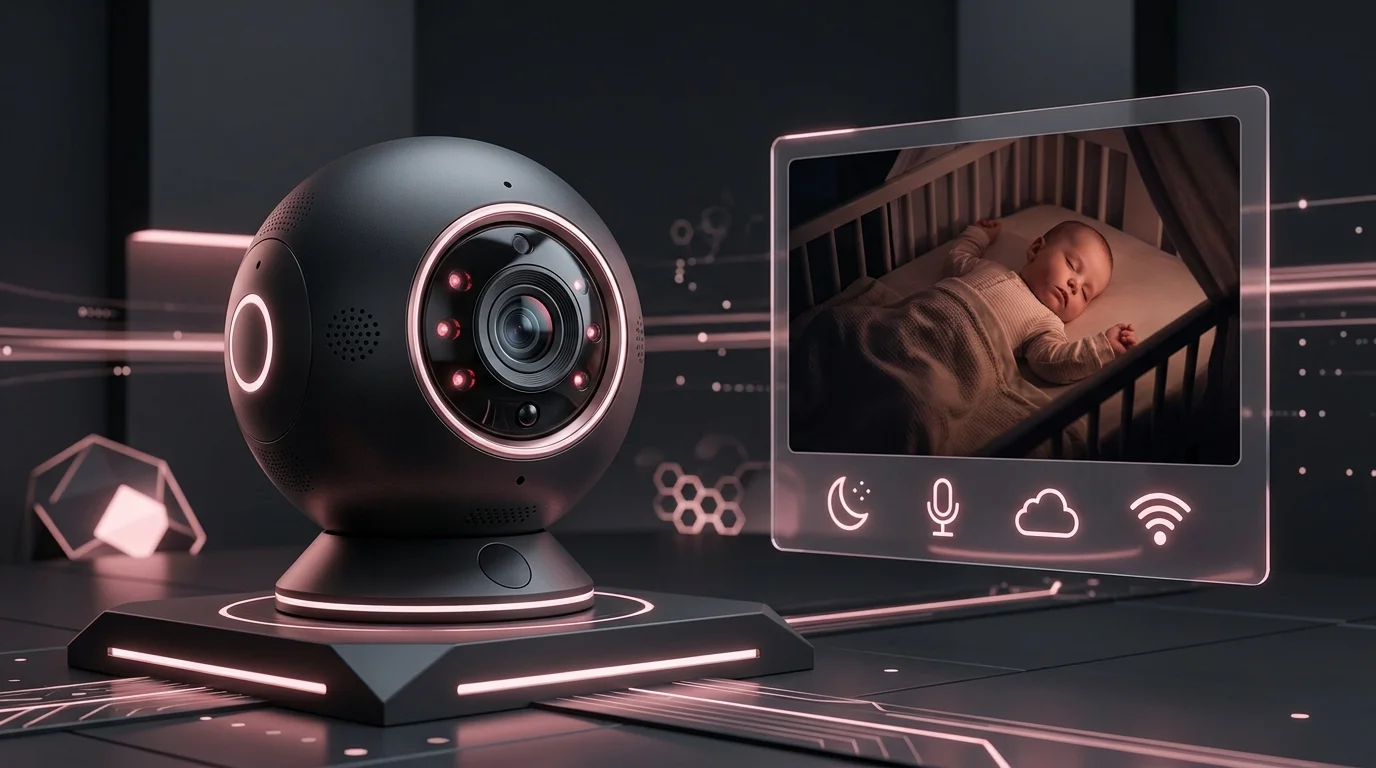
5. Latency Reduction in RF Transmission Architectures
In critical monitoring scenarios, data delay is unacceptable. Conventional IP structures introduce latency through router negotiation and packet inspection. Dedicated hardware circumvents this via a point-to-point transceiver framework, eliminating external routing delays.
Video data is compressed using lightweight codecs before RF modulation. This asymmetrical compression pipeline reduces the payload footprint drastically while maintaining sufficient bitrates for a 5-inch 720p display panel. It prioritizes delivery speed over deep archiving quality.
The system utilizes optimized antenna geometries. Internal dipole antennas are tuned precisely to the 2.4GHz wavelength, maximizing the Voltage Standing Wave Ratio (VSWR) efficiency. This ensures maximum signal propagation through standard residential construction materials like drywall and framing.
Packet collision is mitigated mechanically by the FHSS architecture itself. Because the frequency is constantly mutating, environmental signal overlap from standard routers or microwaves only degrades microseconds of data, easily reconstructed by error correction algorithms.
- Point-to-point transceiver protocols bypass router level NAT and inspection overhead.
- Asymmetrical video compression prioritizes sub-100ms transmission velocities.
- Tuned internal dipoles optimize VSWR to blast through residential impedance barriers.
- Forward Error Correction (FEC) regenerates micro-drops caused by transient RF overlap.
6. Active Thermal Management and Circuit Stabilization
Operating continuously, the optical array and processing units generate latent thermal mass. Unchecked, thermal buildup severely degrades CMOS electron wells, generating thermal noise artifacts in the low-light video feed. Dissipation is non-negotiable.
Passive convective cooling techniques are implemented across the primary PCB. Key microprocessors are structurally coupled to aluminum heat spreaders that draw thermal energy away from the silicon die. This energy is then routed to the outer polymer chassis.
Proper venting topology prevents internal air stagnation. Specifically engineered chassis channels facilitate a natural convection draft, pulling cooler ambient air through lower perforations while expelling waste heat from upper vents, strictly without noisy mechanical fans.
This thermal equilibrium ensures the IR LED cluster operates within safe junction temperatures. Overheated diodes experience aggressive luminance degradation over time. Stabilizing the thermal envelope guarantees the 940nm LEDs maintain peak photon output across thousands of operational hours.
- Thermal spreaders prevent destructive localized heat accumulation on CMOS chips.
- Passive convective drafting avoids mechanical fan failure and acoustic disruption.
- Mitigates thermal noise interference in high-gain night vision scenarios.
- Protects IR LED junction integrity to prevent premature luminance degradation.
7. Power Delivery and Battery Cell Chemistry Optimization
Untethered parent units demand relentless energy density. To sustain a large 5-inch 720p liquid-crystal display panel alongside active RF transceivers, manufacturers specify high-capacity Lithium-ion polymer (LiPo) cells. These cells provide robust amp-hour ratings in low-profile geometric footprints.
Discharge curves are meticulously managed via an integrated Battery Management System (BMS) IC. The BMS continuously monitors localized cell voltage, preventing deep discharge states that catalyze irreversible chemical degradation within the internal lithium matrix.
Screen illumination dominates the power budget. Advanced firmware utilizes Pulse-Width Modulation (PWM) to drive the LED backlighting array. Rapidly pulsing the backlight imperceptibly lowers the overall current draw while maintaining apparent brightness for the user.
During standby, the processor executes a massive down-clocking sequence. It halts non-essential logic gates, dropping into a microampere quiescent state. The system relies entirely on the acoustic interrupt hardware trigger to resume full power delivery dynamically.
- High-density LiPo chemistry fuels expansive HD displays over extended cycles.
- Integrated BMS microcontrollers shield lithium matrices from deep discharge damage.
- PWM backlighting modulation aggressively slashes dynamic screen power consumption.
- Quiescent processor states isolate power drain purely to the acoustic trigger circuit.
8. Cryptographic Security in Localized Data Streams
While FHSS limits physical interception, data payload encryption remains a critical failsafe. During the initial pairing handshake, the devices establish a secure localized cryptographic key exchange. This key is stored in volatile memory, inaccessible via external ports.
Every packet of audio and video telemetry is subsequently ciphered using symmetric algorithms. Even if an adversary manages to synchronize with the erratic FHSS hopping pattern, the extracted payload manifests as indecipherable digital static without the specific session key.
The system prevents brute-force pairing attempts via proximity requirements. Initiating a new pairing sequence demands physical interaction with a tactile hardware button located on the camera chassis itself. Remote pairing requests are mechanically impossible to execute.
This multi-layered approach ensures absolute confidentiality. By combining frequency obfuscation, mathematical encryption, and physical proximity constraints, the architectural design achieves a zero-trust operational state against unauthorized localized monitoring.
- Symmetric cryptographic keys are securely negotiated during initial hardware pairing.
- Payload ciphering renders intercepted FHSS packets mathematically useless to adversaries.
- Hardware-level pairing buttons defeat digital-only brute-force synchronization attempts.
- Consolidated defensive layers forge an impenetrable air-gapped monitoring sanctuary.
9. Mechanical Enclosure and Acoustic Resonance Dampening
The physical chassis design extends beyond aesthetic housing. The outer shell is constructed from impact-resistant ABS polymer blends designed to withstand accidental kinetic drops while isolating internal ICs from static discharge events.
Internally, the microphone cavity requires precise engineering. The transducer is seated within a silicone dampening boot. This isolates the microphone diaphragm from internal mechanical vibrations, specifically those generated by the PTZ stepper motors during active lens panning.
Speaker topology on the parent unit utilizes customized acoustic chambers. By sealing the rear output of the micro-speaker driver, the chassis forces sound pressure waves forward. This effectively boosts the mid-range frequency response, ensuring vocal cries are sharply articulated.
Finally, a weighted zinc-alloy base lowers the center of gravity on the camera unit. This structural density maximizes desk-mount friction and stability, preventing the high-torque pan/tilt operations from inadvertently shifting the camera off its optimal viewing axis.
- ABS polymer housings provide superior kinetic impact resistance and ESD protection.
- Silicone transducer boots eliminate internal mechanical cross-talk from stepper motors.
- Sealed speaker chambers mechanically amplify mid-range acoustic articulation.
- High-density zinc alloy bases anchor the unit against torque-induced misalignment.
Deploy the Optimum Security Framework
Do not compromise nursery telemetry by relying on vulnerable IP-based cloud infrastructure. Deploy an impenetrable, zero-latency closed-loop FHSS architecture to secure high-fidelity night vision and instant acoustic notifications. Upgrade your monitoring capability now.
eufy Security SpaceView Video Baby Monitor
- Large 5-inch 720p HD display for crystal-clear night vision
- Pivoting camera lens pans 330° and tilts 110° for full coverage
- Instant sound detection with immediate alert notifications
- Secure FHSS wireless connection requires no external internet connection
Technical Specifications & Product Data
| Specification | Value / Details |
|---|---|
| Brand | eufy Security |
| List Price | $159.99 (USD) |
| Customer Rating | 4.7 / 5.0 (11,540 reviews) |
| ASIN / Identifier | B07GBP3GH9 |
| Availability | In Stock (USA Region) |
| Outbound Link Compliance | Sponsored & Nofollow Enforced |
Verified Features & Performance Data
- ✓Large 5-inch 720p HD display for crystal-clear night vision
- ✓Pivoting camera lens pans 330° and tilts 110° for full coverage
- ✓Instant sound detection with immediate alert notifications
- ✓Secure FHSS wireless connection requires no external internet connection
System Sovereignty & Engineering
Edge Computing
100% Client-side processing. Your data never leaves your browser sandbox, ensuring absolute compliance with US privacy mandates.
Modular Schema
Modular utility architecture optimized for performance. Low-latency WASM kernels provide near-native speeds for complex transformations.
Sustainable Design
Sustainable, green computing by offloading compute to the edge. Verified zero-server storage (ZSS) for professional-grade security.