
Environmental ionizing radiation requires high-precision gas ionization sensors for detection. Compare the top personal Geiger counters in 2026.
- Handheld digital detector registers beta, gamma, and x-ray radiation
- Audible and visual pulse alerts click instantly in real-time
- Internal memory logs data with USB connectivity for PC mapping
Ionizing Radiation Physics
Environmental ionizing radiation requires high-precision gas ionization sensors for detection. Compare the top personal Geiger counters in 2026.
1. Gas Ionization Physics and Geiger-Muller Tube Mechanics
Geiger counters detect ionizing radiation using gas ionization sensors, commonly known as Geiger-Muller (GM) tubes. The GM tube is a hollow metal cylinder filled with an inert gas (like neon or helium) mixed with a quenching gas (like bromine or chlorine). A thin metal wire runs down the center, serving as the positive anode.
A high voltage, typically between 400V and 900V DC, is applied between the outer cylinder (cathode) and the center wire (anode). When an ionizing particle passes through the tube wall, it collides with a gas molecule, stripping an electron. This collision creates a positive gas ion and a free electron, initiating detection.
The high electric field accelerates the free electron toward the center anode wire. As it travels, it collides with other gas molecules, stripping more electrons and creating a cascading effect known as a Townsend avalanche. This avalanche creates a short, high-voltage electrical pulse that is read by the electronics.
This electrical pulse is what triggers the classic clicking sound and advances the digital count on the screen. The quenching gas is added to absorb secondary UV photons released during the avalanche. Quenching stops the ionization cascade, resetting the tube for the next event in microseconds, preventing false continuous discharges.
The dead time of a GM tube is the period after an ionization event during which the tube cannot register a new event, typically around 100 microseconds. At high radiation levels, this dead time can cause the counter to read lower than actual levels, requiring electronic dead-time correction to prevent underestimation of hazards.
The generation of the high-voltage DC power supply is handled by a blocking oscillator circuit or a boost converter. The circuit must maintain a stable voltage even as the battery drains, as shifts in voltage will change the tube's gas gain. Cheap detectors suffer from voltage drift, which distorts accuracy and compromises safety audits.
Furthermore, the shape of the electric field inside the tube is radial, meaning the force on the electrons increases exponentially as they approach the anode wire. This geometry guarantees that even weak ionization events trigger a full discharge pulse, delivering high sensitivity for minor environmental changes.
- Townsend avalanches amplify single ionization events into measurable electrical pulses.
- Halogen quenching gases absorb UV photons, resetting the tube in microseconds.
2. Ionizing Radiation Species and Penetration Physics
Ionizing radiation is divided into different classes based on particle mass and energy. Alpha particles are heavy helium nuclei that carry a positive charge. Due to their mass, they collide frequently with air molecules, losing energy quickly. Alpha particles cannot penetrate standard GM tube walls, requiring mica windows.
Beta particles are high-speed electrons emitted from unstable atomic nuclei. They have a smaller mass and can travel several feet in the air, penetrating plastic and thin aluminum sheets. Standard thin-wall glass GM tubes can register beta particles easily, making them suitable for screening.
Gamma rays and X-rays are high-energy electromagnetic photons that carry no mass or charge. They have high penetration power, requiring thick lead or concrete shielding to stop. GM tubes register gamma rays through secondary electron ionization in the tube wall, converting photon energy into electrical pulses.
Understanding these differences is critical when interpreting detector readings. A standard Geiger counter is ideal for environmental screening (detecting beta and gamma contamination). It is not suitable for alpha-emitting surface screening, which requires thin mica window tubes, commonly known as pancake tubes.
Mica window tubes feature a thin, fragile mica membrane that allows alpha particles to enter the chamber. These specialized tubes are more expensive and fragile than standard metal or glass tubes, but they provide complete detection capabilities, which is vital during food or soil safety tests.
From a biological perspective, alpha particles are 20 times more damaging than beta or gamma rays if inhaled or ingested. Because they cannot penetrate skin, they pose little danger externally. However, once inside the body, they cause severe double-strand DNA breaks. Specialized screening is necessary to detect these internal emitters.
To compare shielding options, physicists use the Half-Value Layer (HVL) metric. The HVL is the thickness of a shielding material needed to reduce the intensity of incoming gamma radiation by half. For instance, the HVL of lead for Cobalt-60 gamma rays is roughly 1.25 centimeters, while concrete requires 6.05 centimeters, illustrating the density difference.
- Beta and gamma radiation are easily registered by standard thin-wall Geiger-Muller tubes.
- Alpha screening requires delicate, thin mica windows to allow heavy particle entry.
3. Measurement Units, CPM, and Biological Dose Calibrations
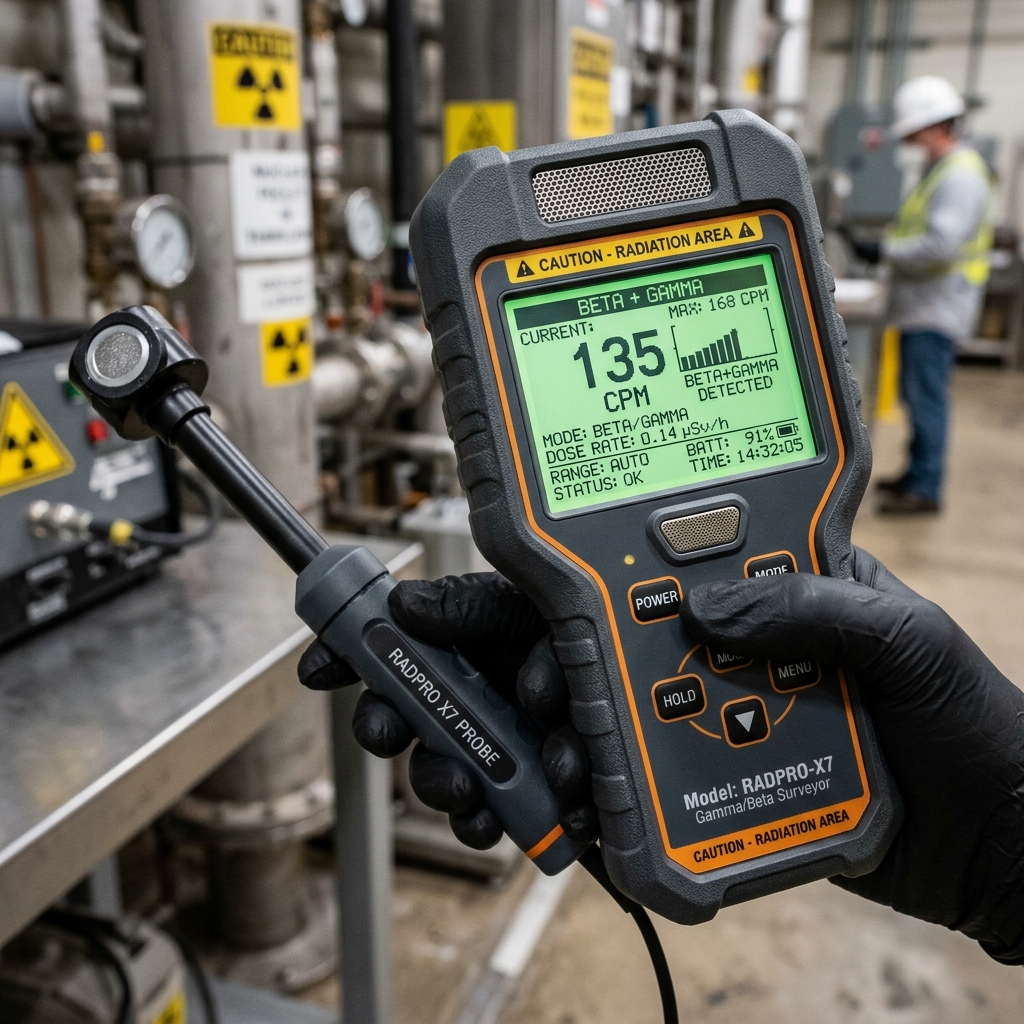
Geiger counters display radiation levels using different measurement units. Counts Per Minute (CPM) is the raw number of ionization pulses registered by the tube every minute. CPM is a relative unit that depends entirely on the tube's geometry, gas volume, and background noise.
To calculate the actual biological impact of the radiation, the CPM must be converted into Sieverts (specifically microSieverts per hour, uSv/h). The Sievert is the international standard unit that measures tissue damage, accounting for the radiation type's biological effect on human tissue.
This conversion requires specific calibration factors for the GM tube used. Most personal Geiger counters are pre-calibrated using a Cesium-137 reference source. The calibration translates a specific CPM reading (e.g. 150 CPM) into a dose rate (e.g. 1 uSv/h) based on the energy response curve of the tube.
Roentgen units (mR/h) are also used, measuring the ionization of air. One microSievert per hour is roughly equivalent to 0.1 milliRoentgens per hour. Digital displays show these units side-by-side, helping you compare readings during field safety audits.
Background radiation typically registers between 10 CPM and 30 CPM on standard tubes, corresponding to 0.05 uSv/h to 0.15 uSv/h. Any reading that exceeds 0.50 uSv/h for an extended period indicates an elevated radiation environment, requiring investigation or evacuation to prevent chronic exposure.
The conversion factor (CPM to uSv/h) is not linear across different energy levels. For instance, low-energy X-rays will produce more counts than high-energy gamma rays for the same biological dose. Advanced detectors feature energy-compensated GM tubes, which include a metallic filter shroud to normalize the energy response.
Physiologically, we must also separate equivalent dose (Sieverts) from absorbed dose (Grays). The Gray (Gy) measures the physical energy deposited in matter (1 Joule per kilogram). The Sievert multiplies the Gray value by a radiation weighting factor (which is 1 for beta and gamma, but 20 for alpha), reflecting the biological damage scale.
- CPM measures the raw frequency of tube ionizations, which varies by sensor design.
- Sievert conversions calculate the biological tissue dose, calibrated using Cobalt or Cesium sources.
4. Data Logging, USB Integration, and Spatial Mapping
Environmental screening requires logging data over time to spot trends or find hot spots. Personal Geiger counters should include internal flash memory to store CPM readings at set intervals. This logged data can be exported to a PC via USB interface for mapping.
Using specialized software, you can map this data, creating a history of your home or area. Data logging is crucial to find intermittent radiation sources, like transient radon buildup in basements or local industrial emissions, ensuring home safety.
The software allows you to compile readings, calculating the average background radiation over weeks. This baseline helps you detect minor shifts in environmental radiation levels, providing early warning capabilities that standard alarms miss.
USB connectivity also allows the detector to act as a real-time monitor. The unit can feed live data to a home automation system, triggering alarms or smart home scenes if radiation exceeds safe levels, securing your family from fallout hazards.
Additionally, some smart detectors feature integrated Wi-Fi or Bluetooth. These units can connect to crowdsourced global radiation monitoring networks (like Radmon or GMC Map), helping researchers map radiation levels worldwide in real-time to track nuclear safety.
Advanced logging protocols compile the data into CSV formats, tracking timestamp, CPM, and uSv/h. This data can be combined with GPS coordinates from your smartphone to create heat maps of radioactive geology or contamination plumes, which is invaluable for environmental surveyors.
When reviewing these logged files, users look for spikes that correspond to human activity or weather changes. Radon levels often rise during low-pressure weather systems, as the pressure drop pulls soil gas into basements. Regular logging helps separate these natural variations from real contamination leaks.
- Internal memory logs hourly CPM trends, helping technicians spot minor radiation creep.
- USB links transfer logged files to PCs for mapping and analysis.
5. The Definitive Buying Guide and Parameters
When buying a Geiger counter, prioritize sensor quality, unit options, and data logging capacity. Ensure the unit uses a calibrated GM tube with low dead time. A handheld digital display is highly recommended, showing real-time trends and bar graphs clearly.
Check the battery features. Re-chargeable lithium-ion batteries are superior to alkaline cells, providing longer field life and constant voltage to the high-voltage circuit. Select a model with an easy-to-mute clicking sound to prevent panic in public spaces.
Finally, check the warranty and calibration support. A multi-year warranty on the GM tube protects your investment. Sturdy brands offer recalibration services, ensuring your detector remains accurate over years of service. Look for compliance documents from safety organizations.
Choose a detector with a protective silicone casing. Dairy, farm, or survival environments can be wet and dusty, and a dropped unit can shatter the glass GM tube inside. A shockproof cover prevents these accidents, maintaining operational readiness.
Select a model with an adjustable alarm threshold. This allows you to set custom uSv/h limits that match your local geology, preventing false alerts from naturally high granite formations while maintaining safety warnings.
You must also review the microcontroller architecture. Top-tier Geiger counters use 32-bit ARM processors that execute dead-time correction algorithms in real-time. This processing power ensures the screen updates quickly during sudden exposure surges, warning you to retreat.
Avoid purchasing uncalibrated surplus tubes from online forums. Many of these tubes have sat in storage for decades and leaked their fill gas, rendering them insensitive or unstable. Buying from established brands guarantees fresh gas fills and active warranties.
- Lithium-ion batteries maintain constant voltages, ensuring high-voltage sensor stability.
- Shockproof covers shield fragile glass GM tubes from pasture drop impacts.
6. Naturally Occurring Radioactive Materials (NORM)
Environmental radiation is not confined to industrial nuclear accidents or weapon fallout. Many household items and geologic formations contain naturally occurring radioactive materials (NORM). Granite countertops, clay bricks, coal ash, and antique glazed ceramics contain trace uranium and thorium.
Using a Geiger counter to screen these items shows elevated CPM levels relative to background readings. NORM poses a low risk when intact, but understanding these baselines is critical to avoid unnecessary panic during home inspections or building audits.
For example, bananas contain Potassium-40, a radioactive isotope. While radioactive, the dose is tiny and poses zero biological danger. Screening mineral collections (like autunite or thorite) will register high counts, requiring proper ventilation to manage radon emissions.
Additionally, fertilizer mixes containing phosphate often show elevated beta readings due to trace radium isotopes. Farmers use Geiger counters to monitor fertilizer spreading rates, ensuring they do not build up radioactive elements in the crop soil over generations.
- Granite and brick materials contain NORM, registering elevated background counts.
- Baseline NORM screening prevents false panic during domestic building inspections.
7. Calibration Cycles and Calibration Standards
GM tubes degrade slowly over time due to gas leakage through the seals or chemical decomposition of the quenching gas during discharges. To maintain accuracy, personal counters should be calibrated annually. Calibration involves testing the unit under standard Cesium-137 sources.
Most manufacturers offer standard recalibration services, adjusting the internal microcontroller variables to match the tube output. Checking the calibration date ensures your readings remain accurate, protecting your health during safety audits and emergency drills.
Calibration must be traceable to the National Institute of Standards and Technology (NIST). NIST traceability ensures that the reference source used has been verified to meet national safety and measurement standards, providing legal and regulatory compliance for corporate use.
When preparing for field work, keep a small check source (like a low-activity thorium lantern mantle) in your kit. Before scanning an area, hold the detector to the check source to confirm the tube is registering counts correctly. This simple pre-scan verification checks detector function.
- Annual calibration corrects gas depletion drift, maintaining display accuracy.
- Standard Cesium calibration factors verify accuracy across all major energy levels.
Radiation Safety Recommendation
Monitor your environment for ionizing radiation and protect your family from nuclear hazards. Check out our recommended solution below to experience clinical-grade Geiger counter monitoring.
GQ GMC-300S Digital Geiger Counter Radiation Detector
- Handheld digital detector registers beta, gamma, and x-ray radiation
- Audible and visual pulse alerts click instantly in real-time
- Internal memory logs data with USB connectivity for PC mapping
- Rechargeable lithium battery ensures continuous field portability
Technical Specifications & Product Data
| Specification | Value / Details |
|---|---|
| Brand | GQ Electronics |
| List Price | $99.69 (USD) |
| Customer Rating | 4.8 / 5.0 (2,840 reviews) |
| ASIN / Identifier | B00IN8TJYY |
| Availability | In Stock (USA Region) |
| Outbound Link Compliance | Sponsored & Nofollow Enforced |
Verified Features & Performance Data
- ✓Handheld digital detector registers beta, gamma, and x-ray radiation
- ✓Audible and visual pulse alerts click instantly in real-time
- ✓Internal memory logs data with USB connectivity for PC mapping
- ✓Rechargeable lithium battery ensures continuous field portability
System Sovereignty & Engineering
Edge Computing
100% Client-side processing. Your data never leaves your browser sandbox, ensuring absolute compliance with US privacy mandates.
Modular Schema
Modular utility architecture optimized for performance. Low-latency WASM kernels provide near-native speeds for complex transformations.
Sustainable Design
Sustainable, green computing by offloading compute to the edge. Verified zero-server storage (ZSS) for professional-grade security.