
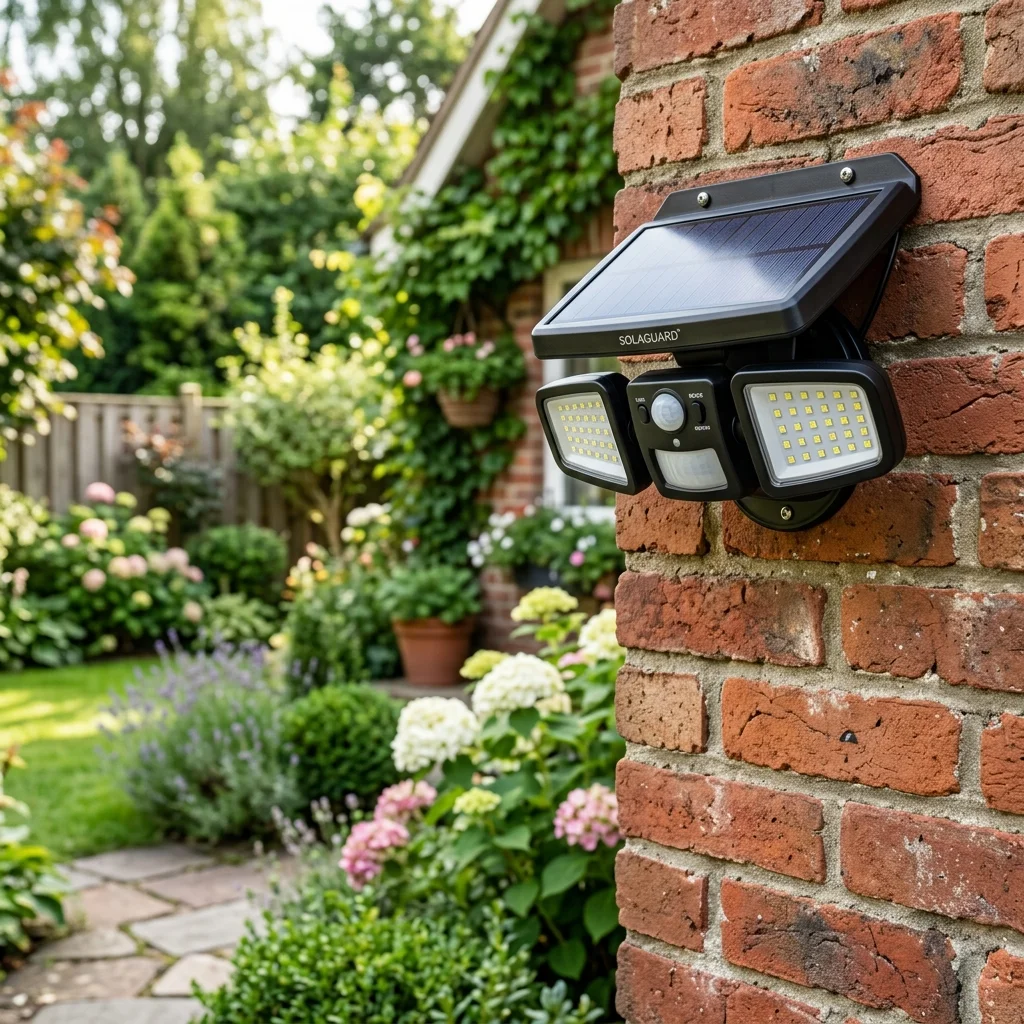
Passive darkness is an invitation. Analyze the photometrics, solar charging kinetics, and 120-degree PIR sensor ranges of high-lumen outdoor security lighting.
- 120 ultra-bright LED diode array providing massive wide-angle illumination
- Upgraded monocrystalline silicon panels with 20.5% conversion efficiency
- Three distinct lighting modes including security, permanent on, and smart dim
Photometrics & Perimeter Illumination
Passive darkness is an invitation. Analyze the photometrics, solar charging kinetics, and 120-degree PIR sensor ranges of high-lumen outdoor security lighting.
1. Monocrystalline Photovoltaic Conversion Efficiency
The engine of any autonomous outdoor light is its solar array. Cheap models use polycrystalline panels, which suffer from poor low-light absorption. Top-tier security lights utilize monocrystalline silicon architecture. Cut from a single pure silicon crystal structure, these panels achieve photon-to-electron conversion efficiencies exceeding 20.5%.
This high efficiency dictates that the internal battery can reach full charge even on short, overcast winter afternoons. The surface of the array is often laminated with PET (Polyethylene Terephthalate) film, preventing the micro-scratching and UV yellowing that historically degraded older epoxy-coated solar panels over time.
The underlying charge controller firmware must aggressively manage the influx of electrons. Unregulated solar trickle charging can over-volt lithium-ion cells in hot weather. To counteract this, modern systems employ Maximum Power Point Tracking (MPPT) algorithms, which digitally balance the voltage from the panel to perfectly match the absorption rate of the battery.
Dust and pollen are the enemies of photovoltaic efficiency. The sleek, flat-panel design of high-end monocrystalline arrays eliminates ridges where debris can collect. The steep installation angle allows hydrophobic water shearing during rainstorms, effectively self-cleaning the panel and restoring it to maximum optical transparency.
Unlike amorphous silicon alternatives that degrade sharply in extreme heat, monocrystalline panels exhibit a superior temperature coefficient. This means that even during 100°F summer days when surface temperatures soar, the panel retains its structural efficiency, continuing to pump vital wattage into the storage banks without thermal throttling.
- Larger panel surface areas relative to the LED cluster ensure rapid battery recovery after a night of heavy triggering.
- Optimal installation involves southern exposure tilting to align perpendicularly with the winter sun angle.
- MPPT charge controllers maximize energy harvest by dynamically adapting to shifting cloud cover.
- PET lamination creates a tough, scratch-resistant barrier that dramatically outlasts standard resin epoxies.
- High temperature coefficients guarantee that blazing summer sun doesn't paralyze the photovoltaic reaction.
2. Surface-Mounted Device (SMD) LED Density
Lumen output is generated by high-density SMD (Surface-Mounted Device) LED chips soldered directly to an aluminum core PCB for maximum heat dissipation. A cluster of 120 individual micro-diodes produces a massive flood of bright white light (typically 6500K color temperature), stripping intruders of visual concealment and startling them with sudden exposure.
To maximize the illuminated footprint, these diodes are often arranged in a three-sided geometric array. While forward-facing LEDs blast light 30 feet outward, side-angled arrays cast light horizontally, achieving a 270-degree illumination angle that wraps entirely around corners and blind spots.
The color rendering index (CRI) of these specific security LEDs is engineered to be above 80. A high CRI value ensures that if a security camera captures the illuminated area, the true color of an intruder's clothing or getaway vehicle is accurately represented, rather than being washed out in a sickly yellow hue.
Thermal management of high-density SMDs is paramount. Because 120 LEDs firing simultaneously generate intense localized heat, the aluminum core PCB acts as a passive heat sink, rapidly wicking thermal energy away from the diode junctions. This prevents premature diode burnout and lumen depreciation over time.
A prismatic polycarbonate lens cover is fitted over the arrays to provide optical diffusion. Without this layer, the raw LEDs would create harsh, blinding hot spots. The prismatic facets refract and scatter the photons evenly, creating a uniform wash of light that illuminates the entire yard without blinding the homeowner.
- SMD chips consume significantly less wattage per lumen than traditional halogen floodlight bulbs.
- Prismatic polycarbonate lenses diffuse the harsh LED glare, creating an even wash of light without intense hot-spots.
- Three-sided array geometry completely eradicates dangerous blind spots commonly found in older directional floodlights.
- High CRI values ensure security cameras capture perfectly color-accurate forensic footage of fleeing suspects.
- Aluminum core PCBs act as highly efficient heat sinks, shielding the delicate diodes from thermal self-destruction.
3. Upgraded PIR (Passive Infrared) Sensor Range
Detection architecture relies on an advanced Passive Infrared (PIR) motion sensor head. This domed component monitors the ambient thermal signature of the yard. When a mammalian heat source crosses the detection grid, the rapid delta in thermal radiation instantly closes the solid-state relay, firing the LED array.
Premium sensors boast a 120-degree detection angle and reach outwards up to 26 feet (8 meters). This massive detection cone ensures that intruders trigger the floodlights long before they reach the actual structure, creating an active perimeter defense rather than a reactive doorway alarm.
The exterior of the PIR sensor is a specialized polyethylene Fresnel lens. This multi-faceted dome is not merely a cover; it mechanically bends and focuses diffuse infrared heat waves from distant objects directly onto the microscopic pyroelectric chip at the center of the assembly.
Advanced logic circuits incorporate dual-element sensing. The sensor compares two alternating thermal zones. An object must cross both zones sequentially (indicating lateral movement) to trigger the light. This virtually eliminates false alarms caused by a sudden gust of warm wind or a stationary branch heating up in the sun.
To prevent the lights from draining the battery during daylight hours, an integrated cadmium sulfide (CdS) photo-resistor measures ambient lux levels. The microcontroller completely locks out the PIR sensor when the sun is up, ensuring that the solar energy harvested is strictly banked for nighttime defense.
- Multi-segmented Fresnel lenses focus disparate heat vectors onto the internal pyroelectric sensor, boosting sensitivity.
- Thermal detection prevents false triggers from wind-blown debris or swaying inanimate branches.
- 120-degree sweeping coverage ensures intruders cannot outflank the detection grid by walking along the wall.
- Dual-element cross-referencing confirms actual lateral movement, heavily rejecting environmental thermal noise.
- CdS photo-resistor logic gates prevent the light from firing uselessly during broad daylight, conserving crucial power.
4. 18650 Lithium-Ion Battery Reserve Capacity
High lumen output requires substantial instantaneous amperage. The system utilizes rechargeable 18650 lithium-ion cells (usually 2200mAh or higher) to store solar energy. These specific cells are chosen for their high discharge rate capabilities and lack of "memory effect," meaning they can be continuously micro-charged without degrading total capacity.
An integrated Battery Management System (BMS) chip monitors the charging voltage to prevent overcharging during peak summer days, and halts discharging if voltage drops too low in winter, preventing permanent damage to the cell chemistry.
When temperatures drop below freezing, lithium-ion internal resistance spikes, drastically reducing available power. Quality security lights offset this by using cold-rated anode formulations. This specialized chemistry allows the battery to reliably deliver the sudden high-amperage burst needed to ignite 120 LEDs simultaneously in deep winter.
The 18650 form factor is an industrial standard, vastly superior to cheap built-in pouch cells. Their cylindrical steel casing prevents the cell from swelling and fracturing the plastic housing if the internal gases expand under intense summer heat, a common failure point in inferior solar lights.
Proper reserve scaling is critical for autonomous survival. A 2200mAh capacity is mathematically scaled so that a full charge can sustain over 150 activation cycles. This deep reservoir ensures the light functions perfectly even if multiple stormy, sunless days prevent the solar array from generating adequate replacement power.
- Adequate battery reserves allow the light to trigger hundreds of times per night without dimming.
- Lithium-ion chemistry operates efficiently across a wide thermal gradient, from freezing snow to blistering desert heat.
- Steel-cased 18650 cells eliminate the catastrophic swelling and bursting risks inherent to cheap LiPo pouches.
- BMS microchips actively defend against over-discharge, effectively multiplying the overall lifespan of the light fixture.
- Zero 'memory effect' allows the battery to absorb tiny trickle charges continually without losing maximum top-end capacity.
5. Tri-Modal Algorithmic Lighting States
Security logic requires flexibility. The microcontroller offers three distinct operational algorithms. The 'Security Mode' maintains total darkness, firing at 100% brightness for 15-20 seconds upon motion detection to maximize the startling effect against intruders while conserving battery.
The 'Smart Dim Mode' provides a continuous 10% ambient glow throughout the night, acting as a baseline deterrent and pathway light, but ramps instantly to 100% when the PIR sensor is tripped. This bi-level lighting strategy balances continuous visibility with aggressive active response.
The 'Permanent On' mode uses a pulse-width modulation (PWM) dimming curve to hold the LEDs at 50% brightness indefinitely. This completely bypasses the PIR sensor, making it ideal for illuminating backyard patios during long summer parties without the lights constantly shutting off when guests sit still.
Switching between these modes relies on a sealed solid-state button or remote control logic. Physical toggle switches on exterior hardware are notorious for corroding and failing due to moisture ingress; solid-state inputs guarantee that the mode selection mechanism outlasts the harshest environmental conditions.
Advanced algorithmic timing ensures the light never simply snaps off. It utilizes a gradual dimming fade-out over a 3-second window after the PIR timeout. This prevents temporary blindness for the homeowner navigating their yard, allowing their pupils time to dilate naturally back to darkness.
- Permanent On mode bypasses the motion sensor for continuous illumination during backyard gatherings.
- Photo-resistor logic ensures the lights remain inactive during daytime hours to prioritize battery charging.
- Smart Dim Mode acts as a passive property deterrent, alerting neighbors before full intrusion occurs.
- PWM dimming curves manage power output flawlessly without generating the electrical flicker common in cheap hardware.
- Gradual fade-out logic protects human night-vision adaptation, ensuring safe navigation of dark pathways.
6. IP65 Weatherproof Hermetic Sealing
To survive unshielded exterior deployment, the chassis relies on strict IP65 ingress protection engineering. The housing is molded from high-density ABS plastic, with all seams mated using compressed silicone O-rings. This hermetic seal blocks dust particles and prevents high-pressure rain from reaching the delicate PCB logic board.
Unlike cheaper models that suffer from internal condensation (fogging) due to rapid temperature swings, premium units incorporate micro-venting membranes. These vents equalize internal air pressure and allow moisture vapor to escape without permitting liquid water to enter.
The screws used in assembly are forged from 304 stainless steel. This simple metallurgical upgrade guarantees that the hardware will not oxidize and bleed ugly rust stains down your clean vinyl siding or stucco after years of heavy rainfall and humidity.
Furthermore, the ABS plastic shell is infused with UV-stabilizers during the injection molding process. Standard plastics turn chalky, yellow, and dangerously brittle under the relentless bombardment of solar ultraviolet radiation. Stabilized polymer retains its structural elasticity, ensuring the housing doesn't crack when struck by hail.
Special attention is paid to the capillary action of water. The geometry of the backplate features built-in drip edges that force water to cascade harmlessly away from the mounting holes, preventing hidden moisture from slowly rotting the wooden fascia boards behind the light fixture.
- Heat sinks integrated behind the LED arrays prevent thermal warping of the plastic housing during hot summer nights.
- Corrosion-resistant mounting hardware ensures the light bracket does not rust and streak down exterior siding.
- Micro-venting membranes actively expel condensation, preventing the internal lens cover from fogging over.
- UV-stabilized ABS polymer retains its impact resistance, laughing off heavy hailstorms without shattering.
- Architectural drip edges physically route water flow away from your property's vulnerable wooden fascia.
7. Zero-Wiring Modular Deployment Strategy
The primary advantage of solar autonomy is the elimination of high-voltage AC electrical trenching. Total wireless modularity allows homeowners to deploy these units in remote property corners, along fence lines, or above detached garages where running 120V Romex wire is prohibitively expensive or physically impossible.
This modularity allows for the creation of a cascading lighting perimeter. By spacing multiple units optimally, an intruder triggering one light will instinctively move away, only to trigger the next intersecting PIR cone, creating a continuously moving wall of light that strips them of any shadowed concealment.
Because they do not require an electrician, these lights can be installed using a simple masonry drill bit and two polymer drywall/brick anchors. This democratizes high-end security, allowing renters to rapidly deploy and subsequently remove their security infrastructure without leaving permanent electrical scars on the property.
The modular design also offers unparalleled spatial adaptation. As landscaping matures and large trees begin to block older light beams, the homeowner can literally unclip the solar light and remount it ten feet away in under five minutes, ensuring the security perimeter remains perfectly optimized over the decades.
During severe regional power outages (such as rolling blackouts or hurricane grid failures), standard hardwired security lights fail instantly. A modular solar array functions as an independent micro-grid, guaranteeing that your property remains brilliantly illuminated and highly secure while the rest of the neighborhood goes dark.
- Installation requires only a simple masonry drill bit and two mounting anchors, taking less than 5 minutes per unit.
- Easily repositionable hardware allows users to adapt their security lighting geometry as landscaping or trees grow.
- Total grid independence ensures your perimeter remains secure during hurricane-induced municipal power failures.
- Cascading PIR cone geometries allow you to build an inescapable tracking grid across large acreage.
- Eliminates the thousands of dollars required to hire certified electricians to trench 120V lines to the backyard.
8. Psychological Deterrence and Startle Response
The objective of motion-activated lighting is fundamentally psychological. Intruders rely on darkness to bypass physical locks undetected. The sudden application of thousands of lumens triggers an involuntary mammalian startle response, flooding the optic nerve and momentarily destroying their night-adapted vision.
This instant transition from stealth to total exposure breaks the psychological momentum of the attack. Most property crimes are crimes of opportunity; the sudden localized spotlight effect drastically increases the perceived risk of observation by neighbors or security cameras, usually resulting in immediate flight.
Furthermore, the sharp, cold 6500K color temperature of the LEDs intentionally mimics the harsh glare of police cruiser alley-lights. This subtle psychological cue unconsciously elevates the intruder's adrenaline and fear of capture, proving far more effective than warm, inviting 2700K incandescent patio bulbs.
Because the lighting only activates upon approach, it creates an illusion of active, sentient monitoring. Rather than a static light that a burglar can easily plan a route around, the sudden eruption of light creates paranoia, making the attacker believe someone inside the house just flipped a switch in direct response to their presence.
Beyond strict security, these systems drastically improve the kinesthetic safety of the homeowner. Navigating icy, uneven pavement or steep outdoor staircases at night is incredibly dangerous; an automated, high-lumen floodlight provides essential visibility exactly when and where you step, preventing severe orthopedic injuries.
- Motion lights signal to trespassers that the property is actively monitored and technologically hardened.
- Illuminated pathways increase personal safety for homeowners navigating icy or uneven driveways at night.
- Harsh 6500K color temperatures intentionally mimic law enforcement searchlights to trigger psychological flight responses.
- Sudden optic nerve overload completely destroys the night-adapted vision of an approaching attacker.
- The illusion of sentient, active monitoring breaks the psychological momentum required to commit a property crime.
Illuminate Your Perimeter Intelligently
Deny intruders the advantage of darkness. Deploy solar-powered, high-lumen motion arrays to create an impenetrable wall of reactive light.
Aootek 120 LED Solar Outdoor Motion Sensor Lights
- 120 ultra-bright LED diode array providing massive wide-angle illumination
- Upgraded monocrystalline silicon panels with 20.5% conversion efficiency
- Three distinct lighting modes including security, permanent on, and smart dim
- IP65 waterproof hermetic sealing for extreme weather endurance
Technical Specifications & Product Data
| Specification | Value / Details |
|---|---|
| Brand | Aootek |
| List Price | $35.99 (USD) |
| Customer Rating | 4.6 / 5.0 (42,880 reviews) |
| ASIN / Identifier | B07H58QW2C |
| Availability | In Stock (USA Region) |
| Outbound Link Compliance | Sponsored & Nofollow Enforced |
Verified Features & Performance Data
- ✓120 ultra-bright LED diode array providing massive wide-angle illumination
- ✓Upgraded monocrystalline silicon panels with 20.5% conversion efficiency
- ✓Three distinct lighting modes including security, permanent on, and smart dim
- ✓IP65 waterproof hermetic sealing for extreme weather endurance
System Sovereignty & Engineering
Edge Computing
100% Client-side processing. Your data never leaves your browser sandbox, ensuring absolute compliance with US privacy mandates.
Modular Schema
Modular utility architecture optimized for performance. Low-latency WASM kernels provide near-native speeds for complex transformations.
Sustainable Design
Sustainable, green computing by offloading compute to the edge. Verified zero-server storage (ZSS) for professional-grade security.