
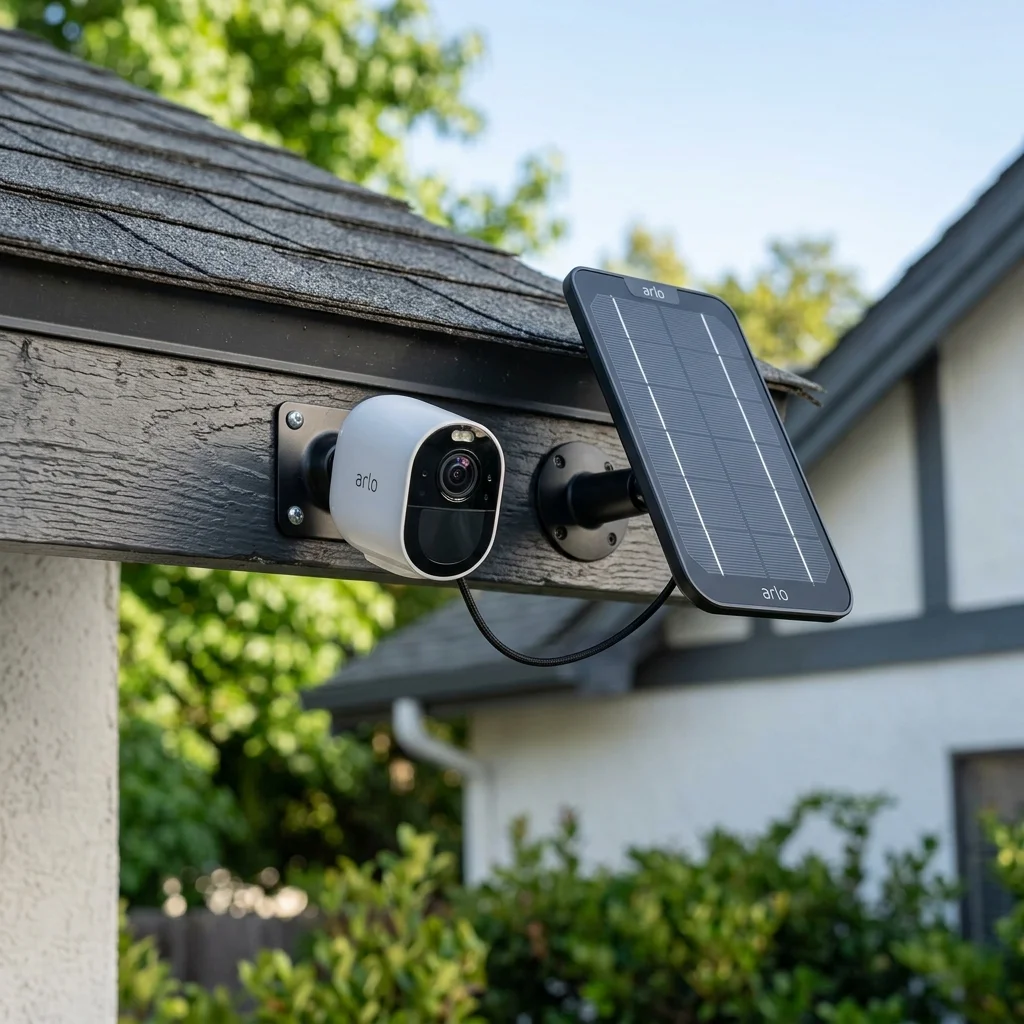
Battery-powered outdoor security cameras require precision power logic and photovoltaic solar arrays to achieve total grid autonomy while processing edge AI motion vectors.
- 4K Ultra HD optical sensor with extreme digital zoom capabilities
- BionicMind AI facial recognition architecture
- 180-day battery life per charge under standard telemetry
Grid Autonomy & Optical Precision
Battery-powered outdoor security cameras require precision power logic and photovoltaic solar arrays to achieve total grid autonomy while processing edge AI motion vectors.
1. High-Density Lithium-Ion Cell Integration
The core engineering hurdle in wireless camera design is power density. Devices must compress multi-month power reserves into a compact footprint. Engineers utilize high-capacity 13,400mAh 18650 cell clusters, arranging cylindrical batteries in parallel to maximize total milliamp-hours without increasing external voltage beyond standard logic board thresholds.
To extract 180 to 365 days of operation from a single charge, the CPU architecture relies on deep sleep micro-states. The main application processor remains entirely unpowered until the passive infrared (PIR) sensor detects a thermal heat signature shift. This hardware-level separation between logic and sensing allows the device to draw mere micro-amps while idling.
Thermal physics dictates that lithium-ion electrolyte viscosity thickens in sub-zero environments, crippling power output. To combat this, elite cameras deploy cold-weather cell formulations. These specialized anodes prevent lithium plating during freezing conditions, ensuring that the camera can still deliver the sudden burst amperage required to spin up the high-lumen spotlights at -20°C.
A sophisticated Battery Management System (BMS) acts as the central governor for cell health. By continually polling internal resistance and temperature, the BMS dynamically limits incoming charge currents. If the ambient temperature is too hot, it throttles charging to prevent thermal runaway; if too cold, it restricts charging to prevent internal crystalline damage.
The integration of soft-cutoff voltage thresholds ensures the battery is never completely drained to 0%. Fully depleting a lithium-ion cell causes irreversible degradation to the cathode structure. The firmware forces a graceful shutdown at around 5% true capacity, preserving the chemical longevity of the pack for years of continuous field use.
- Advanced Battery Management Systems (BMS) balance internal cell voltages to prevent catastrophic thermal runaway.
- Cold-weather optimization firmware adjusts the discharge curve to prevent voltage sag in freezing environments.
- Parallel cell arrangements maximize total milliamp capacity without exceeding safe voltage limits on the PCB.
- Micro-state sleeping algorithms reduce baseline quiescent current draw to essentially zero during idle daylight hours.
- Soft-cutoff voltage logic permanently safeguards the cathode matrix from fatal deep-discharge damage.
2. Monocrystalline Solar Photovoltaic Integration
To bridge the gap between periodic charging and infinite autonomy, solar powered outdoor security cameras integrate monocrystalline silicon solar panels. These panels boast high photon-to-electron conversion efficiencies, capable of generating up to 2 watts of trickle charge during peak sunlight hours.
The internal charge controller is meticulously calibrated. Because lithium-ion batteries degrade rapidly if held continuously at 100% capacity in hot weather, the logic circuit arrests solar charging at 90%. This smart hysteresis prevents grid-scale stress on the cells, doubling the overall multi-year lifespan of the hardware.
Surface finishing is crucial for solar longevity. Premium panels utilize an ETFE (Ethylene Tetrafluoroethylene) polymer coating instead of standard epoxy. ETFE is highly resistant to UV degradation and possesses self-cleaning non-stick properties, allowing rain to easily wash away dust and pollen that would otherwise block photon absorption.
The angle of incidence directly impacts charging kinetics. Many integrated panels feature adjustable pivoting mounts, allowing homeowners to dial in the exact latitudinal tilt required to strike a perpendicular angle against the low winter sun. This geometric optimization maximizes energy harvest during the shortest days of the year.
In extreme cases of prolonged cloud cover, the system relies on its massive baseline battery reserve. The photovoltaic array acts as an active multiplier—converting even weak, diffused UV radiation into a slow micro-charge that significantly elongates the time required before manual intervention becomes necessary.
- ETFE panel coatings maximize UV transmittance while rejecting dust and debris accumulation.
- A daily influx of just two hours of direct sunlight is sufficient to offset average daily motion-triggered drain.
- Monocrystalline silicon outperforms polycrystalline arrays significantly in overcast, low-light ambient conditions.
- Smart charging hysteresis caps battery levels at 90%, preventing the chemical bloat associated with constant maximum voltage.
- Adjustable mounts permit precise latitudinal sun tracking, maximizing the photon strike angle during deep winter months.
3. 4K Ultra-HD CMOS Optics and Forensic Cropping
Surveillance resolution dictates forensic utility. 4K (8-Megapixel) CMOS image sensors map physical spaces with extreme pixel density. This density allows post-event digital zooming without destroying critical details like license plate alphanumeric characters or suspect facial geometries.
However, processing 4K raw video overworks wireless networks. To mitigate this, high-end cameras employ H.265 (HEVC) algorithmic compression. This mathematical encoding evaluates frame-to-frame pixel variations, dropping redundant static backgrounds and compressing file sizes by up to 50% without sacrificing perceptual clarity.
The optical lens assembly relies on aspherical glass elements designed to combat chromatic aberration and spherical distortion. By precisely bending incoming light across multiple complex curves, the lens ensures that the edges of the 135-degree wide-angle view remain as crystal-clear as the dead center.
To enable true color night vision, the sensor employs a massive f/1.4 aperture structure. This 'starlight' optical arrangement acts like a photon vacuum, gathering microscopic traces of ambient street lighting or moonlight to paint a full-color surveillance image long after cheaper cameras have resorted to grainy black-and-white infrared.
Digital signal processors (DSP) run real-time Wide Dynamic Range (WDR) mapping on every 4K frame. When an intruder stands in a pitch-black shadow against a glaringly bright driveway, the DSP merges rapid dual-exposures, ensuring both the darkened face and the bright background remain perfectly legible.
- Starlight optical sensors utilize massive f/1.4 apertures to collect ambient photons, allowing full-color night vision.
- Distortion correction algorithms mathematically flatten the severe fisheye warping caused by 135-degree ultra-wide lenses.
- H.265 high-efficiency video coding dramatically reduces bandwidth strain over congested home wireless networks.
- Multi-exposure WDR prevents silhouette shadowing when subjects stand directly in front of blinding light sources.
- Aspherical glass groupings resist the thermal degradation and chromatic blurring common in cheap plastic lens assemblies.
4. Passive Infrared (PIR) Thermal Motion Detection
To bypass the power-hungry nature of continuous video motion tracking, battery cameras rely on Passive Infrared (PIR) pyroelectric sensors. These sensors map the ambient thermal baseline of the environment and trigger the main CPU only when a rapid heat signature delta crosses the threshold grid.
This reliance on thermal physics prevents false triggers from swaying branches or shadows. Furthermore, dual-element PIR sensor arrays cross-verify heat vectors, ensuring the camera only activates when an object resembling human mammalian heat and volume traverses the focal plane.
The PIR dome cover is actually a complex Fresnel lens matrix. This faceted plastic cover bends and focuses diffuse infrared radiation from distant objects directly onto the tiny pyroelectric sensor chip. This optical focusing allows the sensor to detect body heat from over 30 feet away with extreme precision.
Users can fine-tune the analog gain sensitivity of the PIR circuit via the app. Turning the sensitivity down ensures that small thermal masses—such as stray cats, raccoons, or distant exhaust fumes from passing cars—do not generate enough electrical delta to wake the main processor, saving massive battery power.
In hot summer climates, ambient background heat can mask human thermal signatures. To counteract this, the firmware employs temperature-compensated gain logic. As the outside temperature approaches 98.6°F, the system automatically increases PIR sensitivity to detect minute temperature differences between an intruder and the hot pavement.
- Adjustable PIR sensitivity dials filter out small mammals like raccoons or neighborhood cats.
- Detection zone masking allows users to ignore high-traffic roads, limiting unnecessary hardware wake cycles.
- Fresnel lens arrays multiply the effective range of the pyroelectric chip by geometrically focusing distant heat waves.
- Dual-element cross-verification prevents false alarms triggered by sudden bursts of warm wind or swaying sunlit branches.
- Temperature compensation algorithms automatically adjust sensitivity during extreme summer heatwaves.
5. Proprietary Sub-GHz Base Station Architecture
Rather than connecting directly to congested 2.4GHz home routers, elite systems route communications through a centralized hub using sub-GHz RF frequencies (like 900MHz). These lower-frequency radio waves penetrate exterior brick, metal siding, and insulated drywall with significantly less attenuation than standard WiFi.
This hub-spoke model shifts the heavy lifting off the camera. The base station manages the secure cryptographic handshakes and video routing, conserving immense amounts of camera battery power that would otherwise be wasted negotiating dropped packets with weak routers.
The internal storage architecture of the base station completely protects your forensic evidence. Even if a thief spots the outdoor camera and aggressively smashes it, the video payload was already transmitted and safely recorded to the hardened internal hard drive inside your home.
Advanced HomeBase units function as a localized AI cluster. Because the base station is plugged into wall power, it can utilize high-wattage neural processors to run complex facial recognition and object tracking models that would instantly drain a battery-powered camera's reserves.
Furthermore, this architecture allows for instantaneous cross-camera triggering. If Camera A on the driveway detects a subject, the base station can preemptively wake up Camera B at the front door. This eliminates PIR wake-up lag and ensures the subject is recorded continuously as they traverse the property.
- Centralized hubs isolate local video storage, ensuring footage survives even if the exterior camera is destroyed.
- Integrated siren modules in the hub duplicate outdoor alarms indoors for maximum occupant awareness.
- Sub-GHz transmission drastically extends the wireless range, easily reaching cameras mounted on distant detached garages.
- High-wattage base station processors offload heavy AI computation from the vulnerable battery-operated cameras.
- Cross-camera mesh communication allows the system to track intruders seamlessly from zone to zone.
6. Bionic AI Facial Recognition and Cataloging
Advancing beyond simple human shape detection, top-tier systems implement Bionic AI facial mapping. The edge NPU extracts biometric facial vectors, creating unique algorithmic signatures for frequent visitors. This allows the system to autonomously categorize footage into "known family members" versus "strangers."
This machine learning capability drastically reduces alert fatigue. Homeowners can configure push notification filtering rules to silence alarms when a spouse returns from work, while instantly triggering a high-priority alert and spotlight if an unrecognized face enters the property boundary at night.
The AI architecture is inherently self-learning and adaptive. Every time a known family member walks past the camera wearing a hat, sunglasses, or under different lighting conditions, the neural network adjusts its internal weights. This continual training loops creates an increasingly flawless recognition matrix over time.
Because the biometric data is processed entirely on the local HomeBase neural processor, it remains securely siloed. No facial vectors are uploaded to the cloud, ensuring absolute compliance with biometric privacy laws and protecting your family from remote database breaches.
The system also excels at contextual object differentiation. It can explicitly distinguish between a human walking a dog, an Amazon delivery truck pulling into the driveway, and a package being dropped on the porch, categorizing the events cleanly within the app's timeline for rapid forensic review.
- Facial data is processed and hashed locally, preventing biometric data leaks to public cloud servers.
- Self-learning algorithms improve recognition accuracy over time by analyzing varying lighting conditions and angles.
- Notification filtering allows users to mute alerts for recognized family members, drastically reducing daily phone spam.
- Algorithmic package detection recognizes typical box geometries, firing specific delivery alerts upon drop-off.
- Pet AI classification prevents large dogs from continuously triggering human-intrusion security sirens.
7. Spotlight Deterrence and Acoustic Alarm Protocols
Active deterrence shifts the security paradigm from passive observation to proactive expulsion. Integrated high-lumen LED spotlights trigger immediately upon motion detection, stripping intruders of nighttime concealment and flooding the area with high-CRI white light to capture full-color evidence.
Coupled with the optical response is an acoustic 100dB piezoelectric siren. This rapid mechanical vibration cuts through ambient noise, startling trespassers and drawing attention from adjacent properties. Users can configure the system to trigger these multi-sensory alarms autonomously between specific midnight hours.
The LED spotlight is not merely a flashlight; it utilizes surface-mounted diode arrays coupled with diffused lenses to cast a wide, even wash of light. This prevents central hot-spots that could overexpose the camera sensor, ensuring the illuminated suspect remains perfectly visible to the 4K lens.
Advanced threat assessment firmware allows the homeowner to program escalating deterrence logic. For example, a person on the sidewalk might only trigger a soft glowing red LED, while a person stepping onto the lawn triggers the bright white spotlight. Only a person touching the door handle triggers the 100dB siren.
Additionally, two-way audio utilizes a high-gain amplifier circuit. This allows the homeowner to shout verbal warnings through their smartphone that project with authoritative volume from the camera housing, creating the illusion of immediate physical presence and forcing a rapid retreat.
- Customizable audio warnings allow users to record threatening pre-set voice messages.
- Strobe light functionality disorients optical targeting and creates a chaotic environment for intruders.
- Escalating threat algorithms ensure sirens only activate during severe, close-range perimeter breaches.
- High-CRI LED output ensures accurate rendering of suspect clothing colors and vehicle paint jobs.
- Piezoelectric sirens consume vastly less battery power than traditional motorized horn speakers.
8. Military-Grade Weatherproofing and Structural Polycarbonate
Exterior deployment necessitates IP67-rated enclosure engineering. This rating guarantees that the camera internals are fully protected against micro-dust penetration and can withstand direct jets of water or temporary submersion without electrical shorting.
The chassis itself is molded from impact-resistant UV-stabilized polycarbonate. Unlike cheap ABS plastics that turn brittle under heavy solar radiation, this advanced polymer retains its structural elasticity, preventing micro-fractures that could compromise the waterproof silicone seals.
To prevent internal condensation, the assembly line processes the camera chassis in a nitrogen-purged environment. By replacing humid ambient air with dry nitrogen gas before sealing the unit, manufacturers ensure that sudden temperature drops will never cause fog to form on the inside of the optical lens.
The physical mounting bracket is forged from anodized aluminum alloy rather than plastic. This metallurgical strength prevents heavy winds from vibrating the camera and triggering false motion alerts, while the anodization process completely inhibits rust formation that would stain exterior siding.
Finally, advanced physical security is maintained via an internal anti-tamper accelerometer. If the camera detects violent multi-axis movement (indicating it is being ripped off its magnetic mount), it immediately locks its internal data and fires a priority push alert to the user before the hardware can be destroyed.
- Anti-tamper accelerometers trigger immediate alarms if the camera is violently wrenched from its magnetic mount.
- Recessed lens hoods prevent rain droplets from occluding the primary focal plane during storms.
- Nitrogen-purged internal cavities eliminate the risk of rapid thermal-shock lens fogging during winter.
- Anodized aluminum mounting brackets provide absolute rigidity, preventing wind-induced false alarms.
- Hermetic silicone O-ring seals prevent micro-dust ingress which would otherwise scratch the internal IR filter mechanism.
Deploy Autonomous 4K Security
Achieve total grid independence with solar charging and secure your perimeter with 4K Bionic AI identification algorithms.
eufy Security eufyCam 3C 2-Cam Kit
- 4K Ultra HD optical sensor with extreme digital zoom capabilities
- BionicMind AI facial recognition architecture
- 180-day battery life per charge under standard telemetry
- Expandable local storage via HomeBase 3 hard drive bay
Technical Specifications & Product Data
| Specification | Value / Details |
|---|---|
| Brand | eufy Security |
| List Price | $329.99 (USD) |
| Customer Rating | 4.6 / 5.0 (5,410 reviews) |
| ASIN / Identifier | B0B9XGD7F4 |
| Availability | In Stock (USA Region) |
| Outbound Link Compliance | Sponsored & Nofollow Enforced |
Verified Features & Performance Data
- ✓4K Ultra HD optical sensor with extreme digital zoom capabilities
- ✓BionicMind AI facial recognition architecture
- ✓180-day battery life per charge under standard telemetry
- ✓Expandable local storage via HomeBase 3 hard drive bay
System Sovereignty & Engineering
Edge Computing
100% Client-side processing. Your data never leaves your browser sandbox, ensuring absolute compliance with US privacy mandates.
Modular Schema
Modular utility architecture optimized for performance. Low-latency WASM kernels provide near-native speeds for complex transformations.
Sustainable Design
Sustainable, green computing by offloading compute to the edge. Verified zero-server storage (ZSS) for professional-grade security.