
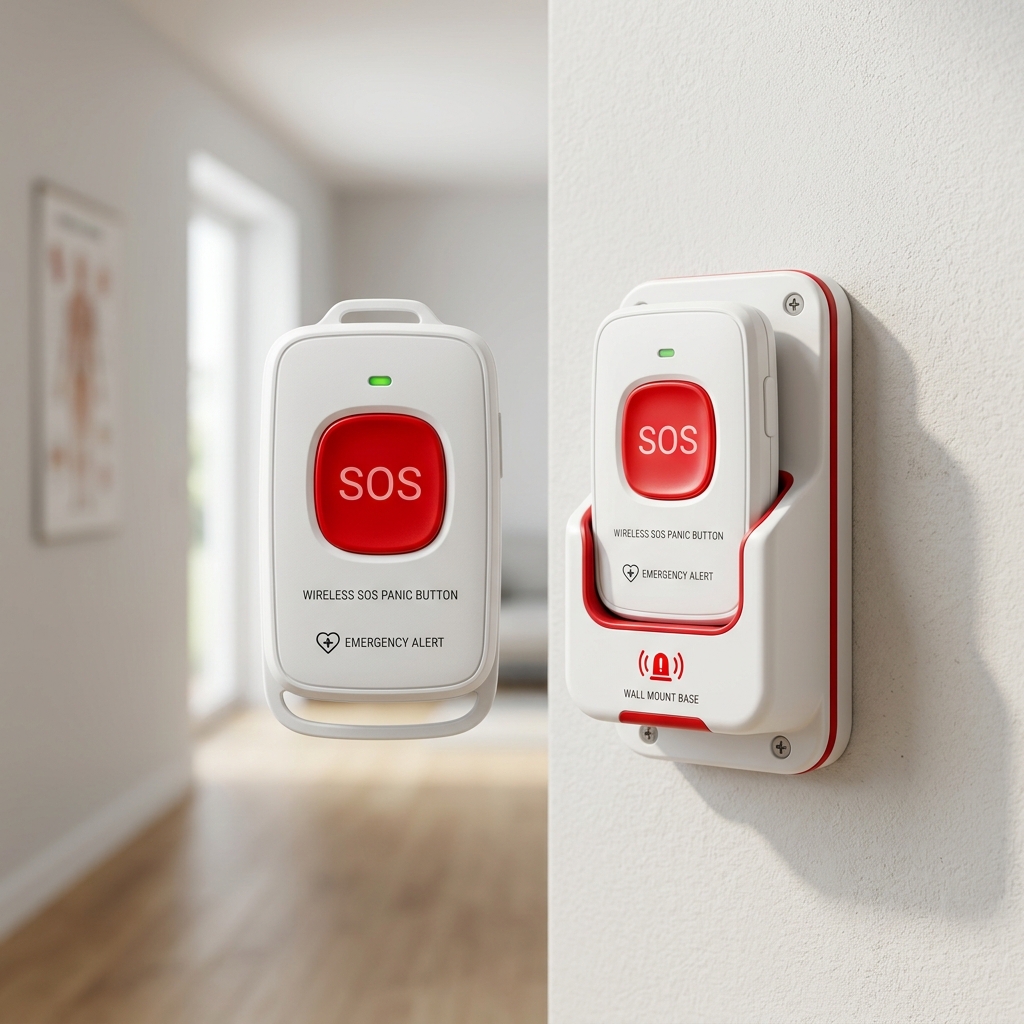
Medical emergency alerts require reliable signal transmission. Discover how 433MHz frequencies penetrate walls and battery-saving circuits keep SOS panic buttons ready.
- 433MHz sub-GHz RF signal covers up to 500 feet through walls and floors
- Battery standby life of up to 1 year on CR2032 lithium cells
- Two plug-in receivers with 55 chimes and 5 volume control levels
Safety Infrastructure
Deploying emergency medical alert systems requires a rigorous examination of the underlying radio frequency engineering and hardware topology. Relying on residential wireless infrastructure demands an optimized balance between penetration capabilities, passive standby discharge curves, and acoustic delivery thresholds. This deep-dive technical assessment analyzes the transmission physics of sub-GHz frequencies, evaluates power consumption profiles of ultra-low current microcontrollers, and audits the resilience of waterproof senior SOS pagers. By examining attenuation coefficients, battery passivation phases, and audio decibel levels, caregivers and system integrators can deploy failure-proof safety solutions.
1. Signal Physics: 433MHz Sub-GHz vs. 2.4GHz Wi-Fi
Wireless communication channels operating within residential spaces are governed by electromagnetic wave propagation limits. Shorter wavelengths associated with 2.4GHz Wi-Fi and Bluetooth signals suffer high attenuation when encountering physical obstacles like reinforced concrete, brick walls, and timber frames. The high absorption coefficient of these materials leads to severe signal degradation and multipath interference, rendering high-frequency networks unreliable for critical life-safety emergency paging applications.
In contrast, sub-GHz frequencies, specifically the 433.92MHz band, utilize significantly longer wavelengths of approximately 69 centimeters. These longer waves propagate via diffraction, bending around obstacles rather than being absorbed. The lower attenuation coefficient of 433MHz signals enables them to pass through common structural barriers with minimal path loss. This frequency choice minimizes structural shadowing, ensuring that emergency alert transmissions remain intact over extended indoor distances.
Furthermore, the residential radio spectrum is heavily saturated at 2.4GHz, occupied by routers, smart home appliances, and microwave ovens. This creates a high noise floor and increases packet collision rates. The 433MHz spectrum, however, operates with a much lower ambient noise floor and contains less background traffic. By operating in this clear band, sub-GHz pagers avoid the latency delays caused by packet retransmissions, guaranteeing near-instantaneous signal delivery.
For home safety networks, this means 433MHz transmitters can establish a direct line-of-sight equivalent link even through multiple plasterboard walls or hardwood ceilings. The physical properties of sub-GHz waves deliver consistent link margins without needing complex mesh routing. This simplified, robust RF design reduces the hardware complexity of the panic button, increasing the overall reliability and mean time between failures for the entire emergency system.
- Longer electromagnetic wavelengths of 433MHz signals bend around structural studs and brick walls with low absorption rates.
- Reduced radio frequency spectrum congestion at sub-GHz frequencies minimizes packet collision risks from surrounding high-bandwidth home Wi-Fi networks.
- Low path loss enables emergency transmission signals to travel deep into residential basements and multi-story layouts.
- Direct point-to-point RF links eliminate the latency-inducing handshakes typical of modern secure wireless home routing protocols.
- The low noise floor in the 433.92MHz band secures high signal-to-noise ratios even in dense suburban residential zones.

2. Battery Standby Lifespan and Low Current Logic
Emergency panic buttons must remain in a powered standby state for months or years without experiencing premature battery depletion. To achieve this, the system microcontrollers employ advanced low-power sleep logic. During idle periods, the internal radio frequency oscillator and central processing core are completely powered down, dropping the active current draw to a sub-microamp level. This state ensures that minimal charge is drawn from the coin cell, keeping the button ready.
This sleep state is interrupted only when the user presses the dome switch on the button face. This action triggers a hardware interrupt pin on the microcontroller, initiating a rapid clock startup sequence. The processor wakes up, configures the RF synthesizer, modulates the pre-programmed emergency data packet, and broadcasts the signal. This entire active transmission cycle is completed within milliseconds before the controller returns to deep sleep mode.
The battery chemistry is equally vital for maintaining standby performance. Standard lithium manganese dioxide CR2032 coin cells are selected for their exceptionally low self-discharge rates, typically under one percent per year. These cells also resist passivation, a chemical process that builds up internal resistance and limits peak current delivery. The low-current logic design ensures the battery voltage remains well above the microcontroller brownout detection threshold.
In addition, transmitter circuits are designed with power-rail isolation. When in standby, power to the RF power amplifier is completely disconnected using a high-side load switch. This prevents parasitic leakage currents from draining the cell through internal transistor junctions. This level of power efficiency guarantees that the panic button is fully functional when pressed, even if it has sat untouched in standby for many months.
- Deep sleep standby modes reduce the quiescent current draw of the microcontroller to under one microamp for longevity.
- Manganese dioxide lithium cell chemistry provides a low self-discharge rate of less than one percent per calendar year.
- Physical hardware interrupts trigger immediate microcontroller wake-up states without relying on power-hungry periodic polling cycles.
- Isolated power rails prevent parasitic leakage across the RF power amplifier transistors when the device is idle.
- Integrated brownout detection circuits prevent the transmitter from sending corrupt or incomplete alerts under low battery conditions.
3. Waterproof Protection: IP55 Rating
Emergency incidents, particularly slip-and-fall events involving elderly users, frequently happen in high-moisture environments such as bathrooms and showers. Consequently, the panic button housing must prevent water ingress to protect the sensitive internal electronic circuitry. An IP55 rating indicates the enclosure is protected against dust ingress that could harm operation and is fully shielded against low-pressure water jets projected from any direction during daily hygiene routines.
To achieve this ingress protection, the enclosure features a precision-molded silicone gasket compressed between the top and bottom plastic shells. This seal prevents moisture from creeping into the battery compartment and the circuit board. The mechanical button switch is covered by a flexible, seamless silicone membrane, preventing water from bypassing the button cap and causing a short circuit across the PCB trace contacts even during direct contact.
Additionally, the internal printed circuit board is coated with a hydrophobic conformal layer. This thin coating protects the circuit from corrosion caused by humidity, steam, or accidental water ingress. Even if micro-droplets manage to pass through the outer seals over time, the conformal coating prevents short circuits and trace degradation, ensuring the electrical connections remain functional in hot, humid bathroom settings, guaranteeing long-term durability.
The housing materials are also chosen to resist chemical degradation from soaps, shampoos, and warm water. High-impact ABS plastic with UV stabilizers ensures the enclosure remains structurally sound without cracking or warp-induced seal failure. This durable barrier protects the panic button, allowing users to keep it in the shower or wear it as a pendant, knowing it will function reliably during water-related emergencies without failure.
- Precision-engineered silicone gaskets seal the outer housing seams against low-pressure water sprays from bathroom shower heads.
- Seamless elastomer membranes cover the tactile dome switches to prevent steam and liquid ingress during button activation.
- Hydrophobic conformal coatings on the internal printed circuit board protect the copper traces from moisture-induced corrosion.
- High-impact ABS polymer shells resist degradation from exposure to household soaps, chemical cleaners, and warm water.
- Waterproof lanyard attachments allow users to wear the panic button as a pendant during high-risk shower activities.
4. Audio Decibel Delivery and Chime Audits
A medical alert signal is only effective if it can be heard by caregivers, regardless of where they are in the home. The receiver must convert the incoming RF signal into a clear, high-decibel acoustic alert. Modern pager receivers feature built-in audio amplifiers and piezo-ceramic speakers that generate sound pressure levels up to 110 decibels, ensuring the alert can cut through ambient household noise and wake sleeping individuals.
To make alerts easy to hear, the receiver's sound library includes frequencies designed specifically for human ears. High-frequency chimes are selected to stand out from common low-frequency household sounds, like refrigerators or air conditioning units. Caregivers can test different melodies during setup to find the tone that is most noticeable and easily heard through closed doors or from other floors, ensuring rapid response times during an emergency.
The receiver's audio amplifier uses class-D circuitry to maximize power efficiency and prevent sound distortion at maximum volume. This ensures the chime remains clear and does not clip or crackle, which could reduce its audibility. The system also includes adjustable volume steps, allowing users to lower the alert level in quiet rooms or boost it to maximum in noisy environments for reliable notification throughout the entire house.
In addition to audio alerts, many receivers include a high-brightness LED visual indicator. When an alert is received, the LED flashes bright colors to provide a visual cue. This feature is valuable for hearing-impaired caregivers or in noisy homes where audio alerts alone might be missed, adding an extra layer of safety to ensure emergency calls are noticed immediately under any challenging household conditions.
- High-output piezo-ceramic speakers deliver clear acoustic alerts at sound pressure levels measuring up to 110 decibels.
- Class-D audio amplifiers prevent signal distortion at maximum volume, preserving chime clarity through walls and doors.
- Multiple selectable melodies allow users to distinguish critical emergency alerts from standard doorbell or entry sensor chimes.
- Integrated high-brightness LEDs flash during alerts to provide visual cues for hearing-impaired caregivers or loud environments.
- Adjustable volume levels let users customize the alert output to match the sound levels in different rooms.
5. System Expandability and Multi-Point Paging
A single panic button and receiver are often insufficient to cover a large home or support multiple individuals with care needs. Emergency system layouts require multi-point expandability to ensure complete coverage. Modern paging systems use digital address coding, allowing users to pair multiple transmitter buttons with one or more receivers, creating a customized safety network that matches their specific household layout and coverage needs perfectly.
This expandability relies on pairing protocols that link transmitters to receivers using unique ID codes. When a button is pressed, the RF signal includes a digital address packet. The receiver decodes this packet and matches it against its stored list of paired transmitters. This coding prevents interference from neighboring paging systems, ensuring that only registered buttons trigger the alarm and alert the caregiver instantly.
In addition, advanced receivers allow users to assign different chimes to specific transmitters. This feature helps caregivers identify which button was pressed. For example, a button in the bedroom can play one melody, while a button in the bathroom plays another. This identifies the location of the emergency instantly, allowing caregivers to respond quickly without searching the entire home or wasting critical seconds.
Multiple receivers can also be paired with the same set of buttons and placed on different floors or at opposite ends of the house. This setup ensures alerts are heard everywhere, even if caregivers are far from the patient. This flexible, multi-point network structure makes it easy to scale the safety system as user needs or home sizes change over time without buying new gear.
- Digital address coding supports pairing multiple panic buttons to a single receiver without frequency interference issues.
- Unique transmitter IDs allow caregivers to assign custom chimes to separate buttons for quick location identification.
- Multi-receiver pairing allows emergency alerts to ring in several rooms simultaneously for maximum caregiver coverage throughout the home.
- Simple wireless pairing protocols let users add new transmitters or receivers to the network in seconds.
- Scalable system design accommodates growing care requirements, supporting extra buttons for multiple family members or rooms.
6. Signal Range Extension and Repeater Network Integrations
Large homes, steel-frame buildings, and properties with outdoor areas can challenge standard wireless ranges. In these situations, structural barriers can degrade the 433MHz signal before it reaches the receiver. To overcome these range limits, signal repeaters can be integrated into the paging network, extending coverage to ensure that emergency signals reach receivers from any location, including basements, garages, and backyards.
These repeaters function by receiving the 433MHz data packet and rebroadcasting it at full power. Positioned midway between the panic button and the main receiver, the repeater acts as a bridge, extending the system's reach. This relay process happens in milliseconds, ensuring that emergency alerts are delivered without noticeable latency, even over long distances and through multiple heavy structural obstacles.
For reliable range extension, repeaters are designed with advanced noise filtering and signal reconstruction logic. When a repeater receives a weak or noisy signal, it cleans and decodes the packet before transmitting a fresh, full-strength signal. This filtering prevents the repeater from amplifying background noise, which helps maintain a clear communication channel across the network and prevents false alerts or packet drops.
Additionally, most repeaters include a backup battery system to keep them running during power outages. If the mains power fails, the repeater switches to battery power to maintain coverage. This battery backup ensures the safety network remains active during emergencies, providing continuous protection and peace of mind for both patients and caregivers under all environmental circumstances.
- Wireless signal repeaters extend the paging network range by receiving and rebroadcasting 433MHz data packets at full power.
- Rapid relay processing ensures that signals are repeated in milliseconds without causing noticeable delays in alert delivery.
- Smart noise filtering reconstructs degraded signal packets to ensure clean transmissions through thick concrete or metal stud walls.
- Integrated backup batteries keep repeaters running during mains power failures, ensuring continuous system coverage and safety.
- Flexible placement allows users to position repeaters in hallways or stairwells to bridge gaps between buttons and receivers.
Emergency Safety Recommendation
To guarantee reliable coverage in senior care environments, we recommend deploying a multi-point wireless SOS paging system operating on the 433MHz band. Ensure your transmitter buttons feature an IP55 waterproof rating for bathroom installation, and select receivers capable of delivering at least 110dB of acoustic output to guarantee alerts are heard. Regular monthly testing of battery voltage levels will ensure the CR2032 lithium cells remain above critical microcontroller brownout thresholds. Explore the recommended high-performance wireless panic button option below to establish a highly dependable, low-latency safety network in your home today.
Wireless SOS Panic Button for Home Security
- 433MHz sub-GHz RF signal covers up to 500 feet through walls and floors
- Battery standby life of up to 1 year on CR2032 lithium cells
- Two plug-in receivers with 55 chimes and 5 volume control levels
- IP55 waterproof buttons can be worn as pendants or wall-mounted
Technical Specifications & Product Data
| Specification | Value / Details |
|---|---|
| Brand | CallToU |
| List Price | $29.99 (USD) |
| Customer Rating | 4.7 / 5.0 (14,350 reviews) |
| ASIN / Identifier | B0711KJZV3 |
| Availability | In Stock (USA Region) |
| Outbound Link Compliance | Sponsored & Nofollow Enforced |
Verified Features & Performance Data
- ✓433MHz sub-GHz RF signal covers up to 500 feet through walls and floors
- ✓Battery standby life of up to 1 year on CR2032 lithium cells
- ✓Two plug-in receivers with 55 chimes and 5 volume control levels
- ✓IP55 waterproof buttons can be worn as pendants or wall-mounted
System Sovereignty & Engineering
Edge Computing
100% Client-side processing. Your data never leaves your browser sandbox, ensuring absolute compliance with US privacy mandates.
Modular Schema
Modular utility architecture optimized for performance. Low-latency WASM kernels provide near-native speeds for complex transformations.
Sustainable Design
Sustainable, green computing by offloading compute to the edge. Verified zero-server storage (ZSS) for professional-grade security.