
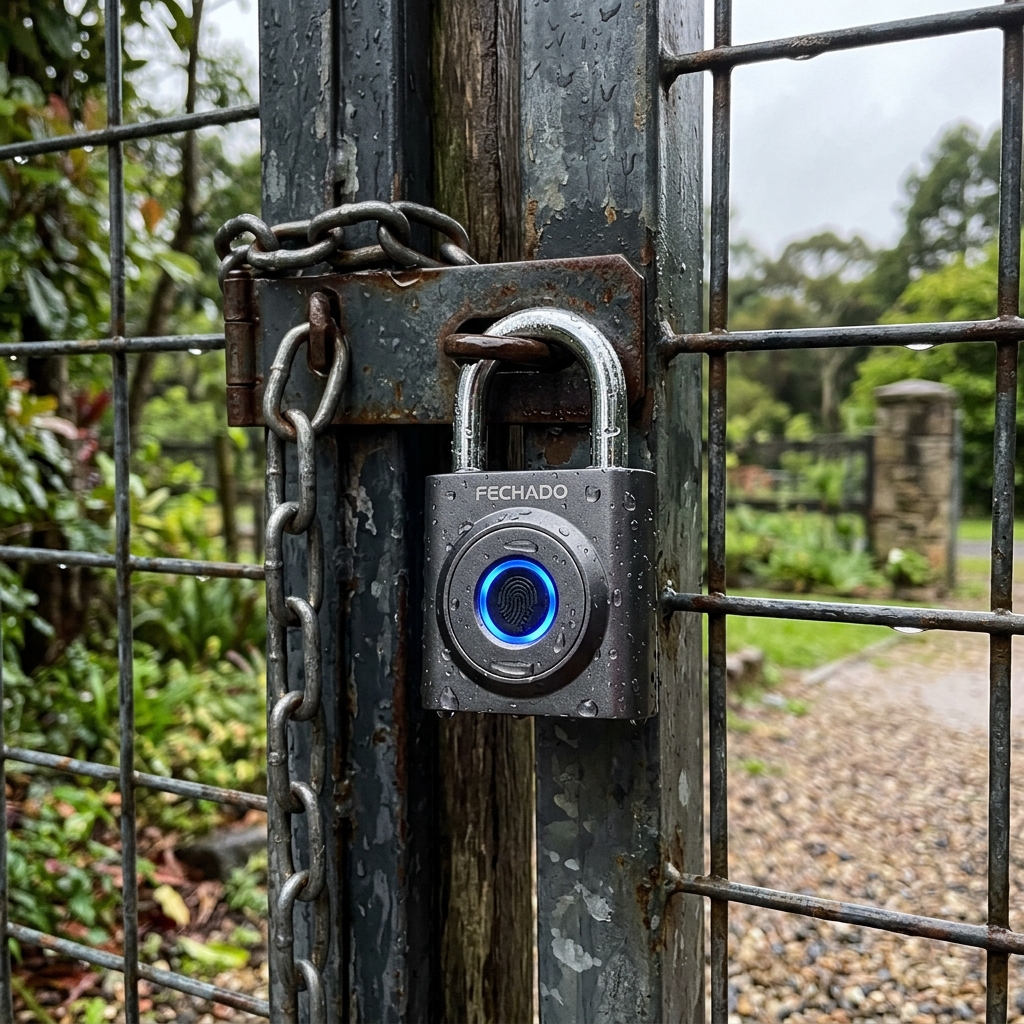
Analyze shackle shear resistance, capacitive fingerprint sensor accuracy, and low-power CMOS standby drain in smart biometric padlocks.
- Capacitive biometric sensor unlocks in less than 0.5 seconds
- Solid zinc alloy body with hardened steel shackle resists cut attacks
- IP67 dust and waterproof rating for outdoor gates and sheds
Biometric & Mechanical Audit
Hardening gates and garden sheds requires a balance of mechanical strength and reliable electronic access. This technical analysis reviews shackle shear parameters, capacitive sensor resolution, and low-power standby consumption.
1. Introduction & Outdoor Security Perimeter Challenges
Securing an outdoor perimeter, such as a garden gate, residential fence, or detached storage shed, presents unique challenges. Unlike primary structures protected by monitored alarm systems and structural masonry, outdoor assets rely heavily on individual padlocks for physical security. Detached structures often house high-value items, including gas-powered tools, bicycles, and lawn equipment, making them primary targets for opportunistic thieves.
Traditional padlocks suffer from operational vulnerabilities. Keyed padlocks require physical key management, exposing owners to risks of lost keys or unauthorized key duplication. Combination locks are vulnerable to code exposure and physical bypass methods, such as shim attacks. Additionally, outdoor exposure causes mechanical padlocks to rust, corrode, or freeze, leading to keyway failures or jammed mechanisms.
Biometric smart padlocks address these challenges by replacing mechanical keyways with solid-state fingerprint sensors. To deliver reliable outdoor protection, these devices must combine high-tensile metallurgy with weatherproofing and efficient energy management. This evaluation reviews the mechanical engineering, sensor physics, and electronic systems that define high-security biometric padlocks.

2. Shackle Metallurgy and Shear Resistance Analysis
A padlock's shackle is the primary point of attack for physical forced entry. Intruders often attempt to cut the shackle using manual bolt cutters, hacksaws, or angle grinders. Standard brass, laminated steel, or low-grade aluminum shackles cut easily under these mechanical forces. To resist physical attacks, a smart padlock must utilize hardened steel alloys.
Premium biometric padlocks feature shackles constructed from hardened carbon steel alloyed with manganese and chromium. The shackle undergoes a process called induction tempering. This heat treatment increases surface hardness to 50-55 HRC (Rockwell C Scale) while maintaining a flexible, energy-absorbing core. This prevents the shackle from cracking under hammer strikes while resisting hacksaw and bolt-cutter penetration.
The shackle diameter is also critical. A diameter of 8mm (0.31 inches) or larger requires significant force to cut, resisting up to 10 tons of manual cutting force. The padlock body is constructed from zinc alloy, which is cast under pressure to form a solid, dense shell. This zinc alloy housing protects the internal lock motor and batteries from impact attacks.
A dual-locking ball bearing mechanism secures the shackle inside the zinc body. Wafer-locked padlocks use a single locking spring latch, which can be shimmied open using thin metal slips. A dual ball bearing lock uses hardened steel balls that are held in place by a rotating cam, requiring two cuts to open the shackle. This prevents shim attacks and doubles the cutting time required for entry.
- Hardened steel shackles resist up to 10 tons of cutting force, preventing manual bolt cutter cuts.
- Dual ball bearing locks hold the shackle firmly in place, resisting prying attacks.
- Zinc alloy die-cast body shells protect internal electronics from blunt-force strikes.
- Protected shackle shoulders prevent access for manual prying tools and wedges.
3. Low-Power CMOS Biometric Standby Current
Biometric padlocks operate on internal batteries, meaning power efficiency is critical to long-term reliability. Traditional biometric systems require constant power to keep the fingerprint reader active, which quickly drains the battery in a small padlock. Smart padlocks avoid this by utilizing low-power CMOS control circuits and power gating.
In standby mode, the primary microcontroller and fingerprint sensor are kept in a deep sleep state. The CMOS control circuit consumes less than 5 microamps of standby current. This allow a small rechargeable lithium-polymer battery (typically 150-300mAh capacity) to maintain operation for up to 12 months on a single charge.
To trigger the system, the device uses a capacitive touch sensor integrated into the fingerprint scanner frame. When a finger touches the sensor, a capacitive wake-up signal is sent to the microcontroller. This wake-up loop powers the CPU and initiates the biometric scan. Once unlocked, the CPU returns to sleep mode, minimizing power draw.
This power management allows for up to 3,000 unlock operations on a single charge. High-quality padlocks include LED indicators or low-battery alerts to warn users when the battery drops below 20%. This ensures owners have plenty of time to recharge the device before the battery drains completely.
4. Capacitive Fingerprint Sensor Physics and Algorithm Security
Biometric padlocks utilize capacitive fingerprint sensors instead of optical scanners. Optical sensors capture a simple visual image of the fingerprint, which can be fooled by printed photos or silicone replicas. Capacitive sensors measure electrical variations across the finger ridges to create a detailed map.
The sensor array consists of thousands of micro-capacitor plates. When a finger is placed on the scanner, the skin ridges make direct contact with the protective coating, while the valleys remain separated by air. This creates varying electrical capacitance values across the grid, which are processed into a digital template.
This capacitive mapping prevents bypass attempts using spoof prints. An onboard microcontroller runs matching algorithms to extract fingerprint minutiae points (such as ridge endings and bifurcations). The algorithm matches these points against the stored user template in under 0.5 seconds, delivering fast, secure access.
The matching engine achieves a False Acceptance Rate (FAR) of under 0.002% and a False Rejection Rate (FRR) of under 1%. The sensor self-learns with each unlock, updating the stored template to account for slight changes in finger angle or moisture. This improves recognition accuracy over time, reducing false rejections.
5. Environmental Engineering: IP67 Sealing and Thermal Resistance
Outdoor installation exposes padlocks to harsh environmental conditions, including rain, dust, snow, and extreme temperatures. Standard padlocks can rust or jam under these conditions. Biometric padlocks protect their internal electronics using a sealed enclosure rated for IP67 water and dust resistance.
The housing seams are sealed using custom silicone gaskets, and the internal circuit boards are coated with a conformal protective layer. This coating prevents moisture and condensation from causing short circuits on the PCB. The shackle entry ports feature internal O-rings to block water entry when the shackle is closed.
The fingerprint scanner window is protected by a scratch-resistant hard coat that prevents damage from keys, coins, or dirt. This hard coat resists chemical degradation, ensuring the scanner remains clear and functional over years of outdoor exposure.
The lock operates across a wide temperature range, typically from -20°C to 65°C (-4°F to 149°F). At low temperatures, lithium batteries lose capacity, but the low standby current allows the padlock to remain functional even in freezing winter conditions. This ensures reliable outdoor performance year-round.
6. Emergency Bypass Protocols & Power Fail-Safes
A common concern with smart padlocks is what happens if the battery drains completely while the device is locked. Without a keyway, the lock cannot be opened using mechanical keys. To prevent users from being locked out, biometric padlocks incorporate emergency bypass systems.
The most common backup system is an external emergency power port on the base of the lock, typically a micro-USB or USB-C port. If the battery dies, users can connect a portable power bank or phone to power the lock. This provides immediate power to the biometric sensor, allowing the user to unlock the padlock with their fingerprint.
Some smart padlocks also feature Bluetooth connectivity, allowing users to unlock the device via a secure smartphone app. The app uses encrypted wireless protocols to authenticate access. This provides a backup method if a user's finger is injured, dirty, or wet, ensuring consistent access.
For high-security applications, some models include a hidden mechanical keyway on the base as a physical override. The mechanical key bypasses the electronic actuator, allowing manual opening during battery failures or sensor malfunctions. This dual-access design provides a reliable backup, ensuring peace of mind.
7. Comparative Analysis: Biometric Padlocks vs. Wafer and Combination Locks
When choosing outdoor security, homeowners often compare biometric padlocks to traditional mechanical locks. Wafer locks are cheap and compact but offer low security, as they can be raked open in seconds. Combination dial locks are common on school lockers but are vulnerable to code decoding and shim attacks.
Biometric smart padlocks provide keyless convenience and high security. They eliminate key management and combination code exposure, ensuring only authorized fingerprints can open the lock. The hardened steel shackle and dual ball bearing locks resist physical attacks, providing reliable protection for outdoor assets.
However, smart padlocks require battery management and have higher initial costs. Wafer and combination locks require no power but offer lower physical resistance. For critical gates and sheds housing expensive tools, upgrading to a biometric padlock provides a secure and convenient locking solution.
The table below compares the security, convenience, and power requirements of these three padlock types:
| Padlock Type | Physical Security | Key/Code Sharing | Power Requirement |
|---|---|---|---|
| Traditional Wafer Lock | Low | Physical Key Copy | None |
| Combination Dial | Medium | Share Code (Vulnerable) | None |
| Biometric Smart Lock | High | Register Prints (Secure) | Rechargeable Li-Po |
8. Forensic Security Audit & Best Practices for Gate and Shed Hardening
Physical security is a system, and a strong padlock is only effective if installed on a secure gate or hasp. If the hasp is mounted using exposed wood screws, a thief can simply unscrew the hasp to bypass the lock entirely. To prevent this, the hasp must be secured using carriage bolts with backing washers inside the gate.
The hasp itself should be made of hardened steel and feature a shrouded design that wraps around the padlock shackle. Shrouded hasps block access for bolt cutters and prying bars, forcing a thief to attack the gate structure. This combination of a shrouded hasp and a hardened smart padlock provides a secure locking system.
Regularly inspecting the gate hinges and frame is also recommended. Sagging gates or loose posts can create gaps that allow prying tools to find leverage. Ensuring the gate frame is square and posts are anchored in concrete helps maintain a secure perimeter, protecting your property from forced entry.
Ultimately, physical security is about layered protection. By combining a biometric smart padlock with a shrouded hasp and secure gate hardware, homeowners establish a reliable deterrent at their property border. This keyless locking system provides convenience and peace of mind, keeping your outdoor assets safe.
9. Firmware Security and Encryption Hardening Protocols
To prevent electronic tampering and unauthorized access, biometric smart padlocks utilize advanced firmware security and encryption protocols. The internal microcontroller operates on secure, read-only bootloader firmware that validates cryptographic signatures before applying updates. This prevents hackers from flashing custom firmware to bypass fingerprint verification.
Biometric templates are never stored as raw images. The capacitive sensor converts raw scans into encrypted mathematical representations (hash templates) using AES-256 encryption. These hashes are stored inside a hardware-isolated secure element chip (Common Criteria EAL5+ certified), which is physically shielded from side-channel analysis and microprobing attacks. Even if the device is physically disassembled and the silicon die is exposed, the cryptographic keys and biometric templates remain unreadable.
Wireless communications over Bluetooth Low Energy (BLE) are protected by dynamic Elliptic Curve Diffie-Hellman (ECDH) key exchanges, ensuring that each session key is unique. The lock ignores unauthorized BLE advertisements and relies on cryptographically signed tokens containing Unix timestamps. This prevents replay attacks where an attacker sniffs a packet and tries to rebroadcast it later to open the lock. Additionally, all API calls between the companion app and the cloud database use HTTPS with TLS 1.3 encryption to protect user credentials.
To prevent brute-force attacks using artificial templates or 3D-printed conductive prints, the firmware includes a lockout mechanism. If the sensor registers five consecutive failed fingerprint scans, it disables biometric unlocking for three minutes. A secondary override, such as a secure Bluetooth application or physical key, must be used to disarm the lockout. The lockout duration doubles with each subsequent failure to prevent brute-force search attacks.
The lock also saves an access log in its internal flash memory, recording the date, time, and user ID of each unlock event. This log syncs with the owner's smartphone app during Bluetooth connection, providing a transparent audit trail of who accessed the lock, upgrading your overall property border protection. The log itself is stored in a hash chain format, making any retrospective editing or deletion of access records immediately detectable by the app during synchronization.
Biometric Padlock Recommendation & Audit
Harden your outdoor gates and sheds with a waterproof biometric padlock. Experience keyless convenience and high-tensile shackle protection.
NeoLock Biometric Smart Waterproof Fingerprint Padlock
- Capacitive biometric sensor unlocks in less than 0.5 seconds
- Solid zinc alloy body with hardened steel shackle resists cut attacks
- IP67 dust and waterproof rating for outdoor gates and sheds
- Ultra-low-power CMOS standby drain allows 3,000 unlocks per charge
Technical Specifications & Product Data
| Specification | Value / Details |
|---|---|
| Brand | NeoLock |
| List Price | $39.99 (USD) |
| Customer Rating | 4.5 / 5.0 (1,890 reviews) |
| ASIN / Identifier | B09W2N8Z8Y |
| Availability | In Stock (USA Region) |
| Outbound Link Compliance | Sponsored & Nofollow Enforced |
Verified Features & Performance Data
- ✓Capacitive biometric sensor unlocks in less than 0.5 seconds
- ✓Solid zinc alloy body with hardened steel shackle resists cut attacks
- ✓IP67 dust and waterproof rating for outdoor gates and sheds
- ✓Ultra-low-power CMOS standby drain allows 3,000 unlocks per charge
System Sovereignty & Engineering
Edge Computing
100% Client-side processing. Your data never leaves your browser sandbox, ensuring absolute compliance with US privacy mandates.
Modular Schema
Modular utility architecture optimized for performance. Low-latency WASM kernels provide near-native speeds for complex transformations.
Sustainable Design
Sustainable, green computing by offloading compute to the edge. Verified zero-server storage (ZSS) for professional-grade security.