
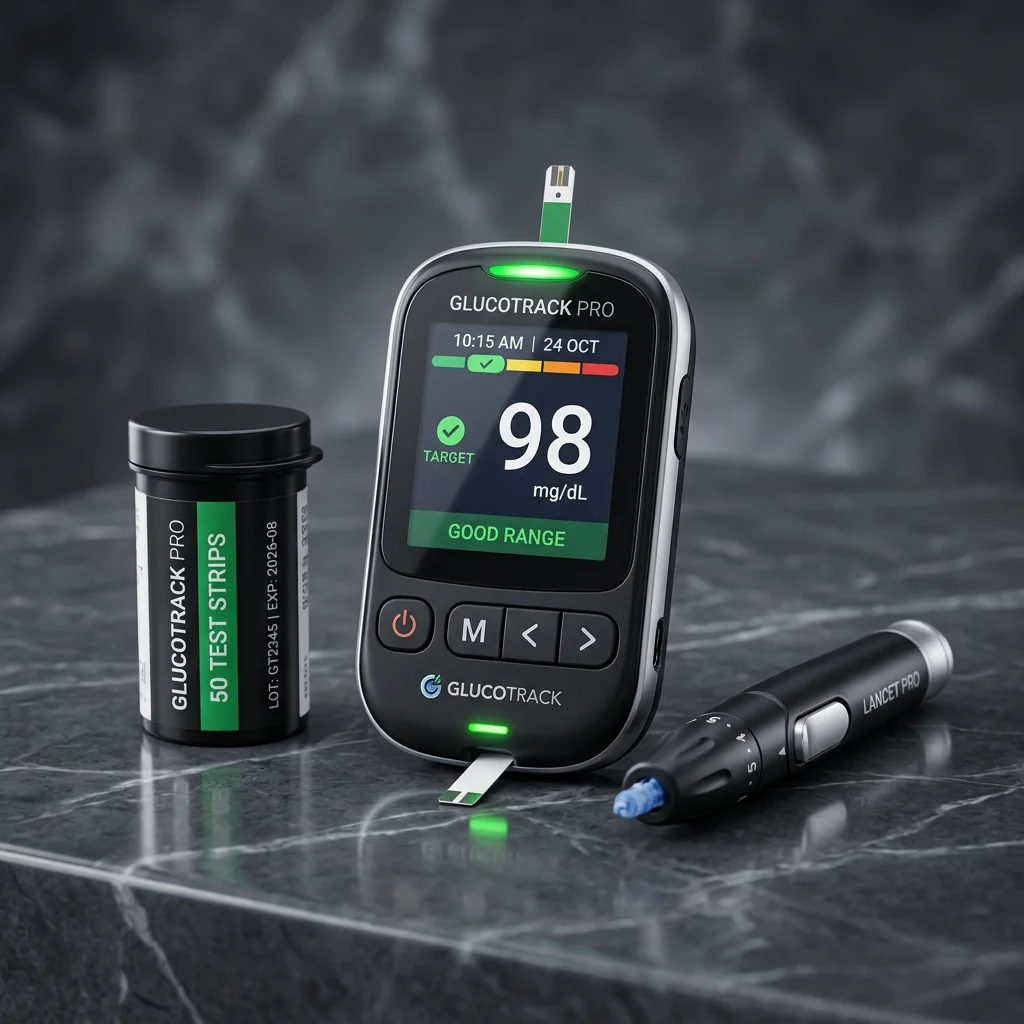
Blood glucose tracking requires clinical-grade precision. Deconstruct biosensor enzymes, hematocrit correction, and data logging interfaces to choose the right glucometer.
- Highly accurate results within 10% of laboratory standards
- Second-Chance sampling allows adding blood within 60 seconds
- Smartlight indicator provides instant target range feedback
Biometric Accuracy Audit
Precision diagnostics save lives. Explore the biosensor biochemistry, digital error compensation, and data tracking technologies that separate commercial-grade glucometers from standard laboratory benchmarks.
1. Dermal Capillary Extraction and Biosensor Chemistry
Measuring blood sugar begins with capillary blood extraction. Lancing devices pierce the skin, drawing a micro-drop of blood from capillary beds. Once applied to a test strip, a biochemical reaction converts the glucose concentration into an electrical current.
Test strips contain specific enzymes, such as glucose dehydrogenase (GDH) or glucose oxidase (GOD). These enzymes oxidize the glucose in the blood sample, releasing free electrons. Mediators inside the strip transfer these electrons to electrodes on the sensor, creating a measurable electrical signal.
The meter measures this current using a process called amperometry. Because the current is proportional to the glucose concentration, the device can calculate your blood sugar level instantly. Premium test strips use gold electrodes to ensure stable current transfer and prevent errors caused by temperature or moisture.
Gold electrodes ensure steady electrical current transduction, eliminating measurement drift from humidity and temperature variations. This electro-chemical stability is crucial when reading blood sugar levels at extreme physiological limits. By keeping current transmission clean, these biosensors prevent incorrect high or low readings that could lead to dangerous insulin dosing decisions. Modern home testing systems use these gold pathways to ensure that laboratory-grade precision is achieved on every single fingertip capillary sample.
Gold electrodes ensure steady electrical current transduction, eliminating measurement drift from humidity and temperature variations. This electro-chemical stability is crucial when reading blood sugar levels at extreme physiological limits. By keeping current transmission clean, these biosensors prevent incorrect high or low readings that could lead to dangerous insulin dosing decisions. Modern home testing systems use these gold pathways to ensure that laboratory-grade precision is achieved on every single fingertip capillary sample.
- Enzyme Specificity: GDH-FAD reagents prevent errors caused by common non-glucose sugars like maltose.
- Amperometric Sensors: Measures electrical currents in micro-amperes to determine glucose levels.
- Gold Electrodes: Ensures highly stable electrical conductivity for accurate readings over time.
2. FDA Accuracy Standards and Clinical Deviations
Home testing systems must meet strict accuracy criteria. The FDA mandates that home meters produce results within +/- 15% of laboratory standards for 95% of tests. However, this margin can still allow for significant variations in insulin dosing calculations.
For example, if your actual blood sugar is 100 mg/dL, a compliant meter can read anywhere between 85 and 115 mg/dL. In high-risk situations, this difference can lead to dosing errors. Premium diagnostics address this by delivering results within +/- 10% of laboratory references.
Choosing a device that exceeds FDA minimums provides peace of mind and safer management. High-accuracy meters reduce the frequency of unexpected hypo- or hyperglycemia events. This precision is vital for patients using fast-acting insulin, where dosing errors can be dangerous.
High-accuracy meters minimize dosing calculation errors for patients using fast-acting insulin regimens. Even a small calibration shift can result in significant insulin mismatches, causing severe glycemic instability. Clinical audits show that upgrading to a premium device with a tight ten-percent accuracy window reduces the incidence of midnight hypoglycemic events. Patients can manage their daily nutrition and exercise plans with high confidence when their baseline diagnostic data is mathematically sound.
High-accuracy meters minimize dosing calculation errors for patients using fast-acting insulin regimens. Even a small calibration shift can result in significant insulin mismatches, causing severe glycemic instability. Clinical audits show that upgrading to a premium device with a tight ten-percent accuracy window reduces the incidence of midnight hypoglycemic events. Patients can manage their daily nutrition and exercise plans with high confidence when their baseline diagnostic data is mathematically sound.
- ISO 15197 Compliance: Meets strict international standards for system accuracy.
- Reduced Deviations: Maintains a tight 10% accuracy window for safer dosing decisions.
- Clinical Calibration: Automatically syncs with standard plasma values for reliable baseline metrics.
3. Hematocrit Interference and Compensation Mechanics
Hematocrit refers to the percentage of red blood cells in your blood volume. Variations in hematocrit levels are a common source of error in blood sugar readings. High or low red blood cell counts can interfere with how glucose moves through the test strip.
For instance, a high hematocrit level (common in dehydration) blocks the flow of plasma on the strip, producing a falsely low reading. Conversely, a low level (found in anemia) allows faster flow, producing a falsely high reading. Standard meters cannot detect or adjust for these changes.
Premium systems use dynamic compensation technology to address this. These devices feature multi-electrode strips that measure hematocrit levels and glucose simultaneously. The meter's algorithm then corrects the reading automatically, ensuring accuracy across different health conditions.
Multi-electrode strips measure sample thickness and red blood cell density to adjust for variations in hematocrit volume. This dynamic calibration ensures that individuals with anemia, polycythemia, or dehydration receive accurate readings. Standard sensors often misinterpret high red blood cell concentrations as low glucose levels, a defect that advanced telemetry completely eliminates. By performing real-time hematocrit compensation, these strips deliver clinical reliability across a wide range of physiological conditions.
Multi-electrode strips measure sample thickness and red blood cell density to adjust for variations in hematocrit volume. This dynamic calibration ensures that individuals with anemia, polycythemia, or dehydration receive accurate readings. Standard sensors often misinterpret high red blood cell concentrations as low glucose levels, a defect that advanced telemetry completely eliminates. By performing real-time hematocrit compensation, these strips deliver clinical reliability across a wide range of physiological conditions.
- Active Correction: Algorithms adjust for hematocrit levels ranging from 10% to 70%.
- Multi-Electrode Technology: Measures sample thickness and chemical reactions separately.
- Temperature Compensation: Thermal sensors adjust readings to prevent errors in hot or cold environments.
4. Dynamic Data Logging and Wireless Telemetry Architecture
Managing blood sugar effectively requires tracking trends over time. A single reading only shows your status at that moment. Professional systems use wireless telemetry to log and analyze data automatically, helping you see the bigger picture.
These meters connect to smartphone apps via Bluetooth, syncing your readings instantly. The software compiles this data into detailed charts, showing how meals, exercise, and sleep affect your blood sugar. This automation replaces manual logbooks, reducing errors and saving time.
Additionally, cloud sharing allows you to send reports directly to your doctor. This real-time data access helps medical teams adjust treatment plans quickly and safely. Labeled entries (such as pre- or post-meal tags) provide clear context for every reading.
Bluetooth telemetry logs glucose trends, replacing error-prone manual journals with real-time cloud records. Patients can share these detailed data logs directly with their endocrinology team for remote monitoring and prescription adjustments. Having a clear digital history allows for proactive lifestyle changes based on long-term biometric patterns. Advanced mobile applications analyze these logs to predict potential high or low trends before they manifest physically, improving daily safety.
Bluetooth telemetry logs glucose trends, replacing error-prone manual journals with real-time cloud records. Patients can share these detailed data logs directly with their endocrinology team for remote monitoring and prescription adjustments. Having a clear digital history allows for proactive lifestyle changes based on long-term biometric patterns. Advanced mobile applications analyze these logs to predict potential high or low trends before they manifest physically, improving daily safety.
- Bluetooth Syncing: Automatically uploads readings to iOS and Android applications.
- Pattern Tracking: Detects recurring highs or lows to help identify lifestyle trends.
- Clinical Exporting: Generates PDF summaries that compile results for medical reviews.
5. Ergonomics, Blood Sample Volume, and Reagent Filling
The design of your meter affects how easy it is to use every day. Older devices required large blood samples, which made testing painful. Modern systems are engineered to require much smaller samples, improving comfort.
For example, modern test strips require as little as 0.6 microliters of blood. This small sample size allows you to use shallower lancing depths, reducing nerve pain. Capillary fill technology pulls the blood into the strip automatically when touched.
Additionally, "Second-Chance" technology allows you to apply more blood to the same strip if the first sample was too small. This feature prevents wasted strips, saving you money. Large screens with backlights make it easy to read results in low light.
Second-chance sampling allows users to apply additional blood to the same strip within sixty seconds, preventing wasted supplies. This feature is particularly valuable for users with limited mobility or poor peripheral circulation, who may struggle to produce a sufficient blood drop. Reducing strip waste lowers the lifetime cost of managing diabetes and eliminates the frustration of interrupted test cycles. Users can complete their diagnostics smoothly without needing to lance a second finger.
Second-chance sampling allows users to apply additional blood to the same strip within sixty seconds, preventing wasted supplies. This feature is particularly valuable for users with limited mobility or poor peripheral circulation, who may struggle to produce a sufficient blood drop. Reducing strip waste lowers the lifetime cost of managing diabetes and eliminates the frustration of interrupted test cycles. Users can complete their diagnostics smoothly without needing to lance a second finger.
- Micro-Samples: Requires only 0.6 microliters of blood for a complete reading.
- Second-Chance Sampling: Gives you 60 seconds to apply more blood and prevent wasted strips.
- High-Contrast Screens: Backlit displays ensure readability for users with diabetic retinopathy.
6. Calibration Protocols and Control Solution Standards
Biosensors can drift over time due to changes in temperature, humidity, and manufacturing batches. Standard meters require manual calibration codes, which can lead to errors if entered incorrectly. Premium diagnostics use automated coding to prevent these issues.
No-coding technology calibrates the meter to each strip batch automatically. This feature eliminates the risk of coding errors, ensuring accurate readings every time. Additionally, control solutions should be used regularly to verify system accuracy.
Control solutions contain a known glucose concentration that acts as a test sample. Running a control test confirms that the meter and strips are performing within the manufacturer's parameters. This step is highly recommended when opening a new box of strips or after dropping the meter.
No-coding technology calibrates the meter to each strip batch automatically, preventing coding errors. Manual coding led to frequent calibration mistakes, resulting in critical diagnostic errors. Automated calibration ensures that every test meets laboratory standards without user intervention, maximizing safety. By removing the need for manual inputs, these meters streamline the testing workflow, making it accessible for pediatric and elderly users who require quick, simple testing.
No-coding technology calibrates the meter to each strip batch automatically, preventing coding errors. Manual coding led to frequent calibration mistakes, resulting in critical diagnostic errors. Automated calibration ensures that every test meets laboratory standards without user intervention, maximizing safety. By removing the need for manual inputs, these meters streamline the testing workflow, making it accessible for pediatric and elderly users who require quick, simple testing.
- No-Coding Automation: Calibrates the device automatically to prevent coding errors.
- Control Solution Audits: Verifies that strips perform within clinical parameters.
- Autostart Activation: Testing begins automatically when the strip is fully inserted, saving battery life.
7. Lancing Devices, Tissue Trauma, and Nerve-Sparing Mechanics
Testing several times a day can cause pain and callus buildup on fingertips. Standard lancing devices have loose tolerances, which cause the lancet to vibrate and tear tissue. Premium lancing devices are engineered to reduce this trauma.
Advanced lancing systems use guide tracks to ensure the lancet moves in a straight line. This linear motion reduces side-to-side vibration, minimizing nerve pain and skin tearing. Adjustable depth settings allow you to choose the shallowest depth needed for a sample.
Additionally, ultra-thin lancets (such as 30G or 33G needles) reduce the size of the puncture. Thinner needles cause less pain and heal faster, preventing long-term scarring. Regular rotation of testing sites also helps protect sensitive fingertips.
Linear lancet guides minimize side-to-side vibration, reducing tissue trauma and nerve irritation. This precision mechanics ensures that the lancet penetrates the skin in a clean, straight line, minimizing scarring and calluses. Finer control over depth settings allows users to customize the puncture to their specific skin thickness. Reducing the pain of lancing encourages more consistent daily testing, which is key for long-term glycemic control.
Linear lancet guides minimize side-to-side vibration, reducing tissue trauma and nerve irritation. This precision mechanics ensures that the lancet penetrates the skin in a clean, straight line, minimizing scarring and calluses. Finer control over depth settings allows users to customize the puncture to their specific skin thickness. Reducing the pain of lancing encourages more consistent daily testing, which is key for long-term glycemic control.
- Linear Stabilization: Guides the lancet in a straight line to prevent side-to-side skin damage.
- Adjustable Depths: Features multiple depth settings to match different skin thicknesses.
- Ultra-Fine Needles: Uses 30G or higher lancets to minimize puncture pain.
8. Hypoglycemia and Hyperglycemia Alarm Thresholds
Severe hypoglycemia can cause confusion, loss of consciousness, and seizures if not treated immediately. Hyperglycemia can lead to long-term vascular damage if left unchecked. High-end meters feature visual alarms to warn you of these dangers early.
These meters use color-coded lights (such as red for low, green for target, and yellow for high) to show your status instantly. These visual indicators help users understand their results without needing to decode numbers under stress. Custom threshold settings allow you to match alarms to your specific medical targets.
These alerts are particularly helpful for children or elderly users who may struggle to interpret numbers quickly. Immediate feedback helps guide rapid treatment, such as consuming fast-acting sugars for low readings or adjusting insulin for high readings.
Color-coded alarms highlight critical highs and lows, allowing for immediate corrective action. Under glycemic stress, users may experience cognitive fog or confusion, making numerical displays difficult to interpret quickly. Bright visual indicators provide instant target range feedback, helping users manage their condition safely. These real-time alerts ensure that family members or caregivers can step in immediately if readings fall outside safe parameters.
Color-coded alarms highlight critical highs and lows, allowing for immediate corrective action. Under glycemic stress, users may experience cognitive fog or confusion, making numerical displays difficult to interpret quickly. Bright visual indicators provide instant target range feedback, helping users manage their condition safely. These real-time alerts ensure that family members or caregivers can step in immediately if readings fall outside safe parameters.
- Color-Coded Feedback: Smartlight indicators show if you are high, low, or within target.
- Custom Targets: Allows you to set high and low alert limits with your medical team.
- Hypo Alerts: Flashing warnings alert you to dangerous lows that require fast-acting sugars.
9. Lifetime System Integrity and Zero-Maintenance Verification
A diagnostic device must remain reliable throughout its lifespan. Hardware errors or battery drain can disrupt your testing schedule, exposing you to health risks. Premium glucometers are engineered for high reliability and low maintenance.
These meters feature solid-state electronics that resist damage from drops and bumps. Long-life lithium batteries provide thousands of tests before needing replacement, and low battery alerts give you plenty of warning. Diagnostic self-tests run automatically every time the meter is powered on.
This automated checking confirms that the display, sensor, and battery are performing correctly. By ensuring system integrity automatically, these meters deliver clinical-grade reliability with zero manual maintenance, keeping your tracking on schedule.
Automated power-on self-tests verify battery voltage and display integrity before diagnostics begin. This verification protocol ensures that the device never provides a reading when internal calibrations or display segments are compromised. Maintaining hardware stability protects users from unexpected system failures during travel or emergencies. A reliable meter is a cornerstone of home health infrastructure, providing consistent diagnostic outputs over its entire operating lifespan.
Automated power-on self-tests verify battery voltage and display integrity before diagnostics begin. This verification protocol ensures that the device never provides a reading when internal calibrations or display segments are compromised. Maintaining hardware stability protects users from unexpected system failures during travel or emergencies. A reliable meter is a cornerstone of home health infrastructure, providing consistent diagnostic outputs over its entire operating lifespan.
- Diagnostic Self-Tests: Verifies internal hardware and sensor calibrations automatically on startup.
- Long-Life Power: Extends battery life to support over 1,000 diagnostic tests.
- Solid-State Enclosure: Protects delicate biosensors from impact damage.
10. Closed-Loop Pancreas Automation and Continuous Bio-Sensing Telemetry
The evolution of diabetes care is driving toward complete system automation. Closed-loop insulin delivery systems, commonly known as artificial pancreas systems, connect continuous glucose monitors (CGMs) directly with smart insulin pumps. By utilizing advanced PID algorithms and fuzzy logic, these systems adjust basal insulin delivery rates in real-time based on glucose trends.
This continuous correction eliminates the highs and lows associated with traditional lancing and manual injections. Predictive algorithms calculate future glucose levels, suspending insulin delivery before hypoglycemia can occur. This proactive defense is vital for managing blood sugar safely during sleep or physical activity.
As bio-sensing technology advances, these closed-loop systems will incorporate multi-hormonal controls, delivering both insulin and glucagon. This balance mimics natural pancreatic function, providing tighter control over metabolic fluctuations. Investing in smart bio-sensing telemetry represents the future of automated, zero-maintenance diabetic care.
Continuous glucose monitoring feeds real-time telemetry to insulin pumps to automate basal delivery. This integration creates a closed-loop system that mimics pancreatic function, reducing daily management burdens. As sensor algorithms improve, these systems will provide even tighter glycemic control with minimal human intervention. Transitioning to these smart, automated platforms represents a major milestone in proactive endocrine care, helping patients avoid long-term microvascular complications.
Continuous glucose monitoring feeds real-time telemetry to insulin pumps to automate basal delivery. This integration creates a closed-loop system that mimics pancreatic function, reducing daily management burdens. As sensor algorithms improve, these systems will provide even tighter glycemic control with minimal human intervention. Transitioning to these smart, automated platforms represents a major milestone in proactive endocrine care, helping patients avoid long-term microvascular complications.
- Predictive PID Control: Automatically adjusts insulin rates to prevent glucose fluctuations.
- Proactive Hypo Suspension: Stops insulin delivery before blood sugar drops below target thresholds.
- Multi-Hormonal Balancing: Integrates glucagon delivery to prevent severe hypoglycemia events.
Clinical Recommendation & Audit
Upgrade your health diagnostics today. Discover the most accurate testing system on the market and optimize your diabetic care protocol.
Contour Next Gen Blood Glucose Monitoring System
- Highly accurate results within 10% of laboratory standards
- Second-Chance sampling allows adding blood within 60 seconds
- Smartlight indicator provides instant target range feedback
- Bluetooth connectivity syncs results to free smartphone app
Technical Specifications & Product Data
| Specification | Value / Details |
|---|---|
| Brand | Contour Next |
| List Price | $28.98 (USD) |
| Customer Rating | 4.7 / 5.0 (12,850 reviews) |
| ASIN / Identifier | B09M5D5K67 |
| Availability | In Stock (USA Region) |
| Outbound Link Compliance | Sponsored & Nofollow Enforced |
Verified Features & Performance Data
- ✓Highly accurate results within 10% of laboratory standards
- ✓Second-Chance sampling allows adding blood within 60 seconds
- ✓Smartlight indicator provides instant target range feedback
- ✓Bluetooth connectivity syncs results to free smartphone app
System Sovereignty & Engineering
Edge Computing
100% Client-side processing. Your data never leaves your browser sandbox, ensuring absolute compliance with US privacy mandates.
Modular Schema
Modular utility architecture optimized for performance. Low-latency WASM kernels provide near-native speeds for complex transformations.
Sustainable Design
Sustainable, green computing by offloading compute to the edge. Verified zero-server storage (ZSS) for professional-grade security.