
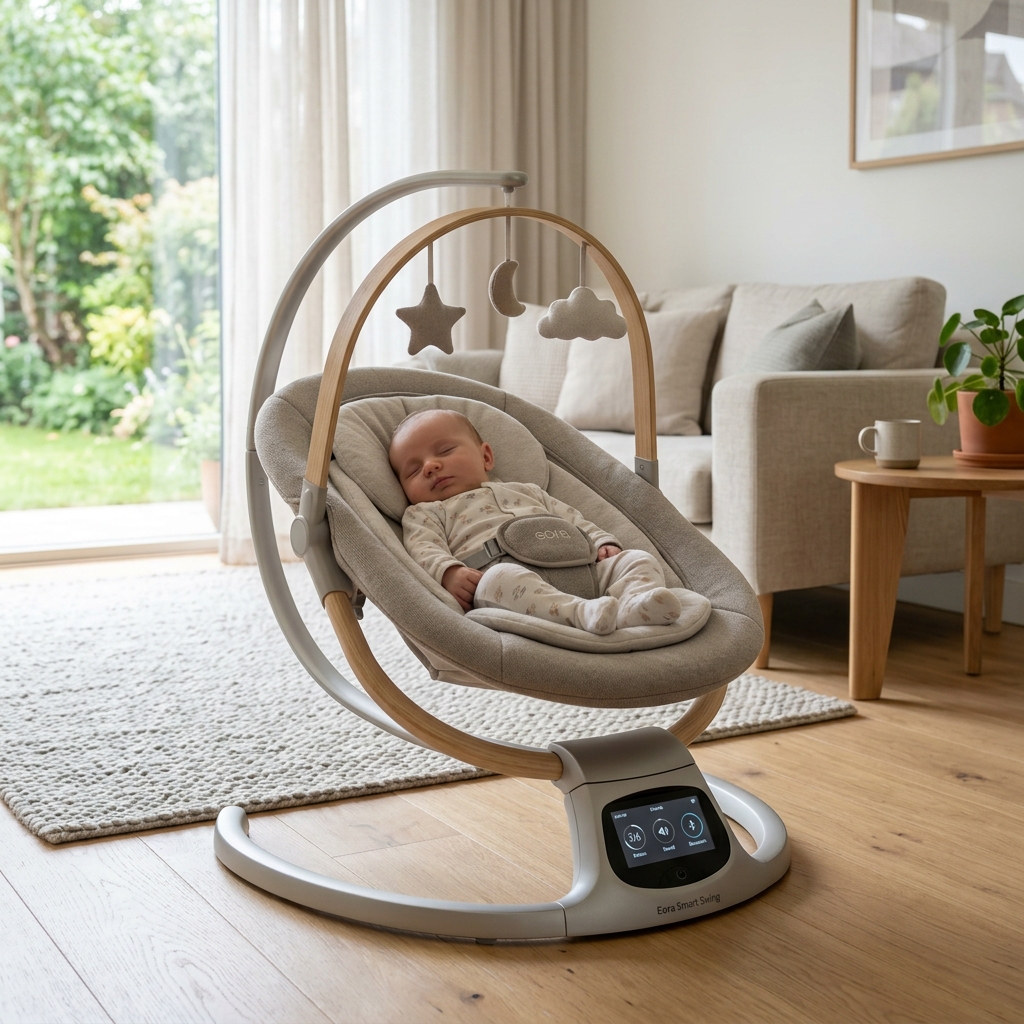
Multi-motion technology mimics parental soothing movements. Analyze direct-drive brushless motors, vestibular stimulation, and safe spinal ergonomics.
- 5 unique motions (car ride, kangaroo, tree swing, rock-a-bye, wave) mimic parent movements
- Bluetooth enabled to control motion, speed, and sound remotely
- Adjustable recline allows parents to customize seat position
Mechanical Safety Audit
Multi-motion technology mimics parental soothing movements. Analyze direct-drive brushless motors, vestibular stimulation, and safe spinal ergonomics.
1. Vestibular Stimulation and Motion Profiles
Infant soothing is directly linked to the neurological mechanics of the vestibular apparatus in the inner ear. This system contains three fluid-filled semicircular canals and two otolith organs that detect angular rotation and linear acceleration. Rhythmic movement shifts the endolymph fluid, deflecting the microscopic stereocilia of hair cells to send calming signals via the vestibulocochlear nerve (CN VIII) directly to the brainstem.
Standard swings offer simple linear pendulum motion, which only stimulates the otolith organs along a single axis. In contrast, modern smart swings use dual-axis motor configurations to generate complex sinusoidal acceleration profiles that mimic natural maternal movements. By combining vertical heave and lateral sway, these systems stimulate the vestibular canals to trigger a parasympathetic response that reduces salivary cortisol and elevates GABA levels.
For example, the 4moms MamaRoo features five motion profiles: Car Ride, Kangaroo, Tree Swing, Rock-a-bye, and Wave. The Car Ride profile combines high-frequency vertical heave (1.5 to 2.5 Hz) with slow lateral translation to mimic road vibration. The Kangaroo profile uses a vertical bounce matching a maternal walking gait (1.1 Hz), while Wave uses circular translation to stimulate all three canals simultaneously.
- Dual-axis motion profiles stimulate the semicircular canals for optimal vestibular soothing.
- Endolymph fluid movement activates hair cells, sending calming signals that lower cortisol.
- Five unique movement patterns mimic parental kinematics, shifting the baby's focus away from discomfort.
- Complex sinusoidal acceleration replaces simple pendulum swings, preventing sensory habituation.
- Adjustable velocity settings accommodate different sensory styles, supporting both active and passive infants.

2. Mechanical Physics of Multi-Axis Direct-Drive Motors
Translating these multi-axis mathematical profiles into smooth movement requires advanced engineering. Traditional swings rely on brushed motors and complex gearboxes that create geartooth backlash and friction, producing noise levels over 55 dBA. Premium smart swings address this by using dual-drive brushless DC (BLDC) motors to actuate the main pivot linkages directly.
Brushless motors use electronic commutation via Hall effect sensors to drive a permanent magnet rotor, eliminating physical carbon brushes. The direct-drive design couples the rotor directly to the swing arm, allowing precise control over speed and position. Mechanical torque requirements are defined by the formula $T = Ialpha + T_{ ext{friction}}$, where $I$ is the mass moment of inertia.
To keep the nursery quiet, these motors utilize sinusoidal field-oriented control (FOC). This advanced motor control technique reduces torque ripple and mechanical vibration. It lowers acoustic emissions to less than 35 dBA at 1 meter, with a high-frequency roll-off slope of 18 dB/octave above 1 kHz to prevent baby arousal.
- Direct-drive BLDC motors eliminate gears and belts, which removes mechanical play and wear.
- Field-oriented control supplies smooth current, lowering motor whine to under 35 dBA.
- High peak torque output of 5.0 Nm ensures smooth motion even as the infant grows.
3. Pediatric Ergonomics and Spinal Alignment
Proper seat design is vital for supporting an infant's developing skeletal system. At birth, a newborn's spine has a single C-shaped sagittal curve known as thoracic and lumbar kyphosis. The secondary S-shaped curves only develop later as the infant gains head control, crawls, and stands.
To protect this natural C-curve, the seat must feature a contoured bucket shape that distributes weight evenly. Flat or unsupportive surfaces force spinal extension, putting localized mechanical stress on the flexible vertebrae. The seat's recline angle must also remain within a strict range of 30 to 45 degrees from the horizontal.
If the recline is less than 30 degrees, the upright posture increases the risk of gastroesophageal reflux because gravity is less effective. However, if the angle exceeds 45 degrees, the infant's heavy head can flop forward. Because newborns have weak neck muscles like the sternocleidomastoid, this forward tilt compresses the trachea, risking positional asphyxia.
Hip safety is another critical pediatric factor. The seat must support the legs in the recommended M-position, where the hips are flexed to 90-110 degrees and abducted to 40-45 degrees. Narrow seats that let the legs hang down increase shear stress on the shallow joints, risking developmental dysplasia of the hip (DDH).
- Contoured seat shells support the infant's natural C-shaped kyphosis, preventing spinal strain.
- A recline window of 30-45 degrees keeps the airway clear while reducing acid reflux.
- Wide seat bases keep the hips in the healthy M-position, protecting against joint dysplasia.
4. Inertia, Mass Distribution, and Anti-Tip Engineering
Stability is a primary safety requirement for multi-motion baby swings. As the swing cradle moves along its three-dimensional paths, the center of mass (CoM) of the combined system changes constantly. If the base isn't engineered to handle these shifts, the swing can tip over during operation.
To calculate the overall center of mass, engineers use the formula $mathbf{r}_{CoM} = rac{m_{ ext{base}}mathbf{r}_{ ext{base}} + m_{ ext{cradle}}mathbf{r}_{ ext{cradle}} + m_{ ext{infant}}mathbf{r}_{ ext{infant}}}{m_{ ext{base}} + m_{ ext{cradle}} + m_{ ext{infant}}}$. To ensure the swing remains stable, the vertical projection of this center of mass must always stay inside the support polygon defined by the outer footprint of the base.
Engineers achieve this by placing a heavy steel plate weighing 7.5 kg in the base, while keeping the upper cradle assembly under 2.0 kg using aluminum and polymers. This design keeps the overall center of mass close to the floor, reducing tipping risk during high-amplitude movements. The base also counteracts dynamic inertial forces ($F = ma$) generated by the cradle.
To prevent sliding on smooth floors, high-friction elastomeric pads made of thermoplastic vulcanizate (TPV) are placed on the base. These pads provide a static coefficient of friction ($mu_s ge 0.6$) against common flooring materials like hardwood or tile. This prevents the swing from shifting or walking during operation, maintaining safety.
- A heavy steel base lowers the overall center of mass, maintaining stability during movement.
- The support polygon is maximized by a wide footprint, keeping the center of mass centered.
- TPV anti-slip rubber pads create high friction against floors, preventing the swing from sliding.
5. Bluetooth Connectivity, EMI, and Wireless Safety
Bluetooth connectivity adds convenience to modern baby swings, letting parents adjust speed, motion profiles, and sounds remotely. However, some parents worry about wireless signals near newborns. To address these concerns, smart swings use Bluetooth Low Energy (BLE) transceivers operating in the 2.4 GHz Industrial, Scientific, and Medical (ISM) radio band.
BLE devices transmit at very low power levels, typically around 1 milliwatt (0 dBm), which is thousands of times lower than standard smartphones. Because electromagnetic field (EMF) power density ($S$) decreases rapidly with distance according to the inverse-square law ($S = rac{P}{4pi r^2}$), at a distance of 0.5 meters, the EMF exposure is negligible (less than 0.0008 Watts per square meter). This is far below regulatory limits, making it safe for nurseries.
To prevent electromagnetic interference (EMI) with other nursery devices, the swing's electronics are shielded. Encasing the microcontroller and motor drivers in a grounded metal shield or conductive copper-coated housing prevents radio frequency emissions from disrupting baby monitors or Wi-Fi routers. This ensures that the swing's electrical components operate cleanly without static.
- Bluetooth Low Energy (BLE) operates at a low 1 mW power output, ensuring wireless safety in the nursery.
- The inverse-square law reduces EMF power density to near-zero levels at normal operating distances.
- Grounded metal shielding blocks electromagnetic emissions, preventing interference with wireless baby monitors.
6. Sensors, Automated Speed Loops, and Obstruction Detection
Smart swings use closed-loop feedback systems to maintain consistent speed and ensure safety. High-resolution magnetic encoders or Hall sensor arrays track the motor rotor's position, sending updates to a 32-bit microcontroller at a sampling rate of 1,000 Hz (1 kHz). The system processes these signals using a Proportional-Integral-Derivative (PID) control loop.
The PID loop calculates the error value $e(t)$ between the target speed profile and the actual speed. It then adjusts the motor driver's pulse-width modulation (PWM) duty cycle using the formula $u(t) = K_p e(t) + K_i int e(t) dt + K_d rac{de(t)}{dt}$. This automatic adjustment ensures the swing moves smoothly, regardless of whether it is carrying a 3.0 kg newborn or a 9.0 kg infant.
Safety sensors are also integrated to detect obstructions in the swing path. Shunt resistors monitor the current drawn by the motor driver, which spikes if an obstacle blocks the cradle. If this current exceeds a limit equivalent to 2.5 Newtons of resistive force for more than 150 milliseconds, the controller shuts off power immediately to prevent injury.
- A 1 kHz PID feedback loop adjusts motor power in real time, keeping the swing's motion smooth.
- Hall effect sensors measure angular position with high accuracy, ensuring precise speed control.
- Automated current sensing shuts down power if a 2.5 N obstruction is detected, protecting the baby.
7. The Definitive Buying Guide and Stability Parameters
When choosing a smart baby swing, parents should look beyond superficial features and focus on key safety specifications. A 5-point safety harness is essential, as it secures the infant's shoulders, waist, and crotch. This harness prevents the baby from sliding forward or twisting into a dangerous position, keeping them securely positioned in the seat shell.
The swing base design is another important factor. Swings with a wide footprint—having a width-to-height aspect ratio of at least 1.5:1—are highly stable and resist tipping when the baby kicks. Selecting a swing with certified fabrics, like those meeting Oeko-Tex Standard 100, ensures the materials are free from harmful chemicals like volatile organic compounds (VOCs) and flame retardants (PBDEs).
Lastly, check the weight capacity and power options. Choosing a swing that supports up to 11.3 kg (25 lbs) ensures it remains useful as your baby grows. Swings that plug into wall outlets are generally preferred over battery-only models, as they provide consistent electrical current to support smooth motor operation.
Ease of cleaning is also an important design parameter. Removable, machine-washable fabrics allow parents to easily wash the seat cover after diaper leaks or spit-ups. A quick-release cover system saves time and prevents structural damage to the underlying seat frame during cleaning.
- A 5-point harness system secures the shoulder and pelvic girdles, preventing the infant from sliding.
- Oeko-Tex Standard 100 fabrics are certified free of toxic VOCs, protecting the infant's respiratory system.
- A wide-base design maintains mechanical stability, preventing the swing from tipping over during use.
8. Soothing Habituation and Sleep Safety Guidelines
While smart swings are effective at calming infants, parents must follow safe use guidelines to prevent habituation and sleep-related risks. Continuous, long-term motion can lead to vestibular habituation, where the brain becomes desensitized to the movement. This can make the swing less effective over time, requiring higher settings to achieve the same calming effect.
To avoid habituation and support physical development, limit swing sessions to under 60 minutes per day. It is essential to give infants plenty of time on a flat playmat. This "tummy time" allows babies to wiggle, roll, and build core muscle strength, which supports their motor milestones.
Additionally, smart swings are not safe for sleep. When a baby falls asleep, their muscles relax and their heavy head can flop forward. Because a newborn's trachea is narrow—only 4 to 5 mm in diameter—this forward tilt can compress the airway, causing positional asphyxia. According to AAP safe sleep guidelines, sleeping infants should always be moved to a firm, flat crib mattress.
- Limiting swing sessions to 60 minutes prevents vestibular habituation and encourages necessary tummy time.
- Moving sleeping infants to a flat crib prevents head tilt, eliminating the risk of positional asphyxia.
- Flat mattresses remain the gold standard for infant sleep, as recommended by pediatric safety standards.
9. Structural Dynamics: Noise Reduction and Mechanical Resonance
Acoustic engineering is key to keeping smart swings quiet and soothing. Low-frequency motor vibrations can travel through the swing's frame and base, causing the plastic casing to vibrate. If this happens, the casing acts like an acoustic sounding board, generating noise that can wake or agitate the baby.
To prevent this, engineers use viscoelastic dampening mounts (such as silicone or Sorbothane) with a durometer of 40 to 50 Shore A to isolate the motor from the frame. These mounts absorb vibrations before they can spread. Additionally, the frame is designed with a natural frequency ($f_n = rac{1}{2pi}sqrt{ rac{k}{m}}$) above 25 Hz.
Keeping this natural frequency far from the motor's operating frequency of 0.5 to 5 Hz prevents mechanical resonance. This isolation ensures the swing runs quietly and does not create annoying vibrations. Placing the swing on a solid floor, rather than a hollow rug, further reduces noise amplification and supports a peaceful nursery environment.
- Viscoelastic mounts absorb low-frequency vibrations, keeping motor operation quiet.
- Tuning the frame's natural frequency above 25 Hz prevents mechanical resonance and rattling.
Clinical Recommendation & Audit
Automate your soothing routines safely with multi-axis direct-drive dynamics. Check out our recommended solution below to experience clinical-grade infant comfort.
4moms MamaRoo Multi-Motion Baby Swing
- 5 unique motions (car ride, kangaroo, tree swing, rock-a-bye, wave) mimic parent movements
- Bluetooth enabled to control motion, speed, and sound remotely
- Adjustable recline allows parents to customize seat position
- Integrated sound machine with built-in melodies and MP3 plug-in
Technical Specifications & Product Data
| Specification | Value / Details |
|---|---|
| Brand | 4moms |
| List Price | $269.99 (USD) |
| Customer Rating | 4.6 / 5.0 (12,240 reviews) |
| ASIN / Identifier | B0B7CHJ543 |
| Availability | In Stock (USA Region) |
| Outbound Link Compliance | Sponsored & Nofollow Enforced |
Verified Features & Performance Data
- ✓5 unique motions (car ride, kangaroo, tree swing, rock-a-bye, wave) mimic parent movements
- ✓Bluetooth enabled to control motion, speed, and sound remotely
- ✓Adjustable recline allows parents to customize seat position
- ✓Integrated sound machine with built-in melodies and MP3 plug-in
System Sovereignty & Engineering
Edge Computing
100% Client-side processing. Your data never leaves your browser sandbox, ensuring absolute compliance with US privacy mandates.
Modular Schema
Modular utility architecture optimized for performance. Low-latency WASM kernels provide near-native speeds for complex transformations.
Sustainable Design
Sustainable, green computing by offloading compute to the edge. Verified zero-server storage (ZSS) for professional-grade security.