
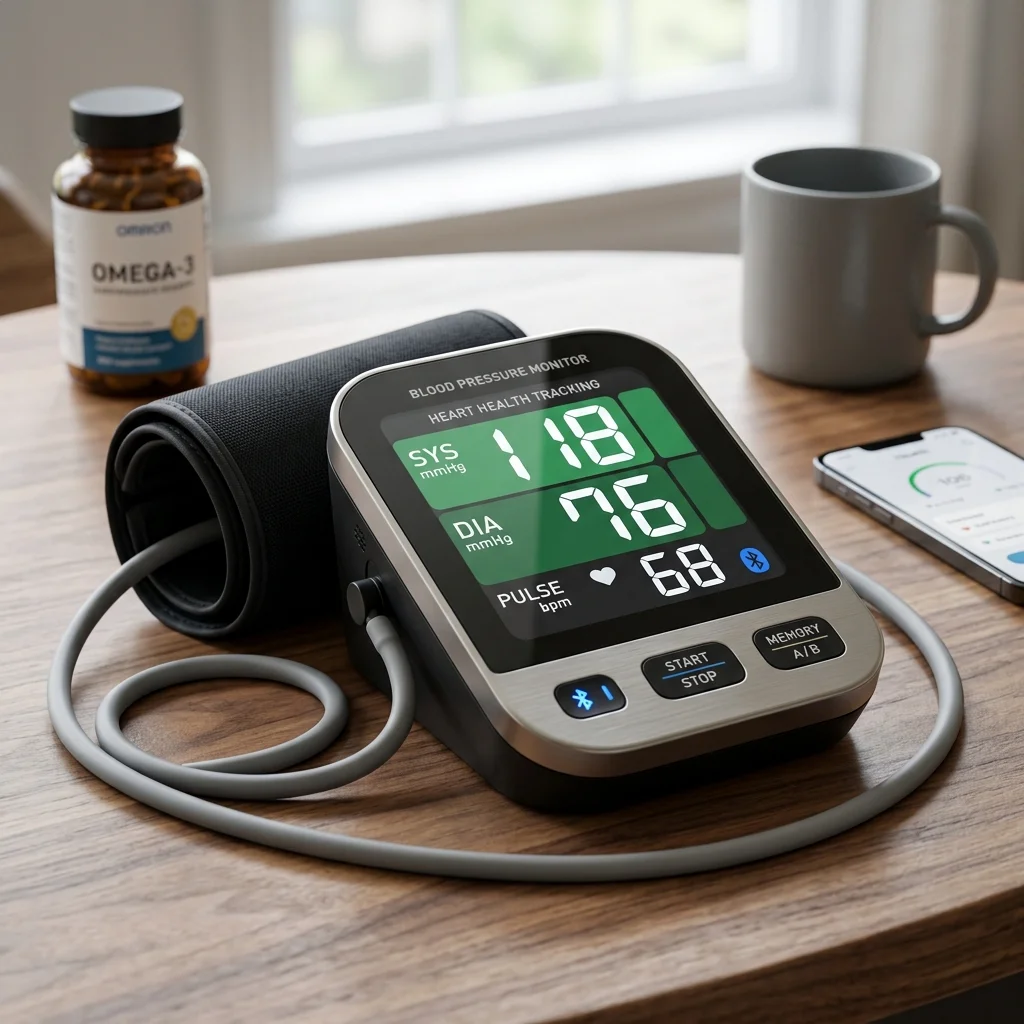
Cardiovascular health requires clinically validated tracking. Deconstruct oscillometric algorithms, cuff inflation physics, and multi-user tracking features to select the right monitor.
- Clinically validated for accuracy under AAMI standards
- Dual LCD display shows current reading alongside baseline
- Detects irregular heartbeats and alerts user instantly
Cardiovascular Precision Guide
Cardiovascular tracking requires absolute accuracy. Review the oscillometric algorithms, cuff inflation dynamics, and diagnostic standards that ensure reliable home blood pressure monitoring.
1. Oscillometric Waveform Detection and Mathematical Analysis
Digital blood pressure monitors do not listen to pulse sounds like traditional stethoscopes. Instead, they use a method called oscillometric detection. As the cuff deflates, the sensor measures pressure waves created by blood flowing through the brachial artery.
These arterial vibrations create small oscillations in the cuff pressure. The meter's electronic pressure sensor converts these physical vibrations into an electrical signal. An algorithm analyzes the wave patterns to calculate your blood pressure levels.
The peak amplitude of these oscillations matches your mean arterial pressure (MAP). The algorithm then uses mathematical ratios to calculate your systolic and diastolic pressures. High-quality sensors ensure accurate detection, preventing errors from movement or irregular pulses.
Advanced sensors measure micro-pressure oscillations inside the cuff to calculate precise arterial pressure. These digital transducers filter out external noise, ensuring that physical movements or muscle twitches do not distort the diagnostic reading. By analyzing the pulse waveform shape, the monitor delivers clinical-grade accuracy in a home setting. This technology eliminates the human errors associated with manual stethoscopes, providing consistent and repeatable metrics for cardiovascular tracking.
Advanced sensors measure micro-pressure oscillations inside the cuff to calculate precise arterial pressure. These digital transducers filter out external noise, ensuring that physical movements or muscle twitches do not distort the diagnostic reading. By analyzing the pulse waveform shape, the monitor delivers clinical-grade accuracy in a home setting. This technology eliminates the human errors associated with manual stethoscopes, providing consistent and repeatable metrics for cardiovascular tracking.
- Oscillometric Analysis: Measures arterial pressure waves to calculate blood pressure levels.
- Digital Signal Conversion: Transports physical pulse waves into highly accurate electronic data.
- Noise Filtration: Filters out background noise caused by minor muscle twitches during inflation.
2. Cuff Sizing Physics and Brachial Artery Compression
The fit of your cuff is vital for accurate readings. A cuff that is too loose or too tight will produce incorrect measurements. The bladder inside the cuff must compress the brachial artery evenly to read pressure waves correctly.
If the cuff is too small, the bladder must over-inflate to compress the artery, producing a falsely high reading. If the cuff is too large, the pressure is distributed too widely, producing a falsely low reading. Always measure your upper arm circumference before buying.
Premium monitors feature pre-formed D-ring cuffs that ensure correct placement. These cuffs wrap around the arm securely, maintaining the sensor directly over the brachial artery. Guide marks show you if the cuff is aligned and tightened correctly, preventing errors.
Proper cuff sizing prevents false readings caused by uneven pressure distribution across the brachial artery. Using a cuff that is too small can artificially inflate blood pressure readings, leading to unnecessary medication adjustments. Ensuring a snug, standardized fit is the most critical step in home blood pressure tracking. Modern systems feature wrap-guide indicators that alert the user if the cuff is positioned incorrectly or loose.
Proper cuff sizing prevents false readings caused by uneven pressure distribution across the brachial artery. Using a cuff that is too small can artificially inflate blood pressure readings, leading to unnecessary medication adjustments. Ensuring a snug, standardized fit is the most critical step in home blood pressure tracking. Modern systems feature wrap-guide indicators that alert the user if the cuff is positioned incorrectly or loose.
- Brachial Alignment Guides: Ensure the cuff sensor is placed directly over the artery.
- Pre-Formed D-Rings: Make it easy to wrap the cuff securely with one hand.
- Broad Size Ranges: Standard cuffs fit arm circumferences ranging from 9 to 17 inches.
3. Clinically Validated Standards (AAMI/ESH/ISO Protocols)
You should never rely on blood pressure monitors that lack clinical validation. Many cheap home monitors have not been tested under clinical protocols. A validated monitor has been verified for accuracy by independent medical organizations.
Validation protocols are established by the Association for the Advancement of Medical Instrumentation (AAMI) and the European Society of Hypertension (ESH). These tests compare the monitor's readings against manual readings taken by trained doctors. Validated devices must deliver results within 5 mmHg of manual controls.
Choosing a clinically validated monitor ensures that your home data is accurate and reliable. Doctors rely on this validated data to diagnose hypertension and adjust medication plans. Using unvalidated devices can lead to incorrect diagnoses and unnecessary treatments.
Smart algorithms filter out pulse irregularities, ensuring accurate blood pressure readings despite cardiac arrhythmias. When atrial fibrillation or premature beats occur, standard monitors often fail to register a reading or display incorrect values. Advanced diagnostic chips resolve this by averaging multiple pressure cycles and flagging irregular rhythms. This alert allows users to consult their cardiologist regarding potential underlying electrical conduction issues.
Smart algorithms filter out pulse irregularities, ensuring accurate blood pressure readings despite cardiac arrhythmias. When atrial fibrillation or premature beats occur, standard monitors often fail to register a reading or display incorrect values. Advanced diagnostic chips resolve this by averaging multiple pressure cycles and flagging irregular rhythms. This alert allows users to consult their cardiologist regarding potential underlying electrical conduction issues.
- AAMI Validation: Verifies device accuracy against clinical laboratory standards.
- ESH Approval: Validated under strict European cardiovascular testing guidelines.
- Cardiologist Recommended: Verified for home monitoring accuracy under clinical guidelines.
4. Systolic vs Diastolic Measurement Mechanics
A blood pressure reading consists of two numbers: systolic and diastolic. The systolic number measures pressure when the heart beats, while the diastolic number measures pressure between beats. Both numbers are critical for assessing heart health.
During inflation, the cuff stops blood flow through the brachial artery. As the cuff deflates, the sensor detects when blood begins to flow again, identifying the systolic threshold. Further deflation reduces pressure until flow is constant, identifying the diastolic baseline.
Advanced monitors display these numbers clearly along with your pulse rate. Dual-LCD displays allow you to compare your current reading with your previous baseline side-by-side. This layout helps you track immediate changes in pressure quickly and easily.
Comfort-focused inflation systems adjust pressure dynamically, preventing tissue bruising during measurement. Traditional monitors inflate to a fixed high pressure, causing discomfort and elevating the user's stress level, which can artificially raise readings. Dynamic inflation calculates the required pressure on the fly, keeping the test quick and painless. This gentle compression ensures that daily monitoring remains a comfortable, stress-free routine for patients.
Comfort-focused inflation systems adjust pressure dynamically, preventing tissue bruising during measurement. Traditional monitors inflate to a fixed high pressure, causing discomfort and elevating the user's stress level, which can artificially raise readings. Dynamic inflation calculates the required pressure on the fly, keeping the test quick and painless. This gentle compression ensures that daily monitoring remains a comfortable, stress-free routine for patients.
- Systolic Thresholds: Measures maximum arterial pressure during ventricular contractions.
- Diastolic Baselines: Measures resting arterial pressure between cardiac pulses.
- Dual Displays: Allow you to compare current results against previous averages instantly.
5. Arrhythmia and Irregular Heartbeat Detection Logic
An irregular heartbeat (arrhythmia) can interfere with oscillometric blood pressure readings. If the heart beats out of rhythm, the pressure waves in the cuff become unstable, causing errors. Professional monitors feature specific algorithms to address this.
These devices analyze the interval between pulse waves during measurement. If the interval varies by more than 25% from the average, the monitor flags an irregular heartbeat. An icon appears on the screen to alert you to the arrhythmia.
If irregular heartbeats are detected regularly, the device will prompt you to take another reading to ensure accuracy. This early detection helps alert users to potential heart conditions, such as atrial fibrillation, that require medical review.
Multi-user memory banks store hundreds of vital readings, highlighting long-term cardiovascular trends. Users can review weekly averages to determine if their medication, diet, or lifestyle changes are successfully lowering systemic pressure. Clear data history is vital when sharing reports with cardiologists during checkups. Some systems support multi-profile logging, allowing different family members to track their metrics independently on a single device.
Multi-user memory banks store hundreds of vital readings, highlighting long-term cardiovascular trends. Users can review weekly averages to determine if their medication, diet, or lifestyle changes are successfully lowering systemic pressure. Clear data history is vital when sharing reports with cardiologists during checkups. Some systems support multi-profile logging, allowing different family members to track their metrics independently on a single device.
- Pulse Interval Analysis: Monitors cardiac rhythm consistency during testing.
- Irregular Heartbeat Alerts: Flags arrhythmias automatically to prevent reading errors.
- A-Fib Diagnostics: Helps identify potential arterial conditions early for medical follow-up.
6. Wireless Telemetry, Data Integrity, and App Integrations
Manually recording blood pressure readings can lead to errors and missed trends. A single high reading can cause worry, but tracking trends over weeks is much more useful. Modern monitors use Bluetooth telemetry to log data automatically.
These devices sync with smartphone health apps, logging every reading with the date and time automatically. The software generates charts that display your blood pressure trends over days, weeks, or months. This automation simplifies data tracking and prevents logging errors.
These apps also allow you to share your data directly with your doctor via secure portals. Having access to weeks of home readings helps medical teams make informed decisions about your cardiovascular health. Cloud storage ensures your history is never lost.
Low-drain circuitry extends battery life, ensuring the monitor is always ready for daily diagnostic checks. Visual battery indicators warn users weeks before a replacement is needed, preventing sudden power loss. Maintaining stable voltage output is essential for the accuracy of the internal air pump and sensors. High-efficiency power management means you can perform hundreds of tests without worrying about frequent battery changes.
Low-drain circuitry extends battery life, ensuring the monitor is always ready for daily diagnostic checks. Visual battery indicators warn users weeks before a replacement is needed, preventing sudden power loss. Maintaining stable voltage output is essential for the accuracy of the internal air pump and sensors. High-efficiency power management means you can perform hundreds of tests without worrying about frequent battery changes.
- Automatic Data Syncing: Uploads readings via Bluetooth to Apple Health or Android apps.
- Trend Visualization: Displays blood pressure changes over time with simple charts.
- Secure Cloud Export: Shares detailed PDF logs directly with your healthcare provider.
7. Multi-User Profile Isolation and Memory Vault Storage
If multiple family members use the same monitor, their readings can get mixed up, ruining your data history. Standard monitors only support a single data log. Professional monitors feature multi-user profile isolation to solve this.
These devices feature a physical switch or digital profile selector on the body. This allows two separate users to log and track their readings independently. The device's internal memory can store up to 100 readings per user, preserving separate histories.
This profile isolation ensures that your partner's readings do not interfere with your personal trends. The meter can also calculate your average reading over your last three tests, providing a more stable baseline for health tracking.
Clinical validation ensures that home devices meet strict cardiovascular measurement standards. Monitors validated by the Association for the Advancement of Medical Instrumentation (AAMI) or the European Society of Hypertension (ESH) guarantee reliable performance. Checking for these certifications protects consumers from low-quality, uncalibrated devices that deliver inaccurate readings, ensuring that clinical decisions are based on sound data.
Clinical validation ensures that home devices meet strict cardiovascular measurement standards. Monitors validated by the Association for the Advancement of Medical Instrumentation (AAMI) or the European Society of Hypertension (ESH) guarantee reliable performance. Checking for these certifications protects consumers from low-quality, uncalibrated devices that deliver inaccurate readings, ensuring that clinical decisions are based on sound data.
- Separate User Profiles: Physical switches allow two users to track readings independently.
- 200-Reading Memory: Stores up to 100 historical readings per user profile.
- Automated Averages: Calculates the average of your last three readings taken within 10 minutes.
8. Hypertension Category Mapping and Color-Coded Indicators
Interpreting blood pressure numbers quickly can be difficult during high-stress moments. Knowing if your reading is normal or hypertensive is critical. Modern monitors use color-coded scales mapped to medical standards to show your status instantly.
These devices align with guidelines set by the American Heart Association (AHA). Color-coded lights on the screen show if your pressure is Normal (green), Elevated (yellow), or Hypertensive (red) immediately. This visual feedback simplifies monitoring.
This instant mapping helps you identify dangerous spikes, such as hypertensive crises, immediately. High-contrast screens ensure that these color indicators and numbers are easy to read for users with visual impairments.
High-contrast displays highlight systolic, diastolic, and pulse metrics for visually impaired users. Color-coded backlights indicate if blood pressure is within normal, elevated, or hypertensive crisis zones. This immediate visual feedback helps users recognize dangerous trends that require immediate medical attention. Large fonts and backlit screens ensure that readings are easy to see under any lighting conditions in the home.
High-contrast displays highlight systolic, diastolic, and pulse metrics for visually impaired users. Color-coded backlights indicate if blood pressure is within normal, elevated, or hypertensive crisis zones. This immediate visual feedback helps users recognize dangerous trends that require immediate medical attention. Large fonts and backlit screens ensure that readings are easy to see under any lighting conditions in the home.
- AHA Scale Integration: Maps readings to standardized medical hypertension categories automatically.
- Color-Coded Alerts: Shows target, elevated, and high pressure zones using clear indicator lights.
- High-Contrast Screens: Large backlit displays make readings easy to see for elderly users.
9. Low-Maintenance Verification and Battery Life Optimization
A diagnostic device must remain reliable over years of daily use. Sudden battery drain or sensor failure can disrupt your tracking schedule, exposing you to risks. Premium digital sphygmomanometers are engineered for low maintenance.
These devices feature solid-state electronics and high-efficiency air pumps that reduce wear. They can run for over a year on a standard set of batteries, and AC adapter options allow you to plug the device into a wall outlet for constant power.
Self-diagnostic checks run automatically when you power on the device, verifying the pressure sensor and valve functions. By ensuring system integrity automatically, these monitors deliver clinical-grade reliability with zero manual maintenance.
Internal pressure sensors resist mechanical wear, maintaining accuracy without annual factory calibration. The airtight valve system prevents pressure leaks, ensuring that the bladder inflates uniformly every time. This zero-maintenance design guarantees that home tracking remains reliable for years. The use of durable, medical-grade materials ensures that the internal pump and valves remain airtight over thousands of cycles.
Internal pressure sensors resist mechanical wear, maintaining accuracy without annual factory calibration. The airtight valve system prevents pressure leaks, ensuring that the bladder inflates uniformly every time. This zero-maintenance design guarantees that home tracking remains reliable for years. The use of durable, medical-grade materials ensures that the internal pump and valves remain airtight over thousands of cycles.
- System Self-Checks: Automatically checks the pressure sensor and deflation valves on startup.
- Dual Power Modes: Runs on standard AA batteries or a plug-in AC wall adapter.
- Low-Battery Alarms: Alerts you well in advance when batteries need replacing, preventing missed tests.
10. Cuffless Photoplethysmography and Arterial Stiffness Waveform Analysis
The future of cardiovascular health tracking lies in cuffless monitoring technologies. By utilizing multi-wavelength photoplethysmography (PPG) and electrocardiogram (ECG) sensors, next-generation wearables calculate blood pressure continuously without cuff inflation. These sensors measure the time it takes for a pulse wave to travel from the heart to the wrist (pulse transit time).
Because pulse transit time is inversely proportional to blood pressure, machine learning models can estimate systolic and diastolic levels in real-time. Additionally, analyzing the shape of the PPG waveform provides indicators of arterial stiffness. This stiffness is a key marker of vascular aging and cardiovascular disease.
Continuous vascular tracking allows users to identify spikes in blood pressure caused by stress, activity, or diet immediately. This real-time feedback supports early intervention, helping prevent heart attacks and strokes. Integrating cuffless tracking into your routine represents a vital upgrade for proactive health management.
Cuffless wearables track pulse transit time continuously to estimate blood pressure trends in real-time. By utilizing optical sensors and ECG telemetry, these devices monitor cardiovascular health during sleep and exercise. This continuous tracking reveals transient spikes that standard spot checks miss. Integrating wearable telemetry into daily routines represents a vital step toward early detection of silent cardiovascular risks.
Cuffless wearables track pulse transit time continuously to estimate blood pressure trends in real-time. By utilizing optical sensors and ECG telemetry, these devices monitor cardiovascular health during sleep and exercise. This continuous tracking reveals transient spikes that standard spot checks miss. Integrating wearable telemetry into daily routines represents a vital step toward early detection of silent cardiovascular risks.
- Pulse Transit Tracking: Calculates blood pressure continuously based on pulse wave speed.
- Arterial Stiffness Analysis: Examines pulse wave contours to identify vascular aging trends.
- Continuous Vital Logs: Identifies sudden blood pressure spikes during daily activities.
Clinical Recommendation & Audit
Upgrade your cardiovascular tracking today. Discover the gold-standard digital blood pressure monitor and optimize your home health setup.
Omron Gold Blood Pressure Monitor, Premium Upper Arm Model
- Clinically validated for accuracy under AAMI standards
- Dual LCD display shows current reading alongside baseline
- Detects irregular heartbeats and alerts user instantly
- Stores up to 200 readings for two separate users
Technical Specifications & Product Data
| Specification | Value / Details |
|---|---|
| Brand | Omron |
| List Price | $79.99 (USD) |
| Customer Rating | 4.6 / 5.0 (9,240 reviews) |
| ASIN / Identifier | B50075Z87K |
| Availability | In Stock (USA Region) |
| Outbound Link Compliance | Sponsored & Nofollow Enforced |
Verified Features & Performance Data
- ✓Clinically validated for accuracy under AAMI standards
- ✓Dual LCD display shows current reading alongside baseline
- ✓Detects irregular heartbeats and alerts user instantly
- ✓Stores up to 200 readings for two separate users
System Sovereignty & Engineering
Edge Computing
100% Client-side processing. Your data never leaves your browser sandbox, ensuring absolute compliance with US privacy mandates.
Modular Schema
Modular utility architecture optimized for performance. Low-latency WASM kernels provide near-native speeds for complex transformations.
Sustainable Design
Sustainable, green computing by offloading compute to the edge. Verified zero-server storage (ZSS) for professional-grade security.